SaaS pricing models are the rules that decide what a customer's bill is tied to: a fixed fee, the number of users, a chosen plan, measured usage, or a mix of these. There are six main ones: flat rate, per seat, tiered, usage-based, freemium and hybrid.
The model matters as much as the price level. Two products that both cost about $200 a month today can cost $199 and $720 a year later, and the only difference is the model behind the bill.
Quick answer: The six main SaaS pricing models are flat rate (one price for everyone), per seat (price × users), tiered (a few plans with rising limits), usage-based (price × units used), freemium (a free plan beside paid plans) and hybrid (a base fee plus usage). They differ in what the bill is tied to, which decides how predictable it is for the buyer and for the seller.
What a SaaS pricing model decides
A pricing model answers one question: what is the charge tied to? That is separate from how high the price is, and from how you arrive at the number, which the value-based pricing example works through.
SaaS, or software as a service, is software sold by subscription. Harvard Business School Online defines a subscription as a program in which the user pays a recurring fee for access to specified benefits. The pricing model is the formula behind that fee.
Harvard Business School's Working Knowledge, reporting on a background note co-written by marketing professor Elie Ofek, lists three broad subscription structures: a single flat price, a freemium option with a free base tier, and multiple tiers priced by combinations of features, usage levels and number of users. Separate that last group into its ingredients and you get the six models compared here.
The main SaaS pricing models in one table
| Model | The bill is based on | For the customer | For the seller | Fits best when |
|---|---|---|---|---|
| Flat rate | One fixed fee per period | The same every period | Predictable, but doesn't grow with the customer | Customers are similar in size and use |
| Per seat (per user) | Number of users × price per user | Changes only when headcount changes | Grows as teams add users | Each added user gets real value from the product |
| Tiered | The plan chosen: a bundle of features and limits | Fixed until a limit is reached | Grows in steps as customers move up | You serve clearly different customer segments |
| Usage-based | Units consumed × price per unit | Varies with activity | Follows usage up and down, harder to forecast | Value and cost both scale with a unit you can measure |
| Freemium | Nothing on the free plan, then one of the other models | Zero until an upgrade | Only a share of users ever pay | A free user is cheap to serve and brings in other users |
| Hybrid | A base fee plus a charge for usage above an allowance | A known floor plus a variable part | A predictable base with usage on top | Customers want a minimum they can budget, but usage varies widely |
How each model works
Flat rate
Every customer pays the same amount each billing period, however much they use. Working Knowledge describes it as a fixed rate paid at regular intervals regardless of usage. It is the easiest model to explain and to bill, and the weakest at charging a large customer more than a small one. The trade-offs are covered in flat rate pricing.
Per seat
The bill is the number of users multiplied by a price per user: 12 users at $25 each is $300 a month. Box's annual report, for example, says its subscription fees depend on the number of users, along with API and AI unit entitlements and the functionality deployed.
The weakness is that a seat is only a rough measure of value. A customer can keep the bill down by limiting who gets a login, even when the whole company benefits from the product.
Tiered
The seller offers a small set of plans, each with a fixed price and a bundle of features and limits. Customers pick the plan that fits and move up when they hit a limit. Ofek's point in the Working Knowledge piece is that tiers tend to succeed when they line up with the needs and preferences of different customer segments. Worked plan structures are in tiered pricing examples.
Usage-based
The bill is units consumed multiplied by a unit price. The unit might be API calls, gigabytes stored, messages sent or invoices issued. Snowflake's annual report describes its version as a consumption-based model in which customers pay only for what they use.
The same filing gives the seller's side. Because customers decide when and how much to consume, the company tells investors it has limited visibility into future results, and that customers may consume less than it expects. The mechanics are explained in usage based pricing.
Freemium
A free plan with no time limit sits beside one or more paid plans. Freemium is more a way to acquire users than a way to charge them: the paid plans still use a flat, per-seat, tiered or usage-based price.
The catch is that many free users never pay. Dropbox's annual report for 2025 says the company served over 700 million registered users but 18.08 million paying users at December 31, 2025. The costs and the conversion math are worked through in freemium pricing.
Hybrid
A hybrid model combines a fixed fee with a usage charge, usually a base subscription that includes an allowance and a per-unit price above it. The shape is not specific to software. In a Journal of Marketing Research study of internet access plans, two of the three plans on offer had a fixed fee, a monthly allowance and a price per megabyte beyond it.
Worked example: one customer's bill under each model
The numbers below are invented for illustration. They are not benchmarks and are not taken from any real product.
Take an invoicing tool and one customer, a small wholesaler. In month 1 it has 8 users and sends 1,500 invoices. By month 12 it has 20 users and sends 6,000 invoices. Six illustrative price lists:
- Flat rate: $199 a month.
- Per seat: $25 per user per month.
- Tiered: Starter at $99 (up to 5 users and 1,000 invoices), Growth at $249 (up to 15 users and 5,000 invoices), Scale at $599 (up to 50 users and 20,000 invoices).
- Usage-based: $0.12 per invoice sent.
- Freemium: free for up to 2 users and 50 invoices a month, then $29 per user per month.
- Hybrid: $99 a month including 1,000 invoices, then $0.08 per extra invoice.
| Model | Month 1 calculation | Month 1 bill | Month 12 calculation | Month 12 bill |
|---|---|---|---|---|
| Flat rate | fixed fee | $199 | fixed fee | $199 |
| Per seat | 8 × $25 | $200 | 20 × $25 | $500 |
| Tiered | Growth plan | $249 | Scale plan | $599 |
| Usage-based | 1,500 × $0.12 | $180 | 6,000 × $0.12 | $720 |
| Freemium | 8 × $29 | $232 | 20 × $29 | $580 |
| Hybrid | $99 + (500 × $0.08) | $139 | $99 + (5,000 × $0.08) | $499 |
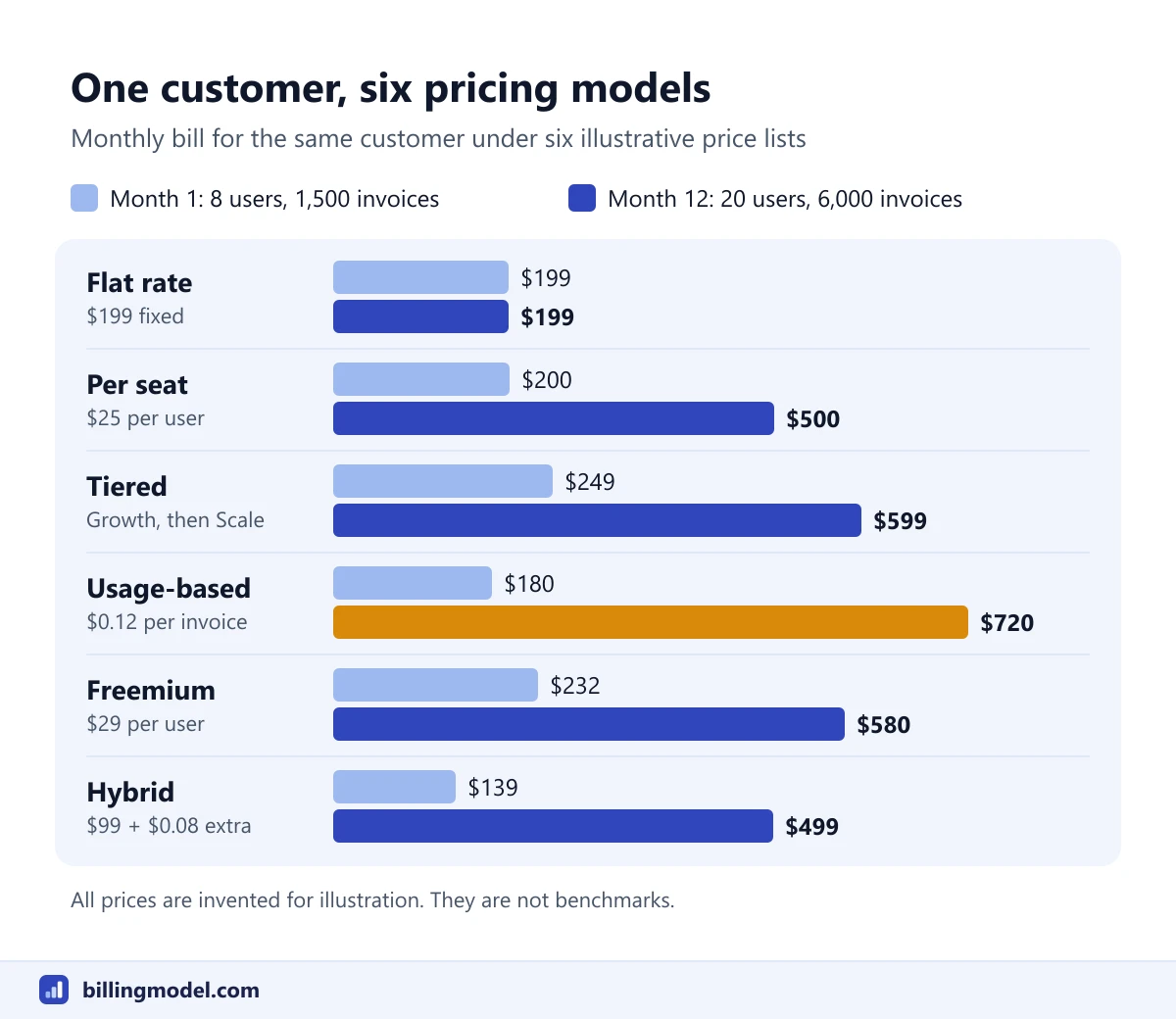 The same customer's bill under six illustrative price lists, before and after it grows.
In month 1 the six bills sit between $139 and $249. A year later they run from $199 to $720. The customer's user count grew 2.5 times and its invoice volume 4 times. The flat-rate bill didn't move, the per-seat bill followed the users (2.5 times, to $500), and the usage-based bill followed the invoices (4 times, to $720).
Under the tiered list the customer moved up a plan because it passed both Growth limits. On the freemium list it was never going to stay free: with 8 users it was past the 2-user limit from the first day.
Neither end of the range is the right answer. At $199 flat, the seller earns the same from a customer that now sends four times the invoices. At $720 on pure usage, the customer's bill has quadrupled, and someone has to explain that to whoever approves the budget.
What research says about flat versus metered bills
Customers often prefer a predictable bill even when it costs them more. The Journal of Marketing Research study mentioned above, by Anja Lambrecht and Bernd Skiera and published in 2006, examined 10,882 customers of a European internet provider. It found that a flat-rate bias (choosing a flat rate when a metered plan would have been cheaper) was more common and more persistent than the opposite mistake.
The authors' explanations include an insurance effect, where people pay extra to avoid swings in the bill, and a taxi meter effect, where watching a cost tick upward takes the enjoyment out of using the service.
The two mistakes had different consequences for the seller. Customers who overpaid on a flat rate were not significantly more likely to leave. Customers who chose pay-per-use and ended up paying more than the flat rate would have cost were far more likely to cancel. Cancellation is what subscription businesses call churn, defined in SaaS churn rate.
Watch out: That study covered consumer internet access, not business software. Treat it as evidence about how people react to metered bills, not as a rule for every SaaS product.
Sellers have their own reason to like fixed fees. An MIT Sloan Management Review article notes that investors favor subscriptions because they produce more predictable long-term revenue than one-off sales. The same article gives the downside: when the seller's costs rise, revenue per customer stays where it is until renewal.
That tension is the case for hybrid pricing: a base fee both sides can plan around, with a usage charge above it.
How to choose between the models
Start with what the customer is paying for. If the product is worth more as more people use it, seats are a fair measure. If it is worth more as volume rises, charge for the volume. If every customer gets roughly the same thing, a flat fee is honest and simple.
Check the answer against your costs. When each unit of use costs you money, for compute, messages or payment processing, a flat fee leaves your heaviest users unprofitable. A usage charge or an allowance fixes that.
Ask how well customers can predict the metric. Usage-based pricing is a poor fit when buyers can't estimate their own usage, because the insurance effect described above can push them toward a competitor that offers a fixed number.
Keep the price list explainable. OpenStax's Principles of Marketing textbook describes how the team behind one online-meeting product settled on a single $49 flat rate after dozens of customer interviews, having found that customers valued an easy-to-understand price as well as the product.
Note: The pricing model also affects invoicing and when revenue can be recorded. Under US GAAP (ASC 606) and IFRS 15 the treatment depends on the contract, so have an accountant confirm it. The general picture is in SaaS revenue recognition.
Frequently asked questions
What is the difference between a pricing model and a pricing strategy?
The model is the structure of the bill: what you count and multiply. The strategy is how you choose the level, for example by starting from cost, from competitors' prices or from customer value. A company can keep its per-seat model and change strategy, or the other way around.
Can a SaaS company use more than one pricing model?
Yes. A free plan for individuals, per-seat plans in several tiers and a metered add-on can all sit on one price list. The Box filing cited above describes fees that depend on users, unit entitlements and functionality at once.
Is freemium a pricing model or a marketing tactic?
Both. It sets the price of the entry plan at zero, and it works as promotion because free users try the product at no risk. Paid plans above the free one still need a model of their own.