SaaS metrics are the handful of numbers a subscription software business uses to see how much recurring revenue it has, how well it keeps customers and what it costs to win new ones. Ten cover almost everything: MRR, ARR, customer churn, revenue churn, gross revenue retention, net revenue retention, ARPA, CAC, LTV and CAC payback.
None of them appears in the accounting standards. They sit beside the financial statements, and each company chooses its own definitions. That is the first thing to know before you compare your numbers with anyone else's.
Quick answer: The core SaaS metrics fall into three groups. Size: MRR and ARR. Retention: customer churn, revenue churn, gross and net revenue retention. Unit economics: ARPA, CAC, LTV and CAC payback. All ten can be calculated from subscription billing records plus your sales and marketing spend.
What SaaS metrics measure
Financial statements report what has already happened under accounting rules. A subscription business also needs to know what repeats. A customer paying $100 a month is worth more than a single $100 sale, but only for as long as they stay.
The metrics answer three questions. How large is the recurring base? How much of it stays? Does it pay to acquire a customer?
Researchers value companies with the same logic. In a Knowledge at Wharton interview, Peter Fader of Wharton and Daniel McCarthy of Emory describe splitting revenue into the part that comes from new customers and the part from existing customers who are retained. McCarthy says a subscription company can be modeled reasonably well from two disclosures: customers acquired each quarter and total customers each quarter.
The ten SaaS metrics in one reference table
Each row gives the usual definition and the simplest form of the formula. The linked articles cover the detail and the edge cases.
| Metric | What it is | Formula |
|---|---|---|
| MRR | Recurring subscription fees per month, on a given date | Sum of each paying customer's monthly recurring fee |
| ARR | The same base expressed per year | MRR × 12 |
| Customer churn rate | Share of customers lost in a period | Customers lost ÷ customers at start |
| Revenue churn rate | Share of recurring revenue lost in a period | (Churned MRR + contraction MRR) ÷ MRR at start |
| Gross revenue retention (GRR) | Recurring revenue kept from existing customers, ignoring upgrades | (MRR at start − churned − contraction) ÷ MRR at start |
| Net revenue retention (NRR) | Recurring revenue from existing customers, upgrades included | (MRR at start − churned − contraction + expansion) ÷ MRR at start |
| ARPA or ARPU | Average recurring revenue per account, or per user | MRR ÷ paying accounts |
| CAC | Cost of winning one new customer | Sales and marketing spend ÷ new customers |
| LTV | Margin a customer brings over the whole relationship | Margin per customer per period × expected lifetime |
| CAC payback | Months of margin needed to earn back CAC | CAC ÷ (ARPA × gross margin) |
Size. MRR is monthly recurring revenue and ARR is annual recurring revenue. The monthly recurring revenue formula explains what counts, and the article on ARR in SaaS covers the annual version.
Retention. Churn counts what you lose. The SaaS churn rate article works through it for customers and for revenue. Retention is the same information turned around. Gross revenue retention can never exceed 100% because it ignores upgrades. The net revenue retention formula adds them back, so NRR can.
Unit economics. Harvard Business School Online's guide to LTV and CAC calculates CAC as marketing cost divided by the number of customers acquired, and LTV as the average customer's yearly contribution margin multiplied by the average customer lifetime in years. Its example is a $115 margin over three years, an LTV of $345, against a CAC of $125. It adds that a ratio below one means you spend more on acquiring customers than you get back from them. The article on LTV in SaaS goes further.
A worked month: ten metrics from one set of numbers
A software company starts March 2026 with 400 customers and $40,000 of MRR. During the month:
- 30 new customers add $2,200 of MRR.
- Upgrades by existing customers add $600.
- Downgrades remove $280.
- 12 customers cancel, removing $720.
- Sales and marketing spend is $18,000, and gross margin is 80%.
The company ends March with 400 − 12 + 30 = 418 customers.
| Metric | Calculation | Result |
|---|---|---|
| Closing MRR | $40,000 + $2,200 + $600 − $280 − $720 | $41,800 |
| ARR | $41,800 × 12 | $501,600 |
| Customer churn | 12 ÷ 400 | 3.0% |
| Revenue churn | ($720 + $280) ÷ $40,000 | 2.5% |
| GRR for the month | ($40,000 − $1,000) ÷ $40,000 | 97.5% |
| NRR for the month | ($40,000 − $1,000 + $600) ÷ $40,000 | 99.0% |
| ARPA | $41,800 ÷ 418 | $100.00 |
| CAC | $18,000 ÷ 30 | $600 |
| CAC payback | $600 ÷ ($100.00 × 0.80) | 7.5 months |
| LTV | $80.00 × (1 ÷ 0.03) | $2,667 |
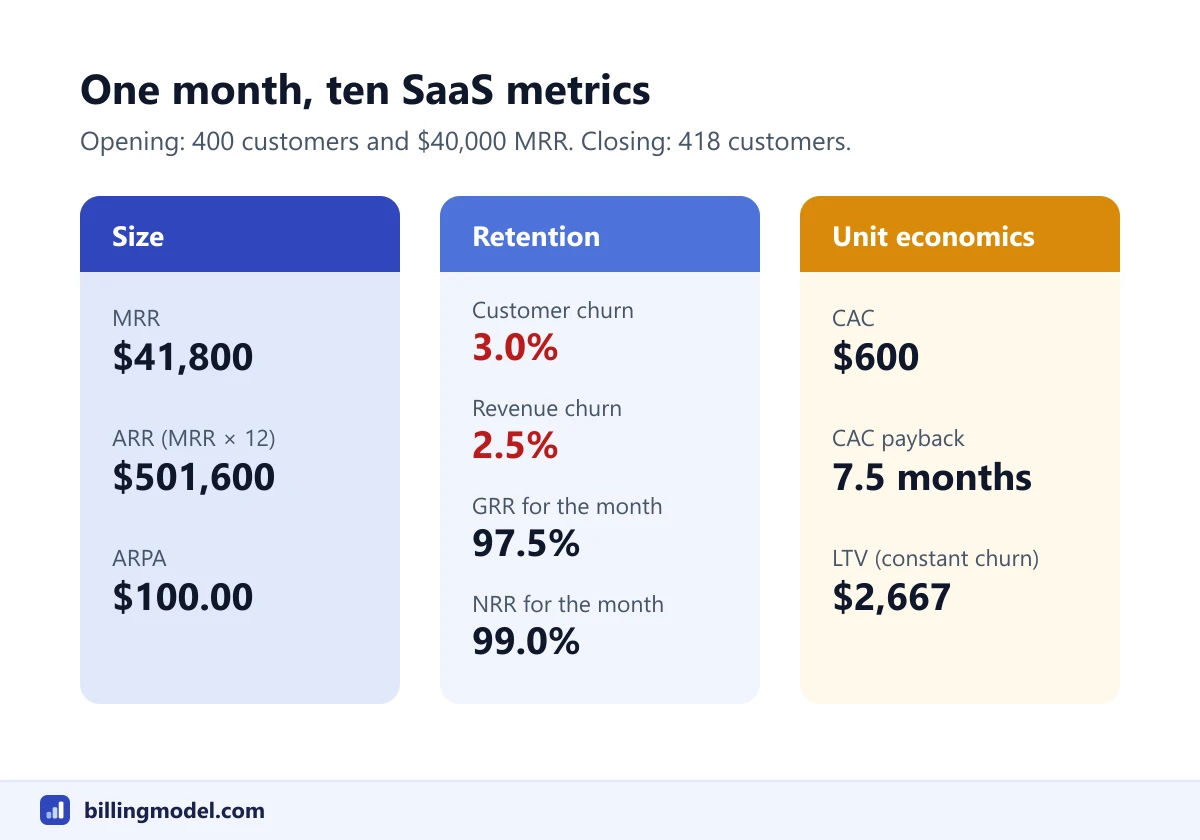 The same month read three ways: size, retention and unit economics.
Two of these results need a caution.
The LTV line uses a shortcut. If 3% of customers leave every month, the average customer stays 1 ÷ 0.03, about 33 months, and 33.3 months of $80.00 margin is $2,667. That assumes churn never changes. In a Marketing Science paper, Peter Fader and Bruce Hardie show that a group's retention rate tends to rise as it ages, because the customers most likely to leave go first. In their illustration, valuing a customer base with one aggregate retention rate understates it by 38%. Treat a one-rate LTV as a rough estimate.
The retention lines are monthly here to keep the example small. The public companies cited below measure retention over 12 months, so a monthly 99.0% is not comparable with a figure in a company report.
Where SaaS metrics come from: your billing data
Almost every input is a dated event in the subscription record. If your subscription billing system keeps those events, the metrics follow from them.
| Billing record | Metrics it feeds |
|---|---|
| Plan price and billing interval | MRR, ARR, ARPA |
| Subscription start date | New MRR, new customer count for CAC |
| Upgrades, downgrades and seat changes | Expansion and contraction, GRR, NRR |
| Cancellation date and reason | Customer churn, churned MRR |
| Failed and recovered payments | Involuntary churn |
| One-time fees and usage charges | Revenue, but not MRR |
Two inputs come from outside billing: sales and marketing spend for CAC, and the cost of delivering the service for gross margin.
The metrics are built from the subscription record, not from invoices or cash. An annual plan billed once still counts one-twelfth of its price each month, whatever the billing period. A system that overwrites the old price when a customer changes plan makes expansion and contraction impossible to reconstruct later. A charge that fails and is never recovered ends a subscription the customer didn't choose to end, which is why failed payment handling shows up in churn.
Why SaaS metrics have no official definition
Revenue is defined by accounting standards: ASC 606 under US GAAP and IFRS 15 under IFRS. The guide to SaaS revenue recognition covers those. MRR, ARR, churn and retention are not defined by either framework.
In the United States, the Securities and Exchange Commission (SEC) accepts that companies report such measures and asks them to explain them. Its 2020 guidance on performance indicators and metrics notes that metrics "can vary significantly from company to company and industry to industry." It says the Commission would generally expect a clear definition of the metric and how it is calculated, why it is useful to investors and how management uses it. Total subscribers and average revenue per user are among its examples.
The filings show the variation.
- ARR. Klaviyo's 2023 registration statement defines ARR as MRR multiplied by twelve. Amplitude's annual report for 2025 defines it as the annual recurring revenue of subscription agreements at a point in time, calls it an operating metric, and says the company is not aware of any uniform standards for calculating such measures.
- Retention. In 2024 SEC staff asked Workday to define the gross and net retention rates it had mentioned. Workday's reply says the gross rate counts only negative impacts such as churn, the net rate also includes add-ons and expansions, and both are based on ARR, which it describes as "a non-GAAP financial measure."
- CAC payback. Klaviyo defines it as the number of months it would take for its non-GAAP gross profit to exceed its adjusted selling and marketing expenses.
Whether a figure is an "operating metric" or a "non-GAAP financial measure" matters under SEC rules. The staff's Financial Reporting Manual says operating and statistical measures such as the number of subscribers are not non-GAAP financial measures. Companies have landed on different labels for ARR, as the examples above show.
Academic criticism exists too. A 2026 MIT Sloan working paper by Hiram Samel and Aditya Chaudhry points out that ARR "is not audited" and that "its calculation varies from company to company." The authors call NRR useful as a diagnostic but add that it "says nothing about profitability."
The SEC's guidance applies to companies that file with it. Rules elsewhere differ, and a private company reporting to its own board has no such rule to follow. The practical lesson travels anyway: write your definitions down, apply them the same way every month, and read the other party's definition before comparing numbers.
Reading the metrics together
No single number is enough, and the usual mistakes come from reading one alone.
- MRR growth without retention. New MRR can hide heavy churn. Look at net new MRR by component.
- Customer churn without revenue churn. In the example, 3.0% of customers left but only 2.5% of recurring revenue did, because the accounts that canceled were small.
- NRR without margin. A company can keep and expand its revenue while losing money on every customer, which is the MIT authors' point.
- LTV without its assumptions. LTV depends on a churn rate and a margin projected years ahead. CAC payback uses fewer assumptions.
- MRR treated as revenue. MRR is a run rate on one date. Recognized revenue and cash follow different rules, as the deferred revenue journal entry shows. How a specific contract is recognized depends on its terms, so confirm that with a qualified accountant.
Frequently asked questions
Which SaaS metrics should a new company track first?
Start with MRR, customer churn and CAC, because they need the least data and answer the three basic questions. Add revenue churn and NRR once customers can upgrade or downgrade. LTV and payback become meaningful only after you have several months of churn history.
Are SaaS metrics part of GAAP or IFRS?
No. Neither framework defines MRR, ARR, churn or retention. Listed companies in the United States that publish them are expected by the SEC to define them and explain how they are calculated. An accountant can tell you how your reported revenue relates to them.
What is the difference between MRR and ARR?
They measure the same recurring base on different scales. ARR is usually MRR multiplied by 12, although companies selling annual contracts often build ARR from contract values instead. Businesses with monthly plans tend to manage by MRR, and those with annual contracts by ARR.
What is the difference between gross and net revenue retention?
Gross revenue retention shows how much recurring revenue you kept from existing customers after cancellations and downgrades, and it tops out at 100%. Net revenue retention also adds upgrades and add-ons from those customers, so it can be above 100%.
How is ARPA different from ARPU?
ARPA divides recurring revenue by paying accounts, and ARPU divides it by users. For a product sold to companies with many seats each, the two differ a lot. Say which one you mean.