Payment processing fees are what a business gives up out of every card sale so the money can move from the customer's bank to its own. On a typical US credit card sale that is a little over 2% of the amount, and most of it never reaches the company you signed up with.
The fee has three parts with three recipients. Interchange goes to the bank that issued the customer's card, a network fee goes to the card network, and the rest is your processor's markup. Only the last part is set by your processor.
Quick answer: Payment processing fees = interchange (to the card-issuing bank) + network fees (to Visa, Mastercard or another network) + the processor's markup. A 2026 Harvard Business School working paper puts the typical US credit card total at 2.25% of the sale, of which interchange is about 1.90%, and puts network fees at an average of 0.14%.
The three parts of payment processing fees
The total a merchant pays is called the merchant discount fee, or the merchant discount rate when it is quoted as a percentage. The US Government Accountability Office's 2025 report on payment card costs breaks it into three components:
- Interchange fee. Paid by the merchant's bank (the acquirer) to the card issuer. The card networks set the rates, and a rate is usually a fixed amount per transaction plus a percentage of the purchase.
- Network fees. Paid to the card network for operating it. You'll also see them called assessments or, in Europe, scheme fees.
- Processor or acquirer fees. The remainder, kept by the acquiring bank or payment processor for routing and settling your transactions.
Visa draws the same line from its side. Its page on interchange says merchants don't pay interchange directly: they pay a "merchant discount" to their financial institution, and interchange moves between the acquiring bank and the issuing bank. Mastercard's explanation calls interchange one component of the merchant discount rate and says Mastercard has no involvement in what acquirers charge merchants.
The sizes are lopsided. A working paper by researchers at Harvard, Northwestern, Stanford and Georgia State, "Who Pays for Payments?" (April 2026), gives the typical US credit card merchant discount as 2.25%, of which interchange is about 1.90%. It puts network fees at an average of 0.14% of the transaction value, a figure it takes from Visa's financial statements and acquirers' disclosures, and it gives no number for the acquirer's share. The GAO saw the same pattern in real bills: interchange was nearly 90% of the card fees that selected federal entities paid in fiscal year 2023.
Interchange: the largest part, and the one that varies most
Interchange depends on the card your customer pulls out, not on your processor. Visa and Mastercard publish their US tables, and Mastercard says its rates are typically updated twice a year. The rate changes with the type of card (debit, credit, premium rewards, commercial), with whether the card was physically present, and with the merchant's category and size.
The table below applies Visa's US interchange table (rates effective April 18, 2026; checked October 2026) to a $100 sale. The credit rows use Visa's general programs, which it calls Product 1 for card-not-present sales and Product 2 for card-present sales.
| Card and situation | Visa's published rate | Interchange on $100 |
|---|---|---|
| Debit card from a large bank (regulated) | 0.05% + $0.21, plus $0.01 | $0.27 |
| Debit card from a small bank, in store | 0.80% + $0.15 | $0.95 |
| Debit card from a small bank, online | 1.65% + $0.15 | $1.80 |
| Basic consumer credit card, in store | 1.51% + $0.10 | $1.61 |
| Basic consumer credit card, online | 1.89% + $0.10 | $1.99 |
| Visa Signature Preferred credit card, online | 2.50% + $0.10 | $2.60 |
| Corporate or purchasing card, card not present | 2.70% + $0.10 | $2.80 |
The same $100 costs between $0.27 and $2.80 in interchange before anyone else is paid. Visa also lists lower "small merchant" rates, such as 1.58% + $0.10 for a basic credit card online, for businesses with no more than $280,000 a year in Visa consumer credit sales.
The debit gap comes from US law. Regulation II caps debit interchange at 21 cents plus 5 basis points of the transaction (a basis point is 0.01%), with 1 cent more for issuers that meet fraud-prevention standards. Issuers with less than $10 billion in assets are exempt. The cap is under legal challenge: a federal district court in North Dakota ruled on August 6, 2025 that the fee standard is contrary to law and should be vacated, but put that on hold pending the Federal Reserve's appeal, and Visa's April 2026 table still applies the capped rate (checked October 2026). In the Federal Reserve's data for 2024, capped transactions on dual-message networks (the group that includes Visa's and Mastercard's main debit systems) averaged $0.22 in interchange, and exempt ones averaged $0.61. US credit card interchange has no equivalent cap.
A $100 sale, split into its parts
Take a $100 online sale paid with a basic US consumer Visa credit card.
- Interchange: 1.89% × $100 + $0.10 = $1.99, from Visa's table.
- Network fees: assume 0.14% × $100 = $0.14, taking the working paper's average as a stand-in. Each network sets its own assessments, and your statement lists the real ones.
- Processor markup: assume 0.25% + $0.10, which is $0.35. This number is an assumption for the example. It is the part you negotiate.
Total fees are $1.99 + $0.14 + $0.35 = $2.48, or 2.48% of the sale. You receive $97.52.
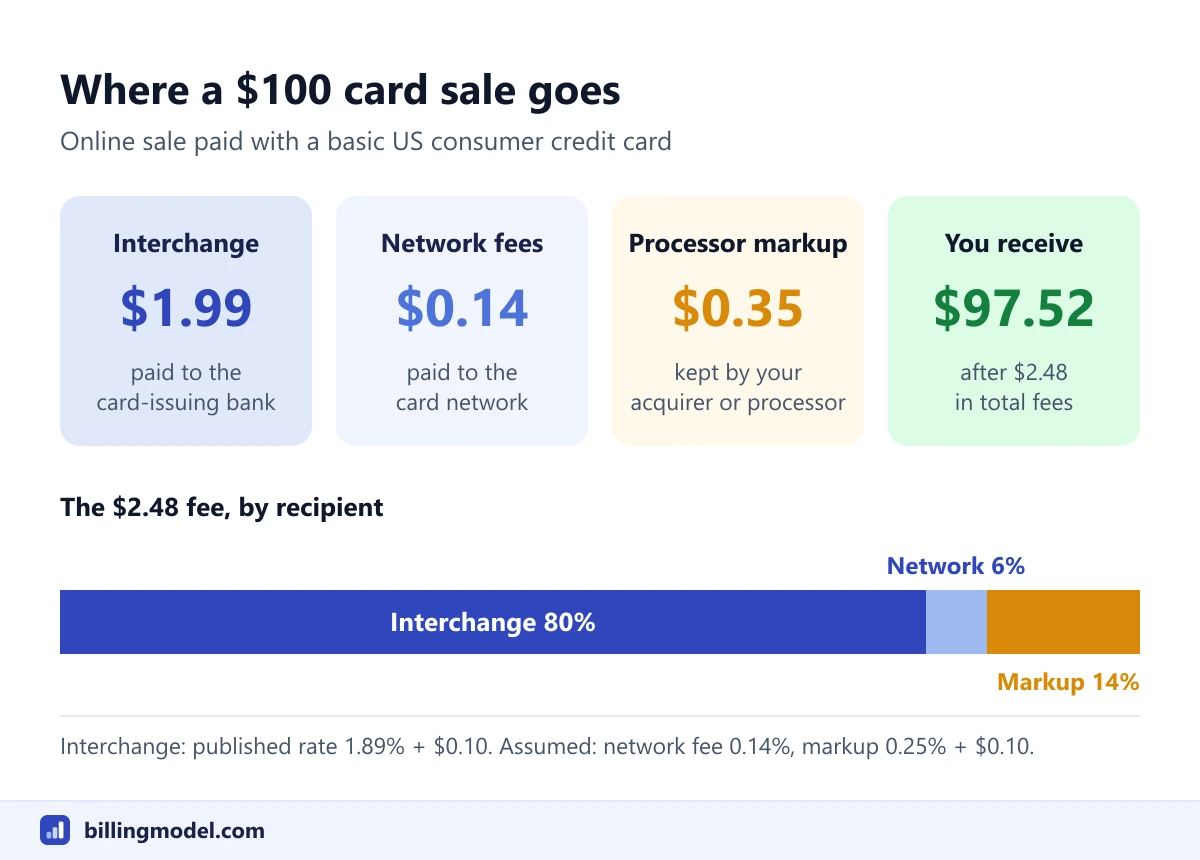 Where a $100 online credit card sale goes. The network fee and the markup are assumed figures.
| Part | Goes to | Amount | Share of the fee |
|---|---|---|---|
| Interchange | Card-issuing bank | $1.99 | 80% |
| Network fees | Card network | $0.14 | 6% |
| Markup | Acquirer or processor | $0.35 | 14% |
| Total | $2.48 | 100% |
Swap in a regulated debit card and interchange falls from $1.99 to $0.27. Nothing about your processor changed. The customer's choice of card moved your cost by $1.72.
Other line items on a processing statement
Percentages per transaction aren't the whole bill. Fixed fees and fees triggered by events sit next to them.
| Fee | When it applies | A published example |
|---|---|---|
| Monthly fee | Every month, whatever you sell | $10.00 a month for one payment gateway |
| Gateway fee | Each online transaction | $0.10 per transaction plus $0.10 per batch settlement |
| Chargeback or dispute fee | Each time a cardholder disputes a payment | $15.00 per dispute received |
| Cross-border and currency fees | The card was issued abroad, or the currency is converted | 1.5% more for international cards and 1% more for conversion |
| PCI non-compliance fee | You haven't shown that you meet the card industry's security standard | Listed by the UK regulator among fees triggered by events |
The monthly and gateway examples are from the University of Washington's merchant fee page. The dispute and cross-border examples are from Stripe's US pricing page. Both were checked in October 2026, and both are illustrations of how such fees are built, not recommendations. The PCI line comes from the UK Payment Systems Regulator's card-acquiring market review (November 2021), which lists chargebacks, refunds and non-compliance with PCI DSS (the Payment Card Industry Data Security Standard) among the events that trigger extra fees.
A gateway, in the regulator's definition, is the software that captures card details on a website and passes them to the acquirer. Dispute costs go well beyond the fee itself, as the guide to the chargeback fee shows.
Flat rate, interchange-plus and tiered pricing compared
The pricing model decides how much of this you can see. The GAO report names three models as common among processors and acquirers.
| Model | How you're charged | What you can see | Who tends to choose it |
|---|---|---|---|
| Flat rate (blended) | One rate for every card, for example 2.9% + $0.30 | Only the total | Smaller merchants who want a simple bill |
| Interchange-plus | Interchange and network fees passed through, plus the processor's own fee | Each part separately | Larger merchants with the volume and staff to analyze their card mix |
| Tiered | Several rates, applied according to risk factors and other requirements the processor sets | The tier a sale landed in, not the interchange behind it | Depends on how the contract defines the tiers |
The 2.9% + $0.30 example is the standard domestic card rate on Stripe's pricing page. On who chooses what, the GAO and a Kansas City Fed article by economist Fumiko Hayashi agree: small merchants often take a flat rate that bundles everything, and large ones typically take interchange-plus because it shows each fee.
A flat rate is a poor fit when many of your customers pay with regulated debit cards. At 2.9% + $0.30 you pay $3.20 on a $100 sale whose interchange was $0.27, and the difference stays with the processor. It suits a business whose volume is too small for the gap to matter, or one that values a bill it can predict.
Note: In Europe the pass-through model is usually split in two, IC+ and IC++. The guide to interchange plus plus pricing explains the difference, and flat rate payment processing covers the blended model.
Why the same card costs less in other countries
Interchange is set country by country, and some governments cap it. In the European Union, the Interchange Fee Regulation limits interchange to 0.2% of the transaction for consumer debit cards and 0.3% for consumer credit cards (checked October 2026). Commercial cards and three-party schemes are outside those caps.
On a sale of 100 in any currency, the EU credit cap works out to 0.30 at most, against 1.99 for the basic US credit card above. The Federal Reserve Bank of Kansas City publishes a comparison of interchange fees across countries every August if you want to see where your markets sit.
Two practical points follow. A business selling in several countries should expect a different cost in each. And a card issued in one country and used in another often carries a cross-border fee on top.
How to work out what you really pay
Your effective rate is total fees divided by total card sales for the same period. Take one monthly statement, add up every fee on it including the fixed ones, and divide by the card volume.
The GAO's figures give a worked case. The federal entities it reviewed paid $784 million in fees on $43,604 million of card revenue in fiscal year 2023, an effective rate of about 1.80%.
Then compare your rate with what interchange alone would have been for your mix of cards. A large gap means the markup or the fixed fees are doing the damage, and those are the parts a processor can change. For large invoices, check whether a bank transfer would be cheaper: ACH processing fees are usually a flat amount per payment.
Frequently asked questions
Who receives payment processing fees?
Three parties share them. The card-issuing bank receives interchange, the card network receives network fees, and the acquirer or processor keeps the rest. In the GAO's review of federal entities, interchange made up nearly 90% of the total.
Are payment processing fees negotiable?
Partly. Interchange and network fees are set by the card networks and are the same whichever processor you use. The markup and the fixed fees belong to the processor, so that is where a quote can differ.
Why do debit cards cost less to accept than credit cards?
In the United States, Regulation II caps debit interchange for large issuers at 21 cents plus 0.05% of the transaction, with 1 cent more for fraud prevention. Credit card interchange has no such cap. Debit cards from small issuers are exempt and cost more.
What is a typical rate for accepting cards?
It depends on your cards and your contract. A Kansas City Fed briefing on business payments reports median fees for the receiving business of 2.0% to 2.5% for credit cards and 1.0% to 1.5% for debit cards. Your own effective rate is the better benchmark.
Can a business pass card fees on to customers?
Some do. The GAO notes that merchants sometimes add a surcharge or a convenience fee to cover part of the cost. Card network rules and local law can restrict this, and Visa's page says merchants must notify their acquirer 30 days before they start surcharging. Check the rules that apply to you before adding a fee.