A Stripe chargeback starts when a cardholder asks their bank to reverse a payment you took through Stripe. Stripe calls it a dispute. When one arrives, Stripe debits the disputed amount plus a dispute fee from your balance and gives you a short window to answer with evidence.
This guide follows the process from the merchant's side, using Stripe's own documentation and its US fees (checked October 2026). Fees differ by country, so check the page for the country of your Stripe account. Billing Model is not affiliated with Stripe.
Quick answer: For a US account, a dispute costs $15 when it is received and another $15 if you counter it, and the second fee is returned if you win. Stripe says you usually have 7 to 21 days to respond and the card issuer usually takes 60 to 75 days to decide. The issuer's decision is final.
How a Stripe chargeback appears in your account
You hear about it in several places at once. Stripe's documentation on how disputes work says it notifies you through the Dashboard, by email, and through webhooks and the API. At the same moment:
- The card network debits Stripe, and Stripe debits your balance for the disputed amount plus a dispute fee.
- The funds are held for the whole dispute.
- You can't refund the payment outside the dispute process while the dispute is open.
- Your dispute rate with that card network goes up.
The disputed amount can differ from the original charge. Stripe lists partial disputes, exchange-rate changes on converted payments, and several recurring charges rolled into one dispute as reasons.
Stripe is a go-between here. Its documentation says it facilitates the case but has no influence over the outcome, which is at the sole discretion of the cardholder's bank. The right the cardholder is using comes from card network rules and, in the United States, from law such as Regulation Z, which lets a credit cardholder report a billing error. Other countries have their own rules.
Stripe chargeback stages and deadlines
Before a dispute: early fraud warnings and inquiries
Two notices can arrive before any money moves.
An early fraud warning is a message from an issuer on the Visa, Mastercard or JCB network flagging a payment it suspects is fraudulent. It needs no response. Stripe says that if the charge isn't refunded, about 40% of Visa and Mastercard warnings become fraud disputes, and that refunding every flagged payment isn't a good strategy. Its own analysis puts the sensible refund point at charges roughly equal to or below your dispute fee, and says refunding is likely not worthwhile on charges more than 35% above it. With a $15 fee, that works out to about $20.25.
An inquiry is a request for information that some networks send before a formal dispute. Stripe says American Express and Discover use this phase most often, and that Visa and Mastercard no longer use it. An inquiry can be closed without a dispute fee by sending evidence that answers it or by issuing a full refund. Ignoring one is risky: Stripe warns it can escalate into a chargeback that is likely unwinnable.
The formal dispute
| Stage | What Stripe's documentation says |
|---|---|
| Dispute window | Card networks typically allow disputes within 120 days of the original payment, and longer in some situations |
| Dispute received | The disputed amount and the dispute fee are debited |
| Your response | Usually due in 7 to 21 days, depending on the card network. Miss the deadline and you lose automatically |
| Issuer review | Usually 60 to 75 days, depending on the card network |
| Decision | The dispute is marked won or lost. The full lifecycle can take 2 to 3 months |
Each open dispute, and the response it needs, is listed on the Disputes tab of the Dashboard. Visa's dispute guide for merchants makes the same point from the network's side: each step in the dispute cycle has a defined time limit, and a late response may lead to an unfavorable outcome.
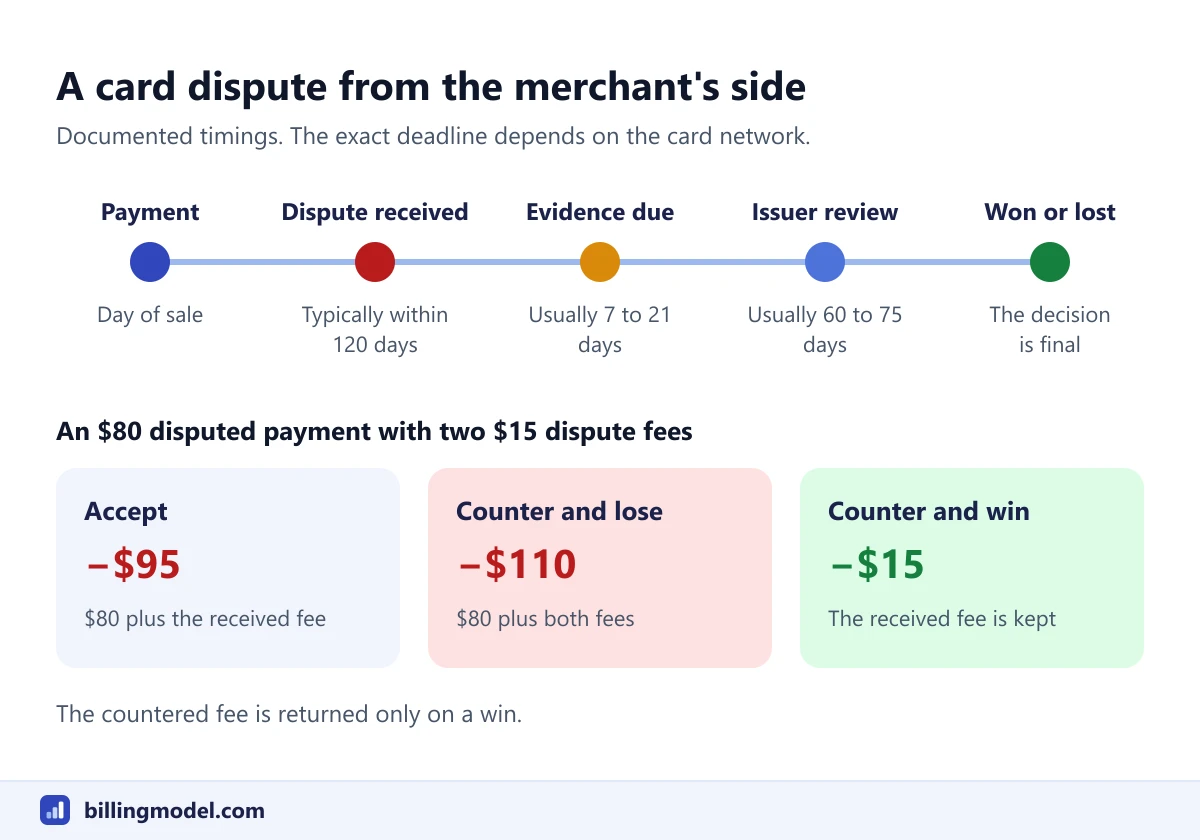 The stages Stripe documents, and what three paths cost on an $80 payment at US fees.
What happens to the funds and the dispute fees
The money leaves first and comes back only if you win. Stripe's dispute fee details list two fees for a US account, the second of them added for disputes initiated after June 17, 2025 (checked October 2026):
- Dispute received fee: $15. Charged for each dispute. Stripe's documentation says it never returns this fee unless your contract states otherwise.
- Dispute countered fee: $15. Charged when you counter. It is returned if you win.
Other countries have their own amounts, such as 20 GBP in the United Kingdom and 20 EUR in eurozone countries, and Stripe says the countered fee doesn't apply to businesses in Mexico and Japan. Our guide to the chargeback fee compares this structure with other providers' published fees.
A worked example
A US business receives a dispute for the full amount of an $80 payment.
| Path | Disputed amount | Received fee | Countered fee | Net effect |
|---|---|---|---|---|
| Accept, or don't respond | −$80 | −$15 | None | −$95 |
| Counter and lose | −$80 | −$15 | −$15 | −$110 |
| Counter and win | Returned | −$15 | Returned | −$15 |
| Inquiry closed with a full refund | −$80 (refund) | None | None | −$80 |
Countering puts another $15 at risk to recover $80, so the choice turns on how strong your records are. The chargeback fee guide has a break-even check for that decision.
What won, lost and accepted mean
- Won: the issuer overturned the dispute. It returns the debited amount to Stripe, and Stripe passes it to you.
- Lost: the issuer upheld the dispute. Stripe's wording is that no money moves from your perspective, because the amount was already debited. Neither fee comes back.
- Accepted: you told the issuer you aren't contesting. Stripe says accepting is the only reliable way to shorten the timeline.
Stripe says the outcome is final for all parties and that it doesn't support the arbitration phase. On a partial win, its fee page says the amount won is returned but the two fees are not. Some disputes can't be challenged under network rules or local regulations, and Stripe closes those as lost as soon as it notifies you.
How to respond and the evidence Stripe lists
Stripe's guide to responding to disputes sets out the order: review the dispute category, read the cardholder's claim, then choose Accept dispute or Counter dispute on the dispute's page.
You get one submission. Stripe forwards it to the issuer immediately and you can't add to it. The practical limits it lists:
- One file per type of evidence, so combine related pages into one file.
- A combined maximum of 4.5 MB, and 19 pages for Mastercard evidence.
- No audio or video, and no links. Banks won't review external content, so tracking pages need screenshots.
Stripe groups the networks' reason codes into categories, and its dispute categories page lists evidence for each.
| Category | Evidence Stripe lists |
|---|---|
| Fraudulent | For digital goods: the customer's purchase IP address, name and email, and logs showing the product was accessed after payment. For shipped goods: a delivery address that matches a verified billing address, shipping documents and tracking |
| Product not received | Shipping address, carrier, tracking number and ship date, or a signature at delivery |
| Product unacceptable | The description or images shown before purchase, your refund policy, and messages with the customer |
| Subscription canceled | The cancellation policy, how and when it was shown, and a renewal notice or proof of continued use |
| Credit not processed | The refund policy, how it was disclosed, and why no refund is owed or proof that one was issued |
| Duplicate | The ID of the other charge and separate receipts showing two distinct purchases |
Stripe calls fraud the most common reason and says these disputes are difficult to win because in many cases the claim is correct. It treats the "unrecognized" category as effectively the same thing. If you believe the payment really was fraud, its advice is to accept. Visa's guide agrees that accepting a dispute you can't remedy may save the time and expense of contesting it. Our guide to chargeback fraud covers Visa's rule on earlier undisputed transactions.
Watch out: A customer who says they withdrew the dispute hasn't ended it. Stripe's page on dispute withdrawals says you still have to submit evidence before the deadline to win.
Dispute rate and monitoring programs
Stripe's Dashboard shows two measures. Dispute activity counts disputes by the date they arrived. Dispute rate counts them by the date of the original charge. Stripe's page on measuring disputes gives an example: 1,000 payments in a week and 10 disputes, only 3 of them on that week's payments, is a dispute activity of 1% and a dispute rate of 0.3%.
Card networks use the activity figure. Stripe says the industry standard treats dispute activity above 0.75% as excessive, and that all disputes count, won or lost.
Stripe's monitoring programs page summarizes the network thresholds as follows (checked October 2026):
- Visa (VAMP): disputes plus fraud reports, divided by captured payments in the same month. The excessive threshold is a ratio of 1.5% with a count of 1,500 in the US, Canada, the EU, Asia-Pacific and Latin America. The 1.5% figure matches the 150 basis points from Visa's own fact sheet, covered in our guide to chargeback prevention.
- Mastercard, as Stripe describes it: a business enters the Excessive Chargeback Merchant level at 100 to 299 chargebacks and a rate of 1.5% to 2.99%, measured against the previous month's payments. The page lists fines starting in the second month, at 1,000 USD. Mastercard's public manuals don't print these thresholds, as our guide to the Mastercard chargeback explains.
Stripe calls its page a general guide and points to the networks for complete figures, so your own figures should come from Stripe or the network.
Prevention features Stripe documents
Stripe's best practices page describes the following. Some sit on paid plans, and listing them is not a recommendation to buy.
- Statement descriptor. Stripe recommends your website domain or business name. Descriptors run from 5 to 22 characters and need at least 5 letters.
- Receipts and policies. Show the full refund and cancellation policy at checkout with a required agreement. Stripe's dispute categories page adds sending a receipt for each payment.
- Radar rules. Radar can block payments or send them to review. Custom rules and manual reviews are on the Radar Plus and Radar Pro plans, and Stripe charges a fee per screened transaction on its Standard, Plus and Pro plans.
- 3D Secure. When an authenticated payment is disputed as fraudulent, Stripe says liability typically shifts to the card issuer, though it isn't guaranteed. Disputes for other reasons follow the standard process.
- Authorize now, capture later. A charge can be captured up to 7 days after authorization, and cardholders can't dispute an uncaptured authorization.
Frequently asked questions
How long do I have to respond to a Stripe chargeback?
Stripe says usually 7 to 21 days, depending on the card network, so treat the date on your own dispute as fixed. If you don't respond before the deadline, you lose the dispute automatically and can't retrieve the funds.
Do I get the Stripe dispute fee back if I win?
Partly. For a US account, the $15 countered fee is returned on a win. The $15 received fee is not returned unless your contract with Stripe says otherwise.
Can I refund the customer once a dispute is open?
No. Stripe's documentation says you can't issue a refund outside the dispute process while a dispute is open, and that the issuing bank has already refunded the cardholder. To concede, accept the dispute.
Does a dispute I win still count against me?
Yes. Stripe says all disputes count toward the measure, won or lost, and that monitoring programs don't consider outcomes.