Chargeback prevention is mostly housekeeping: a billing name customers recognize, an email before a renewal, a refund that goes out the same day, and proof that the order arrived. Each one removes a reason for a customer to call the bank instead of you.
A chargeback is a card payment that the cardholder's bank (the issuer) reverses and sends back to the merchant. Visa's dispute guide for merchants sorts the reasons into four categories: fraud, authorization, processing errors and consumer disputes. The fix is different for each, so prevention works best when you sort your own disputes by cause first.
Quick answer: Many of the chargebacks a merchant can prevent trace back to five causes: true fraud, a billing descriptor the customer doesn't recognize, a subscription renewal they forgot, a delivery or quality problem, and a refund that came too late. The fixes are fraud checks (AVS, CVV, 3-D Secure), a clear descriptor, renewal reminders with easy cancellation, delivery proof and fast refunds, plus records of all of it.
What causes chargebacks
Fraud is the largest single cause in the Federal Reserve research available. A Federal Reserve Bank of Kansas City working paper studied one year of chargebacks, from October 2013 to September 2014, using data from processors that handled more than 20% of US signature-based card transactions. Fraud accounted for about 50% of Visa and Mastercard chargebacks and a smaller share on American Express and Discover, and rates were significantly higher for card-not-present sales, such as online orders, than for in-person sales. The data is old and covers one country, so read it as a baseline, not a current rate.
The rest is spread across reasons a merchant controls more directly.
| Cause | What the customer tells the bank | Main fix |
|---|---|---|
| True fraud | "I didn't make this purchase" (the card details were stolen) | AVS, CVV and 3-D Secure checks |
| Unclear descriptor | "I don't know this company" | A statement name that matches your brand |
| Forgotten renewal | "I cancelled" or "I never agreed to this" | A reminder before renewal and easy cancellation |
| Delivery or quality problem | "It never arrived" or "It's not what was described" | Tracking, delivery proof, accurate descriptions |
| Slow refund | "I returned it and got nothing back" | Same-day credits and a written confirmation |
In the United States, several of these match what the law calls a billing error. Regulation Z, section 1026.13 lists a charge the consumer didn't make and a charge for goods or services not delivered as agreed, among others. Other countries have their own rules, and card network rules apply on top.
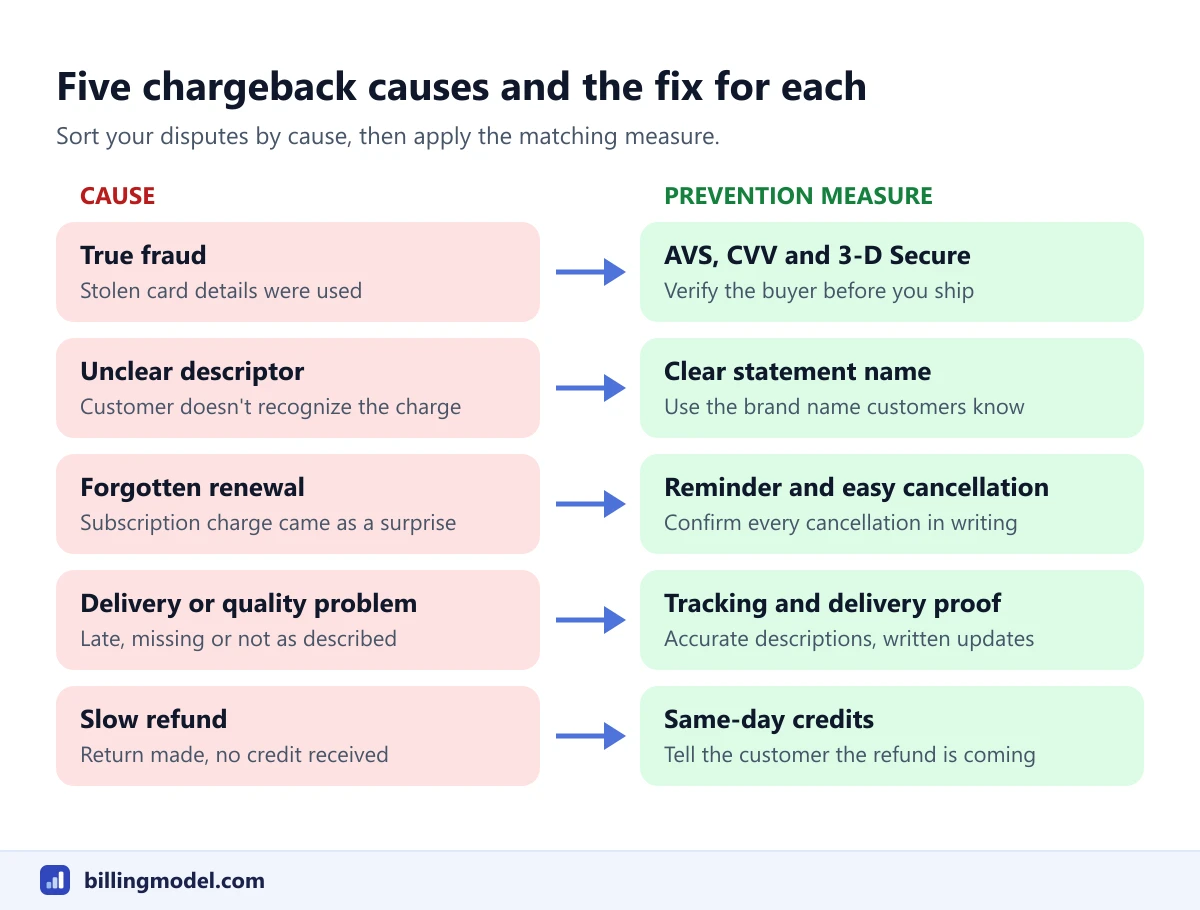 Five common chargeback causes and the measure that addresses each one.
Chargeback prevention measures, cause by cause
True fraud: verify before you ship
Fraud checks compare what the buyer enters with what the issuer has on file. Three are standard for online and phone orders:
- AVS (Address Verification Service) checks the billing address the buyer typed against the issuer's records. Coverage varies by country.
- CVV2 is the security code shown on the card, sent with the authorization request for the issuer to check.
- 3-D Secure asks the issuer to authenticate the cardholder during checkout. Visa's version is called Visa Secure.
Visa's guide tells card-absent merchants to consider using all three. It also says that when a cardholder is successfully authenticated through Visa Secure, the merchant is protected from fraud-related disputes, though liability rules vary by region.
European regulators report the same effect at scale. A joint report from the European Banking Authority and the European Central Bank, published in December 2025, found that card payments verified with strong customer authentication were generally less susceptible to fraud. Card fraud was 17 times higher when the payee was outside the European Economic Area, where that authentication isn't legally required.
Unclear descriptor: use a name customers know
The billing descriptor is the merchant name printed on the customer's card statement. Visa lists an unclear or confusing merchant name among the common causes of card-absent fraud disputes: the customer made the purchase, doesn't recognize the line on the statement, and reports it as fraud.
Visa suggests a simple test: buy something from your own business with your own card and read the statement. If it shows a legal entity name nobody knows, ask your acquirer or processor to change it.
Forgotten renewals: remind, then make cancelling easy
Visa's guide describes recurring transactions as "particularly susceptible to cardholder disputes." Its measures are plain:
- Cancel as soon as the customer asks, and confirm in writing with the effective date.
- Don't bill the card after a cancellation request. If a balance is still owed, Visa's rules require you to ask for another form of payment.
- For trials and introductory offers, be ready to show that the customer expressly agreed to future charges. The evidence Visa's guide describes includes proof that you notified the cardholder at least 7 days before the charge.
A reminder a week before an annual renewal gives the customer time to cancel and gives you a dated record. The consent side of this is covered in the guide to setting up recurring payments.
Delivery and quality: prove it and describe it accurately
- Ship before you charge. Visa advises card-absent merchants not to submit the transaction until the goods have shipped.
- Announce delays in writing. Give the new date and let the customer cancel.
- Match delivery proof to order value. A carrier's confirmation that the parcel reached the right address lets you answer a "not received" dispute. Visa asks merchants to weigh its cost against the value of what they ship.
- Keep descriptions accurate. Visa notes that your return policy has no bearing on a "not as described" dispute.
- Log access for digital products. A record that the account was used after purchase does the job that tracking does for parcels.
Slow refunds: be faster than the bank
"Credit not processed" is its own dispute condition in Visa's rules. Visa's advice is to send credits to your acquirer as quickly as possible, preferably the same day the credit is issued, and to send the customer a note saying the credit is on its way.
Disclose your refund and cancellation policy at checkout as well. For online sales, Visa expects the policy to appear in the checkout sequence or next to the final button, with a click-to-accept step or a similar acknowledgement. The FTC tells US consumers with a quality problem to contact the seller first, so make the seller easy to reach.
A worked example: reading one month of disputes
The numbers below are illustrative. An online subscription business settles 5,200 card-not-present Visa transactions in a month and receives 21 disputes. Sorted by reason:
| Dispute reason | Count | Share of disputes |
|---|---|---|
| Fraud | 10 | 47.6% |
| Cancelled recurring transaction | 5 | 23.8% |
| Goods or services not received | 3 | 14.3% |
| Credit not processed | 2 | 9.5% |
| Not as described | 1 | 4.8% |
| Total | 21 | 100% |
Seven of the 21 are housekeeping failures: five cancelled-recurring disputes and two for credit not processed.
Issuers also filed 11 fraud reports that month. Visa's monitoring ratio adds fraud reports to disputes and divides by settled transactions:
- Before: (11 + 21) ÷ 5,200 = 32 ÷ 5,200 = 0.62%, or 61.5 basis points.
- After removing the seven housekeeping disputes and one fraud dispute caused by an unclear descriptor: (11 + 13) ÷ 5,200 = 24 ÷ 5,200 = 0.46%, or 46.2 basis points.
Eight fewer disputes cut the ratio by a quarter, without touching the fraud tools.
How card network monitoring programs work
Card networks track each merchant's disputes as a share of sales and step in when the share stays high. Visa's guide says Visa monitors merchant dispute activity monthly and notifies the acquirer, which is then expected to work with the merchant on a plan to reduce disputes.
Visa's current program is the Visa Acquirer Monitoring Program (VAMP). According to Visa's VAMP fact sheet (2025 edition, checked October 2026):
- VAMP merged Visa's earlier fraud and dispute monitoring programs into one, with updated thresholds from June 1, 2025.
- The ratio is count-based and covers card-not-present transactions: fraud reports plus disputes, divided by settled transactions.
- A merchant is classed as "Excessive" at a ratio of 150 basis points (1.5%) or more in the US, Canada, the EU and Asia-Pacific. That threshold was 220 basis points until April 1, 2026. It applies with at least 1,500 fraud reports and disputes in the month, and other regions have different figures.
- Acquirers are measured as well. A portfolio is "Above Standard" at 50 basis points and "Excessive" at 70.
- Disputes resolved through pre-dispute solutions are left out of the ratio, depending on timing.
Note: Thresholds change, and other card networks run their own programs with their own numbers. Your acquirer or processor is the source for the figures that apply to your account.
Two things follow from the design. The ratio counts disputes, not dollars, so a $9 dispute weighs as much as a $900 one. And few small merchants reach 1,500 cases a month, but the acquirer has its own portfolio ratio to protect, which gives it a reason to act earlier. Stripe's documentation, for example, describes dispute activity above 0.75% as excessive by industry convention and says every dispute counts, won or lost (checked October 2026).
That is the case for prevention over winning. A dispute you win still counts, and each one usually carries a chargeback fee.
Chargeback prevention checklist
- The statement descriptor shows the name customers know, and receipts use the same name.
- AVS and CVV checks run on every card-not-present order, and 3-D Secure is on where it fits your market.
- Refund, return and cancellation policies appear at checkout with a click-to-accept step.
- Customers get a reminder before every renewal, and at least 7 days' notice before a trial turns into a paid plan.
- Cancellation takes effect as soon as the customer asks and is confirmed in writing.
- Cards are charged when goods ship, not before.
- Delays are announced in writing with the option to cancel.
- Proof of delivery is kept for higher-value orders, and access logs for digital products.
- Credits go out the day a refund is approved.
- Support contact details are visible on receipts, the website and renewal emails.
- Disputes are tracked monthly by reason and as a share of transactions, with card-present and card-absent sales kept separate.
Frequently asked questions
Can chargebacks be prevented completely?
No. Visa's guide says merchants probably cannot avoid disputes completely, and that issuers, acquirers and cardholders make errors too. The realistic goal is to remove the disputes caused by your own process and keep the ratio well under your acquirer's limits.
Does 3-D Secure prevent all chargebacks?
It addresses one category. Visa's guide says a successfully authenticated transaction protects the merchant from fraud-related disputes. A customer can still dispute the same payment for non-delivery, quality or a cancelled subscription, so the other measures still matter.
Is it better to refund than to wait for a dispute?
When the customer has a fair complaint, usually yes. A refund costs you the sale, while a chargeback costs the sale plus a fee and a mark against your dispute ratio. When a claim looks false, the calculation is different, and the guide to chargeback fraud covers how to respond with evidence.
How long should I keep order records?
At least a year is a reasonable floor. Visa's rules on evidence from earlier undisputed transactions look back as far as 365 days. Tax and accounting rules in your country may require longer.