A chargeback fee is the amount your acquirer or payment processor charges each time a cardholder's bank reverses one of your card payments. It comes on top of losing the sale amount, and under many published fee schedules you pay it whether or not the dispute was your fault.
The fee is usually the smallest part of the bill. Add the reversed sale, the goods you already shipped and the time someone spends on the paperwork, and one dispute costs several times the fee. The worked example below adds it up.
Quick answer: A chargeback fee is a per-dispute charge from your acquirer or processor, separate from the disputed amount. On three large US providers' public pages it ranges from $0 to $30 per dispute (checked October 2026). Whether you get it back after winning depends on the provider's terms.
What a chargeback fee is and who charges it
The fee comes from the company that processes your card payments. It doesn't come from the customer, and it isn't billed to you directly by the customer's bank.
The path of a dispute explains why. A Federal Reserve Bank of Kansas City working paper on chargebacks describes five parties: the cardholder, the card issuer, the card network, the merchant's acquirer and the merchant. The issuer sends the chargeback through the network to the acquirer. Visa's dispute guide for merchants says the acquirer then deducts the disputed amount from the merchant's account and informs the merchant.
The acquirer or processor charges a fee for handling that case. Part of it passes on a cost: Stripe's documentation says the card network debits Stripe for the disputed payment and related dispute fees, and Stripe in turn debits the business for the disputed amount plus a dispute fee.
Price lists use different names for the same thing, mostly "chargeback fee" or "dispute fee". Your own fee is in your merchant agreement or on your provider's pricing page. Visa's guide notes that the full extent of a merchant's financial liability for disputes is, in most cases, set out in that agreement.
Published chargeback fee examples
Three large providers publish their dispute fees, and they show how much the structure varies. The table is alphabetical and is not a ranking or a recommendation.
| Provider (US pricing) | Fee per dispute | Returned if you win? |
|---|---|---|
| PayPal | $20 chargeback fee on card payments made outside a PayPal account or guest checkout. For PayPal checkout transactions, a $15 standard or $30 high-volume dispute fee | Not stated on the fee page, which points to the user agreement |
| Square | No fee for chargebacks | Not applicable. Original processing fees aren't returned if you lose |
| Stripe | $15 when a dispute is received, plus $15 if you counter it | The received fee is not returned. The countered fee is returned if you win |
Sources, all checked October 2026: PayPal's merchant fees page (last updated October 1, 2026), Square's payment disputes walkthrough and Stripe's dispute fee details.
Fees are set per country. Stripe's page lists 20 GBP in the United Kingdom, 20 EUR in eurozone countries, 25 AUD in Australia and 15 CAD in Canada for each of its two fees.
Businesses with a negotiated merchant account may not find their fee on a public page. In that case the only reliable figure is the one in your own agreement.
What one chargeback costs: a worked example
The numbers here are illustrative. An online store sells a $120 item. The goods cost the store $48 and shipping cost $9. The processor took 2.9% + $0.30 on the sale, which is $3.78. The customer disputes the charge, the store's chargeback fee is $15, and someone spends 30 minutes on the case at $30 an hour, or $15.
There are two honest ways to total the damage. The first compares the chargeback with the sale you thought you had:
| Cost component | Amount |
|---|---|
| Sale amount reversed | $120.00 |
| Chargeback fee | $15.00 |
| Staff time (30 minutes) | $15.00 |
| Total swing versus a completed sale | $150.00 |
The second counts cash out of pocket, compared with never making the sale at all:
| Cost component | Amount |
|---|---|
| Cost of goods shipped | $48.00 |
| Shipping | $9.00 |
| Original processing fee, not returned | $3.78 |
| Chargeback fee | $15.00 |
| Staff time (30 minutes) | $15.00 |
| Total out of pocket | $90.78 |
The $59.22 gap between the two totals is the profit the sale would have made: $120 minus $3.78, $48 and $9. Seen the other way, the store needs the profit from about one and a half more sales to cover the $90.78.
Either way, the $15 fee is a small share. The swing is 10 times the fee and the cash loss is about six times.
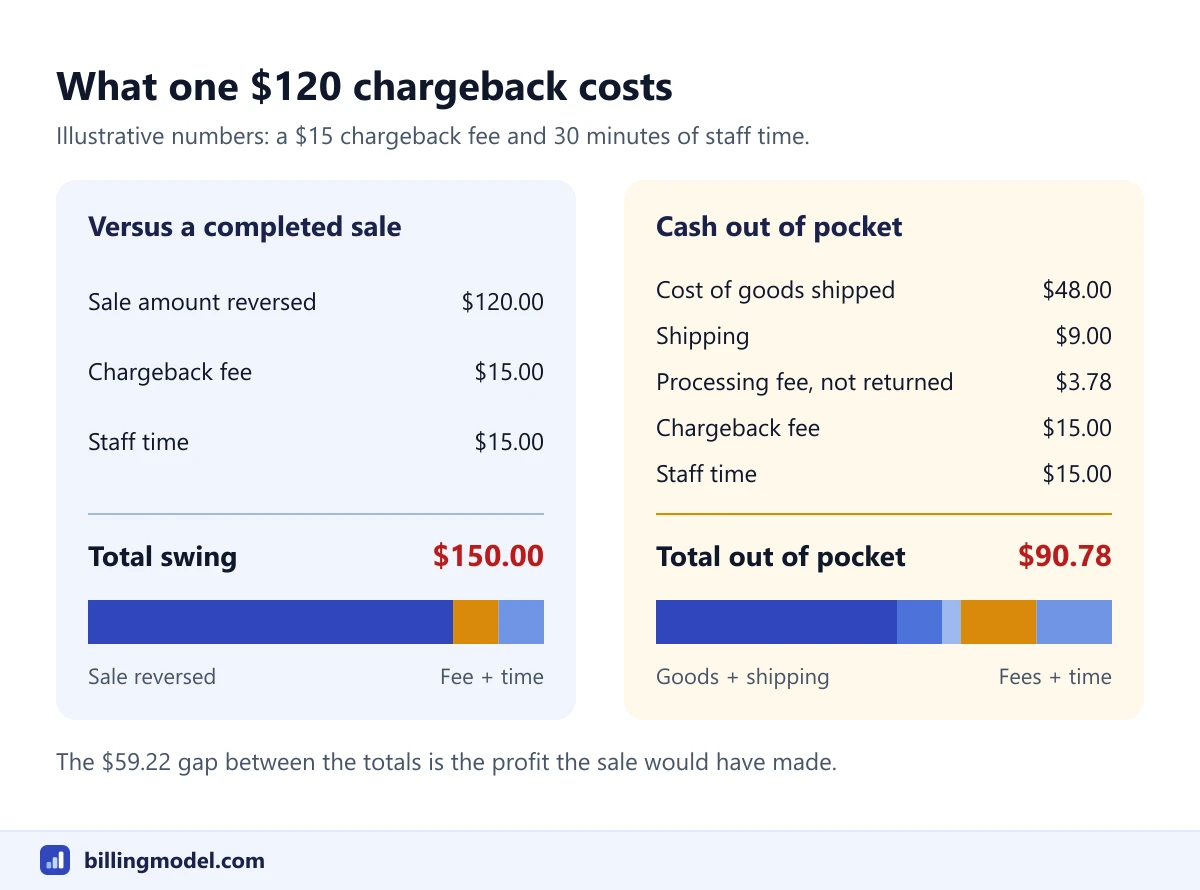 Two ways to total the cost of one $120 chargeback, using illustrative numbers.
The Kansas City Fed paper makes the same point about its own figures. For October 2013 to September 2014, it measured merchants' chargeback losses on Visa and Mastercard sales at about 5 basis points of sales value, then cautioned that this was only one part of the cost: merchants also lose the merchandise, spend labor on resolving disputes and may pay fines and fees to processors or networks.
Should you contest it? A break-even check
Fee structure changes the math on fighting a dispute. Take a schedule like Stripe's, where countering costs another $15 that comes back only if you win, and assume another 30 minutes of staff time ($15) to assemble evidence.
- If you win, you recover $120, the countered fee is returned, and you've spent $15 of time: a gain of $105.
- If you lose, you're out the $15 countered fee and $15 of time: a loss of $30.
With a win probability of p, contesting pays when 105 × p is more than 30 × (1 − p). That works out to p above 30 ÷ 135, or 22.2%.
Run the same check on a $25 sale. Winning nets $25 minus $15 of time, or $10. Losing still costs $30. Contesting pays only when p is above 30 ÷ 40, or 75%.
For context, the Kansas City Fed study found that merchants successfully disputed 20% to 30% of the Visa and Mastercard chargebacks they received between October 2013 and September 2014. That is a share of every chargeback received, contested or not, and an average across all dispute types. It is not a forecast for your case. Visa's guide says it plainly: when a dispute can't be remedied, accepting it may save the time and expense of contesting it.
Is the chargeback fee refunded if you win?
It depends on the provider, and the answer is often no. Winning a dispute returns the disputed amount. The fee follows whatever your contract says.
The published examples above cover the main patterns:
- Kept regardless of outcome. Stripe's documentation says the fee for receiving a dispute is non-refundable for businesses outside Mexico, and that it returns the separate countered fee if you win.
- No fee to refund. Square's help page says it charges no fee for chargebacks.
- Check the agreement. PayPal's fee page lists the amounts and refers to its user agreement for the conditions.
When you read your own contract, look for three things: the fee per chargeback, any second fee for responding (sometimes called a representment or countered fee), and whether either is credited back when the case is decided in your favor.
Watch out: A win doesn't undo everything. On a schedule where the received fee is kept, a merchant who wins the $120 dispute in the example is still out $15, plus the staff time.
How chargeback fees interact with monitoring programs
The per-dispute fee is the first layer of cost. The second is what happens when disputes pile up.
Card networks watch each merchant's disputes as a share of transactions. Visa's program is the Visa Acquirer Monitoring Program (VAMP). Visa's VAMP fact sheet (2025 edition, checked October 2026) defines the ratio as fraud reports plus disputes, divided by settled transactions, counted on card-not-present payments. Merchants and acquirers that exceed its monthly thresholds must put risk controls in place. The thresholds vary by region and have already changed once since the program launched, so ask your acquirer for the current figures.
Stripe's page on measuring disputes describes the consequences from a processor's side: dispute activity above network thresholds for a prolonged period can lead to fines, and it can affect a business's ability to process payments with other processors too.
Three details connect this to the fee you pay per case:
- The ratio counts cases, not dollars. A $9 dispute carries the same fee and the same weight as a $900 one.
- Winning doesn't remove the count. Stripe's documentation says all disputes count toward the measure, won or lost.
- Resolving a problem before it becomes a dispute avoids both. Visa's fact sheet says disputes resolved through pre-dispute solutions are excluded from the VAMP ratio, depending on timing. Stripe's documentation says a case in the earlier inquiry phase, which some networks use, can be closed with a full refund without a dispute fee.
How to pay fewer chargeback fees
You can't negotiate with a dispute after it arrives, so the savings are upstream.
- Remove the avoidable disputes. Unrecognized descriptors, forgotten renewals and slow refunds are process problems. The guide to chargeback prevention covers each one.
- Refund fair complaints early. A refund costs the sale. A chargeback costs the sale, the fee and a mark on your ratio.
- Contest selectively. Use the break-even check above, and save your effort for cases where you hold strong records. The guide to chargeback fraud explains what evidence helps.
- Budget for the rest. The fee belongs in the same budget as your other payment processing fees.
Frequently asked questions
Who pays the chargeback fee, the merchant or the customer?
The merchant pays. The Kansas City Fed paper notes that cardholders are rarely liable in a dispute, because of consumer protection laws and the card networks' zero-liability rules, so the loss falls on the issuer or the merchant. In the United States, for example, Regulation Z caps a credit cardholder's liability for unauthorized use at $50 (checked October 2026).
Do I pay a chargeback fee if I win the dispute?
Often, yes. Some providers keep the fee whatever the outcome, some charge a second fee that is returned on a win, and some charge nothing. Your merchant agreement or your provider's pricing page has the rule that applies to you.
Is a chargeback fee the same as a refund?
No. A refund is money you return to the customer yourself, and it doesn't trigger a dispute fee. A chargeback is a reversal started by the customer's bank, and it brings the fee and a count toward your dispute ratio.
How is a chargeback fee different from a processing fee?
A processing fee is charged on every card sale, often as a percentage plus a fixed amount. A chargeback fee is charged only when a sale is disputed, as a flat amount per case. In the example above, the processing fee was $3.78 and the chargeback fee was $15.