The deferred revenue journal entry records money a customer has paid for something you haven't delivered yet. You debit cash and credit a liability account called deferred revenue. Then, as each month of service is delivered, a second entry moves that month's share out of the liability and into revenue.
For a subscription paid a year in advance, that means one entry on the day the cash arrives and twelve small ones after it.
Quick answer: When the cash arrives, debit Cash and credit Deferred revenue for the full amount. At each period-end, debit Deferred revenue and credit Revenue for the part you have earned. For a $1,200 annual plan that is $1,200 on day one and $100 a month.
Why cash received in advance is a liability
Until you deliver, you owe the customer the service. OpenStax's accounting textbook, published by Rice University, defines unearned revenue, also known as deferred revenue, as a customer's advance payment for a product or service that has yet to be provided. The company can't count the payment as revenue yet, and the textbook notes the customer could ask for the money back before the service is provided.
University finance offices apply the same rule to their own books. Yale's revenue policy states: "Deferred Revenue results when cash is received in advance of Revenue being earned." The amount stays on the balance sheet as a liability until the services are provided or the goods delivered.
The accounting standards use a third name. US GAAP (ASC 606) and IFRS (IFRS 15) call this a contract liability: an obligation to transfer goods or services for which the company has already received payment, or for which payment is due. Both standards say a company may use a different label on its balance sheet. That is why "deferred revenue", "unearned revenue" and "contract liabilities" all appear in published accounts for the same thing.
The deferred revenue journal entry when an annual plan is paid upfront
Two entries do the work: one when the cash arrives and one at each month-end. Take a customer who buys a 12-month software subscription for $1,200 and pays in full on January 1, 2026. Service runs from January 1 to December 31, 2026.
Day one: record the cash
| Date | Account | Debit | Credit |
|---|---|---|---|
| January 1, 2026 | Cash | $1,200 | |
| Deferred revenue | $1,200 |
Cash, an asset, goes up by $1,200. A liability goes up by the same amount. No revenue is recorded, and the income statement doesn't move.
The FASB uses the same pair of entries in its 2014 update that created Topic 606. In Example 38, a customer pays $1,000 before the product is transferred. The entity debits cash and credits a contract liability, then debits the contract liability and credits revenue when it delivers.
Note: If you invoice first and the customer pays later, the first deferred revenue journal entry may debit accounts receivable instead of cash. ASC 606 and IFRS 15 present a contract liability when payment is made or when it falls due, whichever is earlier. Before the cash arrives, that requires an unconditional right to the payment. Whether you have one depends on the contract, for instance on whether the customer can still cancel.
Each month-end: recognize what was earned
At the end of each month, an adjusting entry moves one month of service from the liability to revenue. Here $1,200 ÷ 12 = $100.
| Date | Account | Debit | Credit |
|---|---|---|---|
| January 31, 2026 | Deferred revenue | $100 | |
| Subscription revenue | $100 |
OpenStax describes the routine in its chapter on adjusting entries: at the end of a period the company reviews the unearned account, and any amount that has been earned is recorded as revenue. Cash doesn't appear in this entry. It was recorded on day one.
Equal monthly amounts suit a subscription because access is delivered continuously. The standards list time elapsed among the acceptable ways to measure progress on an obligation satisfied over time, and say straight-line recognition may be appropriate when effort is spread evenly through the period. The guide to SaaS revenue recognition explains how that conclusion is reached for a whole contract.
A 12-month schedule for a $1,200 annual plan
Repeat the monthly deferred revenue journal entry twelve times and the liability runs down to zero.
| Month-end (2026) | Revenue recognized | Cumulative revenue | Deferred revenue balance |
|---|---|---|---|
| January 31 | $100 | $100 | $1,100 |
| February 28 | $100 | $200 | $1,000 |
| March 31 | $100 | $300 | $900 |
| April 30 | $100 | $400 | $800 |
| May 31 | $100 | $500 | $700 |
| June 30 | $100 | $600 | $600 |
| July 31 | $100 | $700 | $500 |
| August 31 | $100 | $800 | $400 |
| September 30 | $100 | $900 | $300 |
| October 31 | $100 | $1,000 | $200 |
| November 30 | $100 | $1,100 | $100 |
| December 31 | $100 | $1,200 | $0 |
| Total | $1,200 |
A quick check works on any row: cumulative revenue plus the remaining balance equals the $1,200 received. On June 30, that is $600 + $600.
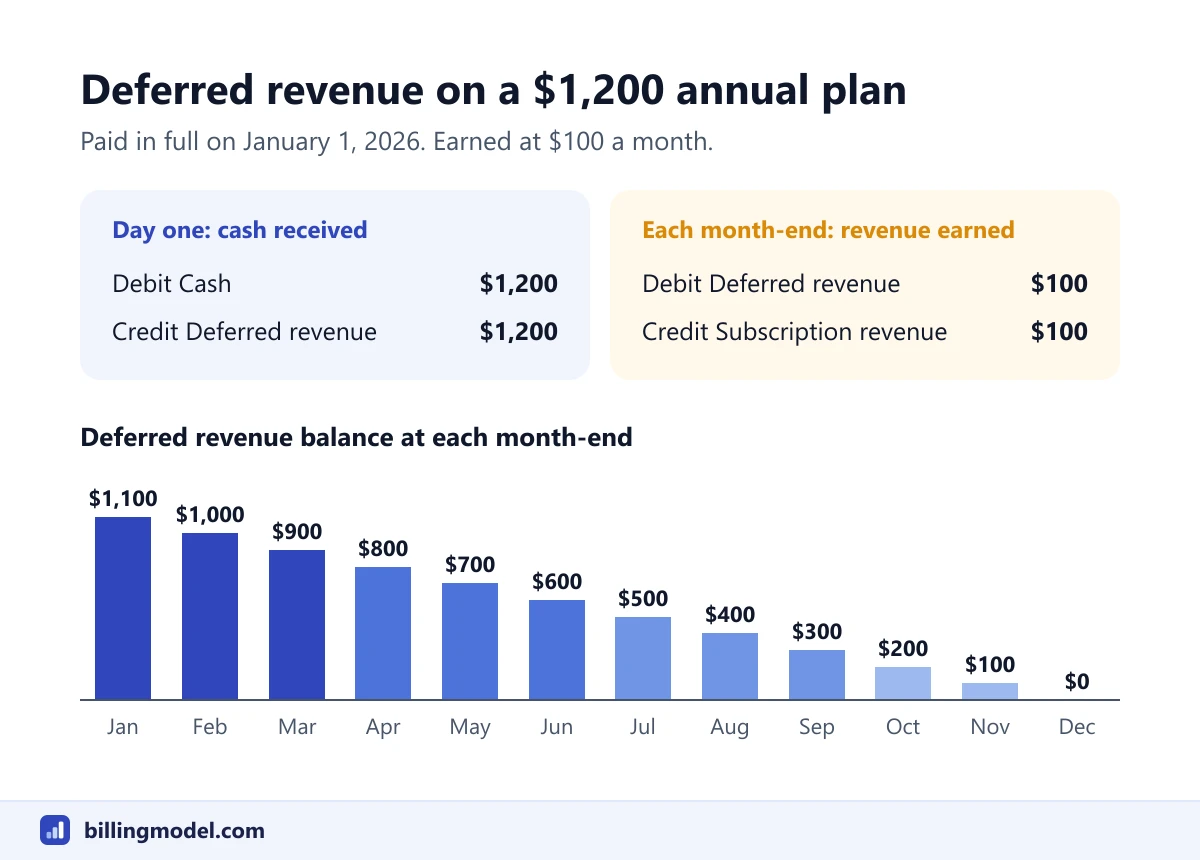 One entry on the day cash arrives, then $100 moved to revenue at each month-end until the balance is zero.
A mid-month start
A plan that starts in the middle of a month earns only part of that month's revenue. One way to work it out is to count days.
Say the same $1,200 plan starts on March 16, 2026 and runs to March 15, 2027, which is 365 days.
- Daily rate: $1,200 ÷ 365 = $3.2877.
- Days of service in March 2026 (the 16th to the 31st): 16.
- March revenue: 16 × $3.2877 = $52.60.
The March 31 entry debits Deferred revenue and credits Subscription revenue for $52.60. By December 31, 2026 the customer has received 291 days of service, so $956.71 has been recognized and $243.29 is still deferred for the remaining 74 days. The two figures add up to $1,200.00.
For comparison, counting the first and last partial months as half a month each gives $50 in March 2026, $100 for each of the next 11 months, and $50 in March 2027, which also totals $1,200. The gap in the first month is $2.60. That is arithmetic, not a method either standard names. Both standards expect one method of measuring progress to be applied consistently to similar obligations, and whether an approximation is acceptable for your books is a question for your accountant.
Where deferred revenue sits on the balance sheet
Deferred revenue is reported under liabilities, split by when it will be earned. OpenStax describes a current liability as an obligation due within the company's operating period, typically a year, and a noncurrent liability as one that falls due later.
For a 12-month plan, the whole balance is current. A multi-year prepayment is split. Suppose a customer pays $3,600 on January 1, 2026 for three years of service, earned at $1,200 a year.
| Date | Total deferred | Current (next 12 months) | Non-current |
|---|---|---|---|
| January 1, 2026 | $3,600 | $1,200 | $2,400 |
| December 31, 2026 | $2,400 | $1,200 | $1,200 |
| December 31, 2027 | $1,200 | $1,200 | $0 |
| December 31, 2028 | $0 | $0 | $0 |
Published accounts show the same split at scale. CrowdStrike's annual report says that as of January 31, 2025 it had deferred revenue of $3.7 billion, of which $2.7 billion was recorded as a current liability and expected to be recorded as revenue in the next 12 months (checked October 2026).
Refunds and cancellations
What happens to the balance when a customer leaves early depends on the contract and your refund terms.
If you refund the unused part, you pay back what you haven't earned. Suppose the $1,200 customer cancels after four months and you return the remaining eight months:
| Date | Account | Debit | Credit |
|---|---|---|---|
| April 30, 2026 | Deferred revenue | $800 | |
| Cash | $800 |
The liability drops to zero, and the $400 already recognized stays in revenue. The customer-facing document for that reversal is usually a credit memo, as the credit memo example shows.
If the plan is non-refundable, the answer is less obvious. Whether and when the remaining balance becomes revenue depends on what you still owe the customer under the contract, so don't assume it can be released on the cancellation date.
There is also a rule for refunds you can see coming. ASC 606 and IFRS 15 both require a refund liability for amounts received that the company expects to give back, updated at each reporting date.
Deferred revenue vs accrued revenue
The two are mirror images. Deferred revenue is cash first, delivery later. Accrued revenue is delivery first, cash later. OpenStax defines accrued revenues as revenues earned in a period that have yet to be recorded and for which no money has been collected.
| Deferred revenue | Accrued revenue | |
|---|---|---|
| Order of events | Paid, then delivered | Delivered, then billed and paid |
| Balance sheet | Liability | Asset |
| First entry | Debit Cash, credit Deferred revenue | Debit Accounts receivable, credit Revenue |
| Later entry | Debit Deferred revenue, credit Revenue | Debit Cash, credit Accounts receivable |
| Subscription example | Annual plan paid upfront | Usage billed after the month ends |
A business with usage-based pricing often has both at once: a fixed fee collected in advance and usage charges earned before they are invoiced. Under ASC 606 and IFRS 15, an earned amount is a receivable when only the passage of time stands between you and payment, and a contract asset when the right still depends on something else.
Mistakes to avoid
- Recording the whole payment as revenue on receipt. It overstates the first month and leaves eleven months with service delivered and nothing recorded.
- Skipping the month-end entry. The liability stays too high and revenue too low until someone catches up.
- Confusing the balance with a metric. Deferred revenue is a balance sheet figure. Monthly recurring revenue is a management measure and follows different rules.
- Following superseded guidance. The FASB's 2014 update says Topic 606 supersedes the revenue recognition requirements in Topic 605, covered in the article on ASC 605.
This article explains the general mechanics. It isn't accounting advice. The right entries for a particular contract depend on its terms and on the framework you report under, so have a qualified accountant confirm them.
Frequently asked questions
Is deferred revenue a debit or a credit?
It normally carries a credit balance, because it is a liability. The account is credited when cash is received in advance and debited as the revenue is earned.
Is deferred revenue the same as unearned revenue?
Yes. OpenStax's textbook uses the two terms for the same account, and ASC 606 and IFRS 15 call it a contract liability. The label on a balance sheet is the company's choice.
Is deferred revenue a current liability?
The part you expect to earn within the next 12 months is current. Anything beyond that, such as years two and three of a three-year prepayment, is non-current.
Does deferred revenue appear on the income statement?
No. It sits on the balance sheet. Only the portion earned in the period reaches the income statement, as revenue.
How often should the entry to recognize revenue be made?
At the end of each period you report on. A business that prepares monthly statements makes the entry monthly, and one that reports only once a year could make a single entry for the amount earned in that year.