Usage-based pricing charges a customer for what they consumed in a billing period: API calls, gigabytes stored, minutes, messages, kilowatt-hours. The price per unit is agreed in advance. The bill is not, because it depends on a quantity nobody knows until the period ends.
You'll also see it called consumption-based pricing, metered billing or pay-as-you-go. The names describe one idea, with small differences in how the customer commits and pays. Every version runs on the same three steps: usage is metered, the measured quantity is rated against a price list, and the result is billed.
Quick answer: Usage-based pricing sets a price per unit of consumption and bills each customer for the units they used. Bill = (metered units − included allowance) × unit price + any fixed fee. Consumption-based pricing is another name for the same model.
What usage-based pricing is
Usage-based pricing ties the amount you charge to a measured quantity of use, not to a plan or a head count. Two customers on the same price list pay different amounts because they used different amounts.
Metered utilities are the familiar version. The US Environmental Protection Agency's guide to reading a water bill separates a flat fee, where every customer pays the same regardless of use, from a uniform rate, where one constant price applies to each metered unit. The second needs a meter. The first doesn't.
Software picked up the model with cloud computing. The US National Institute of Standards and Technology's glossary entry for "measured service", taken from its definition of cloud computing, describes the mechanism: resource use is metered at a level that suits the service (its examples are storage, processing, bandwidth and active user accounts), and it is monitored and reported so that provider and customer can both see it.
Consumption-based pricing is the same model
Consumption-based pricing and usage-based pricing are two names for one thing. "Consumption" is the word some cloud and data companies use. Snowflake, for example, describes a "consumption-based business model" in its annual report filed with the SEC and says it recognizes revenue as customers consume compute, storage and data transfer.
What changes from one seller to the next is the unit being counted.
| What is sold | Unit that is metered | Where the example comes from |
|---|---|---|
| Compute | Type of resource and how long it ran | Snowflake's annual report |
| Data storage | Average terabytes stored per month | Snowflake's annual report |
| Data transfer | Terabytes moved, by cloud provider and region | Snowflake's annual report |
| Internet access | Megabytes used above a monthly allowance | The provider studied by Lambrecht and Skiera (below) |
| Water | CCF (100 cubic feet, or 748 gallons) or gallons | EPA's water bill guide |
How usage is metered, rated and billed
Every usage bill is built in three steps, and each one is a place where a dispute can start.
1. Metering
Metering records billable events and totals them for the period. The decision that matters most is how the total is formed. Calls and messages are simply added up. Storage is a level, not an event, so the contract has to say whether the bill uses the average, the peak or the month-end figure. Snowflake's report, for instance, describes storage fees based on the average terabytes stored per month.
2. Rating
Rating applies the price list to the metered quantity. The simplest rate is one price per unit. Most price lists add something: an included allowance, a monthly minimum, or tiers that change the unit price as quantity grows.
3. Billing
Usage is normally billed in arrears, after the period closes, because the quantity isn't known sooner. Snowflake's report shows both patterns side by side: its on-demand customers are billed monthly in arrears, while customers who commit to a set amount of consumption are typically billed annually in advance and then draw that amount down. Either way, the billing period defines the window the meter totals.
Watch out: Write the aggregation rule into the price list and the contract. "Storage: $0.10 per GB per month" can mean average, peak or month-end storage, and the three produce different invoices from the same data.
Worked example: one month's usage bill
Take a hypothetical document-conversion API with this price list:
- Platform fee: $49 per month, including 10,000 conversions
- Additional conversions: $0.004 each
- Storage: $0.10 per GB per month, on the average amount stored
In September 2026 a customer makes 46,500 conversions. They store 120 GB for the first 10 days and 180 GB for the remaining 20 days.
Step 1: meter. Conversions total 46,500. Average storage is (120 × 10 + 180 × 20) ÷ 30 = 4,800 ÷ 30 = 160 GB.
Step 2: rate. Billable conversions are 46,500 − 10,000 = 36,500, and 36,500 × $0.004 = $146.00. Storage is 160 × $0.10 = $16.00.
Step 3: bill. The invoice issued after month end has three lines.
| Line item | Quantity | Rate | Amount |
|---|---|---|---|
| Platform fee | 1 month | $49.00 | $49.00 |
| Conversions above allowance | 36,500 | $0.004 | $146.00 |
| Storage (average) | 160 GB | $0.10 | $16.00 |
| Total | $211.00 |
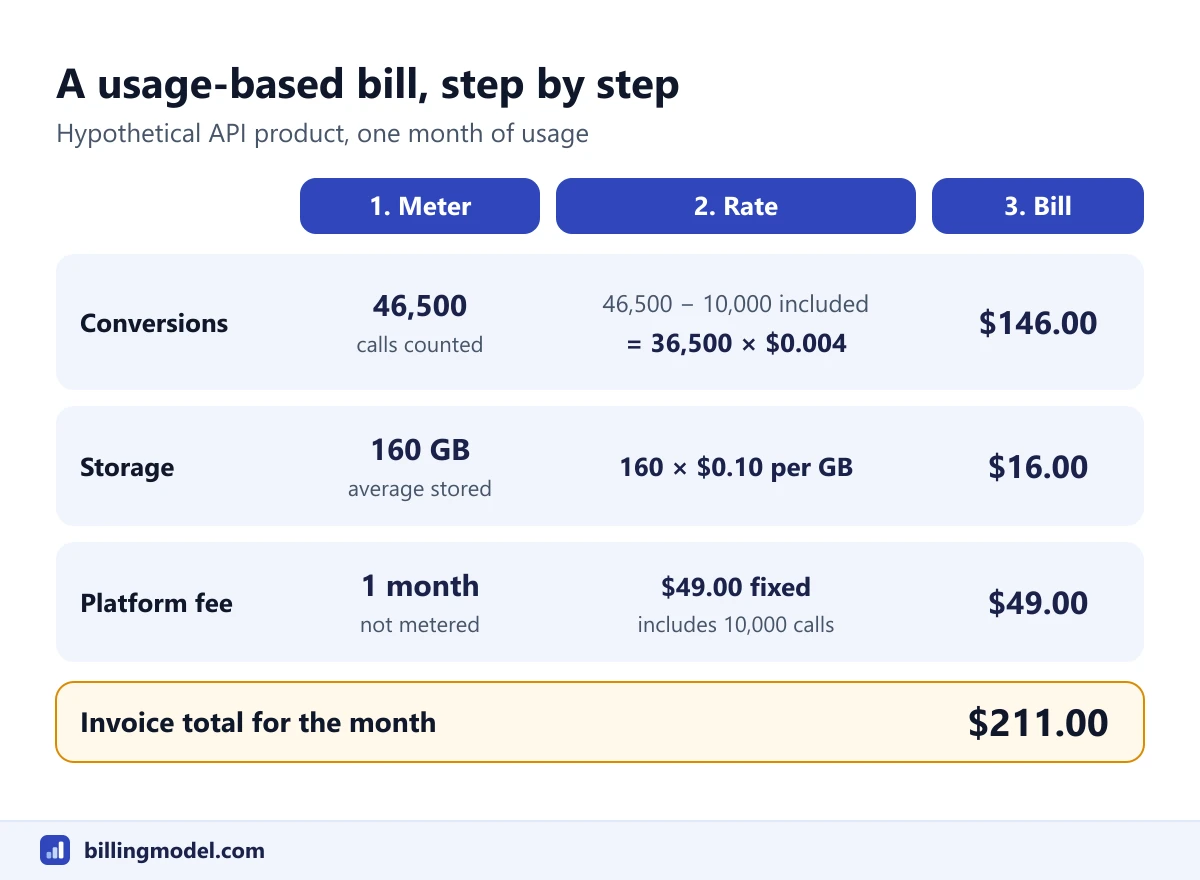 One month's usage bill, from meter reading to invoice total.
Now double the conversions. In October the customer makes 93,000 conversions and stores 180 GB on average. Billable conversions are 83,000, which cost $332.00. Storage is $18.00. The bill is $49.00 + $332.00 + $18.00 = $399.00, an increase of $188.00, or 89%.
Conversions doubled, but the bill rose 89%. The conversion charge more than doubled, from $146.00 to $332.00, because the allowance stays at 10,000. The platform fee didn't move, and storage grew by only 12.5%. In a quiet month of 8,000 conversions and 100 GB the same customer would pay $49.00 + $10.00 = $59.00. That spread, $59 to $399 on one price list, is what the customer has to budget for and what you have to forecast.
The main forms of usage-based pricing
Sellers rarely charge a pure per-unit price with nothing else. These are the common shapes.
| Form | How the customer pays | An example from the sources |
|---|---|---|
| Pay as you go | No commitment. Metered units × unit price, billed after the period | Snowflake's on-demand arrangements, billed monthly in arrears |
| Prepaid commitment | Commits to an amount of consumption at agreed prices, pays up front, draws it down | Snowflake's capacity arrangements, typically billed annually in advance |
| Fixed fee plus overage | A recurring fee includes an allowance. Units above it are charged per unit | The worked example above |
| Two-part tariff | A fixed access fee plus a price for every unit | The cover charge plus price per drink in MIT Sloan's course notes on two-part tariffs |
A company can be consumption-based and still collect most of its money up front. Snowflake reports that on-demand arrangements were about 1% of its revenue in the fiscal year ended January 31, 2026. Most came from capacity arrangements, and many of those contracts let a customer roll unused capacity into a later order, generally when buying more.
Billing software names these patterns in its own way. Stripe's documentation on recurring pricing models, for example, lists fixed fee and overage, pay as you go, and credit burndown. The planned guide to Stripe usage-based billing covers that product's setup.
What changes for your customer and for you
A meter moves risk around. Four effects are documented well enough to plan for.
The bill becomes a variable cost for the buyer. OpenStax's managerial accounting textbook defines a variable cost as one that varies in direct proportion to activity, and a mixed cost as one with a fixed part and a variable part. A pay-as-you-go bill is the first kind. A platform fee plus overage is the second. That suits a buyer whose own revenue rises with usage. It's uncomfortable for one who has to fit a fixed annual budget.
Many buyers will pay extra for a predictable bill. Anja Lambrecht and Bernd Skiera studied 10,882 customers of a European internet provider and reported, in the Journal of Marketing Research, that many stayed on a flat rate when a metered tariff would have cost them less. They trace this partly to an "insurance effect" (a flat rate protects against an expensive month) and a "taxi meter effect" (watching the meter run makes a service less enjoyable to use). The opposite mistake hurt the provider more. Customers on a metered tariff who would have paid less on a larger plan had monthly churn rates 340% to 1,040% higher than customers already on their cheapest option.
People use less of what is metered. An NBER working paper on residential broadband demand by Aviv Nevo, John Turner and Jonathan Williams concluded that usage-based pricing "eliminates low-value traffic". A study of China's heating reform, summarized on an MIT Sloan seminar page, found that replacing a fixed, unmetered payment with consumption-based billing cut heating use by 37% over four years. For a software seller this cuts both ways: less wasteful load to pay for, and customers who hesitate before using the product more.
Your revenue is harder to forecast. Snowflake's report says that because revenue follows consumption, it lacks visibility into the timing of revenue from any particular contract, and that consumption is typically lower during holidays.
Revenue accounting for usage fees falls under ASC 606 in US GAAP and IFRS 15 under IFRS. The IFRS Foundation's summary of IFRS 15 says an entity estimates any part of the consideration that is variable. How that applies depends on the contract, so have an accountant confirm the treatment. The guide to SaaS revenue recognition explains the general framework.
When usage-based pricing fits
Usage-based pricing works when three things are true at once. The customer understands the unit and can check their own count. Your cost to serve rises with that unit. And the value the customer gets rises with it too, so a bigger bill arrives alongside a bigger benefit.
It's a poor fit when customers can't predict their bill, because the insurance effect described above pushes them toward any competitor offering a fixed price. In that case a single flat-rate price or a set of plans is easier to sell, and a fixed fee with an allowance is a workable middle. The overview of SaaS pricing models compares the options.
If you do meter, make the bill easy to anticipate. Give customers a usage page they can check at any time (the internet provider in the Lambrecht and Skiera study let customers monitor usage on its website), send alerts before a threshold is crossed, and offer an allowance or commitment that makes most months predictable.
Frequently asked questions
Is usage-based pricing the same as consumption-based pricing?
Yes. Both mean the customer is charged for a measured quantity of use. "Consumption-based" is the label some cloud and data companies use, and "usage-based" is the more general one.
Is pay-as-you-go the same as usage-based pricing?
Pay-as-you-go is one form of it: no commitment, with measured usage billed after each period. Prepaid commitments and fixed fees with overage are also usage-based, because the final amount still depends on a meter.
How is usage-based pricing different from tiered pricing?
Usage-based pricing decides what you count. Tiers decide the rate for each unit counted. The two are often combined, for example a lower price per call above 100,000 calls, and the article on tiered pricing examples shows the calculations.
Is usage billed in advance or in arrears?
Pure usage is billed in arrears, since the quantity is unknown until the period ends. Fixed fees and prepaid commitments are commonly billed in advance, which is why a single invoice can contain this month's platform fee and last month's overage.
What makes a good usage metric?
A good metric is one the customer can see, predict within reason and connect to the value they get. If a customer can't reproduce your count from their own records, expect invoice disputes.