Tiered pricing changes what a customer pays as they buy or use more. The tiered pricing examples below cover the three structures you'll meet on real price lists: plan tiers, graduated quantity tiers and volume tiers.
The last two are easy to confuse. Graduated and volume pricing can share an identical tier table and still produce different invoices. With the tiers used in this article, 1,250 units cost $2,000 one way and $1,250 the other.
Quick answer: In graduated tiered pricing, each band of units is charged at its own rate and the bands are added together. In volume pricing, every unit is charged at the rate of the tier the total lands in. With tiers of $2.00 (1–500), $1.50 (501–1,000) and $1.00 (1,001 and up), 1,250 units cost $2,000 graduated and $1,250 by volume.
Tiered pricing examples at a glance
"Tiered pricing" is used for two different things: a ladder of plans, and a unit price that changes with quantity. The second comes in two versions.
| Structure | What changes from tier to tier | Cost for a quantity of 1,250 in the examples below |
|---|---|---|
| Plan tiers | The package: limits, features and one fixed price | $49 a month |
| Graduated tiers | The unit price, one band at a time | $2,000 |
| Volume tiers | The unit price for every unit | $1,250 |
The labels aren't standardized. In everyday use, "tiered" often means the graduated kind, set against "volume". Stripe's documentation on tiered pricing uses "tiered" as the umbrella and calls the two modes volume-based and graduated. Check which meaning a price list or a billing tool has in mind before you compare numbers.
Example 1: plan tiers (good, better, best)
Plan tiers offer a few packages at rising prices and let each customer pick. A Harvard Business School Working Knowledge article on subscription fees describes the model as multiple tiers priced for different combinations of features, usage levels and number of users. It quotes professor Elie Ofek's advice to "build tiers that align well with the needs and preferences of different customer segments."
Here is a hypothetical email tool with three plans.
| Plan | Price per month | Contacts included | Users |
|---|---|---|---|
| Starter | $19 | 1,000 | 1 |
| Growth | $49 | 5,000 | 5 |
| Scale | $129 | 25,000 | Unlimited |
A customer with 1,250 contacts doesn't fit Starter, so they pay $49 for Growth. That works out to $49 ÷ 1,250 = $0.039 per contact, about twice the $0.019 a full Starter account pays ($19 ÷ 1,000). The price jumps at each limit and stays flat in between. OpenStax's managerial accounting textbook calls a cost that behaves this way a stepped cost: it changes with activity, but not in a straight line.
Plan tiers exist because sellers can't see what each buyer would pay. MIT Sloan's course notes on price discrimination call the answer consumer self-selection: the firm sets several price levels in advance and lets customers sort themselves.
Two neighbors of this model have their own articles. A free bottom tier turns the ladder into freemium pricing. A single plan with a single price is flat-rate pricing.
Example 2: graduated tiers, step by step
Graduated pricing fills the tiers in order, like buckets. Each unit is charged at the rate of the band it falls in, and a cheaper rate never reaches back to earlier units.
Take a hypothetical messaging service that charges per message sent in a month.
| Tier | Messages | Price per message |
|---|---|---|
| 1 | 1 to 500 | $2.00 |
| 2 | 501 to 1,000 | $1.50 |
| 3 | 1,001 and up | $1.00 |
A customer sends 1,250 messages.
- The first 500 fall in tier 1: 500 × $2.00 = $1,000.
- The next 500 fall in tier 2: 500 × $1.50 = $750.
- The last 250 fall in tier 3: 250 × $1.00 = $250.
- Total: $1,000 + $750 + $250 = $2,000.
The average price is $2,000 ÷ 1,250 = $1.60 per message. No single tier shows that figure, so it helps to list each band on its own invoice line.
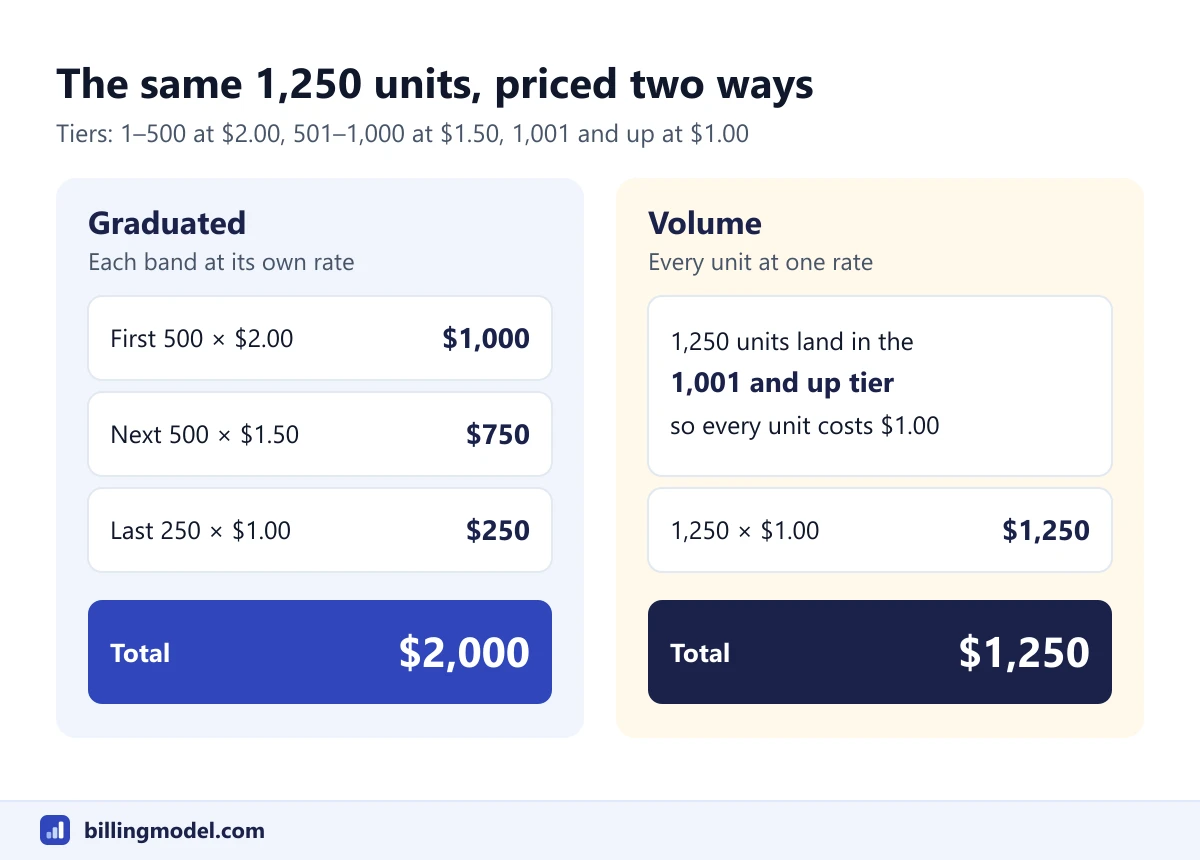 One tier table, two methods: 1,250 units cost $2,000 graduated and $1,250 by volume.
Example 3: the same 1,250 units with volume pricing
Volume pricing looks up one rate for the whole quantity. Using the same table, 1,250 messages land in tier 3, so all of them are charged at $1.00: 1,250 × $1.00 = $1,250. That is $750 less than the graduated bill.
The gap changes with quantity.
| Messages | Graduated total | Volume total | Difference |
|---|---|---|---|
| 400 | $800.00 | $800.00 | $0.00 |
| 500 | $1,000.00 | $1,000.00 | $0.00 |
| 501 | $1,001.50 | $751.50 | $250.00 |
| 1,000 | $1,750.00 | $1,500.00 | $250.00 |
| 1,001 | $1,751.00 | $1,001.00 | $750.00 |
| 1,250 | $2,000.00 | $1,250.00 | $750.00 |
| 2,000 | $2,750.00 | $2,000.00 | $750.00 |
Inside the first tier the two methods agree. Past it, the volume total is always lower, and it does something the graduated total never does: it falls when usage rises. At 1,000 messages the volume bill is $1,500. At 1,001 it is $1,001. Any customer sending between 668 and 1,000 messages would pay less by sending 1,001.
Watch out: A volume table with wide price gaps creates cliffs where a bigger order costs less than a smaller one. Run the numbers on both sides of every threshold before you publish the table.
Volume pricing has more to it, including discounts on single orders. The planned article on volume discount pricing covers that side.
Example 4: tiers where the rate goes up
Tiers don't have to get cheaper, and not all tiered pricing examples come from software. Two public ones charge more per unit as quantity grows, and both are graduated.
Income tax is the best-known one. The US Internal Revenue Service explains its tax brackets as layers of income and says: "You pay the higher rate only on the part that's in the new tax bracket." That is graduated pricing with rising rates. Tax systems elsewhere differ in their rates and rules, but the layered method is the same idea.
Water is the other. The US Environmental Protection Agency's guide to water bills describes increasing block rates, where each block of use costs more per unit than the one before. It says they promote conservation and are most common in urban areas and places with limited supply. The same guide lists declining block rates, where the unit price falls with each block, as common in rural areas with large farming populations or heavy industry.
The direction of the tiers follows the goal. Falling rates reward growth. Rising rates ration something scarce.
Graduated or volume: how to choose and what to avoid
The tiered pricing examples above use one table to keep the comparison fair, but in practice you choose one method. Pick it by asking when the customer learns the quantity. This is a judgment call, and the reasoning runs like this.
For metered use billed after the period, graduated tiers are the safer default. The bill can only rise as usage rises, so there's no threshold where a customer is rewarded for padding their usage, and a small miscount near a boundary moves the invoice by the price of a few units, not by hundreds of dollars. The guide to usage-based pricing explains how that usage is metered and billed.
For quantities chosen up front, such as seats or units in an order, volume tiers are easier to sell because the buyer sees one unit price for everything. The cliffs still need checking.
Three mistakes show up with either method:
- Not naming the method. A tier table alone doesn't say whether it is graduated or volume. State it on the price page and in the contract, with one worked figure.
- Fuzzy boundaries. "Up to 500" and "500+" both claim unit 500. Write "1 to 500" and "501 to 1,000".
- Counting over the wrong window. Say whether tiers reset every billing period or accumulate over the contract.
How far apart to set the tier prices is a separate question from how the tiers are calculated. The value-based pricing example and the overview of SaaS pricing models deal with that.
Frequently asked questions
What is the difference between tiered pricing and volume pricing?
When the two are contrasted, tiered means graduated: each band of units is charged at its own rate. Volume pricing charges every unit at the rate of the tier the total reaches. Past the first tier, the volume total is lower for the same table.
Is tiered pricing the same as usage-based pricing?
No. Usage-based pricing means the bill depends on a metered quantity. Tiers are one way to set the rate for that quantity, and they also apply to things that aren't metered, such as seats or plans.
How do you calculate the average price per unit with graduated tiers?
Add up the charge for each band and divide by the total quantity. In the example above, $2,000 ÷ 1,250 messages gives $1.60, which sits between the $2.00 and $1.00 tier rates.
Can a tier have a flat fee as well as a unit price?
Yes, where the billing system supports it. Stripe's documentation, for example, says a tier can carry a unit amount, a flat amount or both. In its sample table, 12 units cost $66 by volume and $111 graduated, because the graduated method adds the flat fee of every tier the quantity passes through.
How many tiers should a price list have?
The sources used here give no fixed number. The Harvard Business School article's test is whether each tier matches a real customer segment. If you can't say who a tier is for, it probably shouldn't exist.