Subscription pricing models are the ways a recurring price can be built: a fixed fee, a price per unit or per user, a set of tiered plans, a charge for measured usage, or a hybrid of a base fee plus usage. They apply to a gym, a car wash or a meal box as much as to software.
Picking one comes down to three questions. What do customers value? How do your costs scale? How predictable does the bill have to be? Everything else, from annual discounts to set-up fees, is layered on top of that answer.
Quick answer: There are five basic subscription pricing models: fixed fee, per unit or per user, tiered plans, usage-based and hybrid. Charge for the thing customers value, make sure the price rises when your costs do, and give buyers as much predictability as they need. Then add the billing interval, trial, fees, minimum term and discounts.
The five subscription pricing models
A pricing model is the formula behind the bill. A Harvard Business School Working Knowledge article, reporting on work by marketing professor Elie Ofek, lists three broad options for a subscription: a single flat price, a freemium offer with a free base tier, and multiple tiers priced by features, usage levels and number of users. Pull the tiers apart and you get the five structures below.
| Model | The bill is | A non-software case from the sources | The seller's exposure |
|---|---|---|---|
| Fixed fee | The same amount every period | A health club's monthly contract with no fee per visit | Heavy users cost more than they pay |
| Per unit or per user | Units (or users) × a price | A $12 single visit or a $100 ten-visit pass at the same clubs | Revenue stops when use stops |
| Tiered plans | The price of the plan chosen | Planet Fitness memberships from $15 and at $24.99 a month | Customers sit just under a limit |
| Usage-based | Metered units × a unit price | A water utility's uniform rate per metered unit | Bills and revenue are hard to predict |
| Hybrid | A base fee + usage beyond an allowance | A water bill with a fixed base fee and a variable volume fee | Two things to explain instead of one |
The health club rows come from a study of three US clubs by Stefano DellaVigna and Ulrike Malmendier, published in the American Economic Review. Their survey of 97 clubs in the Boston area found 87 offering a monthly contract, 90 an annual contract and 82 a pay-per-visit option. The Planet Fitness prices are for new members, from the company's annual report for 2025 (checked October 2026). The water examples are from the US Environmental Protection Agency's guide to water bills.
For software, the comparison of SaaS pricing models bills one customer under each structure. Each model also has its own guide: flat rate pricing, tiered pricing examples and usage-based pricing. Freemium is left out of the table because it sets the entry price at zero and still needs one of these five above it, as freemium pricing explains.
Three questions that choose the model
1. What do customers value?
Charge for the thing the customer would say they are buying. If the value is in each delivery or each use, a per-unit price follows it. If the value is in being able to turn up whenever they like, a fixed fee matches it better, because the customer isn't buying a count.
The test is whether a bigger bill would arrive with a bigger benefit. Putting a number on that benefit is the subject of the value-based pricing example.
2. How do your costs scale?
A price that doesn't move when your costs do will eventually lose money on someone. OpenStax's managerial accounting textbook defines the three cost patterns that matter: a fixed cost doesn't change in total over the short term, a variable cost varies in direct proportion to activity, and a mixed cost has both a fixed and a variable part.
Utilities show the logic. The EPA guide says the fixed charge on a water bill helps maintain infrastructure and repay the loans that built it, and the variable charge reflects the cost of treating and delivering the water. The price has the same shape as the cost.
3. How predictable must the bill be?
Buyers often prefer a bill they know in advance, and some will pay extra for it. Anja Lambrecht and Bernd Skiera studied 10,882 customers of a European internet provider and, in the Journal of Marketing Research, documented what is known as the flat-rate bias: choosing a flat rate when a pay-per-use tariff would have cost less. They trace it to an insurance effect, a taxi meter effect and overestimated usage.
The seller's side of that finding matters more. The flat-rate bias did not significantly increase churn, the rate at which customers cancel. The opposite mistake, choosing pay-per-use and paying more than the flat rate would have cost, largely increased it.
The health club study found the same preference. Members on a flat monthly fee of over $70 attended 4.3 times a month on average and paid more than $17 per expected visit, when a ten-visit pass cost $10 a visit.
Both studies were published in 2006 and cover consumers. They show that predictability is worth money to buyers. They don't promise that your customers will overpay.
Worked example: pricing a car wash membership
The business and every number here are invented for illustration.
A car wash sells single washes at $12. Each wash costs it $3 in water, chemicals and labor. It wants a subscription and has two kinds of customer in mind:
- A commuter who washes 2 times a month and would pay up to $25 a month.
- A rideshare driver who washes 12 times a month and would pay up to $70 a month.
Four candidate price lists:
- Per unit: $9 per wash, billed monthly.
- Fixed fee: $30 a month, unlimited washes.
- Tiered plans: Basic at $20 (up to 2 washes), Plus at $36 (up to 6), Max at $60 (up to 15).
- Hybrid: $18 a month including 2 washes, then $5 per extra wash.
Cost to serve is 2 × $3 = $6 for the commuter and 12 × $3 = $36 for the driver.
| Price list | Commuter's bill | Driver's bill | Who signs up | Monthly margin |
|---|---|---|---|---|
| Per unit | 2 × $9 = $18 | 12 × $9 = $108 | Commuter only | $18 − $6 = $12 |
| Fixed fee | $30 | $30 | Driver only | $30 − $36 = −$6 |
| Tiered plans | Basic, $20 | Max, $60 | Both | $14 + $24 = $38 |
| Hybrid | $18 | $18 + (10 × $5) = $68 | Both | $12 + $32 = $44 |
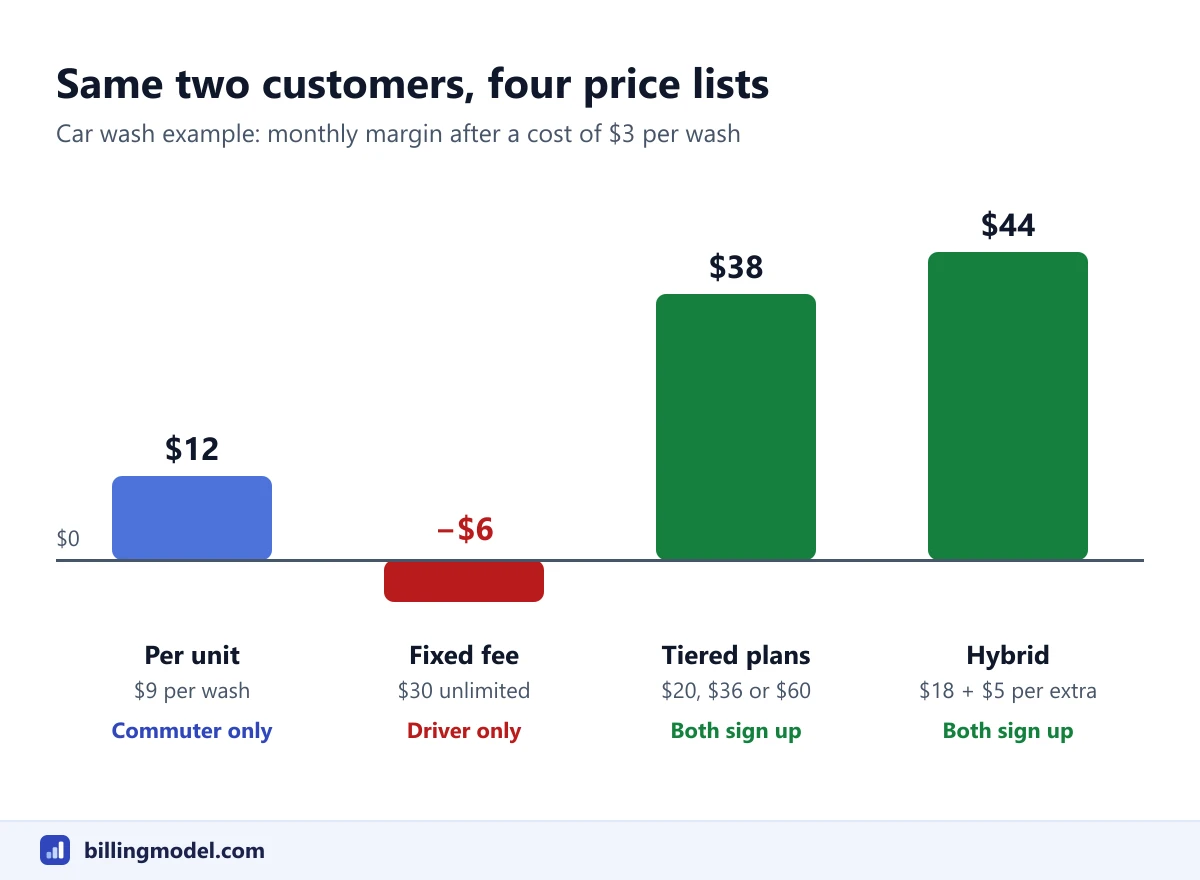 Monthly margin from the same two customers under four price lists. Only the tiered and hybrid lists sign up both.
Now run the three questions.
Value. The driver gets more from the service than the commuter, but not six times more. A pure per-unit price charges $108 against a limit of $70, so the driver never joins.
Cost. The fixed fee does the reverse. At $30 it is too expensive for the commuter and a bargain for the driver, so it signs up exactly the customer who costs $36 to serve. Each driver loses the business $6 a month.
Predictability. The tiered and hybrid lists both win both customers. The hybrid earns $6 more, but the driver's bill moves: 10 washes cost $18 + (8 × $5) = $58, and 14 cost $18 + (12 × $5) = $78, which is over the $70 limit. The Max plan is $60 every month.
The tiered list is the safer choice here, and it is no accident that it charges the driver $5 a wash, between the $2.50 of the unlimited plan and the $9 per-unit price. If the heaviest users turn out to wash 25 times a month, the cap of 15 on Max does the work a meter would have done.
The choices layered on top
The model is the skeleton. Five further settings change what a customer pays in the first year.
| Setting | The options | An example from the sources |
|---|---|---|
| Billing interval | Monthly, quarterly, annual | The health clubs' annual contract cost ten times the monthly fee, paid upfront |
| Trial or free plan | A time-limited trial, or a permanent free tier | The FTC calls a trial that turns into a paid plan a free-to-pay conversion |
| Set-up fee | None, or a one-time charge at sign-up | Planet Fitness lists enrollment fees of $0 to $59 and a $49 annual fee |
| Minimum term | Cancel any time, or a commitment | Planet Fitness says some memberships carry a cancellation fee and that it offers a non-committal option |
| Discounts | For prepaying, for volume, for a promotion | Ten months' price for twelve months is a 16.7% discount |
Apply them to the car wash's Plus plan at $36 a month. Twelve months at list price is 12 × $36 = $432. With a $25 enrollment fee and the first month free, year one is $25 + (11 × $36) = $421. Sold as an annual plan at ten times the monthly price, it is $360 paid on day one.
The interval decision has its own trade-offs, worked through in annual billing. A set-up fee raises accounting questions about when it counts as revenue, covered in SaaS revenue recognition. And a trial that renews into a paid plan falls under consumer protection rules in the United States and other countries: the Federal Register notice in which the FTC describes free-to-pay conversions is summarized, with rules from other countries, in the guide to subscription billing. Have a lawyer check a trial or auto-renewal flow before launch.
Where subscription pricing goes wrong
- Selling unlimited because it is easy to explain. A fixed fee is the best deal for the people who will use the most. Check the margin on your heaviest users before you publish the price.
- Metering something the customer can't see. A per-unit price needs a count both sides trust. The EPA guide notes that a per-unit water rate requires metered service.
- Charging again for something already paid for. The Working Knowledge article describes BMW's 2022 announcement of an $18 monthly charge for heated front seats, which irked buyers who felt they had paid for the feature when they bought the car.
- Copying another company's model. Ofek's point in the same article is that no single model fits every business, and that the tiers that succeed are the ones matched to the needs of different customer segments.
Which kind of subscription business you run narrows the options before any of this starts. The article on subscription model examples sorts them into six types and shows how each one bills.
Frequently asked questions
What are the main subscription pricing models?
Fixed fee, per unit or per user, tiered plans, usage-based and hybrid. Freemium is sometimes listed as a sixth, but it describes a free entry plan, and the paid plans above it still use one of the five.
Which subscription pricing model is best?
None is best in general. The fit depends on what customers value, whether your costs rise with use, and how much bill predictability buyers want. In the car wash example, a tiered list beat both the fixed fee and the per-unit price.
What is a hybrid subscription pricing model?
A base fee that includes an allowance, plus a per-unit charge above it. The customer gets a known minimum bill and the seller is paid for heavy use. The internet provider in the Lambrecht and Skiera study sold two tariffs of this shape beside its flat rate.
Can I change my pricing model later?
Yes, but existing customers signed up under the old one. Decide whether they keep their current terms, and give clear notice of any change. Notice rules for recurring charges depend on the country and the payment method, so check them first.