SaaS revenue recognition is the set of rules that decides when a software subscription fee counts as revenue. Under both major frameworks, US GAAP (ASC 606) and IFRS (IFRS 15), the answer is the same: as the service is delivered. For a subscription that usually means evenly across the term, whenever the invoice is sent or paid.
Both standards reach that answer through one five-step model. The sections below walk a single contract through it.
Quick answer: Identify the contract, identify the separate promises in it, set the total price, split the price across the promises, and recognize each share as that promise is delivered. A 12-month subscription is typically recognized month by month, and cash collected ahead of delivery sits on the balance sheet as a liability until then.
Where the rules come from
There is no accounting rule written only for SaaS. A subscription business applies the general revenue standard, which exists in two near-identical versions.
In May 2014 the US Financial Accounting Standards Board (FASB) and the International Accounting Standards Board issued a common standard. The US version is Topic 606, created by the FASB's Accounting Standards Update 2014-09. The international version is IFRS 15, effective for annual periods beginning on or after January 1, 2018. In the United States, Topic 606 superseded the revenue requirements of Topic 605, which the article on ASC 605 covers.
The core principle is shared. A company recognizes revenue to show the transfer of promised goods or services to customers, in the amount it expects to be entitled to in exchange. The FASB's summary says the two boards reached the same conclusions on all requirements, with a few minor differences. One of them: both versions require that collection be probable, and that word carries a different meaning in each framework.
OpenStax's accounting textbook, published by Rice University, lists the same five steps and makes the basic point plainly: under accrual accounting, revenue is recorded as performance obligations are met, not when cash is collected.
The five-step model for SaaS revenue recognition
The example contract: on July 1, 2026 a customer signs a 12-month agreement for a software platform and a one-day training workshop. The company sells the subscription separately for $24,000 a year and the workshop separately for $6,000. Bought together, the price is $27,000, invoiced and paid in July. Access runs from July 1, 2026 to June 30, 2027, and the workshop takes place in July.
Step 1: Identify the contract
A contract is an agreement that creates enforceable rights and obligations. The standards list the conditions: the parties have approved it, each side's rights and the payment terms can be identified, the deal has commercial substance, and collection is probable. A signed order form with a fixed price and term will usually meet them.
Step 2: Identify the performance obligations
A performance obligation is a promise to transfer a good or service that is distinct. Two tests apply. The customer can benefit from the item on its own or with resources it can readily get, and the promise is separately identifiable from the others in the contract.
The standards also treat a series of distinct services that are substantially the same, and delivered in the same pattern, as one obligation. Twelve months of platform access fit that description, so the subscription is a single obligation. The workshop is sold separately and the software works without it, so assume it is distinct. That gives two obligations.
Step 3: Determine the transaction price
The transaction price is the amount the company expects to be entitled to, leaving out amounts collected for third parties such as some sales taxes. Here it is a fixed $27,000.
Step 4: Allocate the price
When a contract has more than one obligation, the price is split in proportion to standalone selling prices, meaning the price of each item sold separately.
| Obligation | Standalone price | Share | Allocated price |
|---|---|---|---|
| Subscription, 12 months | $24,000 | 80% | $21,600 |
| Training workshop | $6,000 | 20% | $5,400 |
| Total | $30,000 | 100% | $27,000 |
The $3,000 bundle discount lands on both items in proportion: $2,400 on the subscription and $600 on the workshop. The standards allow a discount to be assigned to only some of the obligations when there is observable evidence that it belongs there, under specific criteria.
Step 5: Recognize revenue as each obligation is satisfied
An obligation is satisfied over time when the customer receives and consumes the benefit as the company performs. The FASB's own illustration is a year of monthly payroll processing, which it treats as a single obligation satisfied over time. Where effort is spread evenly through the period, the standards say straight-line recognition may be appropriate. Accountants call this even spread ratable recognition.
For this contract:
- Subscription: $21,600 ÷ 12 = $1,800 a month, from July 2026 to June 2027.
- Workshop: $5,400 in July 2026, when it is delivered.
- July revenue: $1,800 + $5,400 = $7,200. Every later month: $1,800.
Published accounts describe the same pattern. CrowdStrike's annual report for the year ended January 31, 2025 states: "We recognize subscription revenue ratably over the term of the agreement". Workday's annual report for the year ended January 31, 2026 says subscription revenue is recognized over time as services are delivered, starting on the date the service is made available to the customer.
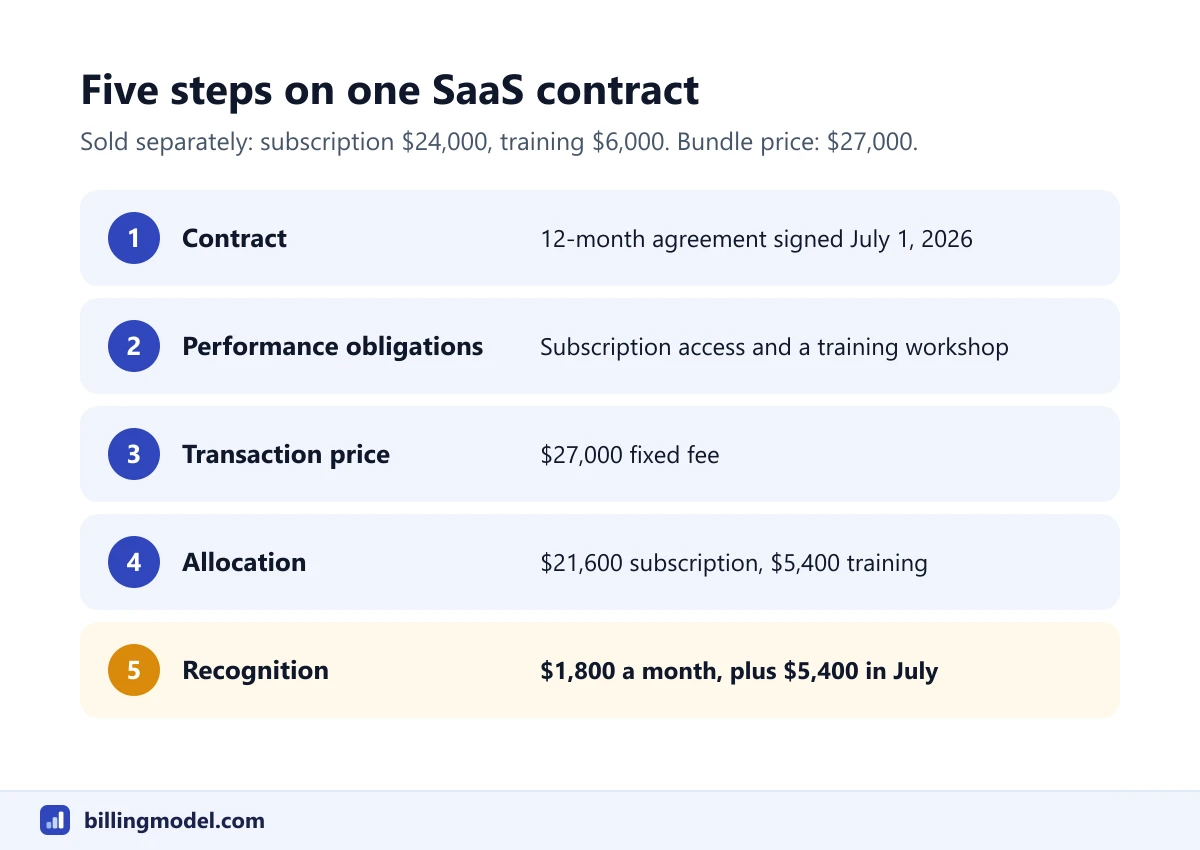 One contract, five steps: a $27,000 bundle becomes $1,800 of subscription revenue a month plus $5,400 for training in July.
The contract month by month: billing, cash and revenue
Billing, cash and revenue are three different events, and in this contract they fall in different months.
| Month | Invoiced | Cash received | Revenue recognized | Deferred revenue, month-end |
|---|---|---|---|---|
| July 2026 | $27,000 | $27,000 | $7,200 | $19,800 |
| August 2026 | $0 | $0 | $1,800 | $18,000 |
| September 2026 | $0 | $0 | $1,800 | $16,200 |
| October 2026 | $0 | $0 | $1,800 | $14,400 |
| November 2026 | $0 | $0 | $1,800 | $12,600 |
| December 2026 | $0 | $0 | $1,800 | $10,800 |
| January 2027 | $0 | $0 | $1,800 | $9,000 |
| February 2027 | $0 | $0 | $1,800 | $7,200 |
| March 2027 | $0 | $0 | $1,800 | $5,400 |
| April 2027 | $0 | $0 | $1,800 | $3,600 |
| May 2027 | $0 | $0 | $1,800 | $1,800 |
| June 2027 | $0 | $0 | $1,800 | $0 |
| Total | $27,000 | $27,000 | $27,000 |
All three columns end at $27,000. They get there on different schedules. The 2026 income statement shows $7,200 + (5 × $1,800) = $16,200 of revenue from this contract, and 2027 shows the remaining 6 × $1,800 = $10,800. On December 31, 2026 that $10,800 is still a liability.
If the customer had paid in August instead of July, the cash column would move and the revenue column would not. The entries behind the last column are set out in the guide to the deferred revenue journal entry.
Watch out: None of these columns is monthly recurring revenue. MRR is a management metric built from subscription prices. ASC 606 and IFRS 15 don't define it, and it shouldn't be used in place of recognized revenue in financial statements.
Set-up and implementation fees
A non-refundable set-up fee is not automatically revenue in the month it is charged. Both standards tell a company to ask first whether the fee relates to the transfer of a promised good or service.
Often it doesn't. Administrative tasks needed to set up a contract don't transfer a service to the customer, so they aren't a performance obligation. In that case the fee is treated as an advance payment for future services and recognized as those services are provided. The FASB's example is a one-year transaction processing contract with a small non-refundable set-up fee: the fee joins the transaction price and is recognized as the processing is delivered.
In numbers, a $1,200 set-up fee on a 12-month plan would add $100 a month to revenue, not $1,200 in month one. The standards add that the period can run past the initial term when a renewal option gives the customer a material right.
The other outcome is the one in the worked example. If the implementation work is a real service the customer could benefit from separately, it may be a distinct obligation with its own share of the price, recognized as the work is done. Which side of the line a given fee falls on is a judgment about the contract, and one to make with an accountant.
Usage-based fees and discounts
Fees that depend on consumption are variable consideration. The general rule is to estimate the variable amount and include it in the transaction price only to the extent that a significant reversal of revenue is unlikely later. ASC 606 sets that bar at "probable", and the text of IFRS 15 sets it at "highly probable".
Both standards also offer a practical shortcut. When the amount a company has the right to invoice corresponds directly with the value delivered so far (the FASB's example is a fixed fee for each hour of service), it may recognize revenue in the amount it has the right to invoice. For pay-as-you-go plans, that can line revenue up with each month's usage charge. Prepaid credits and minimum commitments take more analysis. The guide to usage-based pricing explains the pricing side.
Discounts reduce the transaction price, and step 4 spreads them. Free months work the same way. Take a 12-month committed contract at $1,000 a month with the first two months free. The price is $10,000, and with a time-based measure it would generally be recognized at $10,000 ÷ 12 = $833.33 a month for all 12 months, including the two the customer isn't billed for.
Where SaaS revenue recognition goes wrong
- Recognizing on the invoice date or the payment date. Neither is the test. Delivery is.
- Starting the clock at signing. Revenue starts when the service is made available, which can be later than the signature.
- Booking a set-up fee upfront without checking whether the set-up is a separate promise.
- Ignoring changes mid-term. Upgrades, added seats and extensions change the contract, and both standards have specific guidance on contract modifications.
- Assuming every contract is alike. Cancellation rights, refund terms and renewal options all affect the result. So does a software license the customer can run on its own systems, because the standards have separate guidance on licenses.
This article describes the general rules and isn't accounting advice. The treatment of a specific contract depends on its terms and on the framework you report under, so confirm it with a qualified accountant. For more worked cases, see the ASC 606 revenue recognition examples.
Frequently asked questions
When is SaaS revenue recognized?
As the service is delivered. For a subscription that gives continuous access, that is typically in equal amounts over the subscription term, starting when the customer can use the service.
Does an annual prepayment count as revenue when it is received?
No. The payment is recorded as a liability, often called deferred revenue or a contract liability, and moves to revenue month by month as the service is provided. In the example, $27,000 was collected in July and only $7,200 was revenue that month.
Is ASC 606 different from IFRS 15 for a SaaS company?
The two were written together and share the five-step model. The FASB's summary lists a few minor differences, including the meaning of "probable" in the collectibility test, interim disclosure requirements and rules on early application. The five steps are the same in both, and an accountant can tell you whether any of the differences matters for a particular contract.
Are set-up fees recognized upfront?
Only if the set-up is a distinct service delivered upfront. If it is an internal activity that transfers nothing to the customer, the standards treat the fee as an advance payment for the subscription and it is recognized over the period the service is provided.