Volume discount pricing lowers the price of every unit once the total quantity reaches a threshold. Buy 24 seats and each one costs $12. Buy 25 and all 25 cost $10 each.
Look at the totals and you'll see the oddity that sets this model apart: the bigger order is the cheaper one, $250 against $288. The price table below shows the arithmetic, where these cliffs sit, what sellers do about them, and why economists file quantity discounts under price discrimination.
Quick answer: In volume discount pricing, the whole quantity is charged at the unit price of the tier it falls in: total = quantity × that tier's price. With tiers of $12 (1 to 24 seats) and $10 (25 to 99 seats), 60 seats cost 60 × $10 = $600, and 25 seats ($250) cost less than 24 seats ($288).
What volume discount pricing means
A volume price list has quantity bands, each with a unit price, and one rule: find the band the total lands in and charge that price for everything. The cheaper rate reaches back to the first unit.
The names vary by field. Lecture slides from an MIT logistics course call it an all-units discount, one that applies to all units purchased if the total exceeds the break point quantity. The same slides set it against an incremental discount, which applies only to the quantity above the break point. Billing software has its own labels. Stripe's documentation on tiered pricing calls the first kind volume-based and the second graduated.
That is the whole difference between the two: volume tiers price every unit at one rate, while graduated tiers price each band at its own rate and add the bands up. The article on tiered pricing examples runs one table through both methods, so this one stays with volume.
The quantity being counted can be seats on a subscription, units in a single order, or usage added up over a billing period. The price list has to say which.
A worked volume price table
The numbers here are invented for illustration. Take a hypothetical team-chat tool sold per seat per month.
| Tier | Seats | Price per seat per month |
|---|---|---|
| 1 | 1 to 24 | $12.00 |
| 2 | 25 to 99 | $10.00 |
| 3 | 100 to 249 | $8.50 |
| 4 | 250 and up | $7.00 |
A customer wants 60 seats.
- Find the tier: 60 falls between 25 and 99, so tier 2 applies.
- Read off the unit price: $10.00.
- Multiply the whole quantity by it: 60 × $10.00 = $600 a month.
Nothing is charged at $12, although the first 24 seats sit inside tier 1's range. The same three steps give every row below.
| Seats | Tier | Unit price | Monthly total |
|---|---|---|---|
| 10 | 1 | $12.00 | $120.00 |
| 24 | 1 | $12.00 | $288.00 |
| 25 | 2 | $10.00 | $250.00 |
| 60 | 2 | $10.00 | $600.00 |
| 99 | 2 | $10.00 | $990.00 |
| 100 | 3 | $8.50 | $850.00 |
| 249 | 3 | $8.50 | $2,116.50 |
| 250 | 4 | $7.00 | $1,750.00 |
Read down the last column and the total drops three times: from $288.00 to $250.00, from $990.00 to $850.00 and from $2,116.50 to $1,750.00.
The cliff: where a bigger order costs less
A cliff is a threshold where the total falls as the quantity rises. Stripe's documentation says as much about its own volume mode: because the tier price applies to the entire quantity, the total might decrease.
Around the first threshold the totals run like this: 21 seats cost $252, 22 cost $264, 23 cost $276 and 24 cost $288. Then 25 seats cost $250 and 26 cost $260. Anyone who needs 21 to 24 seats pays less by taking 25.
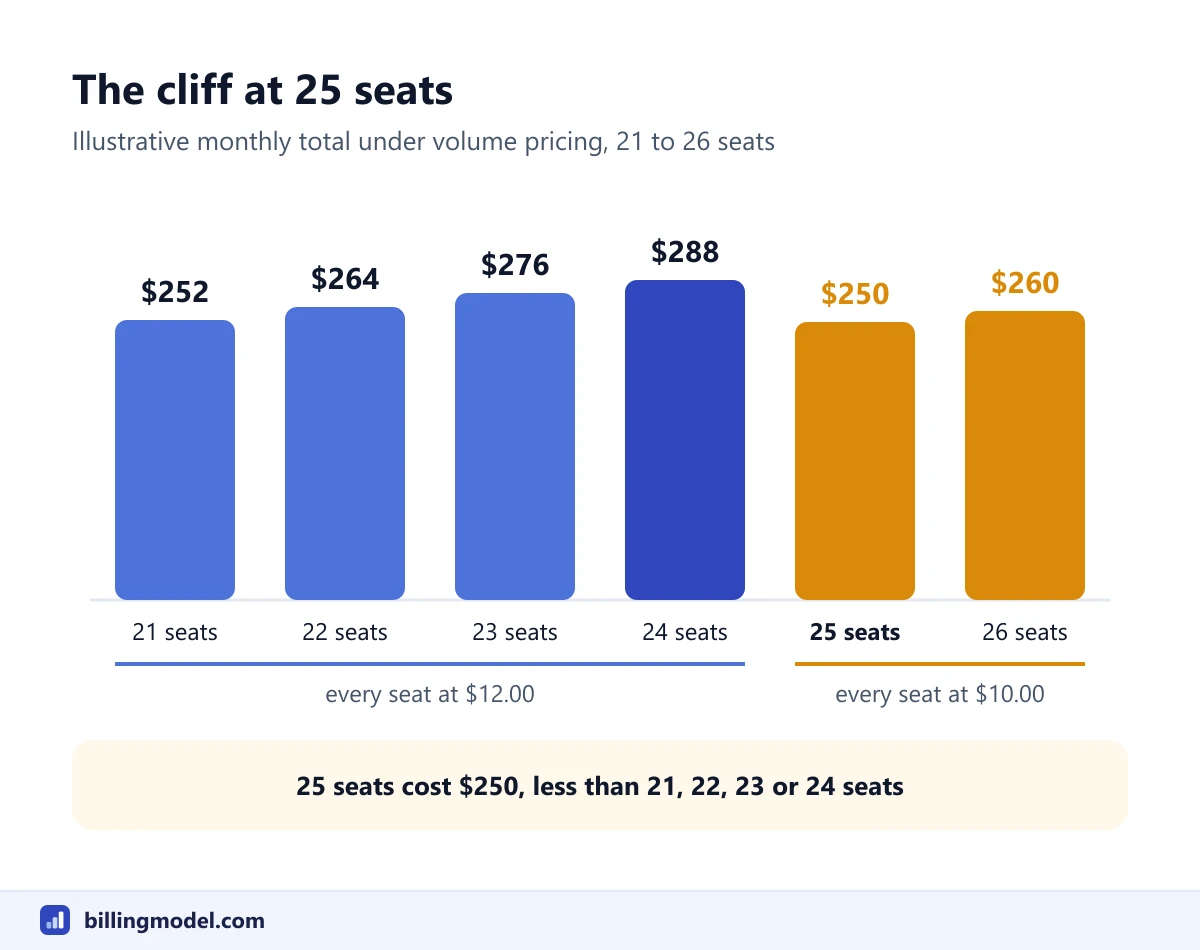 With the price falling from $12 to $10 at 25 seats, the order for 25 costs less than orders for 21, 22, 23 or 24.
You can find the start of each cliff zone without building the whole table. Multiply the threshold by the new price and divide by the old price. That is this article's arithmetic, not a rule from a textbook, and here is how it works out.
| Threshold | Total one seat below | Total at the threshold | Start of the zone | Seat counts that cost more than the threshold |
|---|---|---|---|---|
| 25 seats | 24 × $12.00 = $288.00 | 25 × $10.00 = $250.00 | 25 × $10.00 ÷ $12.00 = 20.8 | 21 to 24 |
| 100 seats | 99 × $10.00 = $990.00 | 100 × $8.50 = $850.00 | 100 × $8.50 ÷ $10.00 = 85 | 86 to 99 |
| 250 seats | 249 × $8.50 = $2,116.50 | 250 × $7.00 = $1,750.00 | 250 × $7.00 ÷ $8.50 = 205.9 | 206 to 249 |
At exactly 85 seats the bill is $850, the same as for 100, which is why the second zone starts at 86.
Watch out: In this table, 62 of the first 249 seat counts (4 + 14 + 44) sit inside a cliff zone. Check every threshold before you publish a volume table, because customers will.
How sellers handle the cliff
This article sorts the ways of dealing with a cliff into four. The grouping and the arithmetic behind each are its own, not a list from a textbook.
Leave it and quote the threshold. A buyer who asks for 22 seats is told that 25 cost $14 less ($264 − $250). Buyers of physical goods are taught to look for this: the MIT logistics slides give a procedure that compares the total cost of the buyer's preferred order size with the total cost at the break quantity and picks the lower one. For the seller, the trade is three more units delivered for $14 less. Where an unused unit costs almost nothing to provide, as with an empty software seat, that may be acceptable. Where every unit has to be made and shipped, it is expensive.
Narrow the price steps. The cliff disappears when the new price is at least the old price × (threshold − 1) ÷ threshold. At the 25-seat threshold that is $12.00 × 24 ÷ 25 = $11.52, a discount of 4%. At the 100-seat threshold it is $10.00 × 99 ÷ 100 = $9.90, a discount of 1%. A volume table with meaningful discounts will therefore always have cliffs. They come with the model.
Switch to graduated tiers. If the total must never fall, charge each band at its own rate. The 60-seat customer would pay 24 × $12.00 + 36 × $10.00 = $648 instead of $600.
Say what happens when the quantity drops. A customer on 25 seats who removes three moves back to tier 1, and the bill rises from $250 to 22 × $12.00 = $264. Returns raise the same problem for goods. Professor Catherine Tucker's MIT notes on non-linear pricing warn that customers may buy extra units to get the discount and then expect a refund at the average unit price for whatever they send back. The terms should state how the remaining quantity is priced.
Why sellers offer quantity discounts: the economics
Economists treat a quantity discount as second-degree price discrimination, meaning the seller offers a menu and buyers sort themselves. MIT economist Sara Ellison's lecture notes on price discrimination list three types: first degree, where each buyer's preferences are known; third degree, based on something observable such as student status; and second degree, which relies on self-selection because the seller can't see what each buyer would pay.
Volume tiers are one such menu. Recitation notes from an MIT Sloan economics course name volume discounts among the tools of consumer self-selection, next to access fees and peak pricing. Tucker's notes put the theory in one line: a quantity discount lets you serve high-valuation and low-valuation customers, because one group signals what it is by buying in bulk and the other by buying fewer units at a higher unit price.
Two other reasons sit beside that one.
Each extra unit is worth less to the buyer than the one before. A 2010 Knowledge at Wharton article on research by Raghuram Iyengar and Kamel Jedidi reports that, in their survey of 250 consumers, willingness to pay declined after the first rented DVD and fell steeply after the second. To sell the later units at all, the unit price has to come down.
Large orders can also cost less to serve. OpenStax's managerial accounting textbook notes that fixed costs stay fixed in total but fall per unit as volume rises. The US Federal Trade Commission makes a similar point about wholesale prices: a manufacturer may spend less per unit dealing with large-volume customers.
The scheme only works under conditions. The MIT Sloan notes list three for any price discrimination: the firm has market power, it can prevent resale, and it can tell groups of customers apart. Resale is the one that bites with quantity discounts. If a 250-seat buyer could pass seats on at $9, nobody would pay $12. Tucker's ideal product for a quantity discount is something like a banana, which is hard to hoard and hard to resell.
Legal and practical limits
Charging different buyers different prices can raise competition-law questions. In the United States, the FTC's guidance on the Robinson-Patman Act says a seller charging competing buyers different prices for the same commodity may be violating the Act. It also says price discriminations are generally lawful, particularly when they reflect the different costs of dealing with different buyers, and it gives volume discounts as an example of a cost-justified difference. According to the same page, the Act applies to commodities and not to services.
Other countries have their own rules. Whether a particular discount schedule is lawful depends on the facts and the jurisdiction, so treat this as background and ask a lawyer about your own price list.
The practical limits are simpler. A volume table is unclear unless it names the method, uses boundaries that don't overlap and states the period over which units are counted. Those three points are covered with examples in the tiered pricing article linked above.
When volume pricing fits
Volume tiers suit quantities the buyer chooses in advance, such as seats or units in an order. The buyer sees one unit price for everything, which is easy to quote and easy to check on an invoice.
They are a weaker fit for metered usage billed after the period. A customer can't aim for a threshold they only learn about on the invoice, and a bill that falls when usage rises is hard to explain. Graduated tiers avoid that, as the guide to usage-based pricing describes.
How big the discounts should be is a separate question from how they are calculated. That depends on what the product is worth to each size of customer, which the value-based pricing example works through, and the wider choice of structure is compared in SaaS pricing models.
Frequently asked questions
How do you calculate a volume discount price?
Find the tier that the total quantity falls in and multiply the whole quantity by that tier's unit price. In the example, 60 seats fall in the $10 tier, so the bill is $600. No part of the order is charged at the higher rate.
Why did my total go down when I ordered more?
Because crossing a threshold lowers the price of every unit, not only the extra ones. With a drop from $12 to $10 at 25 seats, the saving of $2 on each of the first 24 seats is larger than the cost of the 25th.
Does a volume discount apply to each order or to a whole year?
It depends on the seller's terms. A table can count the units in one order, in one billing period or across a contract. If a price list doesn't say, ask before comparing quotes.
Is volume discount pricing a form of price discrimination?
In the economic sense, yes. The MIT course notes cited above class quantity discounts as second-degree price discrimination, or consumer self-selection, because buyers choose their own price by choosing a quantity. That is an economic label, separate from the legal question of whether a given price difference is allowed.