Recurring charges are amounts a business collects from the same customer on a schedule, under one standing agreement, without asking for payment details or permission each time. A monthly plan fee, a gym membership and an insurance premium paid by card are all examples.
For the business, the convenience comes with two duties. The customer has to agree in advance, in a form you can produce later, and every charge has to be recognizable when it lands on a statement. Miss either one and the charge comes back as a dispute. The rules cited here are mostly US ones, and other countries have their own.
Quick answer: A recurring charge repeats at a regular interval under a single authorization. It can be fixed (the same amount each time) or variable (based on usage), and it differs from a one-time, or non-recurring, charge such as a setup fee. Before charging repeatedly, get the customer's recorded consent to the amount, the frequency and how to cancel, and use a statement name they will recognize.
What recurring charges are
Three things make a charge recurring: the same customer, a regular interval and one agreement that covers every future payment.
Visa's dispute guide for merchants (June 2024 edition) defines a recurring transaction along those lines. It is one of a series of transactions that use a stored payment credential, are processed at fixed, regular intervals no more than one year apart, and represent the cardholder's agreement that the merchant may initiate future transactions for goods or services provided at regular intervals.
The University of Michigan Treasurer's Office, in its merchant services policy for campus units that accept cards (issued in 2009, revised November 3, 2016), gives everyday examples: insurance premiums, subscriptions, membership fees and tuition.
A recurring charge is collected by the business from a stored card or a bank account. That separates it from a recurring invoice, which the customer pays themselves each period, and it is the payment side of subscription billing.
Fixed, variable and one-time charges
An account can carry three kinds of charge, and customers react differently to each.
| Fixed recurring | Variable recurring | One-time (non-recurring) | |
|---|---|---|---|
| Amount | The same every period | Changes with usage or with what was ordered | Charged once |
| Examples | Plan fee, membership, retainer | Metered usage, overage | Setup, installation, replacement equipment |
| What the customer agrees to | The amount and the frequency | How the amount is worked out, and a range if you offer one | The amount, listed separately |
| Risk | A forgotten renewal | A bill larger than expected | Being mistaken for the regular amount |
Some price lists show the split directly. The University of Iowa's IT department, for example, publishes a service price list with one column for the one-time charge and another for the monthly recurring charge. A standard wired network connection on existing cable is listed at $200 once and $21.00 a month (page last updated July 23, 2026, checked October 2026). In telecom and connectivity contracts the two columns have their own abbreviations, covered in the guide to the monthly recurring charge.
Variable amounts need more care than fixed ones because the customer can't check the figure against memory. If you bill on usage-based pricing, the agreement has to say how the amount is calculated, and the customer should see the figure before it is taken.
A worked example: four months on one account
A customer signs up on March 10, 2026 for a service with a $75.00 setup fee, a $40.00 monthly fee charged on the 10th, and usage billed a month in arrears.
| Charge date | Fixed recurring | Variable recurring | One-time | Total charged |
|---|---|---|---|---|
| March 10 | $40.00 | $75.00 | $115.00 | |
| April 10 | $40.00 | $12.60 | $52.60 | |
| May 10 | $40.00 | $0.00 | $40.00 | |
| June 10 | $40.00 | $31.25 | $71.25 | |
| Total | $160.00 | $43.85 | $75.00 | $278.85 |
Check the columns: 4 × $40.00 = $160.00, $12.60 + $31.25 = $43.85, and $160.00 + $43.85 + $75.00 = $278.85, the same as the four rows added together.
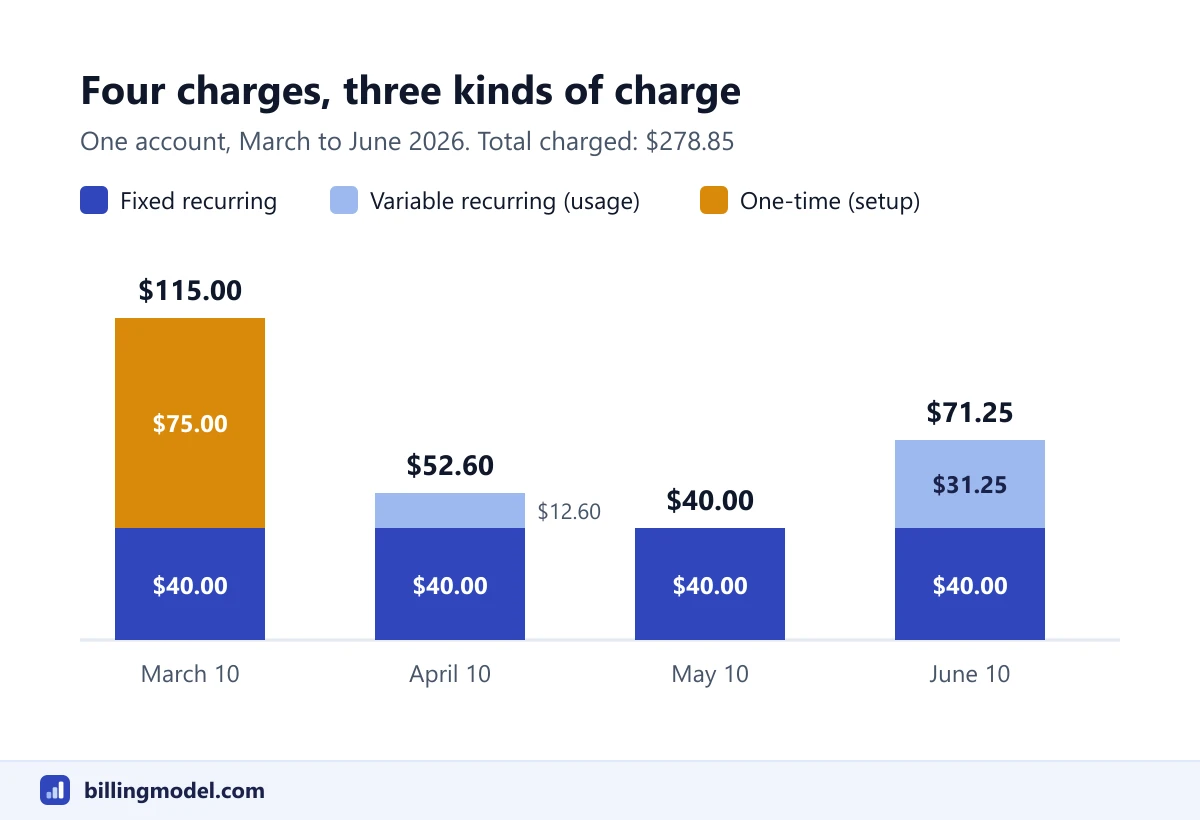 The fixed fee never moves, but no two totals are the same.
That is what the customer sees: four different amounts in four months, from a plan advertised at $40.00. Two things keep it from looking like an error. The receipt for each charge lists the parts separately, and the customer was told in advance what the variable part could be.
The second point is also a legal one for some payment methods. In the United States, Regulation E says that when a preauthorized transfer from a consumer's bank account will vary in amount from the previous transfer or from the preauthorized amount, the payee or the bank must send written notice of the amount and date at least 10 days before the scheduled date. It also lets the payee offer the consumer the option of notice only when a transfer falls outside a specified range. If this customer had agreed to a range of $40.00 to $90.00, the April, May and June debits would all fall inside it.
How recurring charges appear on a statement
The customer sees a recurring charge as one line: a merchant name, a date and an amount. The merchant name on that line is called the billing descriptor or statement descriptor.
Visa's guide is blunt about it. Cardholders must be able to look at their statements and recognize transactions from your business, and the guide tells merchants to check that the acquirer (the bank or processor that handles your card payments) has the correct "doing business as" name on file. Its suggested test is to buy something from yourself with your own card and read the statement.
The two statement lines below are made-up examples for the same $40.00 charge.
| Statement line | What the customer thinks |
|---|---|
| EC HOLDINGS LLC 4471 $40.00 | "I've never heard of this company." |
| EXAMPLECO* PRO PLAN $40.00 | "That's my monthly plan." |
The space is small. Stripe's documentation, as one example of how a processor handles it, says a complete statement descriptor must be between 5 and 22 characters and reflect the business's "doing business as" name, and that clear and accurate descriptors can reduce chargebacks and disputes (checked October 2026). Use the same name on receipts and reminder emails.
A recurring charge has a second recognition problem that a one-off purchase doesn't: time. The customer agreed months ago. Visa's policy for subscription merchants that offer free trials or introductory offers, a June 2019 notice for its regions outside Europe, requires an extra descriptor such as "trial" in the merchant name for the first charge after a free trial ends, so the line explains itself.
Authorization and disclosure before you charge repeatedly
Authorization is the customer's recorded agreement to be charged again without being asked each time. The guide to setting up recurring payments goes through it step by step. These are the main rules it cites, all checked again in October 2026.
- Bank debits in the United States. Regulation E says preauthorized transfers from a consumer's account may be authorized only by a writing signed or similarly authenticated by the consumer, and the business must give the consumer a copy. Nacha, whose rules govern ACH payments, says in an article on compliant authorizations that the authorization gives the customer information on how to revoke it directly with the business, and that the Nacha Rules don't prescribe a specific format.
- Cards. The Visa notice cited above restates an existing rule that the cardholder must expressly consent to an ongoing subscription at enrollment. A merchant that offers free trials or introductory offers that roll into a subscription must also send a copy of the terms, including the start date, the amount, the billing frequency and a simple way to cancel online.
- Online sales to US consumers. The Restore Online Shoppers' Confidence Act sets three conditions for charges that continue until the customer cancels: disclose all material terms before taking billing information, get express informed consent, and provide simple mechanisms to stop recurring charges.
The University of Michigan policy shows what this looks like as an internal rule. A campus merchant that wants to take recurring card payments needs an order form from the cardholder that states at least the amount, the frequency of the recurring charges and how long the permission lasts. For varying amounts the form must leave space for a minimum and a maximum, and the cardholder must be told of the right to written notice at least 10 days before each charge. The merchant keeps the form for as long as the charges continue.
Note: These are US federal rules, card network rules and one university's policy. The EU's SEPA Direct Debit, the UK's Bacs Direct Debit and national and state consumer laws have their own requirements. A lawyer should confirm what applies to your customers.
How unclear recurring charges become disputes
Visa's guide says recurring transactions are "particularly susceptible to cardholder disputes". It names the causes, and none of them is exotic.
For its "cancelled recurring transaction" dispute, the common causes it lists are that the cardholder withdrew permission to charge the account, that the cardholder or the bank closed the card account, or that the charge was processed after the merchant was told the account was closed. For fraud disputes on online and phone orders, the causes include an unclear or confusing merchant name that leads the cardholder to believe the transaction is fraudulent.
Visa's rules prohibit billing the card after a cancellation request, and say that if a balance is still owed the merchant must ask for another form of payment. Its advice is to act on cancellation and non-renewal requests promptly, check for them daily and confirm the closure to the customer in writing.
A dispute costs the sale and counts against the merchant's dispute ratio, before any fee. The guides to chargeback prevention and the chargeback fee cover the monitoring programs and the costs.
"What is this recurring charge on my statement?"
If you're the one looking at an unfamiliar line, these general steps apply. They are not specific to any bank or country.
- Read the whole line. Note the merchant name, the amount and the date. A billing name can be shortened or differ from the brand, so search for the name as printed.
- Check what you've signed up for. Look at your subscriptions, free trials and email receipts. The FTC's guide to subscriptions notes that a renewal can cost more than the last payment when a promotional rate has ended.
- Contact the merchant. If the charge is yours and you no longer want the service, cancel with the company and keep a record of the request. The Consumer Financial Protection Bureau points out that stopping a payment doesn't cancel what you owe under a contract.
- Contact your bank or card issuer. If you didn't agree to the charge and the company won't refund it, or you think your card details were stolen, tell the issuer promptly. For US credit cards, the CFPB says a written billing error notice must be sent within 60 calendar days after the charge appeared on the statement.
A charge you agreed to and forgot about isn't a billing error. The fix for that one is to cancel with the merchant.
Frequently asked questions
What is the difference between recurring and non-recurring charges?
A recurring charge repeats at a regular interval under one agreement, such as a monthly plan fee. A non-recurring charge is billed once, such as a setup or installation fee. Listing them on separate lines helps the customer see which amount will come back next month.
Can the amount of a recurring charge change?
Yes, if the agreement allows it and the customer is told. Variable charges change every period by design. A change to a fixed price calls for notice, and the guide to writing a price increase letter covers what to say and when.
How does a customer stop recurring charges?
The first route is to cancel with the business, using the method in its terms. In the United States, Regulation E also lets a consumer stop a preauthorized bank debit by notifying the bank at least three business days before the scheduled date. Other countries have their own rules.