A monthly recurring charge, or MRC, is the fixed amount a customer is billed every month for a service under contract. The term is used in telecom, and you'll find it in quotes and invoices for internet circuits, phone lines and managed services.
It is one of three kinds of charge on those bills. The other two are the non-recurring charge (NRC), billed once for work such as installation, and usage charges, which change with consumption. Knowing which is which explains why a first invoice is larger than the quoted monthly price, and how to add up what a contract will cost.
Quick answer: The monthly recurring charge (MRC) is the flat fee billed each month for as long as the service runs. A non-recurring charge (NRC) is a one-time fee such as installation, and usage charges vary with consumption. Committed contract value = MRC × number of months in the term + NRC.
What a monthly recurring charge is
The MRC is the price of having the service for a month, whether or not you use it heavily. It stays the same from one invoice to the next until the order changes.
Published definitions are short. AT&T's private line guidebook for North Carolina (pages effective September 1, 2019) says there are two types of rates and charges. Monthly rates are "recurring charges that apply each month or fraction thereof that a service is provided", and nonrecurring charges are "one-time charges that apply for a specific work activity".
Buyers define it the same way. A University of Missouri request for proposals for data circuits, issued in October 2020, defines the monthly recurring cost (MRC) as the recurring cost invoiced every month and the non-recurring cost (NRC) as any one-time cost needed to deliver the service. George Mason University's IT department tells staff who read its telecom bills that MRC stands for monthly recurring charges and "typically does not vary month-to-month".
Outside telecom the same idea goes by plainer names: a subscription fee, a plan price, a retainer. The guide to recurring charges covers the general case, including how such charges are authorized and how they appear on a customer's statement.
MRC vs NRC vs usage charges
A service contract can carry all three, and each behaves differently on the bill.
| MRC | NRC | Usage charges | |
|---|---|---|---|
| Stands for | Monthly recurring charge | Non-recurring charge | No standard abbreviation |
| What it pays for | Having the service for a month | One-time work to start or change it | What was consumed |
| Amount | Fixed by the order | Fixed by the order, billed once | Varies each month |
| Examples | Circuit, phone line, voicemail | Installation, adding a feature, moving a line | Call minutes, data above a committed level |
| Billed | Every month, in advance or in arrears as the contract says | Once | After the period in which it was used |
The AT&T guidebook names three types of nonrecurring charge: installation of service, installation of features and functions, and service rearrangements.
A university price list shows the first two side by side. The University of Iowa's IT department publishes a service price list with a "One-Time Charge" column and a "Monthly Recurring Charge" column. New telephone service on existing cable is listed at $150 plus the price of the phone set once, then $17.50 a month (page last updated July 23, 2026, checked October 2026).
For the third kind, GTT Communications' annual report for 2016, filed with the US Securities and Exchange Commission, describes usage revenue as variable revenue that depends on whether a customer exceeds its committed usage threshold, billed monthly in arrears. A commitment schedule that Bandwidth filed in 2019 puts all three in one definition: the charges that count toward the customer's minimum are the invoiced monthly recurring charges, non-recurring charges and per-transaction usage charges, with taxes and surcharges left out.
Regulators use the same split. The US Federal Communications Commission's pricing rule for network elements that incumbent local phone companies lease to competitors says recurring costs are recovered through recurring charges, with a narrow exception, and it lets state commissions have nonrecurring costs recovered through recurring charges over a reasonable period. A seller can make the same trade in a commercial quote: waive the installation fee and ask for a higher monthly charge or a longer term.
A worked first invoice
The numbers here are an illustration. A business orders a phone and internet service with an MRC of $930.00, an installation NRC of $500.00, long-distance calls at $0.05 a minute, and a 36-month term. The service is activated on March 12, 2026, and the provider bills on the 1st of each month, with the MRC in advance.
The first invoice is dated April 1, 2026, and has four lines.
- Installation (NRC). $500.00, billed once.
- MRC for the partial month. March 12 to March 31 is 20 days. The daily rate is $930.00 ÷ 31 = $30.00, so the charge is 20 × $30.00 = $600.00.
- MRC for April, in advance. One full month: $930.00.
- Usage for March, in arrears. 1,000 minutes × $0.05 = $50.00.
| Line | Period | Amount |
|---|---|---|
| Installation (NRC) | One-time | $500.00 |
| MRC, prorated | March 12 to 31, 2026 | $600.00 |
| MRC, in advance | April 1 to 30, 2026 | $930.00 |
| Usage, in arrears | March 12 to 31, 2026 | $50.00 |
| Total before taxes and surcharges | $2,080.00 |
$500.00 + $600.00 + $930.00 + $50.00 = $2,080.00. That is more than twice the quoted $930.00 a month, and nothing on it is an error. The May 1 invoice drops back to $930.00 plus April's usage.
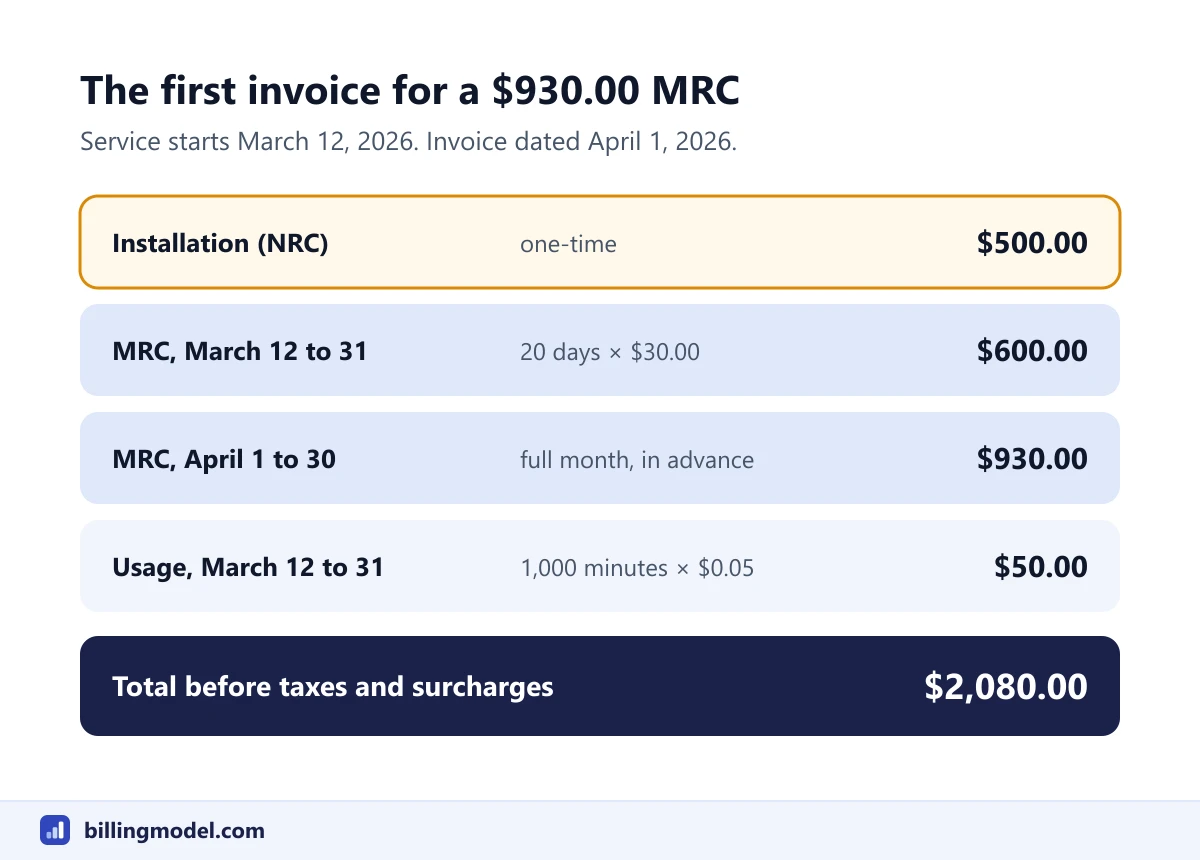 Why the first invoice is $2,080.00 when the quoted monthly recurring charge is $930.00.
Watch out: Proration depends on how a month is counted. This example divides by the 31 days in March. The AT&T guidebook quoted above treats every month as having thirty days for billing, which would make the daily rate $930.00 ÷ 30 = $31.00. Check which method your contract uses. The guide to the billing period explains proration and billing in advance.
Total contract value: MRC × term + NRC
The committed cost of a contract is the monthly recurring charge multiplied by the number of months in the term, plus the non-recurring charges.
Committed contract value = (MRC × months in term) + NRC
For the example: ($930.00 × 36) + $500.00 = $33,480.00 + $500.00 = $33,980.00. Usage, taxes and surcharges come on top and aren't known in advance.
The partial first month doesn't change the total. A 36-month term that starts on March 12, 2026 ends on March 11, 2029: $600.00 for the first 20 days, 35 full months at $930.00 = $32,550.00, and 11 days in March 2029 at $30.00 = $330.00. That adds up to $33,480.00 again.
The term matters because the MRC can depend on it. A Verizon service guide page for Ethernet access circuits quoted between September 1, 2005 and June 30, 2006 lists a Type 1 connection at 10 Mbps at $595.20 a month on a one-year commitment and $482.90 on a five-year commitment, with a $300 non-recurring charge either way. The rates are twenty years old and are shown only for the pattern.
| 1-year commitment | 5-year commitment | |
|---|---|---|
| MRC | $595.20 | $482.90 |
| NRC | $300.00 | $300.00 |
| MRC × months | 12 × $595.20 = $7,142.40 | 60 × $482.90 = $28,974.00 |
| Committed contract value | $7,442.40 | $29,274.00 |
The contract values are this article's arithmetic, not figures from the guide. The five-year MRC works out to $112.30 less per month, about 18.9% lower, in exchange for a commitment nearly four times as large. Compare quotes on both lines.
Two contract terms affect that total. Whether the price can change during the term: GTT's report says its prices were fixed for the duration of the contract, and the Missouri request required that prices not fluctuate during the term. And what it costs to leave early: the Missouri request asks each bidder to state its early termination cost for a circuit canceled before the end of its term.
MRC vs MRR
MRC is a line on one customer's contract. Monthly recurring revenue (MRR) is the seller's total of those lines across all customers on a given date.
GTT's report makes the link visible. It defines its MRR as contracted ongoing service that is generally fixed in price and paid by the customer on a monthly basis, and says this made up about 91% of its 2016 revenue. Its non-recurring revenue primarily consisted of installation and equipment charges collected earlier and spread over time, plus one-time termination charges.
In the worked example, the new customer adds $930.00 to the provider's MRR. The $500.00 NRC and the $50.00 of usage don't count, for the reasons set out in the guide to the monthly recurring revenue formula. MRR is an operating metric that no accounting standard defines.
Revenue in the accounts is a separate question. GTT's 2016 report says installation fees were first recorded as deferred revenue and then recognized ratably over the contractual term of the recurring service. How a specific contract is treated depends on its terms and on the standard that applies (ASC 606 under US GAAP, IFRS 15 under IFRS), so have a qualified accountant confirm it.
What to check on an MRC contract and bill
- The billing start date. Find out whether the MRC starts on the order date, the delivery date or an acceptance date. The contract should say.
- The first invoice. Expect the NRC, a partial month and a full month in advance together, and tell whoever approves the bill.
- The proration method. Actual days or a 30-day month, applied the same way to charges and credits.
- NRCs against the quote. A University of Missouri telephone policy (revised March 17, 2022) says estimates for recurring and non-recurring charges are provided on request. Ask for both in writing and compare them with the invoice.
- What sits outside the MRC. Usage, taxes, surcharges and equipment may be billed separately.
- Changes to the order. Adding or removing a line changes the MRC from that date and may create a new NRC and another prorated line.
Frequently asked questions
What does MRC stand for in billing?
Monthly recurring charge, or monthly recurring cost, as the University of Missouri's request words it. It is the fixed amount billed each month for a service, as opposed to one-time and usage-based amounts.
What is the difference between MRC and NRC?
The MRC repeats every month for as long as the service runs. The NRC is billed once, for work such as installation or a change to the service. A quote that lists both lets you work out the committed cost: MRC × months in the term + NRC.
Is the monthly recurring charge billed in advance?
It depends on the provider and the contract. GTT's 2016 annual report, for example, says the company typically billed monthly in advance, with usage in arrears. Missouri University of Science and Technology's IT department, by contrast, says on its billing statements page that from its April 2021 statement newly added recurring charges are processed a month at a time, with no advance billing.
Is MRC the same as MRR?
No. MRC is what one customer is charged each month under a contract. MRR is the seller's metric: the sum of recurring fees across all active customers, restated per month. One customer's MRC is part of the seller's MRR.
Does the MRC include taxes and fees?
Not necessarily. The MRC is the price of the service, and taxes, surcharges and usage can be added on the invoice. The Bandwidth schedule cited above, for example, lists taxes and surcharges apart from recurring, non-recurring and usage charges. Ask the provider for an estimate of the full monthly bill.