The payment term net 45 means the customer must pay the full invoice amount within 45 days. Unless the contract says otherwise, the count starts on the invoice date, so an invoice dated March 3, 2026 is due on April 17, 2026.
It is the same rule as net 30 with 15 more days. Those 15 days are days you fund the customer's purchase, so work out what they cost before you agree.
Quick answer: Net 45 means the full invoice amount is due 45 days after the invoice date, with no discount. An invoice dated March 3, 2026 is due April 17, 2026. Compared with net 30, the extra 15 days on a $10,000 invoice cost about $41 to finance at an example rate of 10% a year.
What net 45 payment terms mean
"Net" means the whole amount, with nothing taken off. OpenStax's Principles of Accounting explains the notation n/30 as "net of 30" days, the full payment period with no discount, and presents 30 as an example. Net 45 puts 45 in its place.
Buyers define it the same way. A Vanderbilt University finance notice dated December 2, 2019 says "Net 45 days" means the university will pay the invoice 45 days from the invoice date.
No interest runs during the wait unless you agreed some. OpenStax's Principles of Finance says there is usually no interest with trade credit, the name for selling now and collecting later.
Net 45 is American shorthand. For customers elsewhere, write "payment due within 45 days of the invoice date." The other common terms are compared in the overview of invoice payment terms.
How the net 45 due date is counted
Add 45 days to the invoice date. The day after the invoice date is day 1, and day 45 is the due date. This is the same counting rule as on a net 30 invoice, where OpenStax says the days begin counting from the invoice date.
| Invoice date | The count | Net 45 due date |
|---|---|---|
| March 3, 2026 | 28 days left in March + 17 in April | April 17, 2026 |
| January 15, 2026 | 16 days left in January + 28 in February + 1 in March | March 1, 2026 |
| June 15, 2026 | 15 days left in June + 30 in July | July 30, 2026 |
| December 10, 2026 | 21 days left in December + 24 in January | January 24, 2027 |
Month lengths matter. Net 45 is not "a month and a half": the January 15 invoice crosses a 28-day February and falls due on March 1, while the June 15 invoice runs to July 30.
Two of these dates land on a Sunday, March 1, 2026 and January 24, 2027. Whether a weekend due date moves to the next business day depends on your contract, as the net 30 article explains.
Watch out: The buyer may start the clock later than you do. The State of California counts from receipt of a properly submitted, undisputed invoice, and North Dakota State University counts from receipt of the invoice. Both are cited below. Ask which date applies before you send the first invoice.
Who uses net 45, and why
In the published examples below, net 45 is the buyer's term, written into its purchasing rules. All five were read in October 2026.
- Case Western Reserve University says its payment terms generally are Net 45 days from the date of invoice, with faster terms for small businesses.
- Vanderbilt University, in the 2019 notice above, tells staff to make sure its standard net 45 days appears in contracts, and not to sign terms such as "net 30" or "payment due upon receipt" without approval from the Controller or Chief Financial Officer.
- Rutgers University sets up new suppliers at net 45, paid by check. Bank transfer keeps net 45, adding e-invoicing moves the supplier to net 30, and its virtual card pays on invoice approval.
- The State of California makes payment due 45 calendar days after an agency receives a properly submitted, undisputed invoice, unless the contract says otherwise, under section 8474 of its State Administrative Manual (revised August 2023).
- North Dakota State University says that if no date is specified, payment should be made within 45 days after receipt of the invoice.
The reason is cash. OpenStax's chapter on working capital gives the cash cycle as the inventory conversion period plus the receivables collection period, minus the payables deferral period. It follows from that formula that every day a buyer adds to its payables shortens its own cash cycle by a day, and adds a day to the supplier's collection period.
Notice what the Rutgers and Case Western pages have in common. The 45 days is a default, and faster payment is available in exchange for something.
What the extra 15 days cost: a worked example
Net 45 costs the seller in two ways: more cash tied up, and the price of that cash.
Cash tied up. Average receivables equal daily credit sales times the days customers take to pay. A business invoicing $365,000 a year, or $1,000 a day, has $30,000 owed to it on net 30 and $45,000 on net 45 if everyone pays on the due date. Moving to net 45 means finding another $15,000. The OpenStax chapter makes the general point: a liberal credit policy requires more working capital.
The price of that cash. OpenStax names lines of credit and short-term bank loans among the ways a growing company covers the gap. Suppose yours costs 10% a year. That figure is an illustration chosen for easy arithmetic, not a quoted rate. On one $10,000 invoice:
- Net 30: $10,000 × 10% × 30 ÷ 365 = $82.19
- Net 45: $10,000 × 10% × 45 ÷ 365 = $123.29
- The extra 15 days: $123.29 − $82.19 = $41.10, which is 0.41% of the invoice
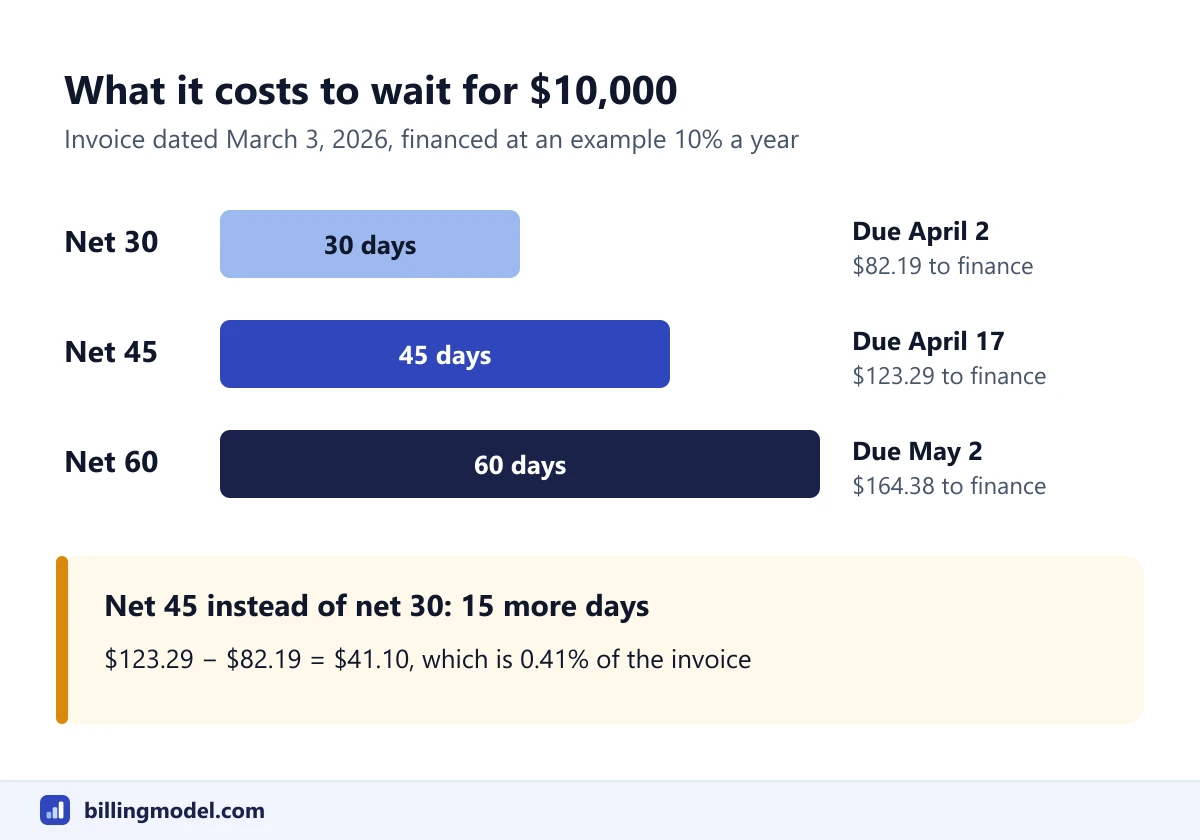 What it costs to wait for a $10,000 invoice at an example borrowing rate of 10% a year.
Across the year the same arithmetic gives $15,000 × 10% = $1,500 on $365,000 of sales.
For a real reference point, the Federal Reserve's H.15 release listed the bank prime loan rate at 7.00% on October 8, 2026 (checked October 2026), and describes prime as one of several base rates banks use to price short-term business loans. At 7.00% the extra 15 days cost $28.77 on the same invoice. Use the rate your own lender charges.
If you don't borrow, the cost is still there. It is whatever that $15,000 would otherwise have paid for.
Net 45 vs net 30 vs net 60
The table uses the same $10,000 invoice dated March 3, 2026, the same $1,000-a-day business and the same example rate of 10%.
| Net 30 | Net 45 | Net 60 | |
|---|---|---|---|
| Due date | April 2, 2026 | April 17, 2026 | May 2, 2026 |
| Cash tied up at $1,000 a day | $30,000 | $45,000 | $60,000 |
| Cost to finance the $10,000 invoice | $82.19 | $123.29 | $164.38 |
| Cost to finance a year of sales | $3,000 | $4,500 | $6,000 |
| Annual cost of a 2% discount for paying in 10 days | 36.73% | 20.99% | 14.69% |
The last row applies the OpenStax formula for the cost of skipping a cash discount: 360 ÷ (credit period − discount period) × discount ÷ (100 − discount). The 36.73% is the textbook's own figure for 2/10 net 30. The other two are this article's arithmetic with the same formula: 360 ÷ 35 × 2 ÷ 98 = 20.99%, and 360 ÷ 50 × 2 ÷ 98 = 14.69%.
How to negotiate net 45
Each option below shortens the wait or pays you for it.
Ask what earns faster payment. Rutgers moves suppliers to net 30 for using e-invoicing. Case Western offers faster terms to small businesses. The buyer's standard term may come with a published way around it.
Take a deposit. GOV.UK says a business can set its own payment terms, including payment upfront. With 30% upfront on the $10,000 invoice, only $7,000 waits 45 days: $7,000 × 10% × 45 ÷ 365 = $86.30, close to the $82.19 for the whole invoice on net 30.
Offer an early-payment discount, carefully. "2/10 net 45" costs you 20.99% a year by the formula above, about twice the example borrowing rate. A 1% discount for payment in 10 days works out to 360 ÷ 35 × 1 ÷ 99 = 10.39%, roughly break-even at 10%. The article on the early payment discount covers other structures.
Bill in stages. Two $5,000 invoices, one at the halfway point and one at completion, each still wait 45 days, but the first clock starts weeks sooner.
Price it in. At the example rate, the extra 15 days are worth 0.41% of the invoice.
Whatever you agree, get it in writing before work starts. Vanderbilt's notice says terms other than its standard need approval from the Controller or Chief Financial Officer, so the conversation has to happen before the contract is signed.
Where the law limits long payment terms
Some jurisdictions cap payment periods or make large buyers disclose them. Three official examples follow. None of them says what applies to your contract, which a lawyer should confirm.
European Union. Directive 2011/7/EU says the payment period fixed in a contract between businesses should not exceed 60 calendar days, unless a longer one is expressly agreed and is not grossly unfair to the creditor. Net 45 sits inside that limit. For public authorities the directive's period is 30 days, with up to 60 in limited cases.
United Kingdom. GOV.UK says an agreed payment date must usually be within 30 days for public authorities or 60 days for business transactions, and that a longer period must be fair to both businesses. Large buyers also have to show their record. The government's payment practices reporting guidance covers companies and LLPs that exceed at least two of three thresholds: £54 million turnover, £27 million balance sheet total and 250 employees (checked October 2026). They publish their standard and maximum payment periods, the average days taken to pay, and the share of payments made within 30 days, in 31 to 60 days and in 61 days or longer. That is disclosure, not a cap.
US federal government. The Treasury's Prompt Payment FAQs say a federal agency pays on the date in the contract or, failing that, 30 days after it receives a proper invoice. Under 5 CFR 1315.5, agencies may pay small businesses as soon as possible once the paperwork is complete. A procurement clause, FAR 52.232-40, then requires a contractor that receives such accelerated payments to pass them on to its small business subcontractors within 15 days of receiving them, to the maximum extent practicable, once the subcontractor has sent a proper invoice and the other required documentation. These rules cover federal contracts only.
Frequently asked questions
Is net 45 counted in calendar days or business days?
In the examples cited here, calendar days. California's manual counts 45 calendar days, and Case Western and Vanderbilt count 45 days from the invoice date. A contract can say otherwise, so check the wording.
Can a customer move me from net 30 to net 45?
Agreed payment terms are part of your contract, so check what it says about changes and ask a lawyer if a customer changes them without asking. In the UK, large businesses must report changes to their standard payment terms and whether suppliers were notified or consulted.
What happens when a net 45 invoice isn't paid?
It is past due on day 46. The first steps are in the article on a past due invoice. Whether you can add interest depends on your contract and local law, as explained in late fees on invoices.
Is net 45 better than net 60?
For the seller, yes. In the example above, net 60 ties up $15,000 more than net 45 at $1,000 of sales a day, and costs about $41 more to finance per $10,000 invoice at 10%.