Calculating interest on late payments takes three inputs: the overdue amount, an annual rate and the number of days the payment is late. Multiply them together, divide by the days in a year, and you have simple daily interest.
The arithmetic is short. The disagreements come from the details around it: which day the count starts, whether a year has 365 or 360 days, what a partial payment does to the balance, and when to round.
Quick answer: Late interest = overdue amount × annual rate × days late ÷ 365. An $8,000 invoice paid 75 days late at an illustrative 10% a year accrues $8,000 × 0.10 × 75 ÷ 365 = $164.38. Some rules divide by 360 instead, which gives $166.67.
Watch out: Every rate in this article is an illustration chosen to make the arithmetic easy to follow. None is a legal or recommended rate. Your contract and the law where you and your customer operate decide what you may charge, and a lawyer should confirm it.
The formula for calculating interest on late payments
Simple interest is charged on the amount owed and never on earlier interest. OpenStax's Contemporary Mathematics textbook gives the simple interest formula as I = P × r × t: the principal, times the annual rate as a decimal, times the time in years. For a period measured in days, it writes the time as days ÷ 365.
Applied to an invoice, that becomes:
Interest = overdue amount × annual rate × (days late ÷ 365)
Official calculations have the same shape. GOV.UK's worked example of statutory interest takes a £1,000 debt at 8.5%, finds £85 of interest a year, divides by 365 to get about 23p a day, and multiplies by 50 days late to reach £11.50. The US Treasury's simple daily interest formula for late federal payments is P(r/360 × d): the same three inputs with a 360-day year.
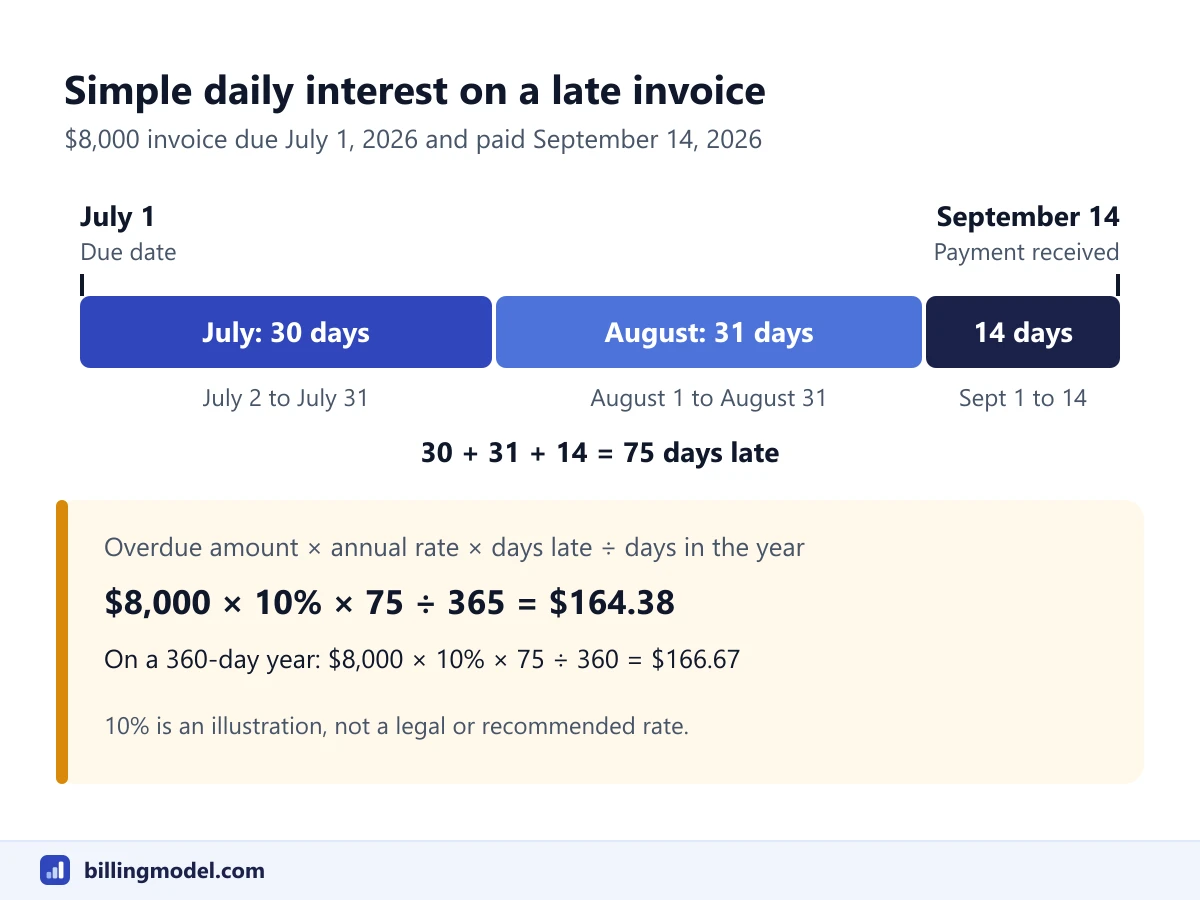 Example 1 in one picture: count the days late, then multiply the amount, the annual rate and the days, and divide by the days in the year.
Where the rate comes from is a separate question. The article on late fees on invoices covers the UK's statutory 8% plus the Bank of England base rate, the EU Late Payment Directive and the US federal Prompt Payment rate.
Step 1: count the days late
When calculating interest on late payments, start counting on the day after the due date and stop on the day the money arrives. That is the convention in two published rules. The US federal regulation at 5 CFR 1315.10 calculates interest from the day after the payment due date through the payment date, and EU Directive 2011/7/EU lets a creditor claim interest from the day following the due date. Your own clause should state its start and end points.
Take an $8,000 invoice dated June 1, 2026 on net 30 terms. It is due on July 1, 2026, and the customer pays on September 14, 2026.
| Month | Days counted | Days late |
|---|---|---|
| July | July 2 to July 31 | 30 |
| August | August 1 to August 31 | 31 |
| September | September 1 to September 14 | 14 |
| Total | 75 |
Step 2: choose the day-count, 365 or 360
The divisor changes the answer, so the clause has to name it.
Example 1: simple daily interest
Use the $8,000 invoice, 75 days late, at an illustrative 10% a year.
- 365-day year: $8,000 × 0.10 × 75 ÷ 365 = $164.38
- 360-day year: $8,000 × 0.10 × 75 ÷ 360 = $166.67
The 360-day year adds $2.29. OpenStax notes that banks have sometimes used 360 as the number of days in a year, and that the smaller denominator results in more interest. The gap is always the same proportion: 365 ÷ 360 = 1.0139, so about 1.4% more interest, whatever the rate.
Neither divisor is a mistake. GOV.UK's example divides by 365 and the US Treasury's formula divides by 360.
Monthly-rate clauses: 1.5% a month
A clause that reads "1.5% per month" is 18% a year as simple interest, because 1.5% × 12 = 18%. How it treats part of a month is a second question the wording has to answer.
Example 2: the same invoice at 1.5% a month
The 1.5% is an illustration, like every rate in this article.
- Converted to a daily rate: $8,000 × 0.18 × 75 ÷ 365 = $295.89
- Charged per full month: July 1 to September 1 is two full months, so $8,000 × 1.5% × 2 = $240.00. The other 13 days earn nothing unless the clause says part months count.
Compounding means adding unpaid interest to the balance so that it earns interest too. If the clause compounds monthly, the second month is charged on $8,120, and two months cost $8,000 × (1.015² − 1) = $241.80. That is $1.80 more than simple interest.
Over a full year the gap widens. Simple interest is $8,000 × 18% = $1,440.00. Compounded monthly it is $8,000 × (1.015¹² − 1) = $1,564.95, an effective 19.56% a year.
That is arithmetic, not permission. The EU directive defines statutory interest as simple interest. The US federal rule goes the other way and adds unpaid interest to the principal after each 30-day period. The Treasury's monthly compounding formula is P(1 + r/12)ⁿ × (1 + (r/360 × d)) − P, and its example of $1,500 due April 1 and paid June 15 at 6% comes to $18.83. Whether your contract may compound is a question for a lawyer.
Partial payments change the base
After a part payment, interest runs only on what is still unpaid. The EU directive says as much for instalments: interest is calculated solely on the overdue amounts.
Example 3: $5,000 paid on day 40
The customer pays $5,000 on August 10, 2026, which is 40 days late (30 in July plus 10 in August), and the rest on September 14, 35 days later. The rate is the illustrative 10% on a 365-day year.
Version A: the payment reduces the invoice amount.
- Days 1 to 40: $8,000 × 0.10 × 40 ÷ 365 = $87.67
- Days 41 to 75: $3,000 × 0.10 × 35 ÷ 365 = $28.77
- Total interest: $116.44, against $164.38 with no part payment
Version B: the payment covers accrued interest first. This is the order OpenStax's textbook uses for a partial payment on a simple interest loan: work out the interest up to the payment date, take it out of the payment, and apply the remainder to the balance.
- Interest to August 10: $87.67
- Applied to the balance: $5,000 − $87.67 = $4,912.33, leaving $3,087.67
- Next 35 days: $3,087.67 × 0.10 × 35 ÷ 365 = $29.61
- Total interest: $87.67 + $29.61 = $117.28
The two versions differ by 84 cents, the interest on the $87.67 of invoice balance that Version B leaves unpaid. Neither one charges interest on interest. Which order applies depends on your contract and local law.
Your terms should also say what the base includes. East Carolina University's past due accounts page calculates interest on the unpaid account balance, excluding any interest and late fees.
Interest plus a fixed fee
Some rules allow a fixed sum on top of interest. In the UK, GOV.UK says a business can charge interest and also claim a fixed sum for recovery costs of £40, £70 or £100, depending on the size of the debt, once per payment (checked October 2026).
Example 4: a £5,000 debt paid 60 days late
GOV.UK gives statutory interest as 8% plus the Bank of England base rate (checked October 2026). Its page points readers to the Bank's current and previous rates and does not say which date's rate to use. The Bank's Bank Rate page showed 3.75% when checked in October 2026. Using that figure as an illustration gives 11.75%.
- A year's interest: £5,000 × 11.75% = £587.50
- For 60 days: £587.50 ÷ 365 × 60 = £96.58
- Fixed sum for a debt of £1,000 to £9,999.99: £70
- Total: £96.58 + £70 = £166.58
This is this article's calculation, not GOV.UK's. Which base-rate figure applies to a particular debt, and whether statutory interest applies at all, is for a UK adviser to confirm. GOV.UK says it cannot be claimed where the contract sets a different rate.
A contractual flat fee works the same way in any currency. Example 1's $164.38 plus a $40 fee agreed in the contract is $204.38. Show the two on separate lines so the customer can check each one.
Rounding, and the four examples side by side
The last choice in calculating interest on late payments is when to round. Round once, at the end, because rounding the daily figure first moves the result.
Both official examples show the effect. GOV.UK rounds its daily amount to 23p and reaches £11.50 for 50 days. Carrying the unrounded £85 ÷ 365 through gives £11.64. The Treasury's example writes its 6.625% rate as .066 and gets $2.75 on $1,500 for 10 days. With .06625 the same formula gives $2.76. Both second figures are this article's arithmetic.
Direction matters too. OpenStax says interest paid to a lender is almost uniformly rounded up to the next cent. The examples here round to the nearest cent. Say in your terms which you use. The US federal rule also sets a floor: interest penalties of less than $1.00 need not be paid.
| Example | Method | Interest |
|---|---|---|
| 1 | $8,000, 75 days, 10% a year, 365-day year | $164.38 |
| 1 | The same on a 360-day year | $166.67 |
| 2 | 1.5% a month as 18% a year, daily, 365-day year | $295.89 |
| 2 | 1.5% for each of two full months, simple | $240.00 |
| 2 | Two full months, compounded monthly | $241.80 |
| 3 | $5,000 paid on day 40, taken off the invoice amount | $116.44 |
| 3 | $5,000 paid on day 40, applied to interest first | $117.28 |
| 4 | £5,000, 60 days, 11.75% a year, plus a £70 fixed sum | £166.58 |
How to show the interest on an invoice
Show the working, on a new document. GOV.UK's guidance is that if you decide to add interest to the amount owed, you should send a new invoice. The US federal rule requires a notice stating the amount of the interest penalty, the number of days late and the rate used. An interest invoice built on those three facts looks like this:
INTEREST INVOICE 2051-INT                   September 14, 2026

Original invoice 2051, dated June 1, 2026          $8,000.00
Due date: July 1, 2026
Paid in full: September 14, 2026 (75 days late)

Interest under clause [number] of our agreement
$8,000.00 × 10% a year × 75 days ÷ 365               $164.38

Amount now due                                       $164.38

Simple interest on a 365-day year, from the day after the
due date through the payment date, rounded to the nearest cent.
This layout is an example, not a standard. Adapt it to your agreement and have a lawyer review the clause behind it.
If the invoice is still unpaid, state the interest up to a named date and the daily amount after it. For Example 1 that is $8,000 × 0.10 ÷ 365 = $2.19 a day.
Tax on an interest line varies by country. The EU's Your Europe guidance on late payment says you charge interest on the gross amount of the debt, including VAT, but do not pay VAT on the interest. An accountant can confirm the treatment where you are.
Reminders come before an interest charge. The article on a past due invoice sets out that sequence, and the overview of invoice payment terms shows where a late-payment clause sits among the other terms.
Frequently asked questions
Is interest on a late payment simple or compound?
It depends on the contract and the governing law. The EU directive defines statutory interest as simple interest, while the US federal rule adds unpaid interest to the principal after each 30-day period. If your clause doesn't mention compounding, ask a lawyer how it would be read.
How do I work out interest for part of a month?
Convert the monthly rate to an annual one and count days. At an illustrative 1.5% a month, 13 days on $8,000 is $8,000 × 0.18 × 13 ÷ 365 = $51.29. A clause that charges for full months only, or for each part month, gives a different figure, so read the wording first.
Does a partial payment stop the interest?
No, it reduces the base. Interest keeps running on the unpaid remainder until it is cleared. In Example 3, a $5,000 payment on day 40 cut the total from $164.38 to $116.44.