A payment reminder template is a short message you reuse whenever an invoice is close to its due date or past it. A useful one states the invoice number, the amount, the due date and how to pay, so the customer can act without looking anything up.
Below are five templates, one for each stage from a few days before the due date to a final notice. They are illustrations written for this article, not a standard. Adapt them to your own terms, and have a lawyer review any final notice or any message that mentions legal action.
Quick answer: Send a short reminder a few days before the due date, on the due date, about a week late, at 30 days late, and a final notice at about 45 days. Every message carries the same facts: invoice number, amount, due date, how to pay and a contact. The tone gets firmer at each stage. The facts stay the same.
When to send each payment reminder
Each stage has one job, and the message should do that job and stop. The timings below are an illustration that follows the same stage logic as the follow-up sequence in the article on a past due invoice, which also places a second notice around day 15 and a phone call around day 30.
To make the dates concrete, take invoice 2087 for $3,250, dated August 15, 2026 on net 30 terms. Thirty days on, 16 in August and 14 in September, it is due on September 14, 2026.
| Stage | Timing | Date in the example | Goal |
|---|---|---|---|
| 1. Advance notice | 3 days before the due date | September 11 | Confirm the invoice arrived and is queued for payment |
| 2. Due date | Day 0 | September 14 | Prompt payment today |
| 3. First overdue reminder | 7 days late | September 21 | Catch an oversight |
| 4. Firm reminder | 30 days late | October 14 | Get a payment date in writing |
| 5. Final notice | 45 days late | October 29 | Set a deadline and name the next step |
The final notice in the example gives the customer until November 13, which is 60 days after the due date (16 days left in September, 31 in October and 13 in November).
Published procedures use their own clocks. The University of South Carolina's controller, for one, tells staff to begin contacting customers when invoices are outstanding 30 days and beyond. Starting earlier is a choice, and there is some evidence for reminding people before the date. A randomized trial with a micro lender in Uganda, reported in an NBER working paper by Cadena and Schoar, sent borrowers a monthly text reminder before each loan payment was due. The paper reports a 7 to 9% increase in the probability of paying on time for borrowers in its treatment groups, and says the effect was similar in size across the reminder and the trial's two financial incentives: a cash reward equivalent to a 25% cut in the interest rate on the current loan, and a 25% cut in the rate on the next loan. That study covers one micro lender's borrowers, not business invoices, so read it as a pointer and not as proof.
What every payment reminder template must carry
A reminder fails when the customer has to go and find something. Every message, from the first to the last, should contain:
- The invoice number. GOV.UK's list of what an invoice must include starts with a unique identification number. Quote it in the subject line.
- The amount outstanding, with the currency.
- The due date, and once it has passed, the number of days overdue.
- How to pay: bank details, a payment link, the methods you accept.
- A contact: a named person with a phone number or email address for questions and disputes.
- A copy of the invoice. South Carolina's three past due letters each enclose a statement and a copy of the invoice, and the later ones enclose the earlier letters too.
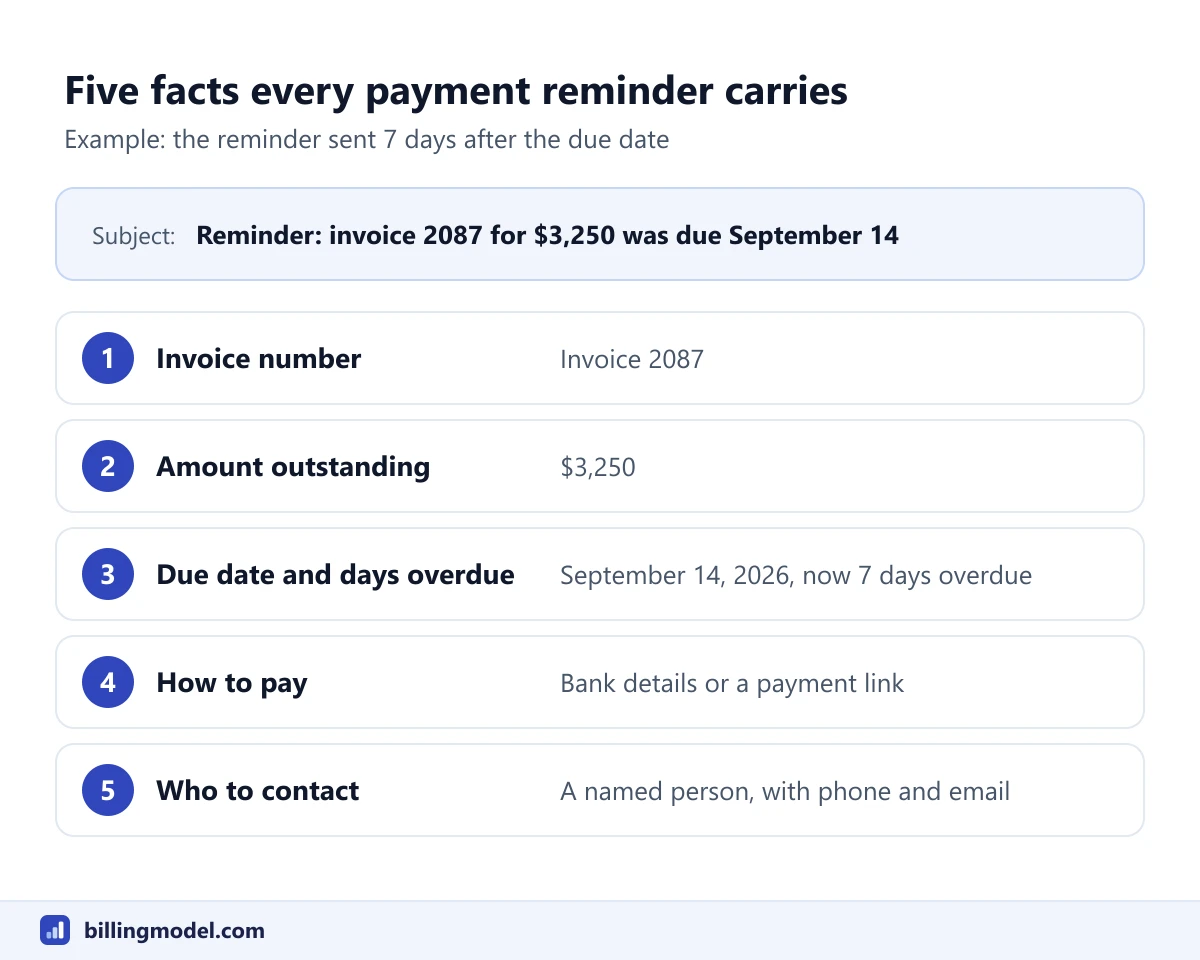 The same five facts appear in every reminder. Only the tone and the deadline change from stage to stage.
A payment reminder template for each stage
Replace the bracketed parts with your own details. These are examples to adapt, not standard wording.
1. A few days before the due date
Subject: Invoice [number] for [amount] is due on [due date]

Hi [Name],

A quick note that invoice [number] for [amount] is due on [due date].
A copy is attached in case the original didn't reach you.

Payment details: [bank details or payment link]

If anything on the invoice needs correcting before it can be paid,
tell me now and I'll fix it.

Thanks,
[Your name], [company], [phone]
2. On the due date
Subject: Invoice [number] for [amount] is due today

Hi [Name],

Invoice [number] for [amount] is due today, [due date].

You can pay by [method] using [bank details or payment link].
If the payment has already been sent, thank you. Nothing more
is needed.

Questions can come straight to me at [email or phone].

[Your name], [company]
3. About a week late
Subject: Reminder: invoice [number] for [amount] was due [due date]

Hi [Name],

Invoice [number] for [amount] was due on [due date] and is now
[number] days overdue. It may simply have been missed, so another
copy is attached.

Payment details: [bank details or payment link]

Could you tell me the date it will be paid? If there is a problem
with the invoice or the work, reply here and I'll look into it.

Thanks,
[Your name], [company], [phone]
4. Thirty days late
Subject: Invoice [number] is 30 days overdue: [amount] outstanding

Dear [Name],

Invoice [number] for [amount], due on [due date], is now 30 days
overdue. Reminders were sent on [dates]. Copies are attached.

Please pay the full amount by [date], or reply by then with the
date payment will be made.
Payment details: [bank details or payment link]

If you dispute any part of the invoice, tell me which part and why,
so that the rest can be paid in the meantime.

[Include only if your agreement allows it: Under clause [number]
of our agreement, interest applies to overdue amounts.]

Regards,
[Your name], [title], [company], [phone]
5. Final notice
Subject: Final notice: invoice [number], [amount], [number] days overdue

Dear [Name],

This is the final reminder for invoice [number] for [amount]. It
was due on [due date] and is now [number] days overdue. Reminders
were sent on [dates], and a copy of the invoice is attached.

Please pay the full amount by [deadline date].
Payment details: [bank details or payment link]

If neither payment nor a written proposal has arrived by that date,
we will [the step you have decided on and are entitled to take].

To discuss this, contact [name] on [phone] or at [email].

Regards,
[Your name], [title], [company]
Watch out: In the final notice, name only a step you are entitled to take and intend to take. The options, such as pausing service or using a collection agency, depend on your contract and local law, and they are set out in the past due invoice article.
Tone: why it gets firmer at each stage
Start by assuming a mistake. South Carolina's guidance says the first phone call should confirm that the customer received the invoice, because it may have gone to someone who never got it or who forgot to start the payment. An accusing first message is wrong for that customer and unnecessary for the others.
Firmness then rises in steps. The same guidance describes letters that increase in strength of message up to a final notice: a friendly reminder, a stronger second letter, and a third saying the account will be sent to collections if payment isn't received. The templates above follow that pattern. "Hi" becomes "Dear", a request for a date becomes a deadline, and only the last message mentions a consequence.
Don't stretch the gaps out of politeness. OpenStax's accounting textbook says that the longer a receivable goes unpaid, the lower the probability that it will be collected.
Use the person's name and a specific amount. In a UK trial run in 2012 with 5,450 people who owed court fines, described in J-PAL's summary of the evaluation, a text message raised the average amount paid from £4.46 to £10.94 compared with no text in the first phase, and in the second phase the version that addressed the recipient by name performed best. Small wording changes mattered in tax letters as well: an NBER paper by Hallsworth and co-authors, using data on more than 200,000 people in the UK, found that adding social norm and public goods messages to standard tax payment reminder letters considerably enhanced compliance.
Both studies concern individuals paying fines or tax, and the Uganda trial concerns a micro lender's borrowers. None is about companies paying suppliers. No study opened for this article tested reminder wording on business invoices.
What not to write in a reminder
Leave out anything you can't back up. Three kinds of wording cause trouble:
- Threats you don't intend or aren't entitled to carry out, such as legal action you haven't decided on.
- Shaming, such as copying in people who have nothing to do with the invoice or posting about the debt publicly.
- Anything misleading: a wrong amount, a fee or interest charge the customer never agreed to, or a letter dressed up to look like a court document.
Where the customer is a consumer, wording like this can also be regulated. In the United States, the Consumer Financial Protection Bureau's Regulation F is one example. Its section on harassing conduct bars debt collectors from threatening violence, using obscene or profane language, and publishing lists of people who allegedly refuse to pay. Its section on false or misleading representations covers falsely implying that a message comes from an attorney, misstating the character, amount or legal status of a debt, threatening action that cannot legally be taken or is not intended, and using documents that imitate legal process.
Regulation F has limits of its own. Its definitions restrict "debt" to a consumer's obligations from transactions that are primarily for personal, family or household purposes, and define a "debt collector" as a business whose principal purpose is collecting debts, or a person who regularly collects debts owed to another. A creditor collecting its own debts is included when it uses a name that suggests a third party is doing the collecting. State laws and other countries have their own rules, so ask a lawyer which apply to your reminders.
On charges, mention a late fee or interest only if your terms allow it. The articles on late fees on invoices and calculating interest on late payments cover that ground.
Text message and phone versions
A text has room for the facts and nothing else:
[Company]: invoice [number] for [amount] was due on [due date].
Pay here: [link]. Questions: [phone]. Reply STOP to opt out.
For a call, use the same order as the email: confirm the invoice arrived, ask who approves payment, ask whether anything is disputed, and agree a date. Then log the call and confirm the date by email.
Calls and texts to consumers have their own limits in some places. Under Regulation F, again as a US example for debt collectors, the rule on communications treats contact before 8:00 a.m. or after 9:00 p.m. at the consumer's location as inconvenient unless the collector knows otherwise, and requires emails and texts to include a clear and simple way to opt out. The harassment section presumes a violation when a collector calls about a debt more than seven times within seven consecutive days. Check the rules where your customers are before you set up automated texts.
Frequently asked questions
How many payment reminders should I send before a final notice?
No rule fixes the number. The sequence here uses four messages before the final notice, and the University of South Carolina's guidance uses two letters before its final one. Pick a number you can apply to every customer in the same way.
Should a payment reminder mention late fees?
Only if a late fee or interest is part of your agreed terms or applies by law where you operate. If it does, quote the clause and show the calculation. If it doesn't, leave it out, because a charge the customer never accepted may not be collectible.
What should a final notice say?
That it is the last reminder, what is owed, the deadline, and what you will do next. South Carolina's third letter, for example, says it is the final notice and that the account will be sent to collections if payment isn't received. Have a lawyer review yours before you send it.