The meaning of a pro forma invoice is a preliminary bill: a document laid out like an invoice that a seller sends before the goods ship or the work is done. It shows the buyer what the real invoice will say if the sale goes ahead.
It is not that real invoice. The US International Trade Administration calls a pro forma "a quote in an invoice format", and the UK tax authority's manual says it is normally not an accounting document. A final invoice still has to follow.
Quick answer: A pro forma invoice sets out the goods or services, prices, delivery terms and payment terms of a sale that has not happened yet. Buyers use it to apply for an import license, open a letter of credit or pay in advance. It does not replace the final invoice, and in the UK it is not a VAT invoice.
The meaning of a pro forma invoice in plain words
A pro forma invoice is an offer written in the layout of a bill.
The International Trade Administration's list of common export documents describes it as a negotiating tool between seller and buyer before an export shipment. The seller uses it to quote at the start of the transaction, and the document is the seller's declaration that it will provide the products at the stated date and price.
HMRC, the UK tax authority, starts from what an invoice is for. Its VAT Traders' Records Manual says the primary function of an invoice is to give formal confirmation of a specified supply of goods or services. A pro forma carries some or all of the same information but does not do that job. The manual adds that pro formas are often used to offer goods or services to customers the supplier doesn't know, or whose creditworthiness is doubtful, and that the document sets out what will be supplied if payment is made.
Two things follow from those descriptions:
- It doesn't bill for anything already delivered. It may ask for payment in advance, as a condition of going ahead.
- It normally stays out of the books. HMRC's manual says a pro forma is normally not an accounting document and does not belong in the books of account of the trader that issues it or the one that receives it.
What a pro forma invoice contains
A pro forma carries nearly everything the final invoice will. The International Trade Administration's page lists eleven items:
- Seller's name and address
- Buyer's name and address
- Buyer's reference
- Items quoted
- Prices of items, per unit and extended totals
- Weights and dimensions of the quoted products
- Discounts, if applicable
- Terms of sale or the Incoterm used, including the delivery point
- Terms of payment
- Estimated shipping date
- Validity date
Incoterms are the International Chamber of Commerce's rules for who arranges shipping, insurance, documents and customs clearance. The agency's Incoterms overview says sales contracts should refer to the Incoterms 2020 rules.
Add one thing the list leaves out: the words "Pro forma invoice" at the top. HMRC's manual says pro formas should always be clearly described as such, preferably with the endorsement "This is not a VAT invoice."
Watch out: Treat an issued pro forma as fixed. The International Trade Administration says the document informs the buyer and the import authorities about the future shipment, and that changes should not be made without the buyer's consent.
A filled-in pro forma invoice example
The seller and buyer below are made up, and the layout is an illustration, not a standard form. Adapt it to your own sale and have important documents reviewed by a professional.
| Field | Entry |
|---|---|
| Document title | PRO FORMA INVOICE (this is not a tax invoice) |
| Reference | PF-2027-018 |
| Date | March 4, 2027 |
| Seller | Example Instruments Inc., 200 Harbor Road, Example City, USA |
| Buyer | Sample Agri Supplies Ltd, 14 Canal Street, Sample Town |
| Buyer's reference | Request for quotation RFQ-552 |
| Item 1 | 40 handheld grain moisture meters × $180.00 = $7,200.00 |
| Item 2 | 40 carrying cases × $15.00 = $600.00 |
| Subtotal | $7,800.00 |
| Discount | 5% volume discount: −$390.00 |
| Goods total | $7,410.00 |
| Freight and insurance | $640.00 |
| Total | $8,050.00 |
| Weights and dimensions | 2 cartons, each 60 × 40 × 40 cm, 31 kg gross in total |
| Terms of sale | CIP Sample Town (Incoterms 2020) |
| Terms of payment | 30% deposit by wire transfer with the order. Balance due 30 days after the final invoice date |
| Estimated shipping date | Within 3 weeks of receiving the deposit |
| Validity | Prices valid until April 30, 2027 |
The arithmetic, step by step:
- Meters: 40 × $180 = $7,200. Cases: 40 × $15 = $600. Subtotal: $7,800.
- Discount: $7,800 × 5% = $390, leaving $7,410 for the goods.
- Add freight and insurance: $7,410 + $640 = $8,050.
- Deposit: $8,050 × 30% = $2,415. Balance: $8,050 − $2,415 = $5,635.
CIP stands for Carriage and Insurance Paid To, one of the Incoterms 2020 rules on the agency's list. The reference PF-2027-018 comes from its own series, so the pro forma doesn't use up a number in the invoice sequence. The article on an invoice number example explains why that matters.
Pro forma invoice vs quote vs commercial invoice vs final invoice
The four documents can show the same prices. What differs is when each one is issued and what it proves. In an export sale the commercial invoice is the final invoice, so the last two columns describe one document seen by two readers: customs and the buyer's accounts department.
| Quote | Pro forma invoice | Commercial invoice | Final invoice | |
|---|---|---|---|---|
| What it is | A price offer | A quote in invoice format | The seller's bill for exported goods | Formal confirmation of a specified supply |
| When it is issued | Before the deal | Before shipment or supply | For the shipment | When the supply is made or paid for |
| Confirms a completed sale | No | No | Yes | Yes |
| Role at customs | No stated role | Tells import authorities what is coming | One of the main documents customs use to determine duties | The same, when the sale crosses a border |
| UK VAT invoice | No | No | Not applicable | Yes, if it shows the required details |
The quote and pro forma columns overlap on purpose. The International Trade Administration says a pro forma contains much of the same information as a formal quotation and can be used in place of one.
How a pro forma invoice is used in international trade
A pro forma gives a foreign buyer paperwork to act on before any goods move. The International Trade Administration names four uses: the buyer may need it to apply for an import license, contract for pre-shipment inspection, open a letter of credit or arrange a transfer of hard currency.
Letters of credit. The agency describes a letter of credit as a commitment by the buyer's bank to pay once the exporter ships the goods and presents the required documents. Its page warns that document errors and discrepancies must be amended and resubmitted. It follows that the shipping documents should agree with what the pro forma promised.
Customs valuation. Customs authorities work from the commercial invoice. The agency calls it one of the main documents used by customs in determining duties, and says the pro forma "will eventually become the final commercial invoice" used when the goods are cleared in the importing country.
US imports without a commercial invoice. In US customs rules the term has a second, narrower meaning. Under 19 CFR 141.85, an importer who does not have the seller's commercial invoice can file its own pro forma invoice stating the value or price paid. Section 141.91 of the same regulations requires a bond of one and one-half times the invoice value, and the real invoice must generally be produced within 120 days of the entry filing. Other customs authorities have their own rules.
Advance payment. The agency's guide to methods of payment says that under cash-in-advance terms the exporter is paid before ownership of the goods is transferred, with wire transfers and credit cards the most common ways to pay. The guide to invoice payment terms compares cash in advance with open terms.
Can you pay against a pro forma invoice, and what happens next
Yes, if advance payment is what the two sides agreed. HMRC's manual describes the pro forma as the document against which payment is requested, and says that once payment is made the goods or services are supplied and a VAT invoice should be issued for accounting purposes.
Whether a particular buyer will pay one depends on its own policy. Two universities show the range:
- The University of Glasgow's accounts payable guidance says a pro forma received as a payment request is rejected and returned, and that suppliers must provide a valid VAT invoice. Its one exception covers spin-out companies paid through the university.
- The University of Houston's advance payment policy allows advance payment in listed circumstances and accepts a pro forma invoice as written proof that the vendor requires it.
In the example above, the buyer wires the 30% deposit of $2,415 on March 11, 2027. The goods ship on March 29, and the seller issues final invoice INV-2027-0112 the same day for $8,050, less the $2,415 already paid. The balance of $5,635 is due 30 days later, on April 28, 2027.
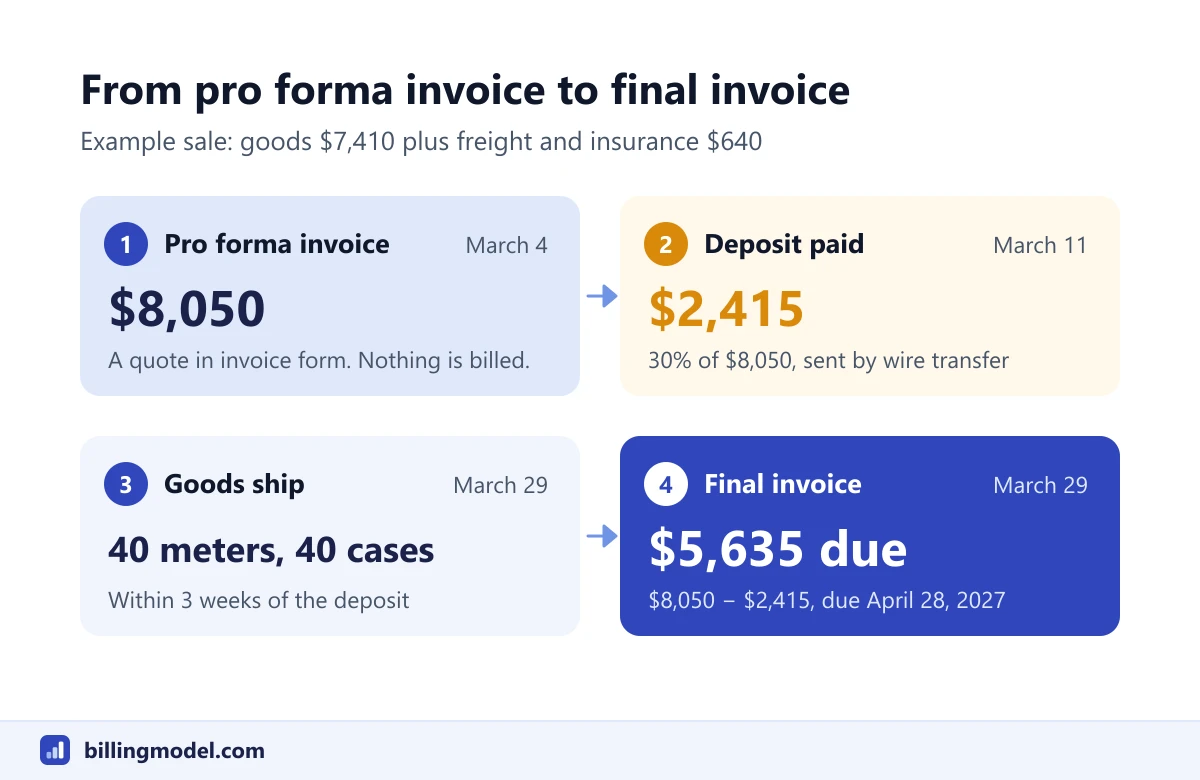 The example sale from pro forma invoice to final invoice.
Three points for the seller:
- The final invoice gets a real invoice number and a due date, as on any net 30 invoice.
- A deposit received before delivery is a separate accounting question. See the deferred revenue journal entry, and have an accountant confirm the treatment for your contract.
- A changed deal means a revised pro forma, agreed with the buyer. A wrong final invoice is corrected differently, with a credit note, as the credit memo example shows.
VAT treatment of a pro forma invoice: the UK example
Tax rules are local, so take this as one country's example. In the UK, paragraph 17.3 of HMRC's VAT guide (Notice 700) says a pro forma used to offer goods or services cannot be used as evidence to reclaim input tax, even if it shows all the details required for a VAT invoice. It tells suppliers to mark the document "this is not a VAT invoice."
The same paragraph says what happens afterward. If you go on to supply the goods or services, or you receive payment, you must issue a proper VAT invoice. HMRC's manual page on accounting for VAT with a pro forma puts the time limit at 30 days from that point.
Read against the example, that guidance points a VAT-registered UK seller that has taken a deposit toward a proper VAT invoice for it. Whether it applies to a particular sale, and an export in particular, is a question for an accountant. Other countries set their own invoice and tax rules, so ask which documents count where you and your customer are registered.
Frequently asked questions
What is the meaning of pro forma invoice in accounting?
Almost none. HMRC's manual says a pro forma is normally not an accounting document and has no place in the books of the business that issues or receives it. The sale is recorded from the final invoice, under your accounting framework and your accountant's guidance.
Is a pro forma invoice legally binding?
That depends on what the parties agreed and on the contract law that applies. The International Trade Administration describes it as the seller's declaration to provide the products at the specified date and price, and says changes need the buyer's consent. Ask a lawyer before you rely on one as a contract.
Can a pro forma invoice be used for customs?
It informs the import authorities about a future shipment, and a buyer may need it for an import license. For clearance, the agency names the commercial invoice as one of the main documents customs use to determine duties. US rules allow an importer's own pro forma as a temporary stand-in, backed by a bond, when the commercial invoice is missing.