"Payable upon receipt" on an invoice means the amount is due when the customer receives the invoice. There is no credit period. "Due on receipt" and "due upon receipt" say the same thing.
The phrase sets when the money is owed. It doesn't guarantee payment that day, because someone still has to open the invoice, approve it and send the funds, and a large customer may pay on its own schedule whatever your invoice says. The term works best with a printed date and an easy way to pay.
Quick answer: Payable upon receipt means payment is expected as soon as the invoice arrives, with no credit period such as the 30 days in net 30. It suits deposits, small jobs and new customers. Agree it before the work starts, print an actual date next to it, and include a payment link or bank details.
What payable upon receipt means
It is a payment term with a credit period of zero. Under "net" terms the customer gets a set number of days to pay the full amount. Here the customer gets none.
No source used for this article gives a formal definition. The OpenStax textbook sections on credit terms cited in the overview of invoice payment terms define net periods and discounts, and don't mention this term. Jean-Paul Olivier's open Business Math textbook uses "payment is due upon receipt" in an example about a dental bill, without defining it.
The nearest legal anchor is in US law on sales of goods. Section 2-310 of the Uniform Commercial Code, as published by Cornell's Legal Information Institute, says that unless the parties agree otherwise, payment is due at the time and place at which the buyer is to receive the goods. That rule is about receiving goods, not an invoice. Payment on receipt of an invoice is contract wording, and it means what your agreement says it means.
Organizations that bill on these terms describe them plainly. UC Berkeley's non-student billing guidelines say payment is due "immediately upon receipt of the invoice unless otherwise negotiated." New York Medical College's receivables policy says an invoice's due date "will normally be upon receipt."
How buyers treat payable upon receipt in practice
Published policies show a gap between "due now" and "paid now," on both sides of the invoice.
Sellers leave room themselves. Berkeley's guidelines make payment due immediately, yet say that in general an invoice is considered delinquent if it is not paid within 30 days of the date it was created. The University of Washington's receivables policy defines accounts as past due if not paid by the 30th day.
Buyers follow their own rules. Four examples, each read in October 2026:
- Indiana University says the payment terms in its supplier profile are followed "regardless of what is stated on the supplier's invoice," and that its standard terms are Net 30.
- Vanderbilt University, in a finance notice dated December 2, 2019, tells staff not to sign contracts with terms such as "payment due upon receipt" or "net 30" unless the Controller or Chief Financial Officer approves. Its standard is net 45 days.
- UCLA pays vendors net 30 from the date an invoice is submitted to Accounts Payable, and says departments cannot adjust payment terms. The same page publishes the submission date of the invoices the office is currently processing.
- US federal agencies pay on the date in the contract or 30 days after receiving a proper invoice, according to the Treasury's Prompt Payment FAQs.
Where nothing was agreed, the law may supply a period. In the UK, GOV.UK says that unless you agree a payment date, the customer must pay within 30 days of getting your invoice or the goods or service. If your invoice says "upon receipt" but the contract is silent, ask a lawyer which one governs.
Watch out: Printing "payable upon receipt" on the invoice may not change the terms a customer has already set up for you, as the Indiana University example shows. Ask a business customer what its payment terms are before you quote, and get any exception in writing.
When payable upon receipt suits
Immediate payment is ordinary for small firms. In the Federal Reserve Banks' 2024 Report on Payments, 38% of US small employer firms said payment in full at the time of service or purchase was the arrangement behind the largest share of their revenue, the most common answer. Another 28% said customers pay after delivery, for example by invoice. The figures come from 4,920 firms surveyed in fall 2023, and the report notes that the survey is not a random sample.
The term fits these situations:
- Deposits and upfront invoices. Work doesn't start until the money arrives, so there is nothing to extend credit on.
- New customers. You have no payment history to go on. Writing about export sales, the US International Trade Administration calls open account terms one of the highest-risk options for the exporter, and says cash in advance lets the exporter avoid credit risk.
- Small one-off jobs. Chasing a $150 invoice for 30 days can cost more effort than the job did.
- Sales to individuals. Olivier's textbook example is a bill for a dental visit.
It fits poorly where the buyer runs a payables process with fixed terms, as the university examples show. There the realistic choice is the buyer's standard term or a negotiated one. Customers who pay automatically by card or bank debit don't need an invoice term at all. That route is covered in setting up recurring payments.
Payable upon receipt wording examples
Pair the phrase with a date. "Upon receipt" alone leaves open when the invoice was received and when it becomes late.
On the invoice:
Invoice date:    June 1, 2026
Payment terms:   Payable upon receipt
Overdue after:   June 8, 2026
How to pay:      [payment link], or bank transfer to [account details]
                 quoting invoice 2031
In the contract, quote or order form, agreed before the work starts:
Payment terms. Each invoice is payable upon receipt. An invoice sent by
email is treated as received on the day it is sent. Amounts not received
within 7 days of the invoice date are overdue.
For a deposit:
Deposit: 30% of the quoted price ($1,200.00 of $4,000.00), payable upon
receipt of this invoice. Work is scheduled once the deposit is received.
These are illustrations written for this article. The 7 days and the 30% are examples, not standards. Adapt the wording to your agreement and have a lawyer review contract terms before you rely on them. More clause wording is in the invoice terms and conditions sample.
How to make payable upon receipt work
The term only helps if the customer can act on it at once.
- Agree it first. Terms that appear for the first time on an invoice may not bind the customer.
- Send the invoice promptly. An invoice that goes out two weeks after the job turns "upon receipt" into net 14. Berkeley's guidelines give its departments three business days to enter a billable transaction and say the system produces the invoice within five.
- Make paying a single step. Put a card or bank payment link on the invoice. The Federal Reserve report found that firms taking payment at the time of sale are more likely than other firms to accept cash and card payments. Card acceptance has a cost, set out in payment processing fees.
- Include what a payables team checks. Vanderbilt's notice lists the supplier's name and address, a unique invoice number, the invoice date, the purchase order number, a description and the amount, and says invoices missing items go back to the vendor.
- Follow up early. With no credit period, the first reminder can go out within days.
Due on receipt vs net 7, net 15 and net 30
The difference between these terms is how long your cash sits with the customer. Average receivables equal daily credit sales times the days customers take to pay, the working-capital relationship used in the overview article.
Take a business that invoices $365,000 a year, which is $1,000 a day, and one invoice dated June 1, 2026. The five-day row is an assumption for illustration: a customer who pays a few days after the invoice lands.
| Terms | Due date | Days to collect | Cash tied up at $1,000 a day |
|---|---|---|---|
| Payable upon receipt, paid by link the same day | June 1, 2026 | 0 | $0 |
| Payable upon receipt, paid after 5 days | June 1, 2026 | 5 | $1,000 × 5 = $5,000 |
| Net 7 | June 8, 2026 | 7 | $1,000 × 7 = $7,000 |
| Net 15 | June 16, 2026 | 15 | $1,000 × 15 = $15,000 |
| Net 30 | July 1, 2026 | 30 | $1,000 × 30 = $30,000 |
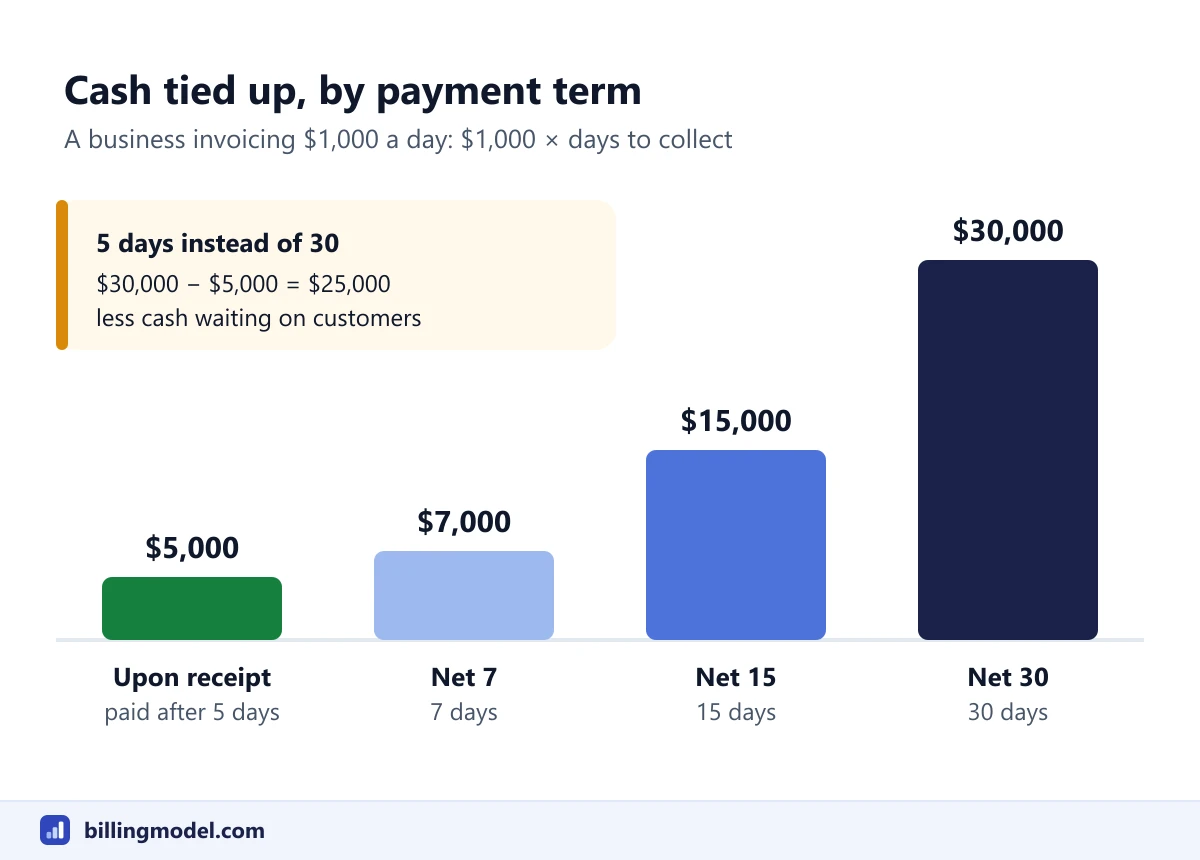 Cash tied up in unpaid invoices for a business invoicing $1,000 a day, by payment term.
Collecting in 5 days instead of 30 frees $30,000 − $5,000 = $25,000. If that cash would otherwise come from a credit line at 10% a year, an example rate and not a quoted one, the saving is $25,000 × 10% = $2,500 a year.
The table has a catch. If a customer on "payable upon receipt" pays on its own net 30 schedule anyway, you are back in the bottom row. What counts is the day the money arrives, and an accounts receivable aging report shows it.
What happens when it isn't paid
An invoice is past due the day after its due date. With "upon receipt" and nothing else, that day is open to argument, which is the reason for the printed date. In the wording above, the invoice dated June 1 is overdue from June 9.
From there the steps are the same as for any late invoice: a polite reminder, a firmer notice, a call. The sequence is laid out in the article on a past due invoice.
A late charge is a separate question. Whether you can add interest or a fee depends on what was agreed and on the law where you and the customer operate, and a lawyer should confirm it. The methods are explained in late fees on invoices.
Frequently asked questions
Is "payable upon receipt" the same as "due on receipt"?
Yes. Both mean payment is expected when the invoice arrives, with no credit period. "Due upon receipt" and "payment due immediately" are other versions of the same term.
How long does a customer have to pay an invoice that is payable upon receipt?
By its wording, no extra time. In practice the answer comes from the contract and the customer's process. Berkeley, for instance, bills on these terms and in general treats an invoice as delinquent after 30 days. State your own cutoff date on the invoice.
Is payable upon receipt the same as cash in advance?
No. Cash in advance means the buyer pays before you deliver. An invoice payable upon receipt asks for payment when the invoice arrives, and unless it is a deposit invoice, that is after you have delivered.
Does payable upon receipt work with large companies?
You can ask, but check their terms first. Vanderbilt's notice tells staff not to sign contracts with "payment due upon receipt" without senior approval, and Indiana University follows the terms in its supplier profile whatever the invoice says.