A credit memo is a document a seller issues to reduce the amount a customer owes on an invoice that has already been sent. This page gives a complete credit memo example with every field filled in, then shows the three ways the credit can be used and the entry that records it.
The name changes with the country. UK tax guidance calls the same document a credit note, and US regulations sometimes use the full form, credit memorandum. All three mean the same thing.
Quick answer: A credit memo says who issued it, who it is for, which invoice it corrects, what is being credited and why, and the amount including any tax. In the example below, a $1,100 invoice is reduced by a $220 credit memo, leaving $880 to pay. The credit can be set against the open invoice, refunded, or held against a future invoice.
What a credit memo is
A credit memo is the seller's written record that a billed amount has gone down. OpenStax's accounting textbook describes a retailer issuing a credit memo when a customer returns goods or is given an allowance. The memo acknowledges the change to the deal and, where the customer hasn't paid yet, the reduction in accounts receivable, which is the money customers owe on credit sales.
The document exists because a posted invoice shouldn't be quietly edited or deleted. Penn State's receivables procedure, for example, states that invoices cannot be edited once posted and that adjustments go through credit memos supported by documentation and approvals. The original invoice stays in the records, and the credit memo explains the difference.
When a credit memo is issued
A credit memo is issued whenever the customer should owe less than the invoice says. The usual cases:
| Situation | What happened | What is credited |
|---|---|---|
| Return | The customer sends goods back | The full price of the returned items |
| Allowance | The customer keeps faulty goods at a reduced price | Part of the price |
| Overbilling | The invoice has the wrong quantity, price or tax | The overcharged amount |
| Discount after invoicing | A discount is agreed or earned after the invoice went out | The discount |
| Cancelled service | Part of a billed service won't be delivered | The undelivered part |
| Overpayment | The customer paid more than was owed | The excess |
The first two rows follow OpenStax, which separates a sales return (the goods come back for a full refund) from a sales allowance (the customer keeps defective goods and gets part of the price back). The middle rows match HMRC's wording in the UK: a valid credit note reflects a genuine mistake, an overcharge or an agreed reduction in the value of what was supplied.
The last row is how the University of Tennessee's accounts receivable procedure uses the term. There, a credit memo arises when a customer overpays, and the resulting credit sits on the account to be applied to future invoices.
What a credit memo must contain
No single worldwide list exists, but tax rules often set a minimum. In the UK, paragraph 18.2.3 of HMRC's VAT guide (Notice 700) says a valid credit note must show:
- an identifying number and the date of issue
- the supplier's name, address and VAT registration number
- the customer's name and address
- a description of the goods or services being credited
- the quantity and amount for each description
- the total credited, excluding VAT
- the rate and amount of VAT credited
- the number and date of the original invoice
A US rule for one industry asks for much the same. Federal regulations for produce dealers, at 7 CFR § 46.21, require a credit memorandum to show the buyer's name, the sales ticket number, the lot number, the date and amount of the credit and the reasons for it, and to be approved by an authorized person. The rule covers only that trade, but the list is close to the UK one.
Two items are worth adding even where no rule asks for them: the reason for the credit, and how it will be settled. Your own country's tax rules may require more, so check them or ask your accountant.
A complete credit memo example
The seller and customer below are made up. The original invoice billed 25 software seats at $40 each, but the contract covered 20, so 5 seats were overbilled. Tax is shown at an illustrative 10%.
| Field | Entry |
|---|---|
| Document type | Credit memo |
| Credit memo number | CM-0117 |
| Date of issue | September 14, 2026 |
| Seller | Example Software Ltd, 12 Quay Street, Example City. Tax registration no. 000 1234 56 |
| Customer | Sample Dental Group, 48 Mill Road, Sample Town |
| Original invoice | INV-2041, dated September 1, 2026 |
| Reason for credit | Invoice billed 25 seats. The contract is for 20 seats |
| Description | Team plan, September 2026: seats billed in error |
| Quantity and unit price | 5 seats × $40.00 |
| Credit before tax | $200.00 |
| Tax credited (10%) | $20.00 |
| Total credit | $220.00 |
| Original invoice total | $1,100.00 |
| Invoice balance after credit | $880.00 |
| How the credit is settled | Applied to invoice INV-2041 |
| Approved by | Finance manager (name and signature) |
The arithmetic, step by step:
- Original invoice: 25 × $40 = $1,000, plus 10% tax of $100, total $1,100.
- Credit: 5 × $40 = $200, plus 10% tax of $20, total $220.
- Balance after credit: $1,100 − $220 = $880.
- Check against a correct invoice: 20 × $40 = $800, plus 10% tax of $80, total $880.
Treat this credit memo example as a starting point. Adapt the layout and wording to your own business and tax rules, and have your accountant review the template before you use it.
How a credit memo is applied
A credit memo can be settled in three ways, and the memo should say which one applies.
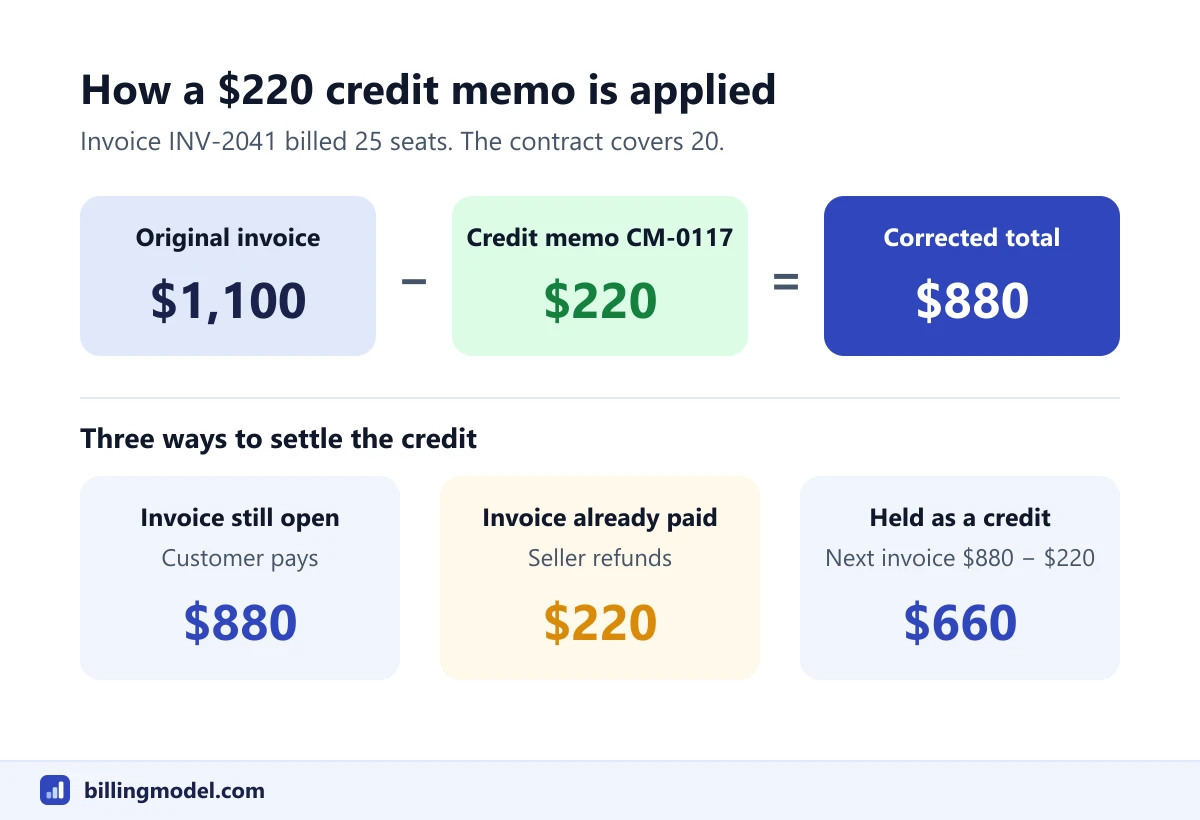 The example credit memo for $220 and the three ways it can be settled.
Against the open invoice. If the customer hasn't paid, the credit reduces the balance: $1,100 − $220 = $880, and the customer pays $880. The University of Connecticut's finance system documentation says a customer credit memo "can only be entered against an invoice with an outstanding balance."
As a refund. If the customer already paid the full $1,100, they have paid $220 too much and you can send it back. Georgia Tech's policy on credit memos and refund checks, written from the buyer's side, tells departments to ask for a refund check instead of a credit when the invoice has been paid and no more business with that vendor is expected.
Held as a credit. The $220 stays on the customer's account and reduces the next invoice. If next month's invoice is correct at 20 seats, it comes to $800 plus $80 tax, or $880. Less the $220 credit, the customer pays $660. This is the arrangement Tennessee's procedure describes, and Georgia Tech's policy notes that future invoice payments offset outstanding credit memos.
Credits that are never applied linger as negative balances on the accounts receivable aging report, so clear them. If the error came from a schedule, correct the recurring invoice as well, or the same overcharge will go out again next period.
The basic journal entry for a credit memo
The entry reverses part of the original sale. OpenStax's worked entries for sales returns and allowances debit Sales Returns and Allowances and credit Accounts Receivable when the customer bought on credit. When the customer has already paid and is refunded, the credit goes to Cash instead.
Sales Returns and Allowances is a contra revenue account. It carries a debit balance and is subtracted from gross sales to arrive at net sales.
For the credit memo example above, with invoice INV-2041 still unpaid:
| Account | Debit | Credit |
|---|---|---|
| Sales Returns and Allowances | $200 | |
| Sales tax payable | $20 | |
| Accounts Receivable | $220 |
The tax line is not in the OpenStax entries, which have no tax in them. It is there because tax you no longer charge is no longer owed to the tax authority. HMRC's guide makes the same point for the UK: a supplier that issues a credit note must adjust its record of output tax.
If physical goods come back into stock, OpenStax adds a second entry at cost: debit Merchandise Inventory, credit Cost of Goods Sold.
Some systems skip the contra account and reverse revenue directly. UConn's documentation says that once a credit memo is approved, the revenue recorded when the invoice was created is reversed. If the invoice was booked somewhere other than revenue, for example as deferred revenue on a prepaid subscription, the reversal has to follow the original entry. The deferred revenue journal entry article explains that account. The right treatment depends on your accounting framework and your facts, so have an accountant confirm it.
Credit memo vs refund vs debit note
| Credit memo | Refund | Debit note | |
|---|---|---|---|
| What it is | A document | A payment | A document |
| Effect on the amount billed | Reduces it | None | Increases it |
| Typical trigger | Return, overcharge, agreed reduction | The customer has paid more than the corrected total | Undercharge or agreed price increase |
| Does money move? | Not necessarily | Yes | Not by itself |
A refund is often the result of a credit memo, not an alternative to one. The memo records why the amount changed, and the refund returns the cash. HMRC's test for a valid credit note reflects this: the customer must be entitled to have the overcharge either refunded or offset against future supplies.
A debit note runs the other way. Under paragraph 18.2.4 of the same HMRC guide, a valid debit note reflects a genuine mistake, an undercharge or an agreed increase in the value of the supply. The term is not used consistently, though. OpenStax uses "debit memo" for the document tied to a purchase return or allowance, so ask which meaning the other party intends. The debit note article looks at the term more closely.
Approvals and common mistakes
Because a credit memo lowers revenue and receivables with one document, published procedures put controls around it. Penn State requires credit memo processing to follow segregation-of-duties rules and lists independent review of credit memos among its fraud-prevention controls. Tennessee sets approval by size: a business manager up to $5,000, the chief business officer from $5,000.01 to $50,000, and the system's chief financial officer above that. UConn's accounts receivable manager approves only when the supporting documents are attached, and departments are told that in an audit they must be able to show why a customer was credited.
Mistakes to avoid:
- Editing or deleting the original invoice instead of issuing a credit memo.
- Leaving off the original invoice number, so the credit can't be matched.
- Crediting the price and forgetting the tax on it.
- Not saying how the credit will be settled.
- Issuing it late. In the UK, HMRC's guide says a VAT credit note must be issued within 14 days of the refund payment being made to the customer. Deadlines elsewhere depend on local tax rules.
Frequently asked questions
Is a credit memo the same as a credit note?
Yes. "Credit memo" and "credit memorandum" appear in US textbooks and regulations, and "credit note" is the term in UK tax guidance. The document does the same job under each name: it reduces an amount already invoiced.
Is a credit memo a refund?
No. A credit memo is a document that lowers the amount billed, and a refund is money sent back. If the invoice is unpaid, a credit memo needs no refund at all.
Can you issue a credit memo after the invoice has been paid?
Yes. The credit then becomes money owed to the customer, settled by a refund or by reducing a later invoice. Some accounting systems only accept a credit memo against an invoice with an open balance.
Does a credit memo need its own number?
It should have one. HMRC's list for UK credit notes starts with an identifying number and a date of issue. A separate sequence with its own prefix, such as CM-0117, keeps credits from being mistaken for invoices. The invoice number example article covers numbering schemes.