A Visa chargeback is a card payment that the cardholder's bank sends back through Visa, which takes the money out of your account while the case is decided. Visa's own rules call it a dispute, and they set out who may act at each stage and how many days each side gets.
Knowing that process helps you read a dispute notice: its category, the evidence its condition accepts and how far the case can still go.
Quick answer: Visa sorts disputes into four categories (fraud, authorization, processing errors and consumer disputes) with numbered conditions from 10.1 to 13.9. Under the Visa rules dated April 18, 2026, the acquirer has 30 calendar days from the dispute's processing date to reply, each pre-arbitration step has 30 days and arbitration must be filed within 10. Your processor's own deadline is shorter, so follow that one.
What a Visa chargeback is, and why Visa calls it a dispute
The Visa Core Rules and Visa Product and Service Rules (April 18, 2026 edition, checked October 2026) define a dispute in eight words: "A Transaction that an Issuer returns to an Acquirer." The issuer is the cardholder's bank. The acquirer is the bank or processor behind your merchant account. Visa's dispute guide for merchants (June 2024) adds the part you feel: when a dispute is valid, the acquirer deducts the amount from the merchant's account and informs the merchant.
"Dispute" is the defined term in both documents. In a text search of the April 2026 rules done for this article, "chargeback" appeared only in the name of a screening service, the Chargeback Reduction Service.
The current structure comes from a project called Visa Claims Resolution. Visa's brief for merchants on that project, copyrighted 2017, says it would consolidate 22 legacy reason codes into four dispute categories and introduce two new processes.
You don't deal with Visa directly. The rules have issuers and acquirers process disputes through a Visa system called Visa Resolve Online (VROL), and your evidence reaches it through your acquirer or processor.
Network rules sit beside consumer law. Visa's rules tell issuers to give cardholders the protections that applicable law provides. In the United States, for example, Regulation Z requires a credit card issuer to resolve a billing-error notice within two complete billing cycles and no later than 90 days. Other countries have their own rules.
The four Visa dispute categories
Every dispute notice carries a condition number, and the digits before the decimal point give the category.
| Category | Conditions | What it covers |
|---|---|---|
| 10. Fraud | 10.1 to 10.5 | The cardholder denies authorizing or taking part in the transaction, in a card-present or card-absent sale |
| 11. Authorization | 11.1 to 11.3 | A required authorization was missing or declined. For transactions completed on or after April 13, 2024, late presentment also sits here |
| 12. Processing Errors | 12.2 to 12.7 | Wrong transaction code, currency, account number or amount, duplicate processing, invalid data. Condition 12.1 covered late presentment through April 12, 2024 and no longer has a section in the April 2026 rules |
| 13. Consumer Disputes | 13.1 to 13.9 | Goods or services not received, cancelled recurring transactions, items not as described, credits not processed |
The condition matters because each one accepts specific evidence. These are the responses Visa's merchant guide lists for five conditions that apply to online and subscription sales.
| Condition | The claim | Evidence the guide lists |
|---|---|---|
| 10.4 Other Fraud, Card-Absent | The cardholder didn't authorize an online, mail or phone order | That the payment was authenticated with Visa Secure, details of two earlier undisputed transactions that share identifiers with this one, or other compelling evidence |
| 13.1 Merchandise/Services Not Received | The order didn't arrive by the expected date | Documentation that the cardholder or an authorized person received it as agreed |
| 13.2 Cancelled Recurring Transaction | The cardholder withdrew permission to charge the account | Proof the cardholder used the service after the withdrawal date and before the dispute was processed |
| 13.6 Credit Not Processed | A promised credit never appeared | Documentation that no credit is due, or the amount and date of the credit already processed |
| 13.7 Cancelled Merchandise/Services | Goods were returned or services cancelled without a credit | Proof the return or cancellation policy was properly disclosed and agreed at the time of sale |
Two instructions repeat across the guide's conditions. If a credit or reversal was already processed, send its amount and date. If the cardholder's claim is valid, accept the dispute. The fraud rows are covered in more depth in the guide to chargeback fraud.
The Visa chargeback process: two paths and their time limits
The category decides which of two processes applies. Tables 11-1 and 11-2 of the Visa rules set the stages and the limits.
Fraud and authorization (categories 10 and 11). The 2017 brief said Visa would provide an automated dispute decision based on its rules, and that one cycle had been eliminated. There is no Dispute Response stage. The acquirer's first reply is a pre-arbitration attempt, due within 30 calendar days of the dispute processing date. The brief gives examples of the grounds: the cardholder no longer disputes the charge, compelling evidence, a credit already processed or an invalid dispute. The issuer then has 30 calendar days to respond, and the acquirer has 10 calendar days after that response to file for arbitration.
Processing errors and consumer disputes (categories 12 and 13). The acquirer may send a Dispute Response within 30 calendar days of the dispute processing date. The issuer has 30 calendar days from that response to make a pre-arbitration attempt, in which it must address the evidence. The acquirer has 30 calendar days to accept or decline, and the issuer then has 10 calendar days to file for arbitration.
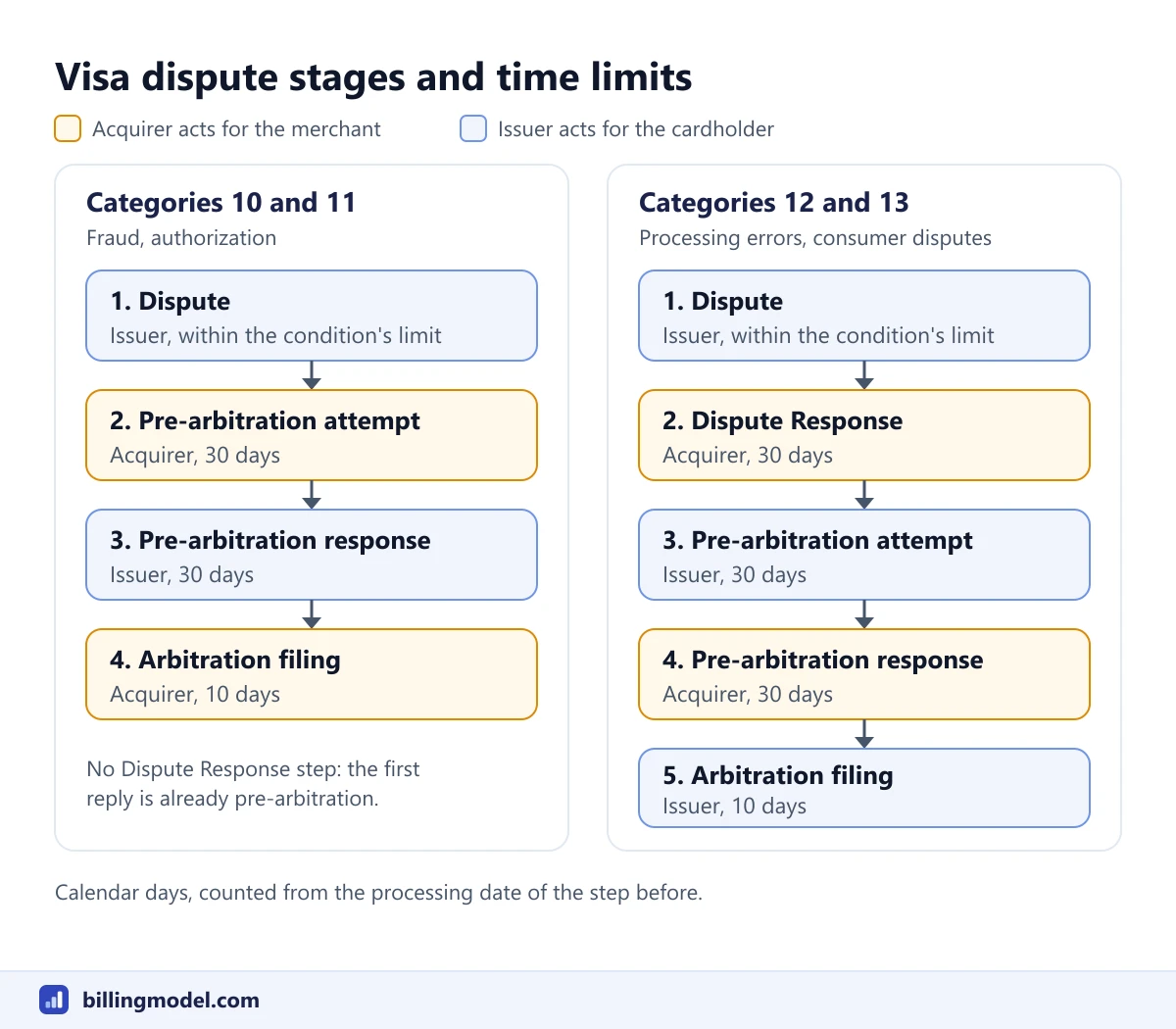 The two Visa dispute paths and the time limit for each stage, from the Visa rules dated April 18, 2026.
Three details from the same rules matter in practice:
- Counting. The processing date of the preceding event is not counted as a day.
- Silence. If a member doesn't respond through VROL within the time limit, the dispute cycle is closed and that member is responsible.
- Local exceptions. Some domestic markets have shorter limits. For a domestic transaction in Nigeria, the acquirer's limit is two business days.
The rules don't name the two paths. A 2023 Visa service sheet for issuers mentions "the Allocation and Collaboration flows within VROL" without defining them. The mapping used here comes from a processor's documentation: Qualpay's help center (last modified April 2, 2026) files fraud and authorization disputes under allocation and the other two categories under collaboration. The same page asks merchants to accept or respond within 16 days of the incoming dispute date.
The issuer's own window depends on the condition. For 10.4 and 13.2 it is 120 calendar days from the transaction processing date. For 13.7, the 120 days can run from the date the cardholder received or expected to receive the goods or services, up to 540 calendar days after the transaction processing date.
Watch out: The 30 days belong to your acquirer, not to you. Visa's guide says the response time on a request may vary by acquirer. Acquirers and processors set their own shorter deadlines inside Visa's limit, as the 16-day example shows, so follow the date on your processor's notice.
A worked timeline with dates
The case below is illustrative, and the dates are counted here from the limits in the rules. A subscription business charges a $240 annual renewal, processed on January 12, 2026. The customer says they cancelled, and the issuer files a dispute under condition 13.2.
| Event | Limit in Visa's rules | Date |
|---|---|---|
| Renewal processed | January 12, 2026 | |
| Last day for the issuer to dispute | 120 calendar days | May 12, 2026 |
| Dispute processed, $240 debited | March 3, 2026 | |
| Processor's deadline for your evidence | 16 days in this example | March 19, 2026 |
| Last day for the acquirer's Dispute Response | 30 calendar days | April 2, 2026 |
| Acquirer files the Dispute Response | March 20, 2026 | |
| Last day for the issuer's pre-arbitration attempt | 30 calendar days | April 19, 2026 |
| Issuer files pre-arbitration | April 10, 2026 | |
| Last day for the acquirer's response | 30 calendar days | May 10, 2026 |
| Acquirer declines | May 1, 2026 | |
| Last day for the issuer to file for arbitration | 10 calendar days | May 11, 2026 |
The only date you control is the first deadline, March 19. Everything after it is filed by the acquirer and the issuer.
The case can also end early. If the issuer had done nothing by April 19, the cycle would close with the issuer responsible, and the $240 would stay with the business.
Had the same dispute arrived under condition 10.4, the reply due by April 2 would instead be a pre-arbitration attempt.
Tools that work before a dispute is filed
Visa documents three tools that act before or early in a dispute. They are described here, not recommended.
- Rapid Dispute Resolution (RDR). The rules define it as a pre-dispute service that lets merchants automate the acceptance of liability for a disputed transaction. A Visa notice dated October 29, 2020 explains that the request reaches a participating seller before formal dispute processing, and that if the seller accepts liability the dispute process is avoided. It tells acquirers not to count RDR-resolved transactions as disputes or in the merchant's dispute ratio. The trade is plain: you give the money back.
- Order Insight. Visa's page on post-purchase tools for merchants says it shares order details with issuers, so that customers can be reassured an unfamiliar transaction is legitimate.
- Compelling Evidence 3.0. This is a rule for condition 10.4. Visa's merchant FAQ says it took effect for pre-arbitration attempts processed on or after April 15, 2023. Two earlier undisputed transactions, 120 to 365 days old and sharing at least two identifiers with the disputed one (one of them the device or the IP address), move liability to the issuer. The evidence can go in before a dispute through Order Insight or afterward through the acquirer. The April 2026 rules list an expansion effective October 24, 2026, which adds transactions at more than one merchant as evidence.
Where disputes meet Visa's monitoring program
According to Visa's VAMP fact sheet (2025 edition, checked October 2026), the Visa Acquirer Monitoring Program divides fraud reports plus disputes by settled transactions, counted on card-not-present payments. A merchant is classed as "Excessive" at 150 basis points (1.5%) or more in the US, Canada, the EU and Asia-Pacific. That threshold was 220 basis points until April 1, 2026. It applies with at least 1,500 fraud reports and disputes in the month, and other regions have different figures.
Disputes resolved through pre-dispute solutions are left out of the ratio, depending on timing. The fact sheet lists no such exclusion for disputes a merchant later wins. That is why chargeback prevention does more for the ratio than winning cases, and why each case still carries a chargeback fee.
Mastercard runs a different process with its own names and time frames, covered in the guide to the Mastercard chargeback.
Frequently asked questions
Is a Visa dispute the same as a chargeback?
Yes. "Dispute" is the term Visa's rules define, and "chargeback" is the everyday word for the same thing: a transaction that the issuer has returned to the acquirer.
How long does a merchant have to respond to a Visa dispute?
Visa's rules give the acquirer 30 calendar days from the dispute processing date. Your own deadline is whatever your processor sets inside those 30 days. The Qualpay example above is 16 days.
Can a merchant file for arbitration with Visa?
Not directly. Under the rules, the acquirer or the issuer files, depending on the category, and Visa then decides which of them is financially liable. Whether your processor will take a case that far is a question for your merchant agreement.
What happens if I miss the deadline?
The dispute stands. Under the rules, a member that doesn't respond within the time limit is responsible and the cycle is closed. Visa's merchant guide warns that a late response can lead to an unfavorable outcome.