The ASC 606 revenue recognition examples below take six contracts a software or service business might sign and run each one through the standard's five steps. Every case ends with a schedule or journal entries you can check with a calculator.
They are simplified illustrations written for this article, each tied to the paragraphs and the FASB illustrative example it follows.
Quick answer: Identify the contract, identify the performance obligations, set the transaction price, allocate it, and recognize revenue as each obligation is satisfied. In the cases here that gives $550 a month for a plan with a set-up fee, a 75/25 split of a $21,000 bundle, and $30 of revenue on a $200 marketplace sale.
How to read these ASC 606 revenue recognition examples
All six apply the five-step model in Topic 606, which the FASB created in Accounting Standards Update 2014-09. OpenStax's accounting textbook, published by Rice University, teaches the same five steps. The guide to SaaS revenue recognition explains each step on one contract, so here they are only named:
- Identify the contract with the customer.
- Identify the performance obligations, meaning the distinct promises in it.
- Determine the transaction price.
- Allocate the price to the obligations.
- Recognize revenue when, or as, each obligation is satisfied.
Paragraph numbers such as 606-10-55-51 are the ones printed in the 2014 update. The FASB has amended parts of the guidance since, so the current Codification text can differ from the paragraphs cited here.
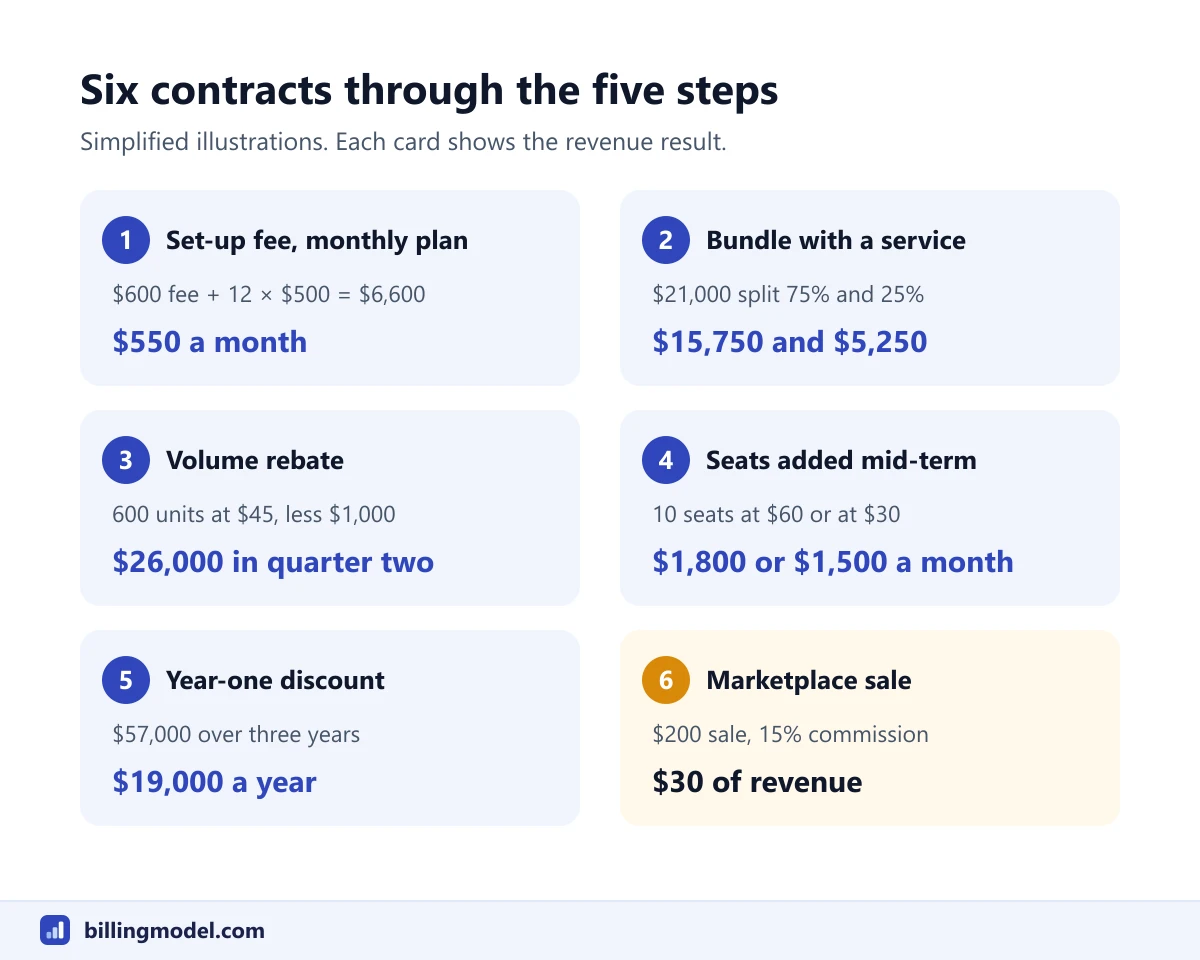 The six illustrations and the revenue figure each one produces.
Note: Real contracts turn on their specific terms: cancellation rights, refund clauses, renewal options, what the customer can use without you. These cases show the reasoning only, and a qualified accountant should confirm the treatment of an actual contract.
Examples 1 and 2: set-up fees and bundled services
Example 1: a monthly plan with a one-time set-up fee
Simplified illustration. On January 1, 2026 a customer signs a 12-month, non-cancelable agreement for software access at $500 a month, paid monthly, plus a non-refundable $600 set-up fee paid at signing. The set-up work is internal account configuration. The customer can renew at the same price without a new fee, and assume that option is not a material right.
- Contract: signed, with fixed payment terms. Assume the criteria in 606-10-25-1 are met.
- Obligations: one. Monthly access is a series of distinct services under 606-10-25-14(b). The set-up tasks transfer nothing to the customer, so under 606-10-25-17 they are not an obligation.
- Price: (12 × $500) + $600 = $6,600.
- Allocation: all of it to the single obligation.
- Recognition: over time on a time basis, $6,600 ÷ 12 = $550 a month.
| Date | Account | Debit | Credit |
|---|---|---|---|
| January 1 | Cash | $600 | |
| Contract liability | $600 | ||
| Each month-end | Cash | $500 | |
| Contract liability | $50 | ||
| Subscription revenue | $550 |
After 12 months the liability is $600 − (12 × $50) = $0 and revenue totals $6,600.
Paragraph 606-10-55-51 treats a fee like this as an advance payment for future services. The FASB's Example 53 has the same shape: a one-year transaction processing contract with a nominal non-refundable upfront fee and a renewal option the entity concludes is not a material right. A material right would stretch the recognition period past the initial term.
Example 2: a subscription sold with a distinct implementation service
Simplified illustration. A customer pays $21,000 on April 1, 2026 for a 12-month subscription and an implementation service completed that month. Sold separately, the subscription is $18,000 a year and the service $6,000. Other firms offer the same service, and it doesn't modify the software.
- Contract: a signed order with a fixed fee.
- Obligations: two. The customer can benefit from each item on its own, and the promises are separately identifiable. Those are the two tests in 606-10-25-19.
- Price: $21,000.
- Allocation: in proportion to standalone selling prices (606-10-32-31).
- Recognition: the subscription at $15,750 ÷ 12 = $1,312.50 a month, the service in April as the work is done.
| Obligation | Standalone price | Share | Allocated |
|---|---|---|---|
| Subscription | $18,000 | 75% | $15,750 |
| Implementation | $6,000 | 25% | $5,250 |
| Total | $24,000 | 100% | $21,000 |
April revenue is $1,312.50 + $5,250 = $6,562.50. The contract liability on April 30 is $21,000 − $6,562.50 = $14,437.50, which is 11 months at $1,312.50.
The distinctness call follows Example 11, Case A. There an installation service that other entities routinely perform, and that doesn't significantly modify the software, is a separate obligation. In Case B the service substantially customizes the software and the two are combined. The proportional spread of the $3,000 discount follows 606-10-32-36 and Example 33, which splits a $100 price across three products with standalone prices totaling $150.
Examples 3 and 4: volume rebates and mid-term changes
Example 3: a volume rebate
Simplified illustration. A payments company sells card readers to a retail chain at $50 each during 2026. If the chain buys more than 1,000 in the calendar year, the price drops to $45 for every unit, back to the first. It buys 200 in the first quarter and 600 in the second.
- Contract: a supply agreement with stated prices.
- Obligations: each reader is distinct and transfers at a point in time.
- Price: variable, because of the rebate. Under 606-10-32-11 an estimate enters the price only to the extent it is probable that a significant reversal of cumulative revenue will not occur.
- Allocation: per unit.
- Recognition: as control of each unit passes.
On March 31 the company, which knows this customer's buying pattern well, expects it to stay under 1,000 units and recognizes 200 × $50 = $10,000. Then the chain opens new stores, and the company expects the threshold to be passed.
Second-quarter revenue is (600 × $45) − (200 × $5) = $27,000 − $1,000 = $26,000. Cumulative revenue is $36,000, or 800 units × $45. Invoices still go out at $50, so the quarter's entry carries a refund liability of 800 × $5 = $4,000:
| Account | Debit | Credit |
|---|---|---|
| Receivable | $30,000 | |
| Revenue | $26,000 | |
| Refund liability | $4,000 |
This is the reasoning of Example 24, where a retrospective volume discount produces a catch-up reduction of revenue in the quarter the estimate changes, and of Example 40, which books the expected rebate as a refund liability. The text of IFRS 15 sets the same constraint at "highly probable".
Plain usage-based pricing with no rebate may fall under the right-to-invoice expedient in 606-10-55-18.
Example 4: seats added mid-term
Simplified illustration. A customer pays $14,400 on January 1, 2026 for 20 seats for 12 months, or $60 per seat per month. By June 30, $7,200 is recognized and $7,200 sits in contract liability. On July 1 the customer adds 10 seats for the remaining six months.
- Contract: the change is an approved modification (606-10-25-10).
- Obligations: the added seats are distinct, and the remaining months are distinct from the months already delivered.
- Price: $3,600 more in Case A, $1,800 more in Case B.
- Allocation: Case A keeps two contracts apart. Case B pools the unrecognized $7,200 with the new $1,800.
- Recognition: evenly from July to December.
| Case A: 10 seats at $60 | Case B: 10 seats at $30 | |
|---|---|---|
| Reflects standalone price | Yes | No |
| Treatment | Separate contract | Old contract ends, new one starts |
| Monthly revenue, July to December | $1,200 + $600 = $1,800 | ($7,200 + $1,800) ÷ 6 = $1,500 |
| Revenue for 2026 | $18,000 | $16,200 |
Neither case restates January to June.
Paragraph 606-10-25-12 makes a modification a separate contract when it adds distinct goods or services at a price that reflects their standalone selling price. Otherwise, when what remains is distinct from what was delivered, 606-10-25-13(a) treats the change as the end of one contract and the start of another. Example 5 shows both outcomes for a sale of products. A cumulative catch-up applies when the remaining work is not distinct, as in Example 8.
Examples 5 and 6: multi-year discounts and marketplace sales
Example 5: a three-year deal with a discount in year one
Simplified illustration. A three-year, non-cancelable subscription starts January 1, 2026. The annual fee is $21,000, cut to $15,000 for year one, and each year is invoiced on January 1. Assume no significant financing component.
- Contract: three years, the period in which both sides have enforceable rights (606-10-25-3).
- Obligations: one series of monthly access (606-10-25-14(b)).
- Price: $15,000 + $21,000 + $21,000 = $57,000.
- Allocation: single obligation.
- Recognition: on a time basis, $57,000 ÷ 3 = $19,000 a year, or $1,583.33 a month.
| Year | Invoiced | Revenue | Revenue ahead of invoices, year-end |
|---|---|---|---|
| 2026 | $15,000 | $19,000 | $4,000 |
| 2027 | $21,000 | $19,000 | $2,000 |
| 2028 | $21,000 | $19,000 | $0 |
| Total | $57,000 | $57,000 |
The $4,000 at the end of 2026 is revenue for work done that can't be billed yet, which 606-10-45-3 presents as a contract asset. Example 7, a modified cleaning contract, levels uneven fees the same way: $80,000 for one year and $66,667 for each of three more are recognized at $70,000 a year.
If the customer could leave after year one without penalty, the enforceable term could be shorter and the answer different.
Example 6: a marketplace sale
Simplified illustration. A software marketplace lists add-ons built by independent developers. A customer buys one for $200. The developer set the price, delivers the add-on and supports it. The marketplace collects the $200, keeps a 15% commission and pays the developer $170.
- Contract: the marketplace's terms with the developer and the buyer.
- Obligations: the specified good is the add-on. The marketplace never controls it, so its promise is to arrange the sale, which makes it an agent (606-10-55-36 to 55-38).
- Price: the commission, 15% × $200 = $30.
- Allocation: single obligation.
- Recognition: when the purchase is made.
| Account | Debit | Credit |
|---|---|---|
| Cash | $200 | |
| Commission revenue | $30 | |
| Payable to developer | $170 |
A reseller that committed to buy licenses in advance, set its own price and answered for the product could be a principal instead, reporting the $200 as revenue and the $170 as a cost.
The FASB's Example 45 is a website earning a 10% commission on goods that suppliers price and ship, and it concludes the site is an agent. The FASB's March 2016 update reframed the indicators as signs that a company controls the good: primary responsibility for fulfilling the promise, inventory risk and discretion over price. It removed the indicators based on credit risk and on being paid by commission.
What the examples leave out
Each of these ASC 606 revenue recognition examples isolates one issue, and a real contract can raise several at once. Two things were left aside:
- Collectibility. Step 1 requires that collection be probable. Every case assumed it.
- Contract costs. The incremental costs of obtaining a contract have their own rules in Subtopic 340-40.
The entries behind a contract liability are in the guide to the deferred revenue journal entry, and the international version of the standard is in the article on IFRS 15 revenue recognition.
None of this is accounting advice. The right answer for a real contract depends on its terms and should be confirmed with a qualified accountant.
Frequently asked questions
Does the standard include its own ASC 606 revenue recognition examples?
Yes. The FASB's 2014 update lists 63 illustrative examples, grouped by topic from identifying the contract to bill-and-hold arrangements. The March 2016 update revised the principal-versus-agent examples and added two.
Is a set-up fee recognized when it is charged?
Only when the set-up is itself a promised service. If the activity transfers nothing to the customer, the fee is an advance payment and is recognized as the later services are provided, as in example 1.
Does a marketplace report the full sale price as revenue?
Not when it acts as an agent. An agent recognizes only its fee or commission, and a principal recognizes the gross amount. The test is whether the company controls the good or service before the customer gets it.