ARR in SaaS stands for annual recurring revenue: the value of a company's active subscriptions on a given date, expressed as an amount per year. A customer paying $2,000 a month for a subscription adds $24,000 to ARR, whether the bill goes out monthly, yearly or every three years.
It is a snapshot of a run rate. It is not the revenue in the income statement, not the cash collected and not the value of contracts signed, and no accounting standard defines it.
Quick answer: ARR = the annualized value of recurring subscription fees from customers active on a given date. For monthly plans that is MRR × 12. One-time fees, services and uncommitted usage are left out. ARR differs from bookings (signed), billings (invoiced) and recognized revenue (earned).
What ARR means in SaaS
ARR answers one question: if every current subscription simply continued for a year, what would the subscriptions bring in? A 2026 MIT Sloan working paper by Hiram Samel and Aditya Chaudhry puts it in a sentence: ARR "annualizes a company's current subscription run rate."
The simplest calculation starts from monthly recurring revenue (MRR), the monthly version of the same idea. The monthly recurring revenue formula explains how to build it. Multiply by 12 and you have ARR.
Take the example company used across this site's metrics articles. It ends March 2026 with 418 customers and $41,800 of MRR.
ARR = $41,800 × 12 = $501,600
That does not mean the company will report $501,600 of revenue this year. It means the subscriptions in place on March 31 are running at that yearly rate. Customers will join, leave, upgrade and downgrade before the year is out.
What counts in ARR and what doesn't
Only fees that recur under a subscription belong in ARR. The test is whether the customer is committed to paying the amount again next period without a new decision.
| Item | In ARR? | Why |
|---|---|---|
| Subscription fee, any billing interval | Yes | Restated per year: $2,000 a month or $72,000 for three years are both $24,000 |
| Committed minimum on a usage plan | Yes | The customer owes it every period |
| Recurring discount | Yes, net | Count the price the customer pays |
| Setup, onboarding or training fee | No | Charged once |
| Consulting and other services | No | Not a subscription |
| Usage above the commitment | Left out in the filing cited below | It varies and nobody has promised it |
| Sales tax, VAT or GST | No | Collected for the tax authority |
| Free plans and unpaid trials | No | Nothing is being paid |
Usage is the hard row. Amplitude's annual report for 2025 leaves overage charges out of the current-period ARR in its retention calculation. A business that bills mostly on usage-based pricing has to write its own rule, state it and keep it.
When ARR = MRR × 12 misleads
The shortcut works for a steady base of monthly plans. It goes wrong in three situations.
Seasonal businesses. MRR × 12 annualizes whichever month you pick. A company with $50,000 of MRR in December and $38,000 in July has an ARR of $600,000 or $456,000 depending on the date. Neither figure is a forecast for the year.
Annual and multi-year contracts. Companies that sell on contract build ARR from the contracts, not from a month. In a 2024 letter to SEC staff, Workday said it annualizes each subscription contract by dividing the total contract value by the number of days in the term and multiplying by 365. A contract worth $54,900 that runs 549 days, from July 1, 2026 to December 31, 2027, works out to $100 a day, or $36,500 of ARR. Dividing by 18 months and multiplying by 12 gives $36,600. The gap is small, but two methods give two numbers.
Usage-based revenue. If most of a customer's bill is consumption, last month's invoice times 12 extrapolates one month's usage across a year the customer never committed to. The committed part is the only clearly recurring part.
Watch out: Multiplying by 12 assumes nothing changes for a year. The MIT authors note that ARR "is not audited" and say that, because it is presented as a forward-looking figure, it tends to overstate the revenue a company will go on to recognize.
ARR vs bookings, billings and recognized revenue: one contract, four numbers
The four measures count the same deal at different moments. Three of them are measures each company defines for itself. Only revenue follows an accounting standard.
| Measure | What it counts | Who sets the rules |
|---|---|---|
| Bookings | The value of contracts signed in a period | The company |
| Billings | Amounts invoiced in a period | The company |
| Recognized revenue | What was earned by delivering the service | ASC 606 under US GAAP, IFRS 15 under IFRS |
| ARR | The yearly rate of active subscriptions on one date | The company |
Filings show the first two in use. A PROS Holdings earnings release from November 2015 described its total contract value bookings as the total value of new customer contracts closed in a period, and warned that bookings "are significantly based on estimates and judgments." Zscaler's annual report for the year ended July 31, 2025 defines calculated billings as total revenue plus the change in deferred revenue in the period.
Revenue is different in kind. IFRS 15 says a company recognizes revenue when, or as, it satisfies a performance obligation, and ASC 606 shares that model. The guide to SaaS revenue recognition walks through it.
The worked contract
On March 20, 2026 a customer signs a noncancelable two-year subscription at $24,000 a year, plus a one-day training workshop for $6,000. Service runs from May 1, 2026 to April 30, 2028. The company invoices $30,000 on May 1, 2026 (the first year plus training) and $24,000 on May 1, 2027. Assume the subscription is recognized evenly, at $2,000 a month over the 24 months, and the workshop is a separate service, priced at what it sells for alone and delivered in May 2026.
- Bookings: $24,000 × 2 + $6,000 = $54,000, all on the signing date.
- Billings in 2026: the $30,000 invoice.
- Revenue in 2026: eight months of subscription at $2,000 is $16,000, plus $6,000 for the workshop, so $22,000.
- ARR on December 31, 2026: $24,000. The workshop is a one-time fee and stays out.
| Measure | 2026 | 2027 | 2028 |
|---|---|---|---|
| Bookings | $54,000 | $0 | $0 |
| Billings | $30,000 | $24,000 | $0 |
| Recognized revenue | $22,000 | $24,000 | $8,000 |
| ARR on December 31 | $24,000 | $24,000 | $0 unless renewed |
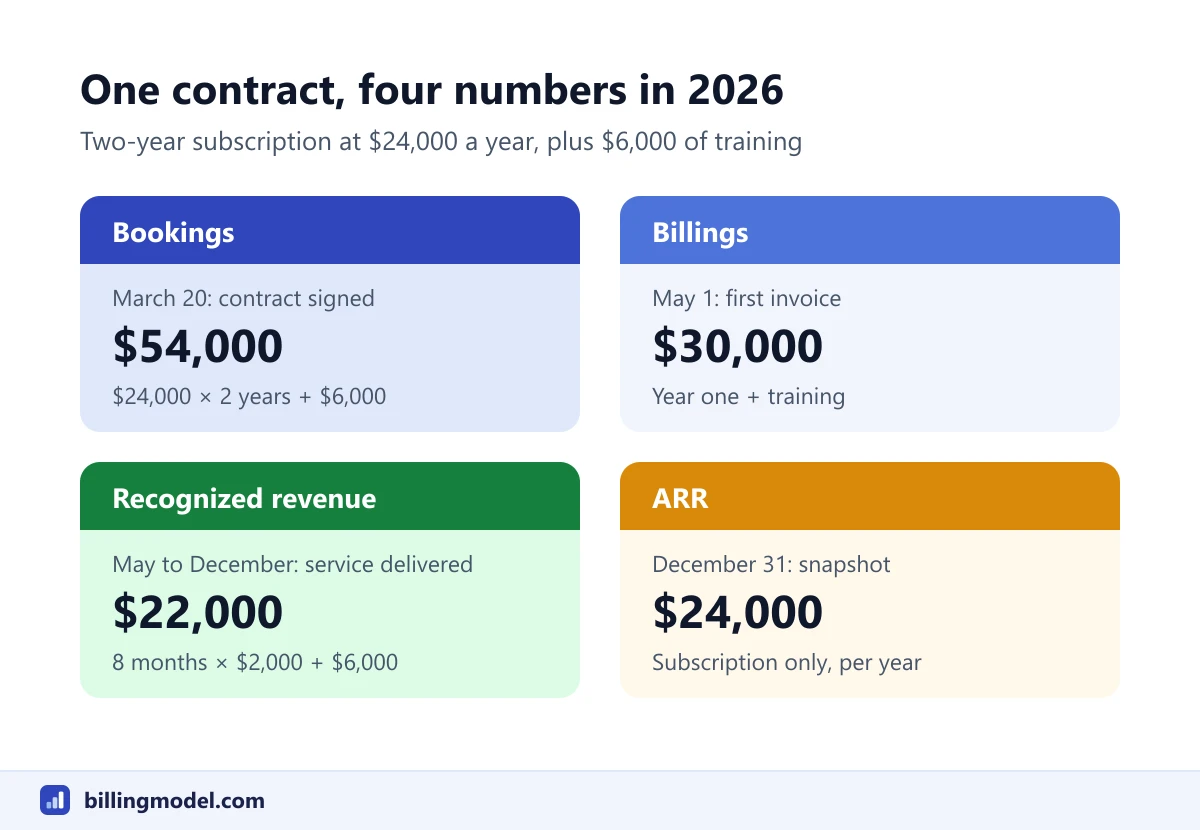 The same two-year contract in 2026: $54,000 booked, $30,000 billed, $22,000 recognized and $24,000 of ARR.
Billings and revenue each total $54,000 over the life of the contract, the same as bookings. Only in 2027, a full year with no changes, do billings, revenue and ARR agree.
Two balances connect the columns. On December 31, 2026 the company has invoiced $30,000 and recognized $22,000, so $8,000 sits in deferred revenue. The deferred revenue journal entry shows how that liability runs down. Zscaler's formula checks out too: $22,000 of revenue plus the $8,000 rise in deferred revenue equals the $30,000 billed.
The other balance is the nearest thing to bookings that the standards themselves require. IFRS 15 asks companies to disclose the transaction price allocated to performance obligations not yet satisfied, and US filers report the same idea as remaining performance obligations. Here that is $54,000 − $22,000 = $32,000 at the end of 2026.
How a real contract is recognized depends on its terms, including whether a fee like the workshop counts as a separate service. A qualified accountant should confirm the treatment of specific contracts.
Contracted ARR vs live ARR
Between March 20 and May 1, 2026 the contract above is signed but the service hasn't started. Whether its $24,000 is in ARR on March 31 depends on the definition.
- Live ARR counts a subscription once it has started. Samsara's annual report for the year ended January 31, 2026 defines ARR as the annualized value of subscription contracts "that have commenced revenue recognition."
- Contracted ARR counts it from signature. The PROS release cited above defined ARR as contracted recurring revenue from agreements that were current or "contracted with a future start date."
On March 31, 2026 the first method reports $0 for this customer and the second reports $24,000.
The end of a contract raises the same question. CrowdStrike's annual report for the year ended January 31, 2025 says that when a subscription has expired and a renewal is being negotiated, the revenue stays in ARR while the company is in active discussion, or until the customer says it won't renew. Workday's letter says ARR is not adjusted until a draft renewal agreement is signed or the customer churns.
How public companies define ARR
No two of these definitions are the same, and each is from a filing with the US Securities and Exchange Commission (checked October 2026).
| Company and filing | How ARR is defined | What stands out |
|---|---|---|
| Klaviyo, 2023 registration statement | The annualized value of existing paid subscriptions, calculated as MRR multiplied by twelve | Built from a monthly figure |
| CrowdStrike, annual report for the year ended January 31, 2025 | The annualized value of customer subscription contracts on the measurement date, assuming contracts expiring in the next 12 months renew on existing terms | Built from contracts, with a renewal assumption written in |
| Samsara, annual report for the year ended January 31, 2026 | The annualized value of subscription contracts that have commenced revenue recognition | Only contracts that have started |
Samsara adds that its ARR "is not a forecast" and has no standardized meaning. Its numbers show the gap between a run rate and a year's revenue: ARR was $1,889.9 million on January 31, 2026, and revenue for the fiscal year that ended that day was $1,618.6 million. For a growing company the year-end rate is higher than the total earned on the way there.
The SEC doesn't prescribe a formula. Its 2020 guidance on performance metrics asks a company that publishes a metric to define it clearly, explain how it is calculated and say how management uses it. That guidance applies to SEC filers, and rules in other countries differ. The habit is worth copying anywhere: before comparing your ARR with someone else's, read their definition. The overview of SaaS metrics covers how the other measures are treated.
Frequently asked questions
Is ARR the same as annual revenue?
No. ARR is the yearly rate of subscriptions on one date, and annual revenue is what was earned over twelve months under ASC 606 or IFRS 15. In the worked contract, 2026 revenue was $22,000 and year-end ARR was $24,000.
How do you calculate ARR from MRR?
Multiply MRR by 12. A company with $41,800 of MRR has $501,600 of ARR. For annual or multi-year contracts, start from the contract instead: divide the recurring contract value by the term in years, or by days and multiply by 365.
Do one-time fees count toward ARR?
No. Setup, onboarding, training and consulting fees are charged once, so they are left out. They can still be bookings, billings and revenue, which is one reason the four numbers differ.
Is ARR a GAAP or IFRS measure?
No. Neither framework defines ARR, and it is not audited. It is an operating metric, so a listed company that reports ARR in SaaS filings publishes its own definition beside it.
Should a small company track MRR or ARR?
They carry the same information on different scales. A business selling monthly plans can manage by MRR and multiply by 12 when someone asks for ARR. One that sells annual contracts will find ARR, built from the contracts, more natural.