This cost-based pricing example takes a product from a list of costs to a price in five steps: add up the variable cost, total the fixed costs, spread them over an assumed volume, add a markup, and check the break-even point. The company is invented. The formulas come from OpenStax textbooks and MIT course notes.
The answer is a $100 price on an $80 unit cost. The more useful lesson is how much that $80 depends on one guess, the number of units you expect to sell, and why the method stops working for software.
Quick answer: Cost-based (cost-plus) pricing sets price = unit cost × (1 + markup), where unit cost = variable cost per unit + fixed costs ÷ expected units. In the example, $40 + ($240,000 ÷ 6,000) = $80, and a 25% markup gives $100. That is a 20% margin on the price, and break-even is 4,000 units.
What cost-based pricing means
Cost-based pricing starts from the seller's side: work out what one unit costs, then add a percentage for profit. It is also called cost-plus or markup pricing.
OpenStax's Principles of Marketing textbook describes the cost-based objective as setting prices based on the costs of doing business. Its example is a smartphone that costs $3,000 to produce and sells for $3,300 after 10% is added.
Professor Catherine Tucker's MIT course notes, Pricing Beyond the 3 Cs, write the method as a formula:
Price = (1 + markup %) × (unit variable cost + average fixed cost)
Two terms need defining. The OpenStax chapter says fixed costs are expenses that do not change regardless of the number of units sold, such as a lease, while variable costs change with the number of units produced. Average fixed cost is the fixed total divided by the number of units.
Cost-based pricing example, step by step
Every number below is illustrative. The company makes a handheld barcode scanner that it sells to small shops.
Step 1: Add up the variable cost of one unit
| Variable cost | Per scanner |
|---|---|
| Components | $27.00 |
| Assembly labor | $8.00 |
| Packaging and shipping | $5.00 |
| Total variable cost | $40.00 |
Step 2: Add up the fixed costs for the year
| Fixed cost | Per year |
|---|---|
| Salaries | $168,000 |
| Rent and utilities | $42,000 |
| Equipment, software and insurance | $30,000 |
| Total fixed costs | $240,000 |
Step 3: Spread the fixed costs over an assumed volume
The company expects to sell 6,000 scanners this year.
- Average fixed cost: $240,000 ÷ 6,000 = $40.00 per scanner.
- Unit cost: $40.00 variable + $40.00 fixed = $80.00.
Step 4: Add the markup
The owners want a 25% markup on cost.
- Price: $80.00 × 1.25 = $100.00.
- Profit per scanner: $100.00 − $80.00 = $20.00.
If all 6,000 sell, revenue is $600,000. Take away $240,000 of variable cost (6,000 × $40) and $240,000 of fixed cost, and $120,000 is left. That equals 6,000 × $20, as it should.
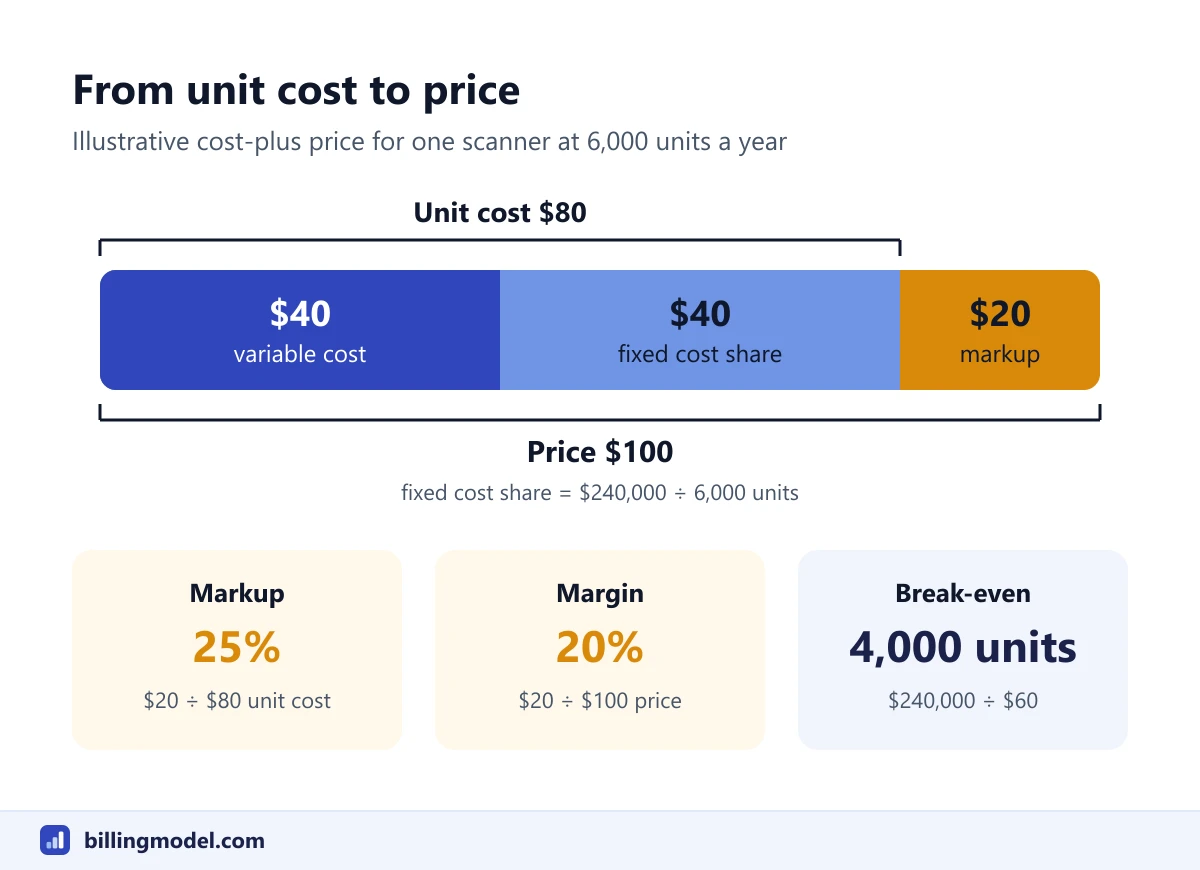 The same $20 is a 25% markup on the $80 cost and a 20% margin on the $100 price.
Step 5: Find the break-even point
The break-even point is the sales level where total cost equals total revenue, so there is neither profit nor loss. OpenStax's managerial accounting textbook gives the break-even formula as total fixed costs divided by the contribution margin per unit, which is the price minus the variable cost.
- Contribution margin: $100 − $40 = $60 per scanner.
- Break-even: $240,000 ÷ $60 = 4,000 scanners, or $400,000 of sales.
The same page adds a target-profit version: (fixed costs + desired profit) ÷ contribution margin. For a $120,000 profit that is ($240,000 + $120,000) ÷ $60 = 6,000 scanners, which matches step 4.
Markup versus margin
Markup and margin describe the same dollars with different denominators. Markup divides the profit by the cost. Margin divides it by the price.
OpenStax's marketing textbook defines markup as a percentage of what the seller paid: shoes bought for $50 and sold for $75 carry a 50% markup. The same page works out a margin as a percentage of sales, $3,250 of gross margin on $7,250 of net sales, or 44.83%.
In the scanner example:
- Markup: $20 ÷ $80 = 25%.
- Margin: $20 ÷ $100 = 20%.
To convert, margin = markup ÷ (1 + markup), and markup = margin ÷ (1 − margin). The conversions below are arithmetic on the $80 unit cost.
| Markup on cost | Price | Margin on price |
|---|---|---|
| 10% | $88.00 | 9.1% |
| 25% | $100.00 | 20.0% |
| 50% | $120.00 | 33.3% |
| 60% | $128.00 | 37.5% |
| 100% | $160.00 | 50.0% |
The gap widens as the percentages rise. Doubling the cost, which the OpenStax page calls keystone pricing, is a 100% markup and a 50% margin.
Watch out: A 25% margin is not a 25% markup. To earn a 25% margin on an $80 cost, the price has to be $80 ÷ (1 − 0.25) = $106.67, a markup of 33.3%. Pricing at $100 instead leaves $6.67 per unit behind, or $40,000 over 6,000 units.
The margin here is profit after all costs. A gross margin, like the one in the OpenStax shoe example, counts only the cost of the goods sold. Say which one you mean whenever you quote a percentage.
Why the unit cost depends on the volume you assume
The $80 unit cost in this cost-based pricing example is only true at 6,000 units. OpenStax's managerial accounting textbook gives the reason in its section on cost behavior patterns: "fixed costs remain fixed in total but can increase or decrease on a per-unit basis." Its example is a $1,000 monthly rent that works out to $5.00 a shirt at 200 shirts and $2.50 at 400.
Run the scanner through the same formula at other volumes.
| Assumed units | Fixed cost per unit | Unit cost | Price at 25% markup |
|---|---|---|---|
| 3,000 | $80.00 | $120.00 | $150.00 |
| 4,000 | $60.00 | $100.00 | $125.00 |
| 6,000 | $40.00 | $80.00 | $100.00 |
| 8,000 | $30.00 | $70.00 | $87.50 |
| 12,000 | $20.00 | $60.00 | $75.00 |
One product, one cost structure, and prices from $75 to $150. The formula gives no way to choose between them, because the volume it needs depends on the price it produces. Tucker's notes call the calculation circular: costs are a function of sales, and sales are a function of price.
The circle turns vicious when sales fall. If the company prices at $100 and sells 4,000 scanners, it only breaks even. Selling 3,000 loses $60,000 (3,000 × $60 − $240,000). Cost-plus then says the unit cost has risen and the price should go up to $125 or $150. The notes ask whether a time of declining sales is really the right moment to raise prices. In a Knowledge at Wharton interview on pricing, professor Jagmohan Raju describes the same spiral: low sales push costs up, so the price is increased even further.
Where cost-plus fails for software
Software pushes the volume problem to its limit, because almost all of the cost is fixed. Take a hypothetical subscription product with $600,000 a year of fixed costs, mostly developers' salaries, and $36 a year of variable cost per customer for hosting and support.
| Assumed customers | Fixed cost per customer | Unit cost | Annual price at 25% markup |
|---|---|---|---|
| 1,000 | $600.00 | $636.00 | $795.00 |
| 5,000 | $120.00 | $156.00 | $195.00 |
| 20,000 | $30.00 | $66.00 | $82.50 |
The price runs from $82.50 to $795 on the strength of a forecast. Marking up the one cost that is known doesn't help either. $36 × 1.25 = $45 a year leaves $9 per customer toward the fixed costs, and $600,000 ÷ $9 means 66,667 customers before the company breaks even.
Tucker's notes state that cost-based pricing is misplaced in industries with high fixed costs and near-zero marginal costs, and that distributing fixed costs is hard. Hal Varian, an economist at the University of California, Berkeley, made the same argument about information goods in a 1997 paper, Versioning Information Goods. Such goods have large fixed costs of production and small variable costs of reproduction, he wrote, and his conclusion was blunt: "Cost-based pricing makes little sense in this context; value-based pricing is much more appropriate."
The value-based pricing example shows the size of the gap for one software product: a 60% markup on a $420 cost gives $672 a year, while pricing from customer value gives $2,600.
What cost is still good for
Cost is the floor under any price, even when it is a poor way to choose the price.
Two tests from the cost-based pricing example above carry over to any method. A price has to exceed the variable cost, or every sale loses money. And at the volume you can realistically sell, the contribution margin has to cover the fixed costs, which is what the break-even figure tells you.
The first test is the one that matters for a one-off deal. OpenStax's section on special orders says that when an order can be filled with unused capacity, fixed costs are irrelevant to the decision. In its example a chair maker with a $2,800 regular price and $1,650 of variable cost per chair gains $150 a chair by accepting an order at $1,800.
Beyond that, the method has three blind spots:
- Buyers. The OpenStax marketing chapter warns that customers don't know or care what the seller's costs are, so a cost-based price can land above or below what they would pay.
- Your own numbers. Tucker's notes cite a delivery company that charged $4.69 a job when its fully allocated cost was $9.24, a loss of $4.55 on every job.
- The upside. Raju calls cost-plus a safe way of doing things, with a catch: you never learn how high you could have gone.
It also ignores rivals, which is the starting point of competitor-based pricing. How the price is then packaged, per seat, per unit or as a flat fee, is compared in SaaS pricing models.
Everything above is a pricing calculation, not bookkeeping. How costs are classified and allocated in your accounts depends on your business and the standards you report under, so confirm that with an accountant.
Frequently asked questions
What is the formula for cost-based pricing?
Price = unit cost × (1 + markup percentage). Unit cost is the variable cost per unit plus the fixed costs divided by the number of units you expect to sell. With an $80 unit cost and a 25% markup, the price is $100.
Is markup the same as margin?
No. Markup is profit as a percentage of cost, and margin is profit as a percentage of price. A $20 profit on an $80 cost is a 25% markup and a 20% margin, and the two only match at zero.
What is the difference between cost-plus pricing and break-even pricing?
Break-even pricing looks for the point where revenue only covers costs, with no profit. OpenStax's marketing textbook gives the break-even pricing formula as fixed costs ÷ (unit price − variable unit cost). Cost-plus pricing adds a profit percentage on top of the unit cost.
Why is cost-plus pricing a poor fit for SaaS?
Because one more customer costs very little to serve, nearly all the cost is fixed and has to be allocated over a customer count nobody knows in advance. Change the forecast and the "cost" changes with it, so the price ends up resting on a guess.