Competitor-based pricing sets your price by reference to what rivals charge: a little below them, level with them, or a little above. It is also called competition-based pricing. OpenStax's Principles of Marketing textbook describes it as a company that "sets its prices according to the prices of its competitors."
The method is quick, and it keeps you inside a range buyers already accept. Its weakness is what it leaves out: your own costs and what the product is worth to the customer. The worked example below builds a benchmark from four rivals, picks a price and then shows what one price cut does to it.
Quick answer: Competitor-based pricing means building a benchmark from rivals' real prices and setting yours below, at or above it. In the example, four rivals charge an effective $23, $24, $25 and $34 per agent per month. The median is $24.50, so the candidate prices are $22.05 (10% below), $24.50 (at) and $26.95 (10% above).
What competitor-based pricing is
A price can start from one of three facts: what the product costs you, what it is worth to the buyer, or what the alternatives cost. This method starts from the third. The first is worked through in the cost-based pricing example and the second in the value-based pricing example.
The OpenStax chapter on setting a pricing policy lists it as the competition objective, with prices "developed based on competitors' prices". Its example is Amazon, which the book says gathers competitors' prices on some of its most popular products and sets its own just below them. A related objective in the same chapter, market share, prices at, below or above comparable products depending on what yours offers.
Professor Catherine Tucker's MIT course notes, Pricing Beyond the 3 Cs, define it less kindly: a firm has no pricing policy that relates to its own product, only one that reflects its competitors' decisions. According to the notes, sometimes that means copying a competitor's price without doing any pricing research. Sometimes it means discounting against a competitor until a market-share target is reached.
Below, at or above: the three positions
Every competitor-based price is a position against a benchmark. Each position is a bet about how buyers see the products.
| Position | The bet | What can go wrong |
|---|---|---|
| Below the benchmark | Buyers see the products as alike and will switch for a lower price | Rivals match the cut, and everyone earns less on the same sales |
| At the benchmark | Price won't decide the sale, so you compete on something else | A better product gets the same price as a weaker one |
| Above the benchmark | Buyers can see a difference and will pay for it | If they can't see it, you lose sales and rivals stay where they are |
The first and third risks come from how rivals respond. OpenStax's economics textbook describes the pattern in its section on oligopoly, a market with a few large sellers. In its kinked demand curve model, rivals "will immediately match any price cuts", so a lower price brings little extra volume. A firm that raises its price alone loses a considerable share of sales, because the others don't follow.
Competitor-based pricing in six steps: a worked example
The company and every number below are invented for illustration. The product is help-desk software sold per agent per month.
Step 1: Name the real alternatives
List what a customer would buy if your product didn't exist. Tucker's notes on economic value to the customer say to be honest about who the closest competitor is. Their example is a video-calling service that wanted to compare itself with dedicated conferencing systems when its real rival was free.
Here there are four rivals, A to D.
Step 2: Convert every price to the same unit
Published prices aren't comparable until they describe the same customer, period and package. The same MIT notes describe a firm whose calculation went wrong because every rival discounted 80% from its list price.
Pick one reference customer. This one has 10 agents and pays annually.
| Rival | Published price | Adjustment for the reference customer | Effective price per agent per month |
|---|---|---|---|
| A | $30 per agent per month | 20% off for annual billing | $30 × 0.80 = $24.00 |
| B | $25 per agent per month, annual only | None | $25.00 |
| C | $18 per agent plus a $50 monthly platform fee | $50 ÷ 10 agents = $5 | $18 + $5 = $23.00 |
| D | $40 per agent per month, phone support included | 15% off for annual billing | $40 × 0.85 = $34.00 |
Step 3: Choose the benchmark
In order, the four prices are $23, $24, $25 and $34.
- Average: ($23 + $24 + $25 + $34) ÷ 4 = $106 ÷ 4 = $26.50.
- Median, the middle value: ($24 + $25) ÷ 2 = $24.50.
Rival D sells a different package, and it pulls the average $2 above the median. The median is the better benchmark here because one outlier barely moves it.
Step 4: Pick a position and turn it into a price
A price index is your price divided by the benchmark.
- 10% below: $24.50 × 0.90 = $22.05.
- At the benchmark: $24.50.
- 10% above: $24.50 × 1.10 = $26.95.
Say the product matches A, B and C feature for feature and lacks D's phone support. Nothing justifies a premium, and nothing forces a discount. The price is $24.50.
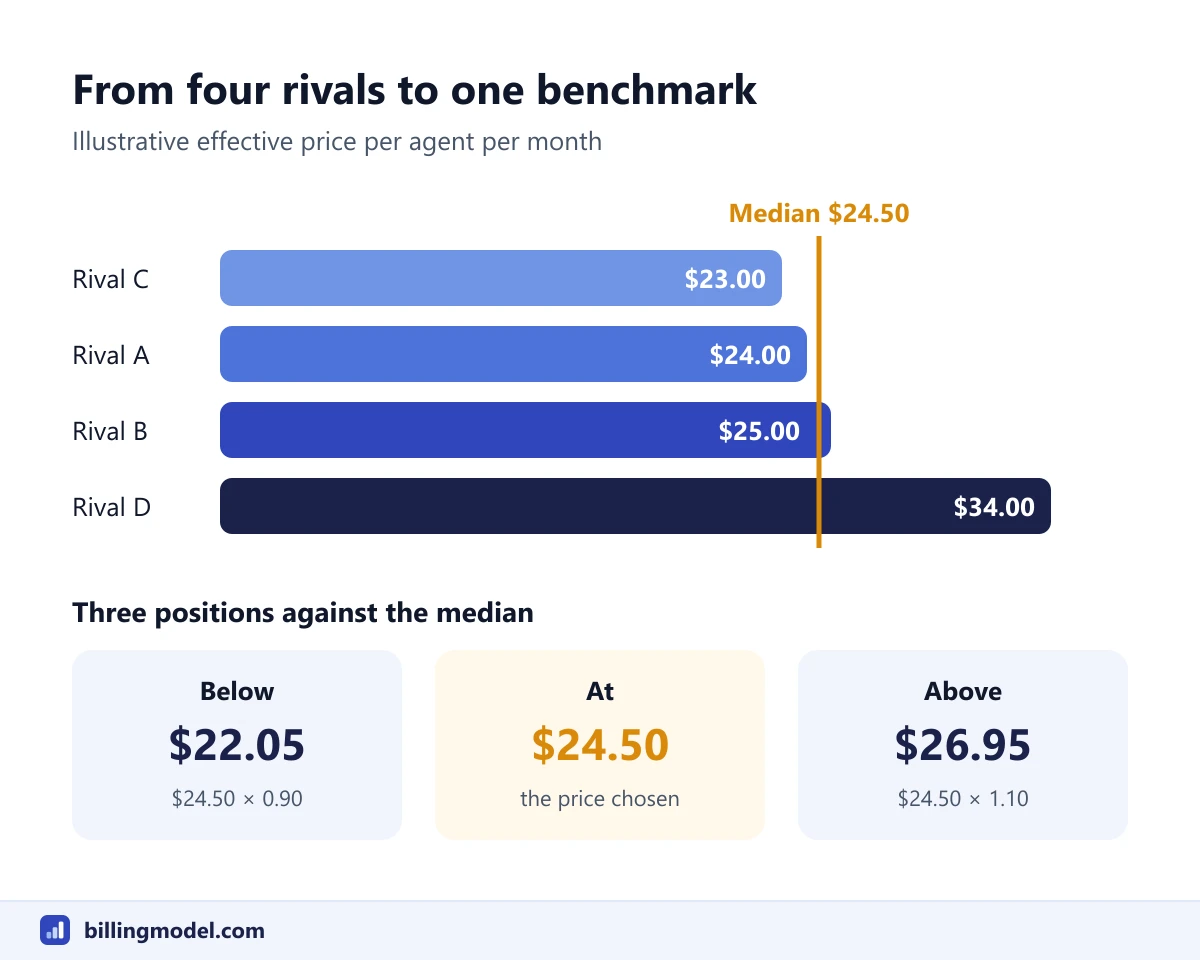 Four rivals, one benchmark, three possible positions. All figures are illustrative.
Step 5: Check the price against your cost
Competitors' prices say nothing about your costs. Suppose serving one agent costs $9 a month in hosting, support and payment fees. At $24.50 the margin is $24.50 − $9 = $15.50 per agent. With 1,000 agents, that is $15,500 a month.
Step 6: Test it against a price cut
Rival C cuts its price by 20% and you decide to follow.
- New price: $24.50 × 0.80 = $19.60.
- New margin: $19.60 − $9 = $10.60 per agent, which is $4.90 or about 32% less.
- Agents needed to earn the same $15,500: $15,500 ÷ $10.60 = 1,463, about 46% more than today.
With these numbers, a 20% price cut needs 46% more volume to earn the same margin. If A and B follow as well, nobody's price advantage has changed, and it is hard to see where 463 extra agents would come from.
What competitor-based pricing leaves out
It ignores your costs. A rival may have lower costs than you, or deeper pockets. Tucker's lecture notes on responding to competitors' price cuts call this the shallow-pockets trap, and list two more reasons to hesitate before cutting: customers may read a low price as low quality, and the customers a discount attracts aren't loyal.
It ignores value. Her notes mention a radiology software firm with a unique 3D capability that lost millions by pricing level with the market leader. In a Knowledge at Wharton interview on pricing, professor Jagmohan Raju puts the rule both ways round. Copying rivals is safe, he says, but in many settings you will lose out. And if your product is no better than the competition, "you don't deserve to get a higher price."
It can start a price war. In the same interview, professor John Zhang says that when firms all price off each other, they end up in a price war, prices keep falling and service gets cut to pay for it. The MIT notes list three conditions that put a market at risk: falling demand, spare capacity and few differences between products. They name beer as the classic case.
Software changes the speed, not the logic. A Harvard Business School Working Knowledge article on research by Alexander MacKay and Zach Brown looked at pricing algorithms that react to rivals' prices. Using 18 months of online prices for allergy drugs at five large retailers, the researchers estimated that prices were 5.2% higher on average than in a simulation of traditional price-setting. The explanation given is that when one retailer will quickly match or undercut any cut, its rivals have less reason to cut in the first place.
The legal line: watching prices is not agreeing prices
Legal line: Agreeing prices with a competitor is price fixing. In the United States, the FTC's guidance on price fixing says an agreement among competitors to fix prices is almost always illegal. The European Commission's antitrust overview calls a cartel between competitors, which may involve price fixing, the most flagrant example of conduct that infringes EU competition law. GOV.UK's guidance on anti-competitive activity says a UK business breaks the law if it agrees with another business to charge the same prices. Other countries have competition laws of their own.
Looking at prices a rival has published and then deciding your own is a different thing. The FTC's page says matching competitors' pricing "may be good business, and occurs often in highly competitive markets", and that a company may charge the same price as its competitors as long as the decision was not based on any agreement or coordination with a competitor.
What the regulators describe as illegal is agreement, not similar prices. The FTC defines price fixing as an agreement among competitors, whether written, verbal or inferred from conduct, and notes that not all price similarities result from one. GOV.UK tells UK businesses they must not discuss the prices they are going to charge with competitors, and that sharing information through a third party such as a trade association is covered too.
This is a general description, not legal advice. Competition law differs by country, so ask a lawyer before doing anything that involves contact with a competitor.
When competitor-based pricing makes sense
Use it as the main method when buyers see the products as interchangeable and can compare prices easily. That is Raju's case of a product no better than the competition.
It is also a reasonable starting point when you are new to a market and have no sales data of your own. Rivals' prices are at least evidence of what buyers already pay.
In every other case it works better as a check than as a method. The value-based approach uses the closest alternative's price as its first input and then adds the value of the differences, so the benchmark you built in steps 1 to 3 isn't wasted. Tucker's notes make the general point: cost, customer and competition are constraints a price has to respect, and each becomes a bad strategy when it is the only thing you look at.
Which structure the price sits in, per seat, tiered or metered, is a separate decision compared in SaaS pricing models.
Frequently asked questions
Is competitor-based pricing the same as competition-based pricing?
Yes. Both names describe setting prices by reference to rivals. OpenStax's marketing textbook calls it the competition objective, and the MIT course notes cited above use competition-based pricing.
What is a simple example of competitor-based pricing?
Three similar products sell for $23, $24 and $25 a month. A new entrant with nothing extra to offer prices at $24. If it had a clear advantage it might charge $26, and if it needed to win customers fast it might charge $22.
Is it legal to match a competitor's price?
The US FTC says matching competitors' pricing may be good business, provided the decision is made independently and not through agreement or coordination with a competitor. Rules differ by country, so check with a lawyer where you operate.
What are the main disadvantages of competitor-based pricing?
It ignores your costs and the value of your product, and it ties your margin to other firms' decisions. When several firms price off each other, one cut can turn into a price war.