This value-based pricing example sets an annual price for a piece of business software in six steps, starting from what the product is worth to the customer and not from what it costs to build. The company and its numbers are invented. The method follows lecture notes from an MIT Sloan pricing course.
The short version: find what the customer would otherwise buy, add up in money what your product does better, and charge for part of that difference. In the example the answer is $2,600 a year. Cost-plus pricing would have said $672, and matching the competitor would have said $900.
Quick answer: Value-based pricing caps the price at the price of the customer's closest alternative plus the money value of what your product does better. In the example the ceiling is $900 + $3,400 = $4,300. The seller charges for half of the added value, so the price is $900 + $1,700 = $2,600 a year.
What value-based pricing means
Value-based pricing sets the price from the customer's side. Harvard Business School Online describes it as a method that relies mainly on customers' perceived value of a product. The same article gives the boundaries: a price can sit anywhere between the firm's cost and the customer's willingness to pay, which is the most that customer would pay.
Cost is the floor and willingness to pay is the ceiling. The gap between them is value the sale creates, and the price decides how it is split. HBS Online calls the customer's share customer delight and the seller's share the firm's margin.
The hard part is the ceiling, because no buyer announces a maximum price. The MIT OpenCourseWare lecture notes on economic value to the customer, from Professor Catherine Tucker's pricing course, give a way to estimate it. A customer buys your product only if it leaves them better off than their closest alternative, so:
Price ceiling = price of the closest alternative + differentiation value
Differentiation value is the money value of everything your product does better than that alternative, minus anything it does worse.
Value-based pricing example in six steps
Everything below is illustrative. The product is software that chases unpaid invoices: it sends reminders on a schedule, escalates each past due invoice and logs the replies.
Step 1: Pick one customer segment
Value differs from buyer to buyer, so the calculation is done for one kind of customer at a time. HBS Online's article on willingness to pay makes the same point: the maximum varies with who the customer is and how urgent the need is.
The segment here is small wholesalers with $1,460,000 of annual sales on credit and a part-time credit controller paid $32 an hour.
Step 2: Name the benefit, not the feature
The MIT notes insist on defining a benefit instead of a feature. "Automated reminder sequences" is a feature. The benefits are fewer staff hours spent chasing payment, and cash that arrives sooner.
Step 3: Find the closest alternative and its real price
For this segment the closest alternative is a generic reminder add-on for accounting software at $75 a month, or $900 a year.
Two cautions from the MIT notes apply. Be honest about who the closest competitor is, even when it is something cheap or free. And use the price customers really pay: the notes describe a company whose calculation suggested doubling its price, until it noticed that every rival discounted 80% from its list price.
Step 4: Put a number on each difference
| Difference from the alternative | Calculation | Value per year |
|---|---|---|
| Staff time saved | 5 hours a month × $32 × 12 months | +$1,920 |
| Cash collected sooner | $20,000 less tied up in unpaid invoices × 9% borrowing cost | +$1,800 |
| Setup effort, first year | 10 hours × $32 | −$320 |
| Differentiation value | $1,920 + $1,800 − $320 | $3,400 |
The second line needs unpacking. Sales on credit of $1,460,000 a year are $4,000 a day ($1,460,000 ÷ 365). If customers pay 5 days sooner, the wholesaler has 5 × $4,000 = $20,000 less waiting to be collected. If it borrows at 9% a year to fund that gap, it saves $20,000 × 9% = $1,800 in interest.
The third line is negative on purpose. An honest calculation counts what the product does worse, and here it takes longer to set up.
Step 5: Add the alternative's price to get the ceiling
$900 + $3,400 = $4,300 a year.
At $4,300 the customer would be exactly as well off buying the $900 add-on. That is the maximum, not the price.
Step 6: Decide how much of the added value to charge for
The MIT notes call it a common misperception that the ceiling is the price. A firm generally gives up some of its differentiation value, and the notes suggest starting from a 50% split. Their own example is a server maker that calculated $6,000 of differentiation value over a $6,800 alternative and priced at $9,800, keeping half.
Applying the same split here:
- Price = $900 + (50% × $3,400) = $900 + $1,700 = $2,600 a year, about $217 a month.
- The customer is $1,700 better off in the first year than with the alternative ($3,400 of added value − $1,700 of extra price).
- The floor is the cost to serve one customer: $35 a month, or $420 a year. The price leaves $2,600 − $420 = $2,180 a year above that.
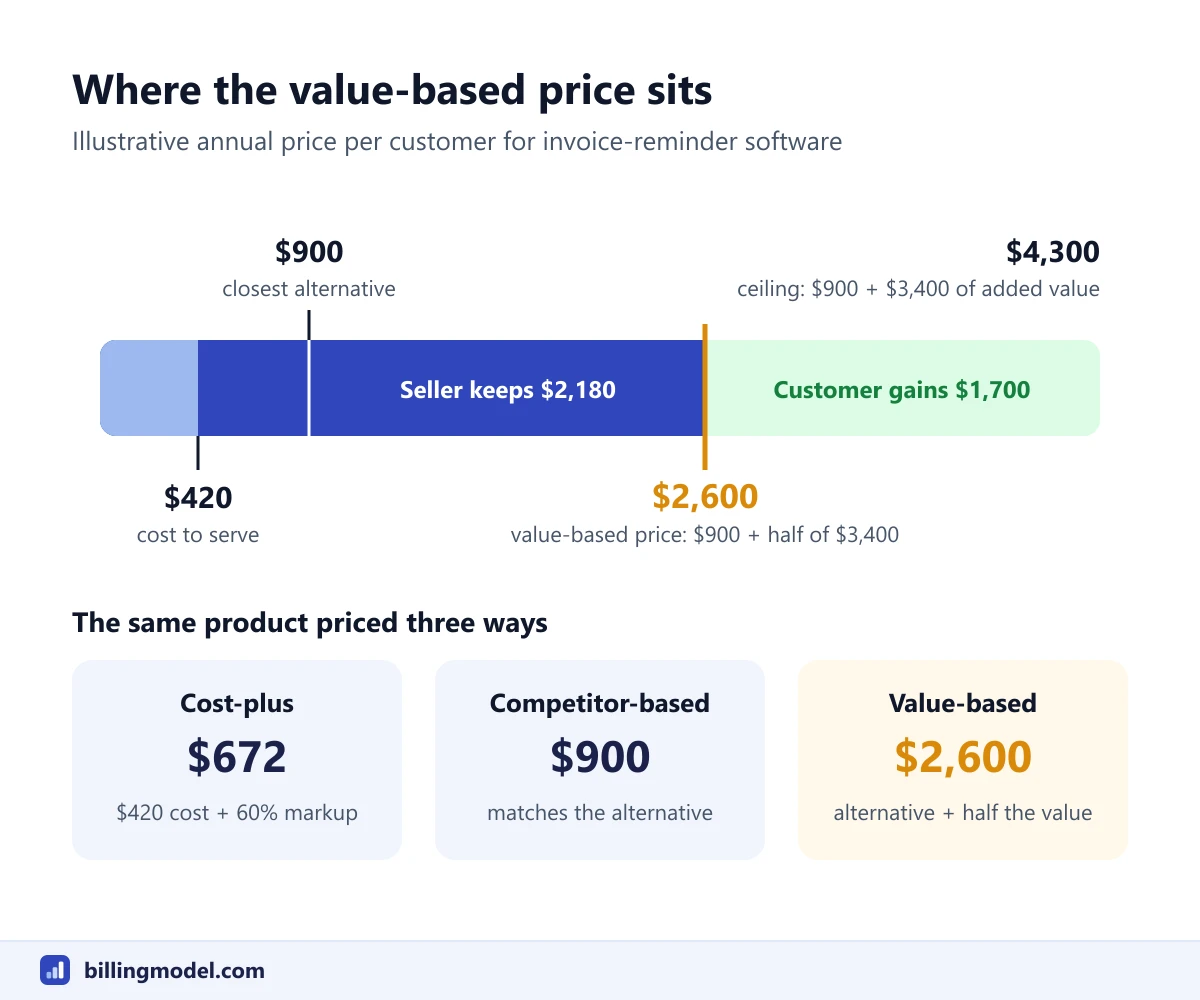 The price sits between the cost floor and the value ceiling. The split decides who keeps the difference.
Stress-test the number before you publish it
The price is only as good as the estimates behind it. The MIT notes say a firm may have to price well below the ceiling when customers are unsure the benefit will materialize, or when the benefit is new and hard to understand.
Here the labor saving is easy to verify and the faster collection is not. A skeptical buyer who believes only the labor saving sees $1,920 − $320 = $1,600 of differentiation value and a ceiling of $900 + $1,600 = $2,500. For that buyer, $2,600 is too high.
There are two ways out. One is to prove the benefit: measure how many days pilot customers take to get paid before and after. The notes observe that existing customers often agree to such benchmarking because they see it as free consulting. The other is to launch lower and raise the price once the evidence exists.
Then check the result against what buyers say and do. HBS Online lists four ways to measure willingness to pay: surveys and focus groups, conjoint analysis (asking people to rank bundles of features), auctions, and experiments that test different prices on comparable groups.
How this differs from cost-plus and competitor-based pricing
The three methods start from different facts, and in this example they produce three very different prices.
| Method | Starts from | Price in the example | What it ignores |
|---|---|---|---|
| Cost-plus | The seller's cost plus a markup | $420 × 1.60 = $672 | What the product is worth to the buyer |
| Competitor-based | A rival's price | $900 | Whether your product is better or worse |
| Value-based | The alternative's price plus added value | $2,600 | Nothing by design, but it rests on estimates |
OpenStax's Principles of Marketing textbook describes cost-based pricing as setting prices from the costs of doing business, with the example of a smartphone that costs $3,000 to make and sells for $3,300 after a 10% profit is added. Its warning is that customers neither know nor care what the seller's costs are. The method is covered in the cost-based pricing example.
The same textbook describes a competition objective as setting prices according to competitors' prices. In a Knowledge at Wharton interview on pricing, professors Jagmohan Raju and John Zhang call both approaches safe and incomplete. With cost-plus you never learn how high you could have gone. Copying rivals loses money when your product is better, and across an industry it can slide into a price war. See competitor-based pricing.
MIT Sloan Management Review gives a real case. A European supermarket chain priced a new private-label yogurt with health benefits at €1.99 from a cost of €1.29, while the branded competitor sold at €2.99. The authors, Andreas Hinterhuber and Stephan Liozu, judged the price wrong because perceived customer value was not the main input.
In the software example, cost-plus gives $672. That is less than the weaker alternative charges, for a product that saves the customer $3,400 more.
Note: Value-based pricing doesn't replace the other two numbers. Cost is still the floor, and the competitor's price is the first term in the formula.
Where value-based pricing goes wrong
Most failures come from the inputs, not the formula.
- The wrong alternative. The MIT notes give the case of an online video-calling service that wanted to compare itself with dedicated conferencing systems when its real competitor was a free calling app.
- The wrong units. The notes mention a cleaning product whose maker underpriced it by overlooking that it cleaned twice as much as the rival product.
- Charging the whole ceiling. A customer who gains nothing from switching won't switch.
- Different prices for identical buyers. Zhang warns in the Wharton interview that buyers who learn someone else paid less resent it. The usual answer is published plans for different segments, as in these tiered pricing examples.
- Charging for the wrong thing. The notes credit Xerox's profits to pricing per photocopy, a unit that tracked the benefit. Choosing that unit is the subject of usage based pricing and of the wider comparison of SaaS pricing models.
There is also a limit that has nothing to do with arithmetic. The MIT notes say to price below the ceiling when it is ethically right or legally required, and point to price-gouging laws that apply in emergencies. Those rules differ by jurisdiction.
Frequently asked questions
What is a simple value-based pricing example?
A tool saves a customer $3,400 a year more than the $900 product they would otherwise buy. The most they would rationally pay is $4,300. The seller charges $2,600, so the customer keeps $1,700 of the gain and has a reason to switch.
What is the formula for value-based pricing?
There is no single official formula. The one in the MIT course notes is: price ceiling = price of the closest alternative + differentiation value. The price is then set somewhere below the ceiling and above cost.
How is value-based pricing different from cost-plus pricing?
Cost-plus starts from the seller's cost and adds a markup. Value-based pricing starts from the buyer's alternative and adds the worth of the differences. When a product is much better than its rivals, cost-plus tends to underprice it.
How do you find out what customers are willing to pay?
You estimate it, then test it. Estimates come from calculating savings for a typical customer, as in the example. Tests include surveys, conjoint analysis and controlled price experiments, the methods HBS Online lists.
Should you charge every customer a different value-based price?
Not usually. Value does differ between segments, but quoting each buyer a different price for the same thing invites resentment and haggling. A common answer is to group customers into a few segments and publish a plan for each.