A recurring ACH payment is an automatic debit from a customer's US bank account, repeated on a schedule the customer authorized in advance: rent on the 1st, or a software subscription on the 15th. The business starts each payment. The customer agrees once.
It travels over the ACH network, which the Federal Reserve describes as a nationwide network through which banks send each other batches of electronic credit and debit transfers. The Federal Reserve Payments Study counted 22.4 billion ACH debit transfers worth $36.80 trillion in 2024.
Quick answer: A recurring ACH payment is a repeating bank debit that a US customer authorizes once. The business (the originator) sends each debit through its bank (the ODFI) and an ACH operator to the customer's bank (the RDFI). Debits settle the same day or the next banking day. They can be returned within about two banking days for reasons such as insufficient funds, and for 60 days if a consumer says the debit was unauthorized.
What a recurring ACH payment is
ACH payments come in two kinds. A credit pushes money out, as payroll direct deposit does. A debit pulls money in, and a recurring ACH payment is a series of debits. You'll also see it called direct debit, direct payment or an electronic check.
Nacha, the organization that writes the ACH rules, labels each entry with a three-letter code for how it was authorized. Its guide for developers lists PPD for consumer debits authorized in writing, WEB for those authorized online or on a mobile device, TEL for those authorized by phone, and CCD for debits to business accounts.
ACH is a US system. The nearest equivalents elsewhere are SEPA Direct Debit for euro payments and Bacs Direct Debit in the United Kingdom. The rules differ: a SEPA Core payer, for instance, can request a refund for eight weeks without giving a reason.
Authorization requirements
No debit may be sent without the account holder's permission, and the burden of proving that permission sits with the business.
For consumer accounts, federal Regulation E says a preauthorized transfer may be authorized only by a writing signed or similarly authenticated by the consumer, who must get a copy. An electronic agreement can qualify. Nacha says in an article on compliant authorizations that a consumer debit authorization gives the customer information on how to revoke it directly with the business, and that the Nacha Rules don't prescribe a specific format.
Four more points come from Nacha's developer guide and its checklist for originators:
- Business accounts. Debits to a company's account rest on an agreement between the two businesses instead of the consumer rules.
- Changes. A consumer must get 10 calendar days' notice of a change in amount, and any receiver 7 calendar days' notice of a change in date. Regulation E separately requires written notice 10 days before a debit that differs from the last one.
- Proof. You must be able to produce the authorization within 10 days when your bank asks.
- Account validation. Debits authorized online need a commercially reasonable fraud check that includes validating the account, for example with a prenote (a non-monetary test entry), micro-deposits or a verification service.
The wider consent and record-keeping steps are in the guide to setting up recurring payments. Authorization wording has legal weight, so have a lawyer review yours.
How the debit moves: originator, ODFI, ACH operator, RDFI
Five parties handle every debit. Nacha's explanation of how ACH payments work uses a utility bill as its example.
- The receiver (your customer) authorizes the debit.
- The originator (your business) sends payment instructions to its bank, sometimes through a third party such as a payment processor.
- The ODFI, the originating depository financial institution, is your bank. It bundles your instructions with those of other companies into a file.
- The ACH operator sorts the file and routes each entry onward. There are two operators, the Federal Reserve and The Clearing House.
- The RDFI, the receiving depository financial institution, is the customer's bank. It withdraws the money from the customer's account.
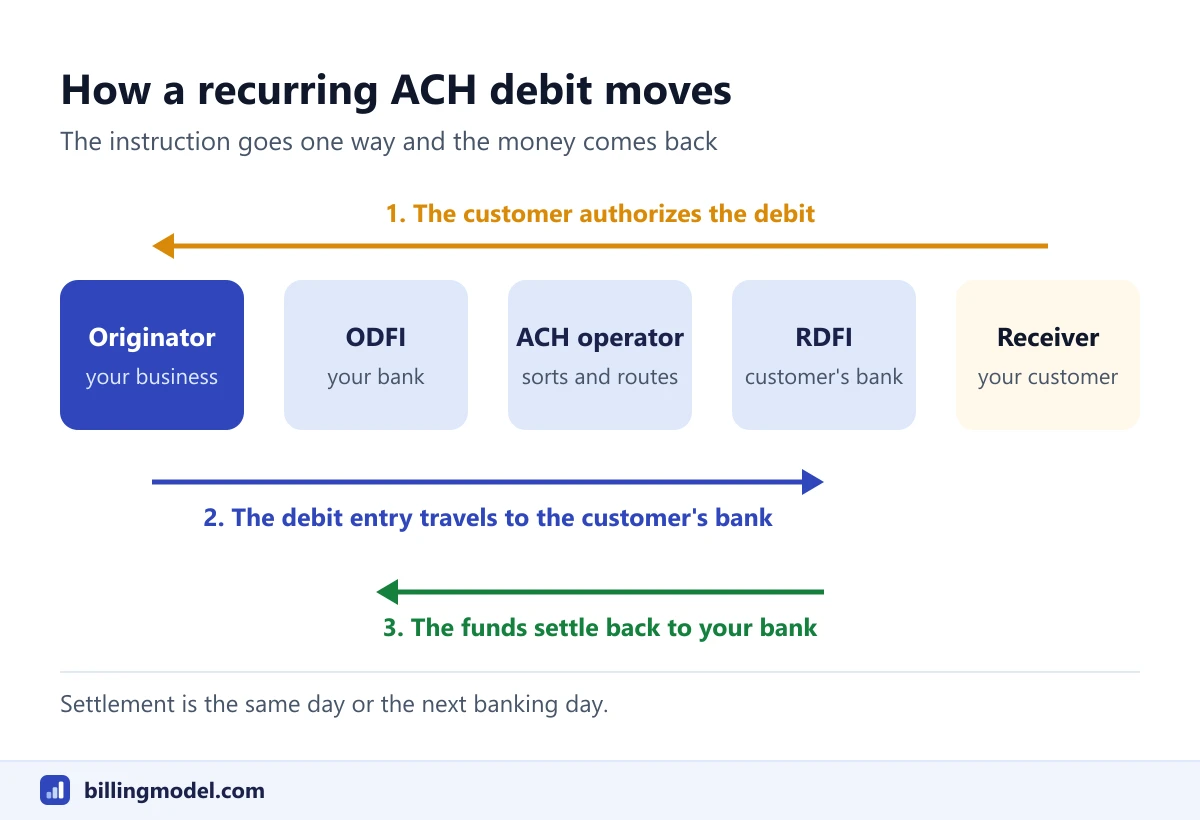 The instruction travels from your bank to the customer's bank, and the money travels back.
Nothing in this chain confirms the customer's balance in advance. Emory University's note on account validation makes the point for its own payers: validation checks the routing and account numbers against the bank's records, not whether funds are available. That is why an ACH debit can settle first and come back later.
Timing: standard and Same Day ACH
ACH is a batch system. Nacha's fact sheet says the network settles four times every banking day and not at all on weekends or federal holidays. Its explanation of how payments move adds that a debit settles either the same day or the next banking day, and can't carry a settlement date more than one banking day ahead.
The Federal Reserve's FedACH processing schedule shows the windows (effective September 12, 2022; checked October 2026). Times are Eastern.
| Bank's file reaches FedACH by | Settlement |
|---|---|
| 10:30 a.m. | 1:00 p.m. the same day |
| 2:45 p.m. | 5:00 p.m. the same day |
| 4:45 p.m. | 6:00 p.m. the same day |
| Not sent as same-day | 8:30 a.m. on the next banking day at the earliest |
Those are deadlines for banks. Nacha's guidance for originators points out that each bank sets earlier cutoffs of its own, so ask yours. Same Day ACH covers debits as well as credits and is limited to $1 million per payment, the limit in force since March 18, 2022. Nacha has approved an increase to $10 million, effective September 17, 2027 (checked October 2026).
A worked example with dates
A landlord collects $1,500 rent by ACH debit, due Thursday, March 5, 2026, from a tenant's personal account.
| Step | Date | What happens |
|---|---|---|
| Standard debit sent | Wednesday, March 4 | The landlord's bank sends the entry for next-day settlement |
| Settlement | Thursday, March 5, 8:30 a.m. ET | The tenant's bank is debited and the landlord's bank credited |
| Standard return window | About Monday, March 9 | Two banking days after settlement, a return for insufficient funds can still arrive |
| Unauthorized-debit window | Monday, May 4 | The 60th calendar day after settlement |
Had the landlord missed Wednesday's cutoff, a same-day entry in the bank's hands before the 10:30 a.m. window on March 5 would settle at 1:00 p.m. that day.
The count for the last row: 26 days remain in March after the 5th, April adds 30, and 4 more reach May 4, which makes 60. For an unauthorized debit to a consumer account, Nacha gives the bank's deadline as the opening of business on the banking day after that 60th day, which here is Tuesday, May 5.
Returns and common return codes
A return is the customer's bank sending the debit back. Each return carries a code that begins with "R" and says why, and the code decides what you may do next.
| Code | Meaning | What you can do |
|---|---|---|
| R01, R09 | Account overdrawn: not enough funds to cover the debit | Retry within the limit below |
| R02 | Account closed | Get new account details |
| R03 | No account, or unable to locate the account | Correct the details |
| R04 | Invalid account number structure | Correct the details |
| R07 | The customer revoked the authorization | Stop. Debit again only with a new authorization |
| R10 | The customer says the originator is unknown or not authorized | Stop. Debit again only with a new authorization |
| R11 | An authorization exists, but the debit didn't follow its terms | Fix the error and send a corrected entry within 60 days of the return |
| R20 | The account type doesn't accept ACH debits | Ask for a different account |
The descriptions follow Nacha's own wording in its micro-entry return guidance for R01, R09 and R20, its operations bulletin on returns for R02 to R04, and its page on unauthorized return reasons for R07, R10 and R11.
Retries are limited. Nacha calls re-sending a returned debit reinitiation and limits it to two times. The retry must be for the same amount and carry the description "RETRY PYMT". A debit returned as unauthorized can't be retried at all.
Return rates are watched. Nacha's risk rules set a threshold of 0.5% for debits returned as unauthorized, and inquiry levels of 3.0% for account-data returns (R02, R03, R04) and 15.0% for returns of every kind.
Corrections must be applied. When a bank accepts a debit but sends back a notification of change (a code beginning with "C"), Nacha's checklist for originators says to make the change within six banking days or before the next entry, whichever is later, in most cases.
What to tell the customer after a return, and when to pause service, is covered in the guide to a failed payment.
The customer's right to stop or dispute a debit
A consumer can stop a recurring debit without your cooperation. Under Regulation E, they can tell their bank, by phone or in writing, at least three business days before the scheduled date, and the bank may ask for written confirmation within 14 days. The CFPB's official interpretation adds that once the bank is told the authorization is no longer valid, it must block all future debits from that payee.
A consumer can also dispute a debit after the fact. Regulation E's error resolution rule gives them 60 days from the date the bank sent the statement showing the debit. The bank then has 10 business days to investigate, or up to 45 days if it credits the account provisionally. On the network side, Nacha's rules allow an unauthorized consumer debit to be returned for 60 days after settlement, compared with two banking days for a business account.
Two consequences follow for the business. Money from a consumer debit isn't beyond recall for about two months, and your signed authorization is the evidence that answers a claim. And a stopped payment is not a canceled debt. The CFPB tells consumers that canceling an automatic payment doesn't cancel what they owe, so you can still bill the balance another way.
Cost compared with cards
ACH debits tend to carry larger amounts than cards do. In the Federal Reserve Payments Study the average ACH debit transfer in 2024 was $1,647. Card payments in the same table came to $11.50 trillion across 187.7 billion payments, an average the study lists as $61.
One published example shows the gap from the payer's side. Clemson University accepts electronic checks with no added service charge and adds a 3% fee to domestic card payments (checked October 2026).
The guide to ACH processing fees explains what a business pays per debit, and payment processing fees covers the card side.
Whatever the fee, ACH has costs of its own: no instant approval, returns that arrive days later, a 60-day window for consumer claims, and return-rate limits your bank will hold you to.
Frequently asked questions
Is a recurring ACH payment the same as direct debit?
In the United States, yes. Direct debit, direct payment and electronic check are common names for an ACH debit. In Europe and the UK, "direct debit" refers to different schemes, SEPA Direct Debit and Bacs Direct Debit, which have their own rules.
How long does a recurring ACH payment take?
A debit settles on the same banking day or the next one, depending on when your bank sends it. Settlement is not the end, though. A return for insufficient funds can arrive about two banking days later, so it's prudent to wait before treating the payment as final.
Can a customer reverse a recurring ACH debit?
A consumer can stop future debits through their bank with three business days' notice and can dispute a debit they say was unauthorized. Nacha's rules allow such a debit to be returned for 60 days after settlement.
What happens when an ACH debit is returned for insufficient funds?
The money is taken back from your account and you receive return code R01 or R09. Nacha's rules let you send the same debit again up to two times, for the same amount. Tell the customer before you retry, so they have a chance to fund the account.