A failed payment is a charge that didn't go through: the card issuer declined it, or the customer's bank sent a debit back unpaid. For a subscription business it usually happens at renewal, when nobody is at a checkout page to see the error and try another card.
What you do next depends on why it failed. Some failures clear up on their own within days. Others will never succeed however often you try, and repeating them breaks card network and bank rules.
Quick answer: A failed payment is a card charge the issuer declined or a bank debit that was returned unpaid. Read the reason first. Retry temporary failures a few times over one to two weeks, ask for a new payment method when the failure is permanent, tell the customer each time, and pause or cancel only after a stated grace period.
Why a failed payment happens
Every failure comes back with a reason. Card declines carry an issuer response code and US bank debits carry a return code beginning with "R", and your payment processor passes them on, sometimes in simplified form.
| Cause | What it looks like | Can a retry work? | First move |
|---|---|---|---|
| Insufficient funds | Card declined for funds, or a bank debit returned R01 or R09 | Often, after a few days | Retry later and tell the customer |
| Expired or replaced card | Stored card number or expiry date is out of date | Not with the old details | Get updated details |
| Issuer decline | The issuer can't approve now, or will never approve | Depends on the category | Follow the response category |
| Authentication required | The issuer wants the customer to confirm the payment | Not without the customer | Send a link so they can complete it |
| Wrong details | Invalid card number, or a bank debit returned R03 or R04 | No | Ask for corrected details |
| Closed account or revoked permission | Bank debit returned R02 or R07 | No | Stop and contact the customer |
A few of these need a word of explanation.
Expired cards. Card networks run services that pass new details to businesses that keep cards on file. Visa describes its Account Updater as a way for issuers to report new card numbers, new expiration dates and closed accounts to merchants, which reach it through their acquiring bank. Where a processor offers it, an out-of-date card can be replaced on file before the renewal is attempted.
Authentication required. In the EU, the revised Payment Services Directive requires strong customer authentication for electronic payments, with some exemptions. The European Central Bank explains it as at least two of three things: something the customer knows, something they have, and something they are. When a charge fails for this reason, the only fix is for the customer to complete the step. It protects them, and a business shouldn't look for a way around it.
Wrong details. A typo is a different problem from an empty account. Nacha, which writes the US ACH rules, lists R02, R03 and R04 as account closed, no account or unable to locate the account, and invalid account number structure. Clemson University's payment page shows one biller drawing the same line: it charges $30 when an electronic check is returned for non-sufficient funds, a stop payment or a revoked authorization, and $10 when the routing or account number was invalid (checked October 2026).
Soft declines and hard declines
Billing teams sort failures into two groups. A soft decline is temporary, so the same payment might succeed later. A hard decline is permanent: it won't succeed until something changes, usually the payment method. The words are industry shorthand, but the card networks draw the same line in their rules.
Visa groups issuer response codes into four categories. A Visa rules notice dated September 3, 2020, sent to acquirers, issuers and processors in Canada, Europe, Latin America and the Caribbean, and the US, says a merchant is not permitted to reattempt a transaction declined with a Category 1 code, "issuer will never approve". Codes in Category 2, "issuer cannot approve at this time", may be reattempted up to 15 times in 30 days. Visa's merchant news digest repeated both limits in an April 2024 item for all of its regions and applied the same 15-in-30 allowance to its generic Category 4 codes (both checked October 2026). The 2020 notice adds that a decline for an invalid account number must not be retried on the same number.
Treat 15 as one network's ceiling, not a schedule to aim for. The figure is Visa's, so don't assume it applies to the other card brands you accept, and Visa itself tells merchants to check with their acquirer. If your processor runs retries for you, find out how its settings treat each kind of decline.
Bank debits have a tighter rule. Nacha limits re-sending a returned debit, which it calls reinitiation, to two times. Its guidance on reinitiation says the retry must be for the same amount and labeled "RETRY PYMT", and that a debit returned as unauthorized can't be reinitiated at all. The next scheduled debit in a recurring series doesn't count as a retry. The guide to the recurring ACH payment covers return codes in more detail.
What to do after a failed payment, in order
The sequence below is the usual one. The collection reminders in it are known as dunning.
- Read the reason. Sort the failure into temporary or permanent before anything else. Everything after this step depends on it.
- Tell the customer the same day. Say what failed, the amount, when you'll try again, and the date their access changes. Include a link to update the payment method. Never put full card or account numbers in the message.
- Retry on a schedule, for temporary failures only. Space the attempts days apart. An account that was short on the 1st is more likely to be funded after a payday than an hour later.
- Ask for a new payment method. For a permanent failure this is the first step, not the fourth.
- Give a grace period. Keep the service running for a stated number of days so a customer who wants to stay isn't cut off over a card expiry. Put the length in your terms.
- Pause, then cancel. Pausing keeps the account and its data. Cancel after a further period, and say so in writing. If the customer still owes for service already delivered, treat it like any past due invoice.
A first message can be this short. Adapt it to your own terms and dates.
Subject: We couldn't process your payment for [Plan]

Hi [Name],

Your payment of $49.00 for [Plan] didn't go through on March 1.
We'll try again on March 4. Your access continues until March 15.

If your card or bank details have changed, you can update them here: [link]

Questions? Reply to this email.
A worked example: one failed renewal over 30 days
A customer on a $49 monthly plan renews on March 1, 2026, and the card is declined for insufficient funds. The business has a 14-day grace period and cancels after 30 days.
| Day | Date | What happens |
|---|---|---|
| 0 | March 1 | Renewal declines. Email 1 sent. Access continues. |
| 3 | March 4 | Retry 1 fails. |
| 7 | March 8 | Retry 2 fails. Email 2 asks for a new payment method. |
| 14 | March 15 | Retry 3 fails. Grace period ends and the account is paused. Email 3 sent. |
| 30 | March 31 | Subscription canceled. Final email sent. |
That is four attempts in 14 days: the original charge and three retries. It sits well inside Visa's limit of 15 reattempts in 30 days for a temporary decline. If any retry succeeds, the sequence stops and the billing date stays on the 1st.
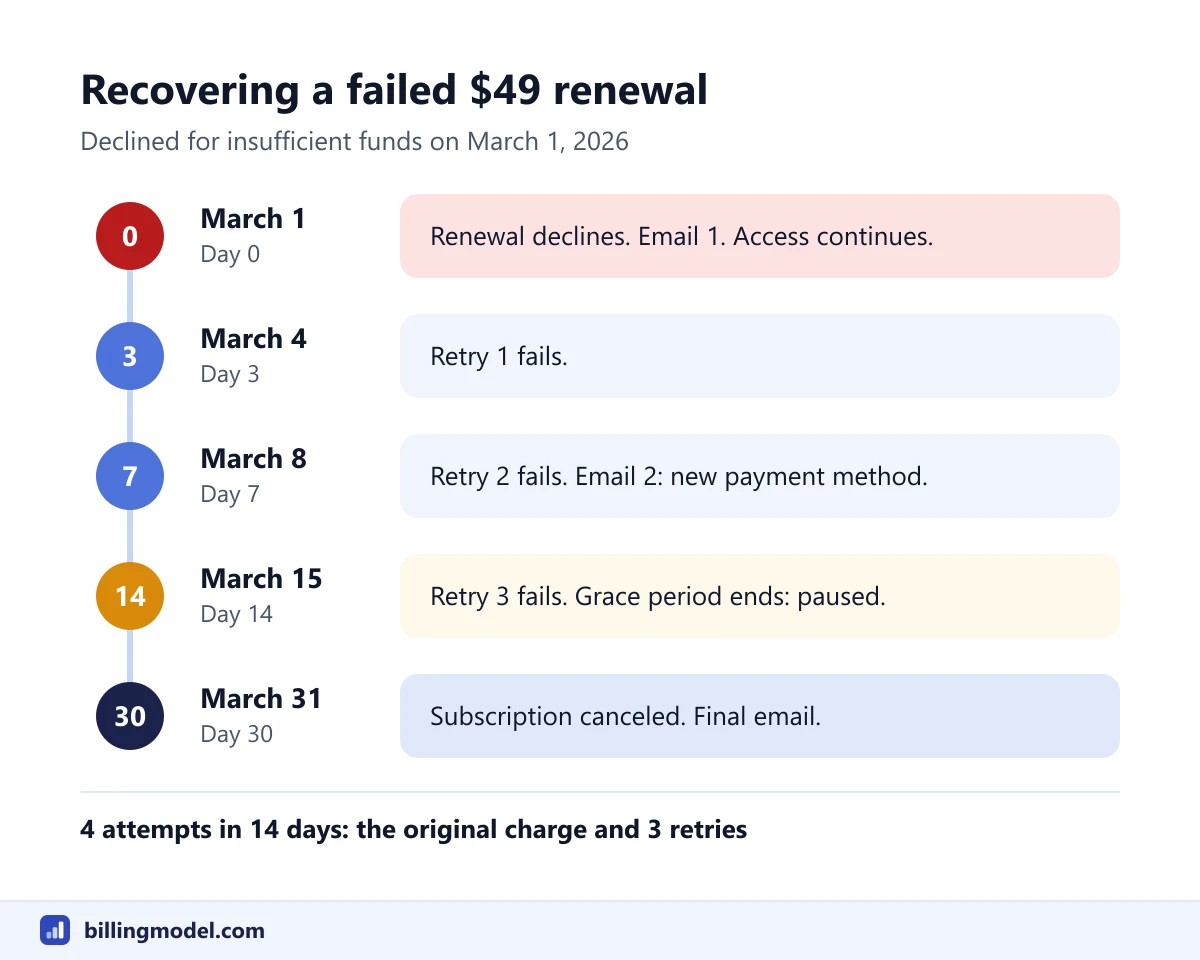 One failed renewal: three spaced retries, a 14-day grace period, then pause and cancel.
How failed renewals cause involuntary churn
Involuntary churn is the loss of customers who never decided to leave. Their payment failed and nobody fixed it. It belongs in your SaaS churn rate, but it has a different cause from a customer who cancels, so count it separately.
Here is the arithmetic with made-up numbers, for illustration only. A service has 1,000 subscribers at $49 a month, which is $49,000 of monthly recurring revenue. In one month, 60 renewals fail.
- With no follow-up, all 60 lapse: 60 × $49 = $2,940 of monthly revenue, and 60 ÷ 1,000 = 6.0% of subscribers.
- With the schedule above, 42 of the 60 pay within the grace period: 42 × $49 = $2,058 recovered.
- The other 18 are lost: 18 × $49 = $882, and 18 ÷ 1,000 = 1.8% involuntary churn for the month.
The check: $2,058 + $882 = $2,940. This article doesn't quote an industry benchmark for involuntary churn, because none of the regulators, card networks or universities consulted for it publishes one. Your own billing records will tell you more. Count failed renewals each month, how many were recovered, and at which step. The effect on revenue feeds straight into the monthly recurring revenue formula.
Mistakes that make a failed payment worse
- Retrying a hard decline. It can't succeed, and Visa's rules prohibit it for Category 1 codes.
- Retrying a different amount. Nacha treats a reinitiated debit for more or less than the original as improper, so a retried bank debit has to match the first one.
- Canceling without a word. A customer who first learns of the failure by losing access was never given a chance to fix it.
- Ignoring return rates on bank debits. Nacha's guidance sets a 0.5% threshold for debits returned as unauthorized and inquiry levels of 3.0% for account-data returns and 15.0% for all returns. Your bank watches these numbers.
- Adding a fee nobody agreed to. Whether you can charge for a failed payment, and how much, depends on your contract and local law. Ask a lawyer before adding one.
- Confusing a failure with a dispute. A decline means no money moved. A chargeback takes back money you already received, and chargeback prevention is a separate job.
Frequently asked questions
Is a declined payment the same as a failed payment?
A decline is one kind of failure. A card charge is declined at the moment of authorization, so you know at once. A bank debit can appear to succeed and then come back as a return a day or two later. Both leave you with an unpaid charge and a reason code to act on.
How many times can you retry a failed card payment?
It depends on the card network and the reason. Visa's published rule, in the 2020 notice and 2024 digest item cited above, allows up to 15 reattempts in 30 days for declines the issuer may approve later and none for declines it will never approve. The example schedule in this article uses three. Ask your processor or acquirer what applies to the other networks you accept.
Should I cancel a subscription as soon as a payment fails?
Usually not. Many failures are temporary, and a short grace period with clear messages recovers customers who want to stay. Set the length in your terms, and cancel only after the final notice has gone out.
Can I move the billing date after a failed payment?
You can, but decide the rule in advance. Keeping the original date is simpler for accounting and for the customer. If you shift it to the day the retry succeeded, say so in your terms and in the receipt. The guide to subscription billing explains how billing dates and renewals fit together.
What should the customer see when a payment fails?
A plain message with the amount, the date of the next attempt, the date access will change, and a link to update the payment method. Give the reason only in general terms, since the customer's bank is the one that can explain a decline.