Flat-rate pricing charges every customer the same fixed price for the same product over a set period, however much or little they use it. One plan, one number, one line on the invoice.
It is the easiest pricing model to explain and to bill. It also fits fewer businesses as they grow, because it ignores two things that differ from customer to customer: what they cost you to serve and what the product is worth to them.
This article covers a flat rate as the price of a product or subscription. A payment processor charging one percentage on every card transaction is a separate subject, covered under flat rate payment processing.
Quick answer: Flat-rate pricing means one fixed price per period for everyone, with no meter and no plan choice. Revenue = customers × price. It works while customers use and value the product about equally, and it stops working when a minority of heavy users drive most of your costs or when large customers would have paid far more.
What flat-rate pricing means
A flat rate is a fixed charge that doesn't depend on use. A Harvard Business School Working Knowledge article on subscription fees describes the flat-fee model as customers paying a fixed rate at regular intervals regardless of how much they use the product or service.
The practical consequence is that you don't need a meter. The US Environmental Protection Agency's guide to water bills makes the same distinction for utilities: under a flat fee every customer pays the same amount whatever they use, while a per-unit rate requires metering.
Two points of vocabulary save confusion later.
"Flat rate" in billing software is broader. Stripe's documentation on flat rate pricing, for example, uses the term for any fixed recurring price, including a set of service levels that each have their own flat rate. Its illustration is a Basic level at $10 a month or $100 a year. In this article, flat-rate pricing means the strict version: a single plan. Once you add a second plan you have tiered pricing.
A flat rate is not the same as a subscription. A subscription is how you bill: a charge that repeats until someone cancels. A flat rate is how the amount is set. Most flat rates are sold as subscriptions, and the guide to subscription billing covers that cycle.
Worked example: one price, two kinds of customer
The arithmetic of a flat rate is short. The interesting part is what it hides.
Take a hypothetical project tool sold at $40 per customer per month, with 400 customers. Fixed costs are $6,000 a month. Variable costs depend on how much each customer uses the product: 300 light users cost $4 a month each to serve and 100 heavy users cost $30 each.
- Revenue: 400 × $40 = $16,000.
- Variable cost: (300 × $4) + (100 × $30) = $1,200 + $3,000 = $4,200.
- Profit: $16,000 − $4,200 − $6,000 = $5,800.
Every customer pays $40, but they aren't equally profitable. A light user leaves $40 − $4 = $36 after variable cost. A heavy user leaves $40 − $30 = $10. Heavy users are 25% of customers and $3,000 ÷ $4,200 = 71% of variable cost.
Now suppose the product gets popular with heavy users and the mix shifts to 200 of each. Revenue is still $16,000.
| 25% heavy users | 50% heavy users | |
|---|---|---|
| Customers (light / heavy) | 300 / 100 | 200 / 200 |
| Revenue | $16,000 | $16,000 |
| Variable cost | $4,200 | $6,800 |
| Fixed cost | $6,000 | $6,000 |
| Profit | $5,800 | $3,200 |
| Average cost per customer | $25.50 | $32.00 |
Profit falls by $2,600, or about 45%, without a single customer leaving or a single price changing. Push the mix further and the plan loses money once 324 of the 400 customers are heavy users. Nothing on a revenue report would show the problem, because revenue never moved.
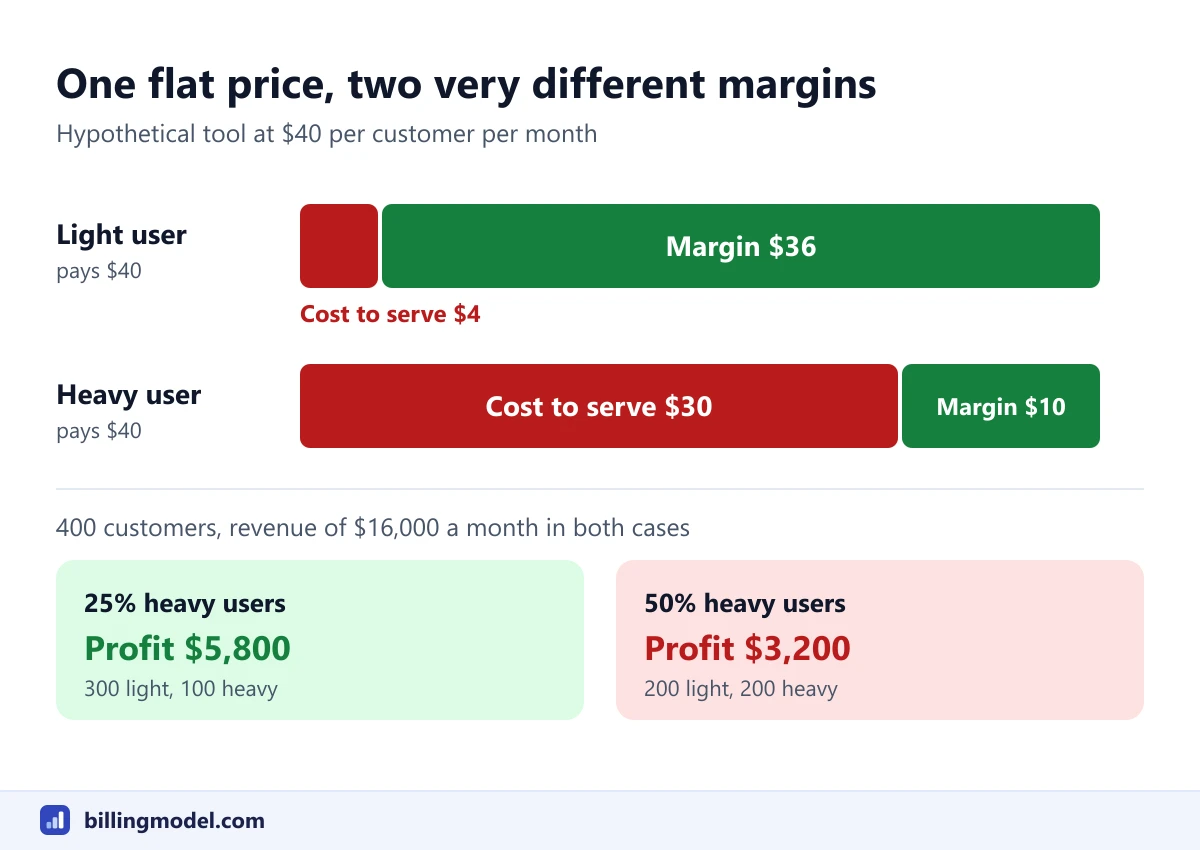 The same $40 price leaves $36 from a light user and $10 from a heavy one.
OpenStax's managerial accounting textbook supplies the terms: a fixed cost doesn't change in total with activity, and a variable cost moves in direct proportion to it. A flat price is safe against the first kind and exposed to the second.
Why customers like a flat rate
Customers often prefer a flat rate even when it costs them more. Researchers call this the flat-rate bias, and two well-known studies measured it.
Anja Lambrecht and Bernd Skiera analyzed 10,882 customers of a European internet provider in a Journal of Marketing Research paper. Over five months, depending on the tariff, up to 46.4% of customers were on a bigger plan than their usage justified, against up to 5.8% who erred the other way. More than half of the first group paid at least double what the cheapest tariff would have cost them. The authors point to three causes:
- Insurance. A fixed bill protects against an expensive month.
- The taxi meter. Watching charges add up makes a service less enjoyable to use.
- Overestimation. People expect to use more than they do.
Stefano DellaVigna and Ulrike Malmendier found the same pattern in gyms. In "Paying Not to Go to the Gym", a study of 7,752 members of three US health clubs, members on a flat monthly fee of more than $70 attended 4.3 times a month on average. The authors put the price per expected visit at more than $17, when a 10-visit pass would have cost $10 a visit.
Read these results carefully. Both studies date from 2006 and cover consumers buying internet access and gym memberships. They show that predictability has real value to buyers. They don't promise that business customers will overpay for your product.
There is also a catch. Lambrecht and Skiera found that customers overpaying on a flat rate were not significantly more likely to leave. But in a Harvard Business School interview on the psychology of pricing, professor John Gourville argues that use drives renewal: health club members who pay monthly keep the cost in view, keep attending and are more likely to renew than members who pay once a year and drift away. A flat-rate customer who stops using the product is a cancellation waiting for a reminder, so track usage alongside your SaaS churn rate.
Flat rate compared with usage-based and tiered pricing
The three models split the same risks differently.
| Flat rate | Usage-based | Tiered plans | |
|---|---|---|---|
| What the customer pays | The same fixed price every period | Units used × unit price | The fixed price of the plan they fit |
| Predictability of the bill | Complete | Low without an allowance or commitment | High, with jumps at plan limits |
| Metering | None | Required | Only to enforce limits |
| Light users | Pay as much as everyone else | Pay little | Choose the small plan |
| Heavy users | Get the most for the price | Pay the most | Move up a plan |
| More revenue from existing customers | Only through a price increase | Rises with use | Rises with upgrades |
The guides to usage-based pricing and to SaaS pricing models go through the alternatives in detail.
When flat-rate pricing stops working
Flat-rate pricing fails quietly, because revenue keeps arriving while the economics underneath shift. Four signs are worth watching.
Cost to serve is concentrated. If a quarter of your customers generate most of your variable cost, as in the worked example, every new heavy user makes the average customer less profitable. A flat price gives them no reason to use less. The EPA guide says flat fees are rarely used for water today and do little to encourage efficient use. A study presented at an MIT Sloan seminar found that when Chinese households moved from a fixed, unmetered heating payment to consumption-based billing, heating use fell by 37% over four years.
Customers differ widely in what they would pay. One price is too high for the smallest buyers and too low for the largest. MIT Sloan's course notes on price discrimination work through a seller with two customer groups: charging each group its own price ($35 and $27.50) earns $27,812.50, and being held to a single price of $32.50 earns $25,937.50. The single price costs that seller $1,875.
Revenue per customer can't grow. With one plan there's nothing to upgrade to, so net revenue retention can only reach 100% if nobody leaves, and growth has to come from new customers or a price increase.
You start writing exceptions. Fair-use clauses, custom quotes for big accounts and discounts for small ones are all signs that the single price no longer describes how you sell.
The usual next step keeps the flat rate and adds to it: a second plan for larger customers, or an allowance with a per-unit charge above it. The internet provider in the Lambrecht and Skiera study sold exactly that, a fixed fee with a monthly allowance and a price per megabyte beyond it, alongside its unlimited flat rate.
When a flat rate is the right choice
A single flat price is a sound choice under three conditions. Customers use the product in roughly similar amounts. Serving one more unit of use costs you close to nothing. And the price is low enough that buyers value a quick decision over a tailored deal.
Early products often meet all three. A flat rate also keeps billing simple: one recurring amount, no usage data to collect and no usage count for a customer to question. Treat it as a starting point and check the customer mix every few months, as in the table above.
Frequently asked questions
What is an example of flat-rate pricing?
A gym that charges one monthly fee for unlimited visits is the classic case. In software, it is a product with a single plan, such as the hypothetical $40 a month project tool above, where every customer gets the same features at the same price.
Is flat-rate pricing the same as a subscription?
No. A subscription describes the billing schedule, a charge that repeats. Flat-rate pricing describes the amount, which is the same for everyone. A subscription can also be priced per user, by usage or in tiers.
Can you combine a flat rate with usage charges?
Yes. A common hybrid is a fixed fee that includes an allowance, with a per-unit price above it. Customers keep a predictable base bill and heavy users pay for the extra cost they create.
Is flat-rate pricing a good fit for SaaS?
It fits a simple product with similar customers and low variable costs. It fits poorly once customers range from small teams to large companies, because one price can't match what each of them costs to serve or would pay.
How do you set a flat-rate price?
Start with the average cost per customer, fixed and variable together, which was $25.50 in the example, and price above it. Then test the result against the heaviest users you expect and against what customers say the product is worth to them.