Subscription model examples go well beyond streaming and software. The same model sells warehouse club memberships, pet food, clothing and cloud computing. What they share is a repeating charge. What separates them is what the customer receives, and that decides how each one bills and where it can break.
This article sorts subscription businesses into six types and describes one or two real companies for each, using the companies' own annual reports. Naming a company here is not a recommendation.
Quick answer: This article uses six types: access or membership (a fixed fee for the right to use something), replenishment (a consumable shipped on a schedule), curation (a box chosen for you), software, media, and usage-based services. Memberships, software and media charge a fixed recurring fee. Replenishment charges per shipment, and usage-based services charge for what was consumed.
What counts as a subscription model
A subscription is a recurring fee for continued access to something. Harvard Business School Online defines it as a program in which a user pays a recurring fee for access to certain specified benefits, and gives magazines, streaming services, and grocery and wine delivery as cases.
A Harvard Business School Working Knowledge article notes that subscriptions now reach beyond software and phone apps to toothbrushes, razors, pet food and apparel.
Regulators classify the same businesses by how the customer ends up being charged. A US Federal Trade Commission notice published in the Federal Register in March 2026 lists four kinds of "negative option" marketing, where a customer's silence is treated as agreement:
- Prenotification plans, such as product-of-the-month clubs, which ship unless the customer declines.
- Continuity plans, such as bottled water delivery, where the customer agrees in advance to periodic shipments until they cancel.
- Automatic renewals, such as a magazine subscription that renews when it expires.
- Free-to-pay conversions, where a free or low-cost trial turns into a paid plan.
The six types below are this article's own grouping, by what the customer receives. One company can belong to more than one.
Six subscription model examples in one table
| Type | What the customer gets | How it bills | Example from a filing | What it must get right |
|---|---|---|---|---|
| Access or membership | The right to use a place or a set of benefits | A fixed fee per month or year | Costco, Planet Fitness | Renewal, because the fee is paid whether or not the member shows up |
| Replenishment | A consumable delivered on a schedule | A charge for each shipment | Chewy's Autoship program | Logistics and delivery timing |
| Curation | Items selected for the customer | A fee per box, credited toward the price of what is kept | Stitch Fix | Selection, inventory and returns |
| Software | Access to hosted software | Per plan or per user, monthly or annually in advance | Dropbox, Box | Turning free users into paying ones, and renewals |
| Media | A library of content or journalism | A recurring fee that depends on the plan, monthly at Netflix | Netflix, The New York Times | Enough use that the fee feels worth paying |
| Usage-based | A metered service | Units consumed × a unit price, sometimes with a base fee | Snowflake, metered water utilities | Accurate metering and a bill the customer can anticipate |
The examples, type by type
The subscription model examples below are described from the linked annual reports. All figures were checked in October 2026.
Access or membership
The customer pays for the right to use something, and the fee doesn't depend on how much they use it.
Costco's annual report for the year ended August 30, 2026 says the annual membership fee is $65 in the United States and varies in other countries, with an upgrade to Executive membership for an additional annual fee. The company reports 84.1 million paid members and membership fees of $5,907 million for the year. Its renewal rate was 92.3% in the US and Canada and 89.8% worldwide.
Planet Fitness bills monthly instead. Its report for 2025 lists monthly dues starting at $15 for new members on its standard Classic Card, a standard annual fee of $49 and enrollment fees of $0 to $59, across about 20.8 million members. It says electronic funds transfer is its primary collection method and that approximately 87% of membership fee payments are collected by ACH direct debit, the subject of the guide to the recurring ACH payment.
Replenishment
The customer receives a product they would run out of, on a schedule, without reordering.
Chewy, an online retailer of pet products, calls its version the Autoship subscription program. Its report for the year ended February 1, 2026 puts Autoship customer sales, a measure the filing defines, at $10,497.1 million, or 83.3% of net sales. The filing says net sales are recorded when products are shipped, so revenue follows shipments and not the calendar.
Curation
Someone else chooses the items, and the customer pays for what they keep.
Stitch Fix's report for the year ended August 1, 2026 describes a "Fix": a box of apparel, shoes and accessories informed by its algorithms and chosen by its stylists. Clients can keep some, all or none of the items. The company charges a $20 styling fee per Fix, credited toward anything purchased. Clients can receive Fixes on a regular cadence or schedule a single one, and the company counted about 2,277,000 active clients.
Software
The customer pays a recurring fee for access to hosted software. Dropbox's report for 2025 describes a free Basic plan beside paid Personal and Business plans and a choice of annual or monthly plans, and says the company typically bills customers at the beginning of each term. Box's report for the year ended January 31, 2026 says its subscription fees are based on customer requirements, including the number of users, under contracts of one to three years or more. The structures are compared in SaaS pricing models.
Media
The customer pays for access to content, and the price depends on the plan.
Netflix's report for 2025 says its revenues are primarily derived from monthly membership fees, with paid plans priced from the US dollar equivalent of $1 to $37 per month at December 31, 2025. Its range of plans includes an ad-supported one. The New York Times Company reported approximately 12.78 million subscribers at the end of 2025, about 12.21 million of them digital-only. It says registered users generally get free access to a limited amount of content before a subscription is required.
Usage-based
The recurring part is the relationship and the billing date. The amount changes every period.
Snowflake's report for the year ended January 31, 2026 describes a consumption-based business model meant to ensure customers pay only for what they use. Metered utilities are the older version. The US Environmental Protection Agency's guide to water bills describes a uniform rate as a constant price for every metered unit, and says many utilities combine a fixed base fee with a variable fee for volume. The mechanics are in usage-based pricing.
Worked example: one year of charges under each type
The numbers below are invented to show how the billing differs. They are not taken from the companies above and are not benchmarks.
| Type | Illustrative terms | What happened in the year | Calculation | Paid in the year |
|---|---|---|---|---|
| Membership | $50 annual fee | One charge on day one | 1 × $50 | $50 |
| Replenishment | $48 per shipment, every 4 weeks | 13 shipments planned, 2 skipped | 11 × $48 | $528 |
| Curation | $15 fee per box, credited against purchases | 4 boxes: $90 of items kept from each of 3, nothing from 1 | (3 × $90) + (1 × $15) | $285 |
| Software | $12 per month | Stayed all year | 12 × $12 | $144 |
| Media | $15 per month | Canceled after month 7 | 7 × $15 | $105 |
| Usage-based | $10 base + $0.05 per unit | 200 units in 9 months, 400 units in 3 | (9 × $20) + (3 × $30) | $270 |
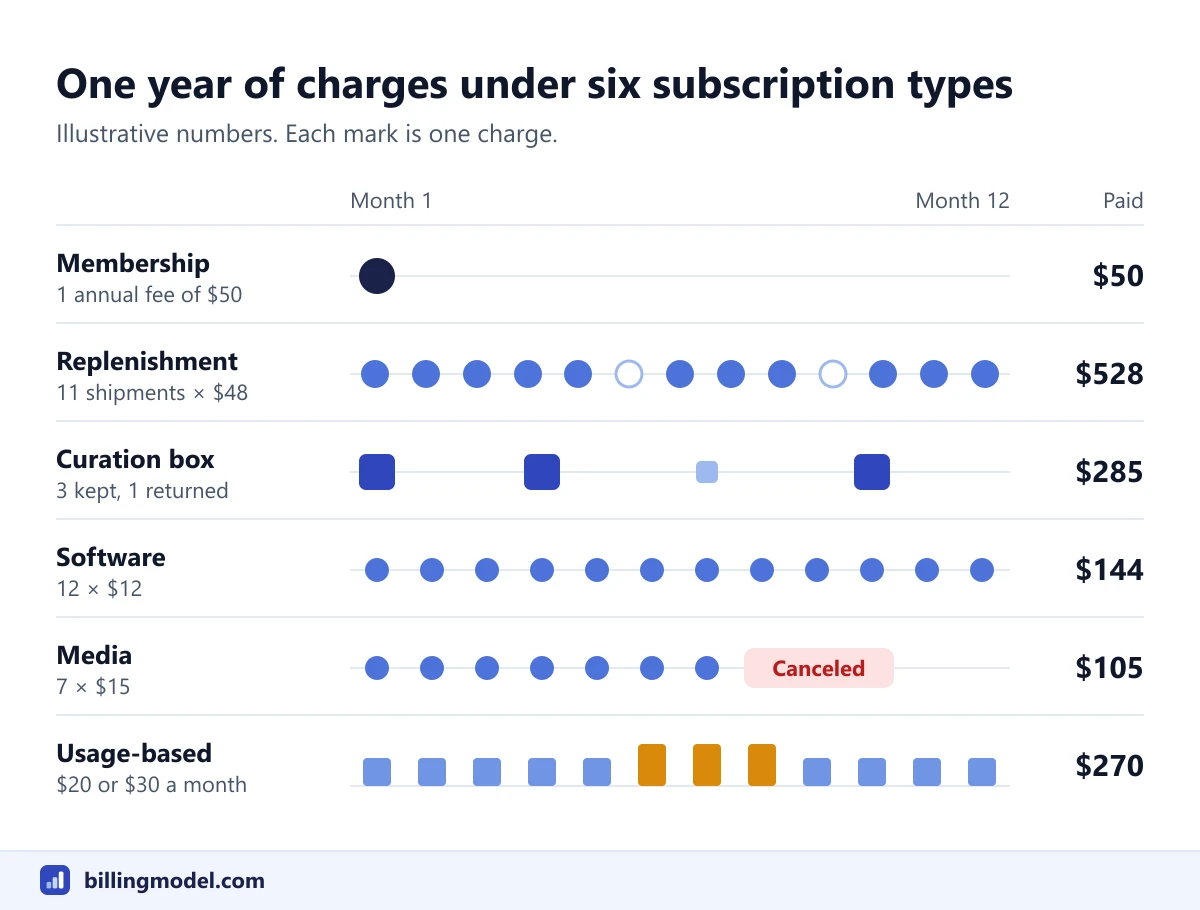 When each type charges over 12 months, and what the customer paid by the end.
Three things stand out. The membership collects once, before any value is delivered, and then has no further contact with the customer's wallet until renewal. The replenishment and curation totals depend on what the customer does: skip two shipments and $96 disappears, return a whole box and that box earns $15 instead of $90. And the usage-based total can't be known in advance at all. A base month is $10 + (200 × $0.05) = $20, and a heavy month is $10 + (400 × $0.05) = $30.
What each type has to get right
Every subscription business has the same underlying problem. Paul Healy, writing for Harvard Business School Online, says a subscription business has to provide reliable value over time and needs very strong operations to do it. Where that is hardest depends on the type.
Membership: renewal. The fee is paid in advance, so the test comes once a year. That is why Costco publishes a renewal rate, which it calculates on a trailing basis from renewals in the period seven to eighteen months before the reporting date.
Replenishment and curation: operations. These models ship physical goods on every cycle. Chewy says it uses fulfillment centers located in the US and Canada and that high participation in Autoship supports the use of its distribution network. Stitch Fix lists inventory management among its risk factors and says it has not always predicted demand and clients' preferences accurately.
Software and media: use. A customer who stops using the product is one billing date away from canceling. Netflix's risk factors say members cancel for many reasons, including a perception that they do not use the service sufficiently. Cancellations are measured as churn, explained in SaaS churn rate.
Usage-based: the meter. The EPA guide points out that a per-unit rate requires metered service. If customers can't check or predict the count, expect disputed bills.
All of them: payment. A subscription that can't collect its renewal loses the customer without anyone deciding to leave. Planet Fitness says ACH debits have advantages over credit cards, including less frequent expiration of billing information. The guide to a failed payment covers what to do when a charge doesn't go through.
Auto-renewing plans also carry disclosure and cancellation rules that vary by country and state. The subscription billing guide summarizes them, and a lawyer should review the sign-up flow.
Real businesses mix the types
Several of the filings above describe combinations. Costco sells a base membership and an upgrade. Planet Fitness charges monthly dues and an annual fee. Stitch Fix offers a recurring cadence and one-time boxes, plus a $49 annual pass for unlimited styling. The New York Times gives registered readers limited free access before a paid plan, which is close to the freemium pricing used in software.
Choosing the type is the first decision. How the price itself is built, from fixed fees to hybrid plans, is covered in subscription pricing models.
Frequently asked questions
What are the main types of subscription business models?
There is no single official list. This article uses six: access or membership, replenishment, curation, software, media and usage-based. The FTC sorts them differently, by how the customer is charged: prenotification plans, continuity plans, automatic renewals and free-to-pay conversions.
What is an example of a replenishment subscription?
A program that ships a consumable on a schedule, such as pet food every four weeks. Chewy's Autoship program is one that a public company describes in its annual report. The FTC's term for this pattern is a continuity plan, and its own illustration is bottled water delivery.
Which subscription model has the lowest churn?
No source opened for this article compares churn across the types on a consistent basis. Companies publish their own measures, such as Costco's renewal rate, and define them differently.
How do subscription businesses bill their customers?
It depends on the type. Memberships, software and media charge a fixed fee each month or year, and Dropbox, for one, says it typically bills at the beginning of the term. Replenishment revenue follows shipments. Usage can only be charged once the quantity is known.