A SaaS churn rate is the percentage of customers, or of recurring revenue, that a subscription software business loses in a given period. You divide what you lost during the period by what you had at the start of it.
The arithmetic fits on one line. The difficulty is in the choices around it: which customers count, how long the period is, and whether you are counting accounts or dollars. Two companies can both report "2% churn" and mean different things.
Quick answer: Customer churn rate = customers lost in the period ÷ customers at the start of the period. Revenue churn rate does the same with recurring revenue. To turn a monthly rate into an annual one, compound it: annual churn = 1 − (1 − monthly churn)^12. A 3% monthly rate is 30.6% a year, not 36%.
What SaaS churn rate measures
Churn is the mirror image of retention. Harvard Business School Online defines the customer churn rate as "the percentage of customers that stop doing business with you in a given period," and the retention rate as the percentage you keep in a set timeframe. Measured on the same group, the two add up to 100%.
A subscription business can observe churn directly, because a customer has to cancel or fail to renew. Businesses without contracts can't. In a Knowledge at Wharton interview, Wharton's Peter Fader and Emory's Daniel McCarthy explain that a retailer has to infer from purchase patterns when a customer has gone, which is one reason subscription companies are easier to analyze.
There are two versions of the number:
- Customer churn, also called logo churn, counts accounts. It tells you how many relationships ended.
- Revenue churn counts recurring revenue. It tells you how much monthly income went with those customers, plus what you lost when remaining customers moved to cheaper plans.
The churn rate formula for customers and revenue
Every version has the same shape: losses during the period on top, the opening balance underneath.
| Measure | Formula | What it tells you |
|---|---|---|
| Customer (logo) churn rate | Customers who canceled in the period ÷ customers at the start of the period | Share of accounts lost |
| Gross revenue churn rate | (MRR lost to cancellations + MRR lost to downgrades) ÷ MRR at the start of the period | Share of recurring revenue lost |
| Net revenue churn rate | (MRR lost − expansion MRR from existing customers) ÷ MRR at the start of the period | Loss after upgrades; can be negative |
MRR is monthly recurring revenue, the subscription fees your current customers pay per month. The monthly recurring revenue formula explains what goes into it. Gross revenue churn is 100% minus gross revenue retention, and net revenue churn is 100% minus the result of the net revenue retention formula.
Revenue churn is measured in MRR, an operating figure, not in the revenue reported in financial statements. How the revenue from a specific contract is recognized depends on its terms and should be confirmed with a qualified accountant.
The denominator is the opening balance because everyone in the numerator has to come from the group in the denominator. Academic work on retention is built the same way. In a Marketing Science paper, Peter Fader and Bruce Hardie define a group's retention rate for a period as the proportion of customers active at the end of the previous period who are still active in this one.
A worked monthly example
A software company starts March 2026 with 400 customers and $40,000 of MRR. During March:
- 12 customers cancel. Together they were paying $720 a month.
- 5 customers downgrade, which cuts their combined MRR by $280.
- Existing customers who upgrade add $600 of MRR.
- 30 new customers sign up.
Step 1, customer churn: 12 ÷ 400 = 3.0%.
Step 2, gross revenue churn: ($720 + $280) ÷ $40,000 = $1,000 ÷ $40,000 = 2.5%.
Step 3, net revenue churn: ($1,000 − $600) ÷ $40,000 = $400 ÷ $40,000 = 1.0%.
| Measure | Lost in March | Opening balance | Rate |
|---|---|---|---|
| Customer churn | 12 customers | 400 customers | 3.0% |
| Gross revenue churn | $1,000 MRR | $40,000 MRR | 2.5% |
| Net revenue churn | $400 MRR | $40,000 MRR | 1.0% |
The 30 new customers appear nowhere in these sums. They change the closing count (400 − 12 + 30 = 418), but they weren't there on March 1.
The customer and revenue figures differ for a reason. The 12 accounts that left paid $60 a month on average, against $100 across the whole base ($40,000 ÷ 400). Cancellations alone removed only 1.8% of MRR ($720 ÷ $40,000). Had one large account left instead, customer churn would look small and revenue churn large. That is why you track both.
Converting monthly churn to annual churn
Monthly churn compounds, so you can't multiply it by 12. Each month's 3% is taken from the customers who are still there, not from the original 400. After one month 388 remain, and the next 3% is 3% of 388.
The conversion is:
Annual churn = 1 − (1 − monthly churn)^12
With 3% a month, 0.97 raised to the 12th power is 0.6938. Annual churn is 1 − 0.6938 = 30.6%. Of the 400 customers you started with, about 278 are left after 12 months and about 122 are gone. Multiplying 3% by 12 gives 36%, or 144 customers, which overstates the loss by 22.
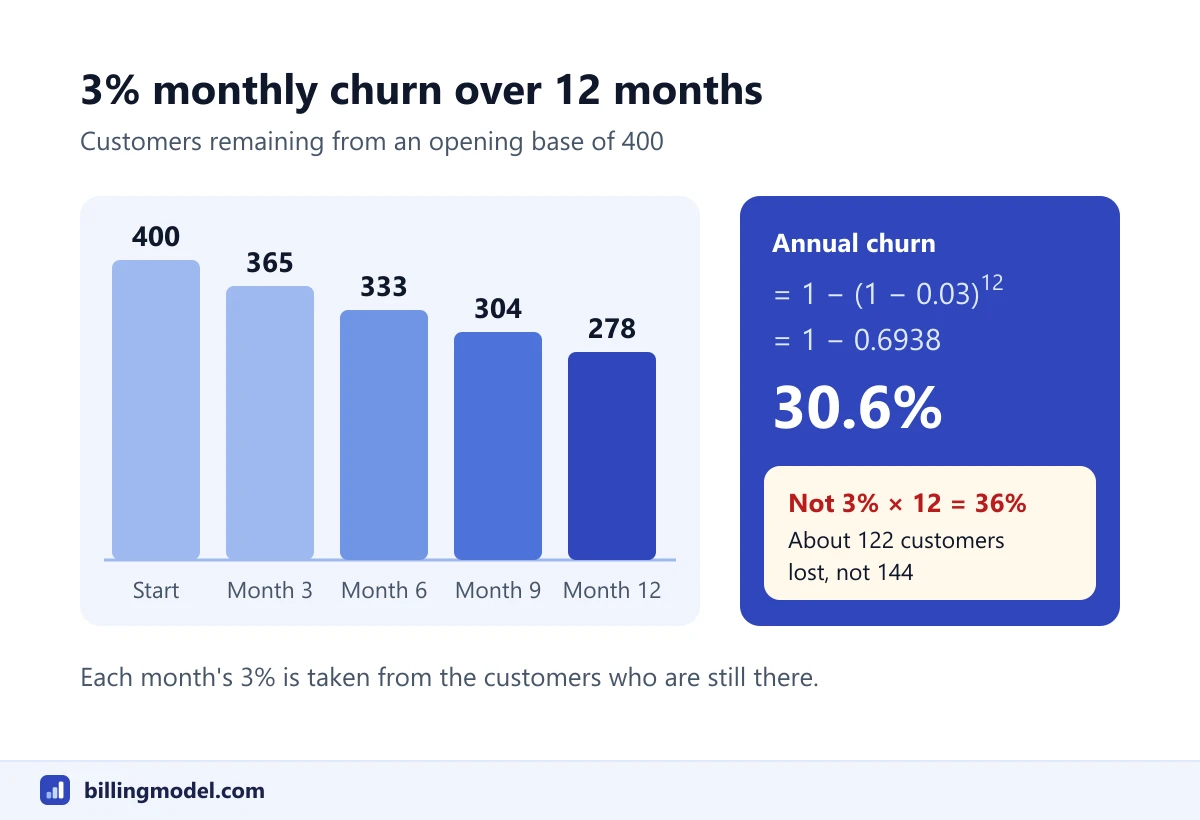 Customers remaining from an opening base of 400 at 3% monthly churn. The annual rate is 30.6%.
To go the other way, use monthly churn = 1 − (1 − annual churn)^(1/12). An annual rate of 20% is 1 − 0.8^(1/12) = 1.84% a month, not 20 ÷ 12 = 1.67%.
| Monthly churn | Multiplied by 12 (wrong) | Compounded annual churn |
|---|---|---|
| 1% | 12% | 11.4% |
| 2% | 24% | 21.5% |
| 3% | 36% | 30.6% |
| 5% | 60% | 46.0% |
| 10% | 120% | 71.8% |
These rows are arithmetic, not benchmarks. The last one shows why the shortcut fails: you can't lose 120% of your customers.
Watch out: Compounding assumes the same rate applies every month, and for a group of customers who joined together it usually doesn't. Fader and Hardie show that the customers most likely to leave go first, so a group's retention rate rises as it ages even if no individual changes behavior. In their illustration, a third of the group renews each year with probability 0.9 and two-thirds with probability 0.5. The group's annual retention climbs from 63.3% in year one to 79.8% in year four. An annual figure projected from a young customer base will tend to be too high.
Common mistakes in a SaaS churn rate calculation
Putting new customers in the denominator. In the example, 12 ÷ 430 (opening customers plus March sign-ups) gives 2.8%, and 12 ÷ 418 (the closing count) gives 2.9%. Both flatter the result, and the faster you grow, the more they flatter it.
Mixing monthly and annual plans. A customer on an annual contract can only leave at renewal. In a month when few contracts come up for renewal, a blended rate looks low for reasons that have nothing to do with how satisfied customers are. Suppose the 400 customers are 300 on monthly plans and 100 on annual contracts, 8 of which were due to renew in March. If 11 monthly customers and 1 annual customer left, monthly-plan churn is 11 ÷ 300 = 3.7%, and the annual plans lost 1 of the 8 contracts due, or 12.5%. The blended 3.0% describes neither group.
Multiplying a monthly rate by 12. Use the compounding formula above.
Counting plan changes as lost customers. A downgrade is lost revenue from a customer you kept. It belongs in revenue churn only. Decide how pauses and returning customers are treated, too.
Changing the definition without saying so. There is no official definition, so consistency is what makes your number usable. Public companies show how much room there is. Peloton's annual report for fiscal 2022 takes quarterly cancellations net of reactivations, divides by the average number of subscriptions at the beginning of each month, then divides by three. Sirius XM's annual report for 2025 divides the monthly average of self-pay deactivations by the average number of self-pay subscribers for the period. One uses opening balances and the other an average, and only one nets off reactivations.
The US Securities and Exchange Commission's 2020 guidance on metrics says it generally expects a metric to come with a clear definition and an explanation of how it is calculated, and that a company changing its method should consider disclosing the change and its effect. That guidance is written for listed companies, but the habit is worth copying: write your definition down and keep it.
Voluntary and involuntary churn
Voluntary churn is a customer deciding to leave. Involuntary churn is a subscription that ends because a payment failed and was never recovered: an expired card, insufficient funds or a bank decline.
Large subscription businesses track the two separately. Sirius XM's report, for example, discusses "voluntary and non-pay churn" as distinct drivers of its subscriber numbers.
The split matters because the fixes are different. Voluntary churn is a product, pricing or service problem. Involuntary churn is a billing problem, and retries, reminders and card updates can recover part of it. The guide to handling a failed payment covers that process. If your subscription billing system records a reason for every cancellation, you can report the two rates separately from day one.
Frequently asked questions
What is a good SaaS churn rate?
It depends on who your customers are, how long their contracts run and what they pay, so a single target is misleading. The article on the average churn rate for SaaS looks at published benchmark data. For day-to-day use, compare your own rate with your own history, using one definition throughout.
What is the difference between customer churn and revenue churn?
Customer churn counts accounts lost and treats every customer the same. Revenue churn counts recurring revenue lost, so a large account weighs more than a small one, and downgrades are included. In the example above the same month produces 3.0% customer churn and 2.5% gross revenue churn.
Can revenue churn be negative?
Net revenue churn can. If upgrades from existing customers add more MRR than cancellations and downgrades remove, the result is below zero, which is the same as net revenue retention above 100%. Gross revenue churn and customer churn can't be negative, because they ignore expansion.
How do you convert annual churn to monthly churn?
Use monthly churn = 1 − (1 − annual churn)^(1/12). An annual rate of 20% works out to about 1.84% a month. Dividing by 12 gives 1.67%, which is too low, for the same reason that multiplying a monthly rate by 12 is too high.
Do new customers count in the churn rate?
Not in the denominator for the period in which they joined. The standard calculation starts from the customers you had on the first day and asks how many of those were lost. New customers enter the opening balance of the next period.