ACH processing fees are what a US business pays its bank or payment processor to move money directly between bank accounts over the ACH network. Unlike card fees, they are usually a flat amount per payment, or a small percentage with a cap, so the cost barely moves as the invoice gets bigger.
A Federal Reserve Bank of Kansas City briefing puts the median fee at $0.25 to $0.50 per ACH payment for the business on either side. The same briefing reports a median of 2.0% to 2.5% for a business receiving a credit card payment.
Quick answer: ACH processing fees are typically a flat fee per transaction (a median of $0.25 to $0.50 in Kansas City Fed research) or a percentage with a cap, plus possible monthly, return and same-day charges. On a $5,000 invoice that is $0.50 to $5.00, against $100 or more by credit card.
What ACH processing fees are
ACH stands for automated clearing house, the US network that carries payroll deposits, bill payments and a large share of business-to-business payments. The Federal Reserve Payments Study counted 39.7 billion ACH payments worth $104.06 trillion in 2024.
A business doesn't connect to the network itself. It sends payment instructions to its bank, sometimes through a payment processor, and the bank passes them to one of two ACH operators, the Federal Reserve or The Clearing House. Nacha, the body that writes the network's rules, sets out the full chain in its explanation of how ACH payments work.
Your fee is the price your bank or processor charges for that service. Underneath it sit the network's own costs, which are tiny. The difference covers the provider's own costs, its risk and its margin.
ACH is a US system. Businesses elsewhere use local equivalents with their own pricing, such as SEPA Direct Debit for euro payments and Bacs in the United Kingdom.
The kinds of ACH fees you'll see
Most price lists combine a per-transaction fee with a few fixed or occasional charges.
| Fee | How it works | A published example |
|---|---|---|
| Flat per-transaction fee | The same amount for every payment, whatever its size | $0.50 per ACH payment |
| Percentage with a cap | A percentage of the payment, up to a maximum | 0.8% with a $5.00 cap |
| Monthly fee | A fixed charge for having the service | Varies by bank and contract |
| Batch or file fee | A charge each time you send a file of payments | Varies by bank and contract |
| Return fee | Charged when a payment bounces back | $5.00 per returned payment |
| Same-day surcharge | Extra for faster settlement | Varies. See the network cost below |
| Account verification | Checking that an account is real before debiting | $1.50 per instant verification |
The flat fee and the return fee are the ACH charges listed on the University of Washington's merchant fee page. The capped percentage and the verification fee are from Stripe's US pricing page, which lists verification by micro-deposit as free. Both were checked in October 2026. They show two common structures and are not recommendations.
For a wider sample, the Kansas City Fed's briefing on business-to-business payments (September 2026) describes ACH pricing as a per-transaction fee that is the same whatever the value, with a median of $0.25 to $0.50 for both the sending and the receiving organization. Checks came in at a median of $1 to send. Wires were $7. The briefing takes these fee figures from a 2022 survey by the Association for Financial Professionals.
A bank's own ACH price list may have more lines than these examples. Ask for the full schedule, and ask what a return costs. The per-item price alone doesn't tell you what a month will cost.
What the network itself charges
The wholesale cost of an ACH payment is a fraction of a cent. The Federal Reserve publishes what it charges banks in its FedACH fee schedule (effective January 1, 2026; checked October 2026). The schedule also lists fees that Nacha sets and the Fed collects.
| Network-level fee | Amount | Paid by |
|---|---|---|
| FedACH origination, per item | $0.0035 | Originating bank |
| Addenda record (extra remittance detail) | $0.0015 | Originating bank |
| Same-day surcharge, per forward item | $0.0010 | Originating bank |
| Nacha admin network fee, per entry | $0.000185 | Originating bank |
| Nacha Same Day Entry fee, per item | $0.052 | Originating bank, credited to the receiving bank |
| Nacha Unauthorized Entry fee, per item | $4.50 | Originating bank, credited to the receiving bank |
| FedACH receipt of a return item | $0.0075 | Bank that receives the returned item |
Add the lines for an ordinary next-day payment and the originating bank pays $0.0035 + $0.000185 = $0.003685, a little over a third of a cent. Make it same-day and the total is $0.003685 + $0.0010 + $0.052 = $0.056685, under six cents.
Banks also pay fixed monthly amounts. The schedule lists a minimum of $55.00 a month for forward origination and a participation fee of $80.00 a month per routing number. Volume discounts start above 750,000 items a month.
Note: These are the Federal Reserve's prices to banks, not prices to businesses. The Clearing House, the other operator, sets its own. What you pay is whatever your bank or processor quotes.
ACH against a card on one $5,000 invoice
ACH is usually cheaper than a card on a large invoice because its fee is flat or capped while a card fee is a percentage with no ceiling. Take a $5,000 invoice and apply the published figures above.
| Payment method | Fee basis | Fee on $5,000 | As a share |
|---|---|---|---|
| ACH, flat fee | $0.50 per payment | $0.50 | 0.01% |
| ACH, capped percentage | 0.8%, capped at $5.00 | $5.00 | 0.10% |
| Credit card, low end of the median | 2.0% | $100.00 | 2.00% |
| Credit card, high end of the median | 2.5% | $125.00 | 2.50% |
| Credit card, published flat rate | 2.9% + $0.30 | $145.30 | 2.91% |
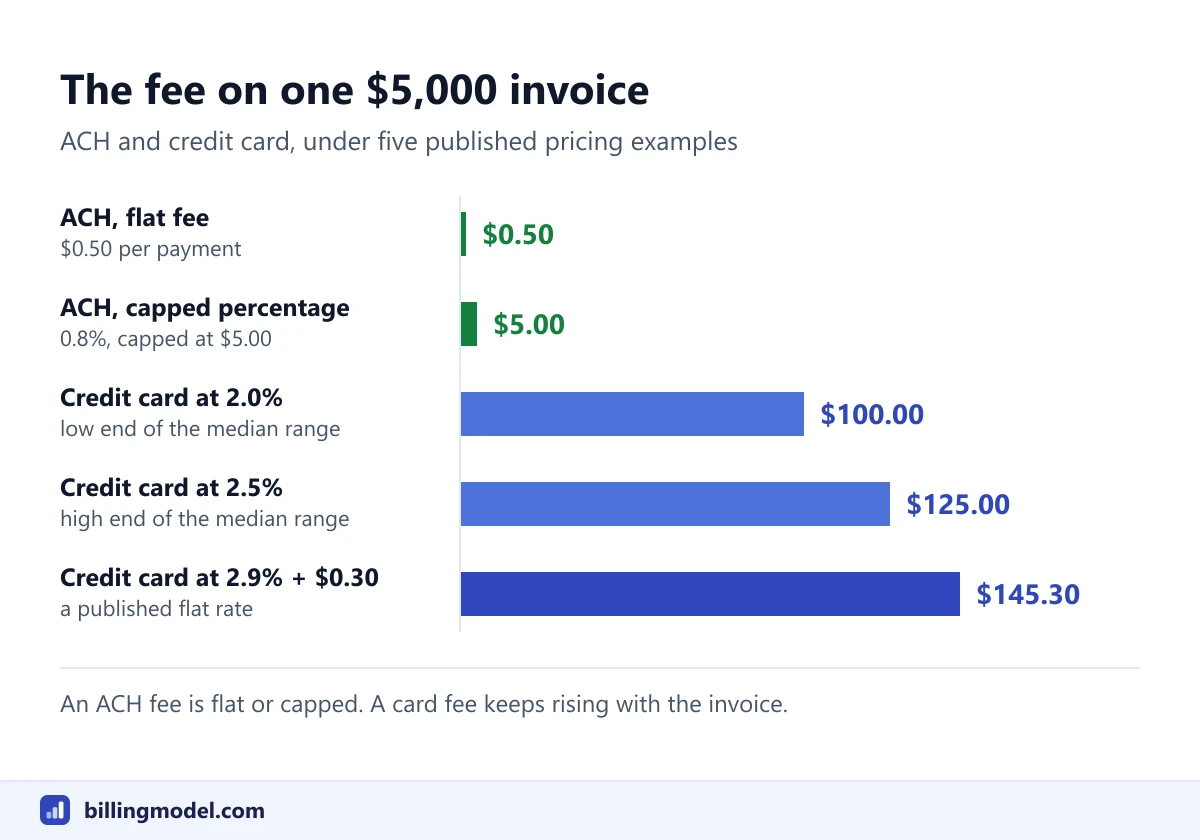 The fee on one $5,000 invoice under five published pricing examples.
The arithmetic for each row:
- Flat ACH: $0.50, and $0.50 ÷ $5,000 = 0.01%.
- Capped ACH: 0.8% × $5,000 = $40.00, which is above the cap, so the fee is $5.00.
- Card at 2.0%: 0.02 × $5,000 = $100.00.
- Card at 2.5%: 0.025 × $5,000 = $125.00.
- Card at 2.9% + $0.30: $145.00 + $0.30 = $145.30.
The two card percentages are the Kansas City Fed's median range for a business receiving a credit card payment. The flat card rate is the standard domestic rate on Stripe's pricing page.
The cap is what matters on the percentage plan. At 0.8% it is reached at $5.00 ÷ 0.008 = $625. Every dollar invoiced above $625 costs nothing extra by ACH and another 2 to 3 cents by card.
Card fees are higher mainly because of interchange, the part that goes to the bank that issued the customer's card. Visa's US interchange table (rates effective April 18, 2026; checked October 2026) lists corporate and purchasing card programs from 1.75% + $0.10 to 2.95% + $0.10, leaving large-ticket and other special programs aside. On $5,000 that is $87.60 to $147.60 before the network or your processor adds anything. The guide to payment processing fees splits a card fee into its parts.
The gap shows up in how businesses pay each other. In the Kansas City Fed's figures, the average business-to-business ACH payment in 2024 was $8,084 and the average credit card payment was $275. The authors suggest the fee structure is part of the reason, since a business may be unwilling to accept a large payment by card.
The trade-offs: speed, returns and limits
The low fee comes with risks a card payment doesn't have. Count them before moving customers to ACH.
Settlement is not instant. Nacha estimates that about 80% of ACH payments settle in one banking day or less. A debit settles the same day or the next banking day, not at the moment the customer agrees to pay.
There is no approval at the moment of payment. A card payment is approved or declined by the card issuer while the customer waits. An ACH debit is sent first and can bounce afterward, for example because the account lacks funds.
Returns can arrive late. For a debit to a consumer's account that the customer says was unauthorized, Nacha's rule on unauthorized return reasons gives a return timeframe of 60 days. Federal Regulation E separately gives consumers 60 days from their statement to report an unauthorized transfer.
Return rates are policed. Nacha's risk rules set a 0.5% threshold for debits returned as unauthorized, and inquiry levels of 3.0% for returns caused by bad account data and 15.0% for all returns (checked October 2026). Your bank will hold you to them.
Same-day payments have a size limit. Same Day ACH is capped at $1 million per payment, the limit in force since March 18, 2022 (checked October 2026). Nacha has approved an increase to $10 million, effective September 17, 2027.
A return costs more than the fee. You lose the payment and have to collect it again, and the customer may already have the goods or the service. The guide to a failed payment covers what to do next, and the mechanics of authorization, timing and return codes are in the guide to a recurring ACH payment.
When ACH is worth offering
ACH pays off most where the amounts are large and the customer relationship is ongoing. Typical cases are business invoices on net 30 terms, annual software contracts, rent and other recurring bills.
It is a weaker fit for small one-off consumer purchases. On a $10 payment, a flat $0.50 fee is 5% of the sale, close to the $0.59 a card would cost at 2.9% + $0.30. A percentage plan at 0.8% would charge $0.08, so the structure matters as much as the headline price. Either way the saving is cents, and the return risk is the same as on a large payment.
A reasonable approach is to offer both and let the invoice size decide which one you encourage. Because the fee is flat, each customer who moves a large recurring payment from card to ACH saves you nearly the whole card fee, month after month.
Frequently asked questions
Are ACH processing fees cheaper than credit card fees?
For large payments, yes. Kansas City Fed research reports a median ACH fee of $0.25 to $0.50 per payment, against 2.0% to 2.5% of the amount for a credit card. For very small payments, a flat ACH fee can be the larger share of the sale.
Who pays ACH processing fees?
Each business pays its own bank or processor. The Kansas City Fed describes both the sending and the receiving organization being charged a per-transaction fee. Whether a business passes its fee on to customers depends on its contracts and on local law.
What is an ACH return fee?
It is a charge from your bank or processor when a payment comes back unpaid, for reasons such as insufficient funds or a closed account. One published example is $5.00 per return. At the network level, Nacha sets a $4.50 fee on entries returned as unauthorized, paid by the originating bank.
Does Same Day ACH cost more?
At the network level it does, by a few cents. The FedACH schedule adds a $0.0010 surcharge, and Nacha sets a Same Day Entry fee of $0.052 per item. What your provider adds on top is its own decision, so ask for the same-day price separately.
Is there an ACH equivalent outside the United States?
Yes, though each has its own rules and prices. SEPA Direct Debit and SEPA Credit Transfer serve euro payments, and Bacs serves the United Kingdom. The fee figures in this article apply only to US ACH.