A Mastercard chargeback is a disputed card payment that the cardholder's bank returns through Mastercard's network, and the money leaves your account when it does. Mastercard still uses the word chargeback, and its Chargeback Guide sets the reasons, the stages and the number of days each side gets.
The cycle has its own vocabulary: first chargeback, second presentment, pre-arbitration, arbitration.
Quick answer: Mastercard groups chargebacks into four categories (authorization-related, cardholder disputes, fraud-related and point-of-interaction errors), identified by message reason codes such as 4808, 4853, 4837 and 4834. In the Merchant Edition of the Chargeback Guide dated May 13, 2025, the acquirer has 45 calendar days to answer with a second presentment. For cardholder-dispute and no-authorization fraud chargebacks, each pre-arbitration step then has 30 days and the issuer has 15 days to escalate to arbitration. Your processor's deadline comes earlier.
What a Mastercard chargeback is
Mastercard's Chargebacks Made Simple Guide (July 2025, checked October 2026) describes a chargeback as a rules-based mechanism, with time-sensitive workflows, through which the issuer and the acquirer settle who is financially liable for a disputed transaction. Only an issuer can start one. The issuer is the cardholder's bank, and the acquirer is the bank or processor behind your merchant account.
Money moves at each step. When a first chargeback is processed, the guide says Mastercard automatically credits the issuer and debits the acquirer. Your acquirer in turn debits you, and a chargeback fee may be added.
The detail sits in the Chargeback Guide, Merchant Edition, a public PDF of 1,153 pages dated May 13, 2025 (checked October 2026). The time frames in this article come from that edition. Mastercard's current rules page links the shorter Made Simple Guide and not this PDF, and the Made Simple Guide says the full Chargeback Guide is available on Mastercard Connect. Your acquirer may be working from a newer edition.
The paperwork runs through Mastercom, an application that issuers and acquirers use to resolve disputes and exchange supporting documents. It serves those two parties, so your evidence goes in through your acquirer or processor.
Network rules are separate from consumer law. In the United States, for example, Regulation Z defines billing errors on credit cards, including a charge the consumer didn't make and goods not delivered as agreed. Other countries have their own rules.
Mastercard chargeback reason codes
Every chargeback carries a message reason code, and the code decides what evidence can answer it.
| Category | Code | What it covers | Issuer's time frame |
|---|---|---|---|
| Authorization-related | 4808 | A required authorization wasn't obtained, including some cases where an authorization's chargeback protection period had expired | Within 90 calendar days |
| Cardholder disputes | 4853 | Goods or services not as described, defective or not provided, a refund not processed, a recurring transaction cancelled before billing | 120 calendar days in the general cases |
| Fraud-related | 4837, 4849, 4870, 4871 | No cardholder authorization (4837), questionable merchant activity (4849), chip liability shift (4870, 4871) | Within 120 calendar days for 4837 |
| Point-of-interaction error | 4834 | The cardholder paid twice or by another means, or was billed an incorrect amount | Within 90 calendar days for a duplicate charge |
These are the guide's general time frames. It lists different periods for some domestic markets and for ATM and Maestro transactions. Days run from the transaction's processing date (Mastercard calls it the Central Site Business Date) or its settlement date, which counts as day zero. A cardholder dispute about ongoing services that stopped has 120 calendar days from the date the cardholder learned of it, and no more than 540 from the transaction.
The guide also lists what the acquirer can answer with:
- Any code. A refund was already issued, or the chargeback is invalid, for example because it was processed past its time frame or more than once.
- 4837, no cardholder authorization. The transaction was authenticated, or the address check (AVS) returned X or Y and the goods went to that address. For e-commerce orders the guide lists compelling evidence, such as correspondence showing the cardholder took part. It also lists properly authenticated transactions, with Identity Check as an example, among those an issuer may not charge back under this code.
- 4853, goods or services not provided. Documentation that the cardholder, or a person they authorized, received the order, such as a signed proof of delivery or pictures of delivery to the address the cardholder specified.
How to organize that kind of record is covered in the guide to chargeback fraud.
The Mastercard chargeback cycle and its time frames
Mastercard describes chargebacks as a two-cycle process, followed by case filing if the issuer wants to continue.
- First chargeback. The issuer returns the transaction with a reason code, inside that code's time frame.
- Second presentment. The acquirer accepts the chargeback or rejects it by sending it back with supporting documentation. The guide allows 45 calendar days from the chargeback date. On a rejection, Mastercard moves the funds back to the acquirer.
- Pre-arbitration case. An issuer that wants to continue files a case within 30 calendar days of the second presentment. The guide requires this step for cardholder disputes (4853), no-cardholder-authorization fraud (4837) and point-of-interaction errors (4834), apart from ATM and Maestro disputes. For authorization-related (4808) and chip liability shift (4870, 4871) chargebacks it is optional: the issuer may go straight to an arbitration case, filed within 45 calendar days of the second presentment.
- Acquirer's pre-arbitration response. The acquirer accepts, or rejects with a rebuttal, within 30 calendar days of the case being submitted. Doing nothing counts as acceptance: Mastercom accepts the case on the acquirer's behalf after 30 calendar days.
- Arbitration case. After a rejection of a required pre-arbitration case, the issuer may escalate within 15 calendar days. Mastercard then rules on who is liable. The Made Simple Guide says the resulting adjustments may include case filing fees and technical violation fees on top of the disputed amount, and that the party held responsible may appeal within 45 calendar days.
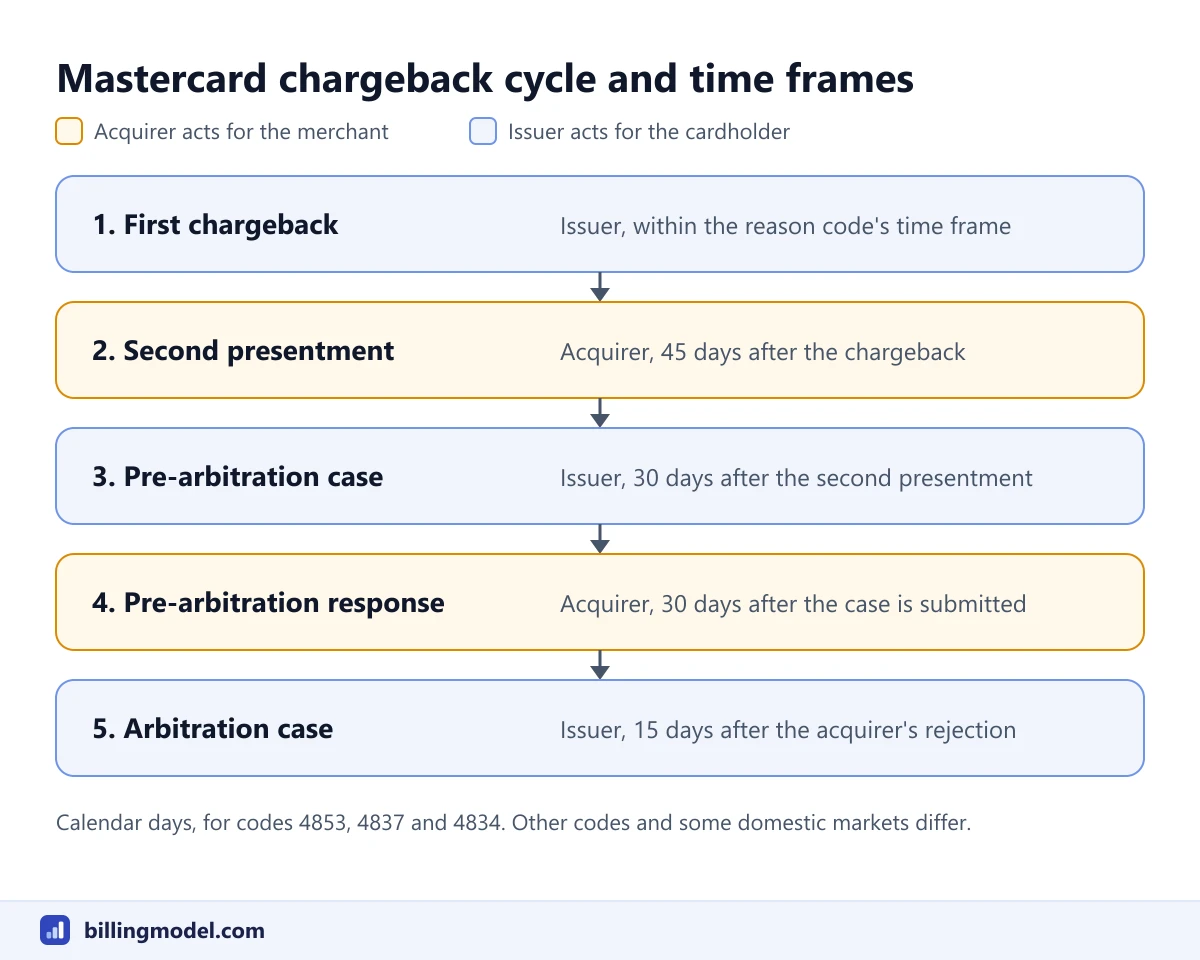 The Mastercard chargeback cycle for codes 4853, 4837 and 4834, with the general time frames from the Chargeback Guide, Merchant Edition, May 13, 2025.
Where pre-arbitration is required, the guide mentions a 75-calendar-day time frame for escalating to arbitration, which matches steps 3 to 5 added together: 30 + 30 + 15.
One rule shapes how you prepare. Mastercard says it will not consider second presentment documentation that arrives on or after a pre-arbitration filing, and that a pre-arbitration response cannot supply documents that were required earlier. The second presentment is the moment to send everything.
Watch out: The 45 days belong to your acquirer, not to you. Acquirers and processors set shorter internal deadlines. Stripe's documentation, for example, says businesses usually have 7 to 21 days to respond, depending on the card network, and that Stripe doesn't support the arbitration phase (checked October 2026). Follow the date on your processor's notice.
A worked timeline with dates
The case below is illustrative, and the dates are counted here from the guide's general time frames. An online store sells a $180 order, processed on January 12, 2026. The customer says it never arrived, and the issuer sends a first chargeback under 4853.
| Event | Time frame in the guide | Date |
|---|---|---|
| Sale processed (day zero) | January 12, 2026 | |
| Last day for the chargeback, general case | 120 calendar days | May 12, 2026 |
| First chargeback, $180 debited (day zero) | March 3, 2026 | |
| Processor's deadline for your evidence | 7 to 21 days in the Stripe example | March 10 to 24, 2026 |
| Last day for the second presentment | 45 calendar days | April 17, 2026 |
| Acquirer second presents with proof of delivery | March 20, 2026 | |
| Last day for the issuer's pre-arbitration case | 30 calendar days | April 19, 2026 |
| Issuer files pre-arbitration | April 10, 2026 | |
| Last day for the acquirer to accept or reject | 30 calendar days | May 10, 2026 |
| Acquirer rejects | May 1, 2026 | |
| Last day for the issuer to escalate to arbitration | 15 calendar days | May 16, 2026 |
By March 20 the $180 has moved twice: to the issuer on March 3 and back to the acquirer with the second presentment. If the acquirer did nothing after April 10, Mastercom would accept the case for it 30 calendar days later and the funds would return to the issuer.
Before the chargeback: collaboration and subscription rules
Mastercard's rules recognize settling a complaint before the cycle starts. Rule 6.2.3 of the Mastercard Rules (June 2, 2026 edition) says an issuer is not obliged to process a chargeback when the cardholder has been reimbursed through a statement credit or through a successful Mastercom Collaboration, Ethoca or equivalent resolution procedure. The public documents opened for this article don't explain how those services work or what they cost, so your acquirer is the source for that.
The Chargeback Guide also describes a First-Party Trust process, in which a no-cardholder-authorization chargeback can be rejected with reason code 5002 after validation through Mastercom Consumer Clarity. The conditions it lists refer to issuers and merchant terminals located in the United States.
For subscriptions and trials, Mastercard modified its merchant requirements from October 11, 2022. Its one-page summary (November 2022) lists a combination of requirements and recommendations: transparency at enrollment, a confirmation email at enrollment, an online cancellation method, a receipt after every billing and a notice 7 days before billing for annual subscriptions. The wider set of measures is in the guide to chargeback prevention.
Mastercard's merchant monitoring programs
Mastercard tracks chargebacks per merchant through the Excessive Chargeback Program (ECP). The Security Rules and Procedures, Merchant Edition (August 4, 2026, checked October 2026) defines the measure: chargebacks received in a calendar month, divided by the merchant's Mastercard transactions in the preceding month, multiplied by 10,000. A merchant with 30 chargebacks in May and 4,000 transactions in April would be at 75 basis points by that formula.
The program has two categories, Excessive Chargeback Merchant (ECM) and High Excessive Chargeback Merchant (HECM). The public edition doesn't print their thresholds. It refers to a separate Data Integrity Monitoring Program manual, which Mastercard's rules page doesn't list, so the figures are left out here. Your acquirer can give you the current ones.
Three related points are in the same public manual:
- Mastercard may assess the acquirer of an ECM or HECM. After six months in either category, it may advise the acquirer on an action plan or require a risk review at the acquirer's expense.
- If a merchant exceeds 100 gross basis points in fraudulent card-not-present transactions for two consecutive months, its acquirer must ensure it sends the card's security code (CVC 2) for validation, or for e-commerce becomes Identity Check enabled.
- MATCH Pro is a database of merchants that acquirers have terminated, which acquirers can consult before signing a merchant. Its listing reason for excessive chargebacks (code 04) applies when chargebacks over the previous three months exceeded 1.5% of Mastercard sales transactions and totaled USD 5,000 or more.
Mastercard's rules page also names an Excessive Fraud Merchant program, but the public manual doesn't set out its thresholds.
Visa and Mastercard terms side by side
The two networks describe the same event in different words. The Visa column comes from the Visa Core Rules dated April 18, 2026, covered in the guide to the Visa chargeback.
| Visa | Mastercard | |
|---|---|---|
| Official term | Dispute | Chargeback |
| Reasons | Four categories, conditions 10.1 to 13.9 | Four categories, reason codes such as 4808, 4837, 4853, 4834 |
| Acquirer's first reply | Dispute Response, or a pre-arbitration attempt for fraud and authorization | Second presentment |
| Time for that reply | 30 calendar days | 45 calendar days |
| Arbitration filing | 10 calendar days after the pre-arbitration response | 15 calendar days after the acquirer's rejection, where pre-arbitration is required |
| System | Visa Resolve Online | Mastercom |
| Monitoring program | Visa Acquirer Monitoring Program | Excessive Chargeback Program |
Frequently asked questions
How long does a merchant have to respond to a Mastercard chargeback?
Mastercard's guide gives the acquirer 45 calendar days from the chargeback date to send a second presentment. Your own deadline is set by your processor and falls inside that period. The Stripe example above is 7 to 21 days.
What is a second presentment?
It is the acquirer's formal rejection of a chargeback, sent back to the issuer with the merchant's supporting documentation. The guide's own code tables also call it a representment.
Does a refund stop a Mastercard chargeback?
It should, if it is documented in time. The guide tells issuers to check for a refund before charging back, and a refund previously issued is one of the listed second presentment reasons. It has to be documented in the second presentment, not at a later stage.