Freemium pricing means offering a limited version of a product free of charge, with no time limit, and charging for a fuller version. The word joins "free" and "premium". The free plan brings users in, and the paid plans earn the money.
The model is simple to describe and hard to make pay. Free users cost something to serve, and in the public figures that exist only a small share of them ever upgrade. Whether freemium suits a product comes down to arithmetic you can do before launch.
Quick answer: Freemium pricing gives away a permanently free, limited plan and sells paid plans with more features, capacity or users. It pays only if revenue from the users who upgrade covers the cost of serving everyone who doesn't. Break-even conversion rate = monthly cost of a free user ÷ (paid price − cost of a paying user + cost of a free user).
What freemium pricing is
Freemium is a free plan and a paid plan sold side by side. A Harvard Business School study of a cloud storage service, presented by Clarence Lee at Wharton's marketing colloquium in 2013, describes it as a hybrid strategy in which a firm offers a limited version that stays free indefinitely and a premium version with more features that costs money. The same abstract says firms regard the free product as a promotional tool.
Two things separate freemium from a discount or a demo. The free plan doesn't expire. And it is a working product that is useful by itself, not a preview.
Freemium only sets the price of the entry plan, at zero. The paid plans above it still need a structure of their own: a flat fee, a price per user, tiers or a usage charge. Those options are compared in SaaS pricing models.
What is free and what is paid
The design decision in freemium is where to draw the line. Give away too little and nobody adopts the free plan. Give away too much and nobody needs to upgrade. The Harvard study names this trade-off directly: how much value the free product should provide relative to the premium one, given that it eats into paid sales.
There are four common places to draw the line. The illustrations in the last column are invented, for an imaginary invoicing tool.
| Line drawn by | Free plan gets | Paid plan adds | Illustration |
|---|---|---|---|
| Features | The core functions | Advanced functions | Free: create and send invoices. Paid: automatic payment reminders |
| Usage or capacity | A small allowance | A higher limit or none | Free: 50 invoices a month. Paid: 5,000 |
| Users | One or two people | The whole team | Free: 2 users. Paid: priced per user |
| Advertising or branding | The product with ads or the vendor's badge | An ad-free, unbranded version | Free: "sent with" footer on every invoice |
Published examples show these lines in use. An image-editing service studied in a 2025 field experiment published in Frontiers in Psychology gave away its basic functions and kept premium features for subscribers. A Knowledge at Wharton article by Ravi Bapna, a University of Minnesota professor, points to paid tiers aimed at users who will pay to avoid advertising. And Box's annual report says the company offers individuals a free version so they can try the platform, while organizations pay fees based partly on their number of users.
A good line follows the moment a user starts getting serious value. A freelancer sending ten invoices a month costs little and may never pay. A business sending 500 has a reason to.
Freemium vs. free trial
A free trial is temporary and freemium is permanent. That one difference changes what the seller pays for and what the user decides.
| Freemium | Free trial | |
|---|---|---|
| Time limit | None | Ends after a set period |
| What the user gets | A limited version | Usually the paid product |
| At the end | Nothing happens: the user keeps the free plan | Access ends, or the plan becomes paid, depending on the terms |
| Seller's cost | Serving free users for as long as they stay | Serving non-buyers only during the trial |
| The user's decision | "Do I need more than the free plan?" | "Is this worth paying for at all?" |
The Frontiers in Psychology paper puts the contrast this way: in a traditional trial, access to all features ends with the trial, while freemium users keep the basic features afterward.
The two are often combined. Dropbox's annual report says the company encourages free users to upgrade through in-product prompts and time-limited trials of paid subscription plans. The image-editing service in the field experiment did the same: new free users could start a 3-day or 7-day trial of premium features that became a paid subscription unless they cancelled.
Watch out: Rules for trials that renew into a paid plan automatically (what must be disclosed, how consent is given, how easy cancelling must be) depend on the country and sometimes the state. Have a lawyer review the sign-up flow.
The economics: free users cost money and few convert
Every free account uses some storage and computing power. Dropbox's annual report says its cost of revenue, mostly the infrastructure that stores and delivers the service, covers both paying users and free users. Free users are a real line in the accounts, paid for by someone else's subscription.
Published conversion figures are scarce, and the ones that exist are low:
- Dropbox reported over 700 million registered users and 18.08 million paying users at December 31, 2025. That is at most about 2.6 paying users for every 100 registered accounts (18.08 ÷ 700). The filing warns that the registered count overstates unique people because one person can register more than once, and that a majority of registered users may never convert.
- The image-editing service in the Frontiers in Psychology experiment tracked 680,588 new users for two years. In the group given a 3-day trial, 0.368% subscribed at least once. In the 7-day group, 0.445% did.
These are two companies, not a benchmark. Conversion depends on the product, the audience and where the line between free and paid sits, and no source opened for this article gives a reliable average across software.
Free users can still be worth something if they never pay. The Harvard study estimated the value of a free user of the storage service at about $24 a year, with the referral program accounting for 65% of it. Bapna's Wharton article makes a similar point: paying users are far more profitable, but free users give a network the density that makes it useful.
Worked example: the conversion rate a free plan needs
The numbers here are invented for illustration. Swap in your own.
A document-signing tool gets 20,000 sign-ups in a year. The paid plan is $15 a month ($180 a year). A paying user costs $2 a month to serve ($24 a year). A free user costs $0.40 a month ($4.80 a year). To keep the math simple, assume everyone signs up on the first day and stays all year.
| 2% convert | 3% convert | 5% convert | |
|---|---|---|---|
| Paying users | 400 | 600 | 1,000 |
| Free users | 19,600 | 19,400 | 19,000 |
| Subscription revenue (paying × $180) | $72,000 | $108,000 | $180,000 |
| Cost of free users (free × $4.80) | $94,080 | $93,120 | $91,200 |
| Cost of paying users (paying × $24) | $9,600 | $14,400 | $24,000 |
| Total serving cost | $103,680 | $107,520 | $115,200 |
| Left after serving costs | −$31,680 | $480 | $64,800 |
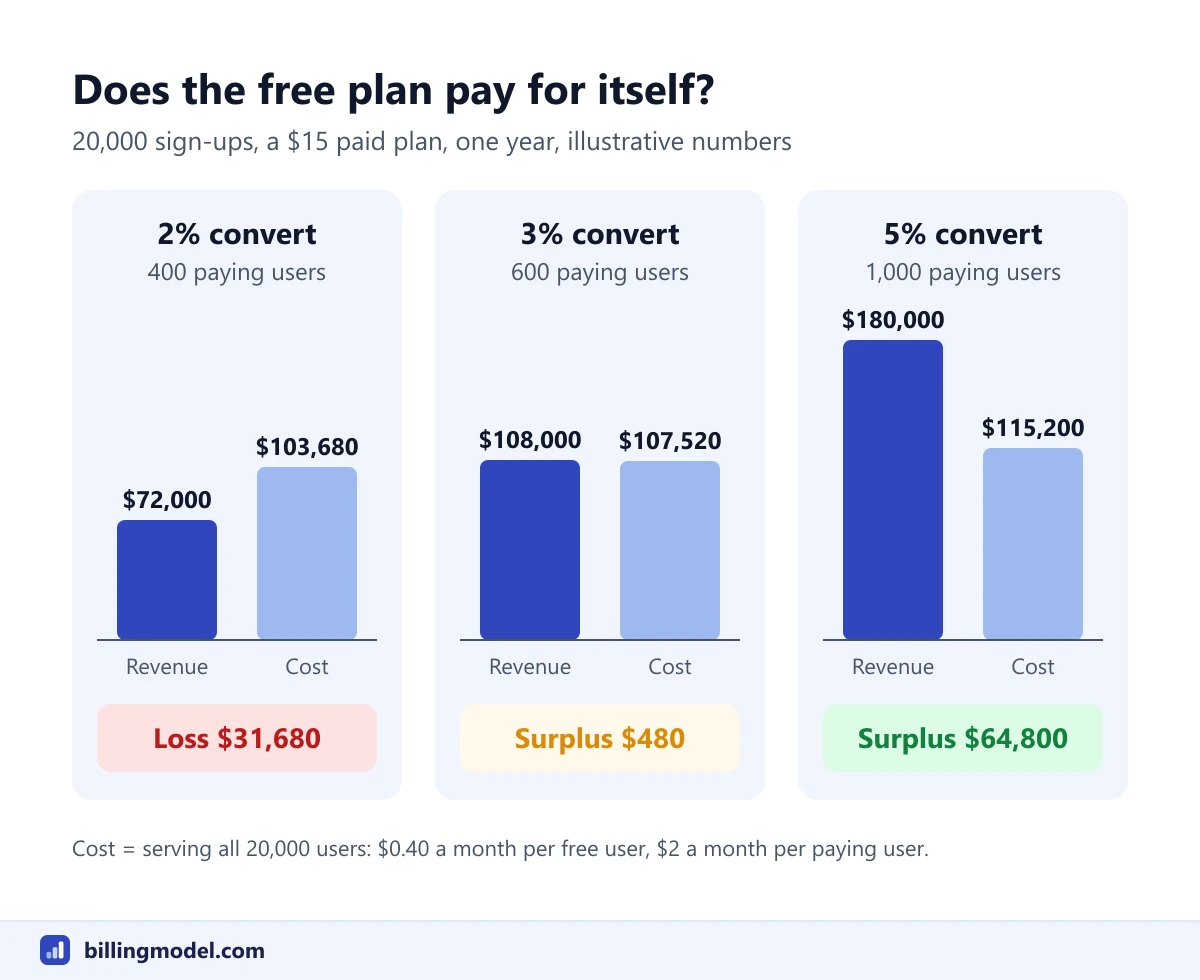 The same 20,000 sign-ups at three conversion rates. One percentage point separates a loss from break-even.
At 3% the free plan barely pays for itself. The break-even point can be worked out directly, using monthly figures:
Break-even conversion = cost of a free user ÷ (price − cost of a paying user + cost of a free user)
$0.40 ÷ ($15 − $2 + $0.40) = $0.40 ÷ $13.40 = about 3.0%.
The formula shows which numbers matter. Halve the cost of a free user to $0.20 and break-even drops to $0.20 ÷ $13.20, about 1.5%. A cheaper free plan, with a tighter storage cap or fewer features that need computing power, lowers the conversion rate you need more reliably than marketing raises the one you get.
Serving costs are only the first hurdle. The $64,800 left at 5% still has to pay for development, sales and everything else, and the example ignores both customers who cancel and the free users who bring in paying ones.
When freemium pricing fits, and the alternatives
Freemium fits when a free user costs almost nothing and does some of your marketing. A Knowledge at Wharton piece on free as a price point explains both halves. Digital goods can be delivered at close to zero marginal cost, and demand at a price of zero is far higher than at even a very low price, so a $1 plan is not a substitute for a free one.
It also needs a large market. If 2 or 3 in 100 users pay, 600 customers take 20,000 to 30,000 sign-ups.
The same Wharton piece carries a warning from marketing professor Stephen Hoch: "The last thing you want to do is get people addicted to free." Once people have had something at no charge, it is hard to get them to pay for it, which Bapna calls the free-to-fee problem.
Freemium is a poor fit when each account needs human onboarding or support, when the market is a few thousand companies, or when the product is only useful once a whole team adopts it. The usual alternatives:
- A time-limited free trial of the paid product.
- A low-priced entry tier, as in these tiered pricing examples.
- Usage-based pricing with a small free allowance, so light users pay little or nothing and heavy users pay in proportion.
Whichever you choose, track conversion and cancellations from the first month. The measures are defined in SaaS metrics.
Frequently asked questions
What is a good freemium conversion rate?
There is no reliable universal figure. The two public data points above are about 2.6 paying users per 100 registered accounts at one large company and under 0.5% of new users at another service. The number that matters is your own break-even rate, which depends on your price and what a free user costs you.
Is freemium the same as a free trial?
No. A free trial ends, and the user must pay or leave. A freemium plan has no end date, but it is limited in features, capacity or users. Many products offer a free plan and a trial of the paid plan together.
How do freemium companies make money?
From the minority of users who upgrade to a paid plan. Some also earn advertising revenue from the free tier. The free plan is a cost that the paid plans have to cover.
Are free users worth anything if they never pay?
They can be. Free users refer other people, and in products where users interact they make the service more useful to paying customers. One Harvard study of a storage service put the value of a free user at roughly $24 a year, most of it from referrals. That figure belongs to one company and one period.
Can a business-to-business product use freemium?
Yes. The Box filing cited above describes one pattern: a free version for individuals, with organizations paying for their users. The arithmetic is the same: the free accounts must be cheap to serve, and enough of them must turn into paying organizations.