Annual billing means the customer pays for 12 months of a subscription in a single charge, in advance, instead of in 12 monthly charges. The price may be quoted per month, as in "$25 per month, billed annually", but the amount that leaves the account on day one is the whole year: $300.
That gap between the number on the pricing page and the number on the card statement is where the confusion starts.
Quick answer: Annual billing charges a full year upfront. To compare it with monthly billing, multiply the monthly price by 12 and subtract the annual price. "2 months free" is a 16.7% discount, and the annual plan is cheaper only if you would have stayed more than 10 months.
What annual billing means
Three separate settings hide behind the word "annual": how often you're charged, how long you're committed, and how the price is displayed. A plan can mix them.
| Wording on the pricing page | What is charged | When |
|---|---|---|
| $30 per month, billed monthly | $30 | Every month |
| $25 per month, billed annually | $300 | Once, at the start of each year |
| $300 per year | $300 | Once, at the start of each year |
| Annual contract, paid monthly | 12 monthly charges | Every month, with a commitment to all 12 |
The second and third rows are the same plan described two ways. The fourth is a different thing: the term is a year, but the billing period is still a month. The interval is one of several settings layered on a price, as the guide to subscription pricing models explains.
Stripe's documentation, for example, illustrates a Basic service level with prices of 10 USD per month and 100 USD per year.
Published accounts describe the same split. Dropbox's annual report for 2025 says customers can choose between an annual or monthly plan, that a majority opt for the annual plan, and that the company typically bills in advance for monthly contracts and annually in advance for contracts of one year or longer (checked October 2026).
Annual billing discount math: a worked example
The numbers here are invented for illustration. Take a plan with two prices: $30 billed monthly, or $300 billed annually, advertised as "2 months free".
- Cost of 12 months on the monthly price: 12 × $30 = $360.
- Cost of the annual plan: $300.
- Saving: $360 − $300 = $60.
- Discount: $60 ÷ $360 = 16.7%.
- Effective monthly price on the annual plan: $300 ÷ 12 = $25.
"2 months free" and "16.7% off" are the same offer, because 2 ÷ 12 = 16.7%. The "$25 per month" on the pricing page is step 5. It is an average, not a charge.
The break-even month
The break-even month is the point where the monthly plan would have cost as much as the annual one. Divide the annual price by the monthly price: $300 ÷ $30 = 10 months.
| If you use the service for | Monthly plan costs | Annual plan costs | Annual plan is |
|---|---|---|---|
| 3 months | $90 | $300 | $210 more |
| 6 months | $180 | $300 | $120 more |
| 9 months | $270 | $300 | $30 more |
| 10 months | $300 | $300 | The same |
| 12 months | $360 | $300 | $60 less |
The table assumes no refund for unused months, which depends on the seller's terms. Under that assumption a customer who leaves after six months has paid $120 more on the annual plan than the monthly one would have cost.
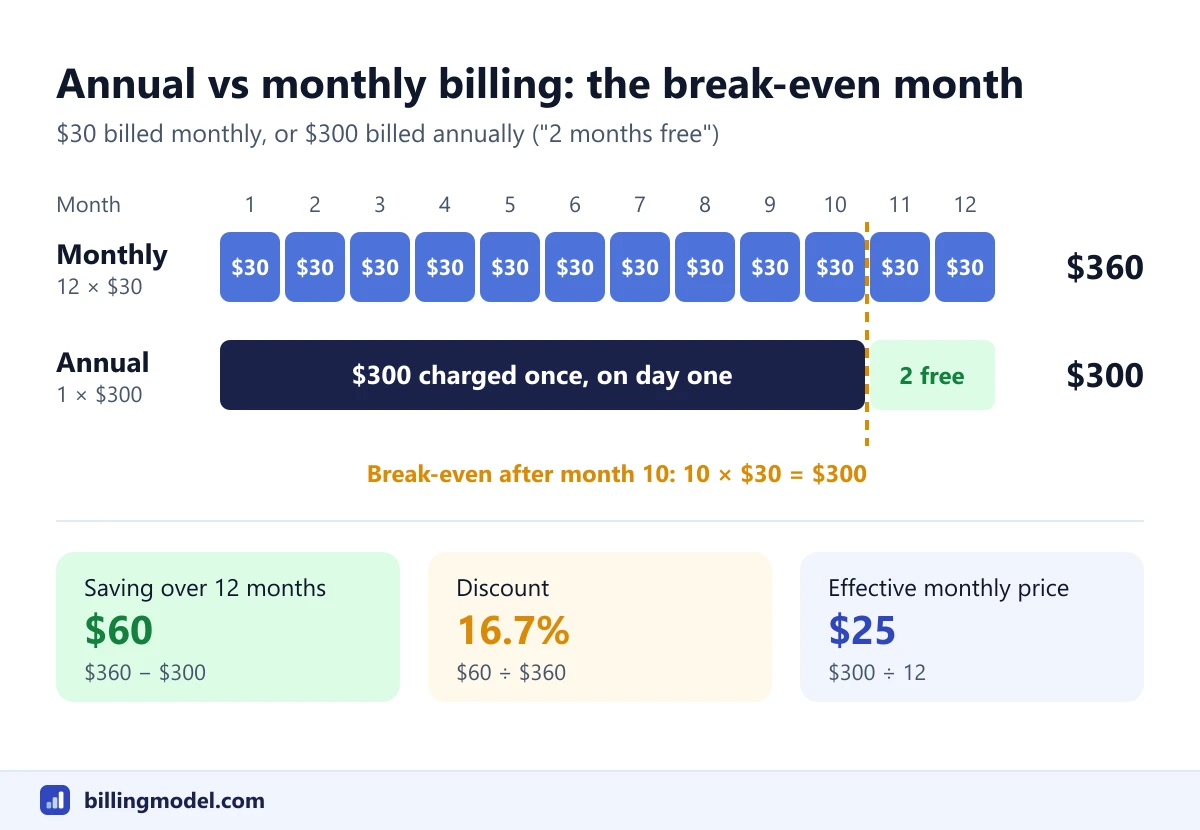 Twelve monthly charges of $30 against one annual charge of $300. The two cost the same at month 10.
Other offers, converted
The same two calculations work for any offer. For a $30 monthly price:
| Offer | Annual price | Discount | Break-even |
|---|---|---|---|
| 1 month free | $330 | 8.3% | 11 months |
| 2 months free | $300 | 16.7% | 10 months |
| 20% off | $288 | 20.0% | 9.6 months |
| 3 months free | $270 | 25.0% | 9 months |
Watch out: "2 months free" has a second meaning. If you pay for 12 months and receive 14, the price of the year hasn't changed. You've paid $360 for 14 months, which is $25.71 a month, a discount of 2 ÷ 14 = 14.3%. Check whether the free months come off the price or are added to the term.
The 10-for-12 structure is an old one. In a study of three US health clubs published in the American Economic Review in 2006, Stefano DellaVigna and Ulrike Malmendier describe an annual contract that charged ten times the monthly fee upfront: $850 against a standard monthly fee of $85. The authors call it a discount of 2 months out of 12 in exchange for a yearly commitment.
What annual billing does for the seller
Annual billing moves cash forward and replaces twelve monthly decisions to stay with one. Both effects have a price: the discount.
Cash arrives earlier. In the example, the annual customer pays $300 on day one. The monthly customer has paid $30 by then and reaches $300 only at the start of month 10. Twelve payments made at the start of each month arrive, on average, 5.5 months after the first one. By this article's arithmetic, the seller gives up $60 of a possible $360 to collect about half a year sooner.
A customer who would have stayed pays less. Someone who would have paid $30 for all 12 months now pays $300. The discount only earns its keep on customers who would otherwise have left, or when the earlier cash is worth more to the business than the $60.
Churn changes the comparison. Churn is the share of customers who cancel in a period, defined in SaaS churn rate. Suppose 100 customers start on the monthly plan and 3% of those remaining cancel each month, the rate used in that article's example. The number still paying shrinks every month, and the 12 monthly collections add up to about $30,616. A hundred annual customers pay $30,000 on day one. At that churn rate, "2 months free" costs the seller almost nothing in year-one cash, and all of it is collected upfront. At lower churn the monthly plan collects more.
Those are illustrative figures, not benchmarks.
Renewal is the catch. An annual customer makes one decision a year, and it is a large one. In a Harvard Business School interview on the psychology of pricing, professor John Gourville describes health club members who pay for a year at the start: they work out a lot in the first month or two, then attend less as the payment fades from memory. A member billed monthly is reminded of the cost every month. His argument is that use drives renewal.
The health club study found the same thing from the other direction. Members on the monthly contract, which renewed automatically until canceled, were 17% more likely to stay enrolled beyond one year than members who had committed for a year. The annual contract in those clubs expired after 12 months and had to be signed again. Monthly members were also slow to leave: on average 2.31 full months passed between their last visit and their cancellation, at a cost of $187 in fees.
That study covers 7,752 gym members, not software buyers, so treat it as evidence about behavior and not as a forecast. Software companies watch the same mix. Dropbox's report says it has seen more new customers choosing monthly plans over annual ones, and warns that a larger share of monthly subscriptions could cause renewals to fluctuate or decline.
What the buyer should check before paying annually
The discount is the easy part. The terms decide whether it was worth taking.
- Refunds. Ask whether canceling mid-year returns the unused months, a partial amount, or nothing. Dropbox's report, for instance, describes its agreements as generally non-cancelable. When a refund is given, the document that records it is a credit memo, as in this credit memo example.
- Renewal. Find out whether the plan renews automatically, on what date, and at what price. A first-year discount may not carry over.
- Reminders. Check whether you'll be told before the renewal charge. A $300 charge you had forgotten about is harder to undo than one you saw coming.
- Changes during the year. Adding users or upgrading partway through can be settled by proration, covered in subscription billing. Ask whether a downgrade produces a credit or nothing until renewal.
- Whether you'll stay. If you aren't confident of passing the break-even month, pay monthly first and switch later.
Consumer law may add rights that the seller's terms don't mention. The EU's Your Europe portal says a consumer who buys a service online can generally cancel within 14 days of the contract being agreed, with exceptions. Rights differ by country and by whether the buyer is a consumer or a business.
How an annual prepayment is accounted for
An annual payment received in advance isn't revenue on the day it arrives. OpenStax's accounting textbook lists subscription services among the common cases of unearned revenue, a liability that turns into revenue as the service is delivered. Costco's annual report shows the treatment at scale: the company says it accounts for membership fee revenue on a deferred basis, ratably over the one-year membership period (checked October 2026).
The entries are in the deferred revenue journal entry article, and the rules behind them in SaaS revenue recognition. Treatment under US GAAP (ASC 606) or IFRS 15 depends on the contract, so have an accountant confirm it.
Disclosure rules for auto-renewing annual plans
An annual plan that renews by itself is what the US Federal Trade Commission calls a negative option: the customer's silence is treated as agreement to be charged again. A year is a long time to remember a renewal date, which is why the rules below matter for annual plans in particular.
- United States. For online sales, the Restore Online Shoppers' Confidence Act sets three conditions: disclose all material terms clearly before obtaining billing information, get the consumer's express informed consent before charging, and provide simple mechanisms to stop recurring charges. The FTC's broader 2024 "click-to-cancel" rule is not in force. In March 2026 the agency asked for public comment on whether to write new rules, and the Federal Register notice says a federal appeals court vacated the 2024 rule on July 8, 2025. The notice also names California, Colorado, Vermont and Virginia among states with their own laws. The FTC's page for the rule listed no later proposal when checked in October 2026.
- United Kingdom. The government said in April 2026 that rules expected to come into force in spring 2027 include a reminder before a contract of 12 months or more renews automatically, and a 14-day cooling-off period after such a renewal.
The subscription billing guide covers these rules in more detail. This is a summary of pages checked in October 2026, not legal advice. The rules differ by country and state and are changing, so have a lawyer review an auto-renewing annual plan before you sell one.
Frequently asked questions
Is annual billing cheaper than monthly billing?
Only if a discount is offered and you stay past the break-even month. With "2 months free", 12 months cost the same as 10 monthly payments, so a customer who would have left before month 10 pays more on the annual plan unless unused time is refunded.
What does "billed annually" mean when the price is shown per month?
It means the monthly figure is the annual price divided by 12. A plan shown as $25 per month, billed annually, produces one charge of $300, not 12 charges of $25.
Can I get a refund if I cancel an annual plan early?
It depends on the seller's terms and on consumer law where you live. Some plans refund unused months, some refund nothing, and some places give consumers a cooling-off period. Read the cancellation terms before paying.
How does annual billing affect MRR?
It doesn't change it. An annual plan is divided by 12, so a $300 plan adds $25 of monthly recurring revenue however the cash is collected. The monthly recurring revenue formula explains the rule.