A billing period is the span of time that one bill covers: the dates of service a customer pays for on a single invoice or charge. On a monthly plan billed on the 1st, the billing period for April runs from April 1 to April 30.
The term gets confused with three neighbors. The billing cycle is how often you bill. The billing date is the day the bill is created. The due date is the day the money is owed. Mixing them up is how customers end up asking why they were charged "early" or "twice".
Quick answer: The billing period is the range of service dates on one bill. The billing cycle is the repeating schedule that produces those periods, the billing date is when each bill is issued, and the due date is when payment must arrive. A customer who starts or changes plan partway through is usually charged a prorated share of the period.
What a billing period is
Every recurring bill answers the question "for which dates?" The answer is the period. It has a start date, an end date and a length in days, and each new one begins where the last ended.
Its length comes from the plan: monthly, quarterly or annual are the usual choices, and annual billing simply makes it 12 months long. A monthly period isn't a fixed number of days. February has 28 or 29 and March has 31, and the price is normally the same for both.
Printing the service dates on each bill removes most confusion. "Pro plan, April 1 to April 30, 2026" tells the customer exactly what a charge is for, which matters when a recurring invoice repeats the same line every month.
Billing period vs billing cycle vs billing date vs due date
The four terms describe different parts of the same schedule. Here they are for a $93 per month plan billed on the 1st.
| Term | What it means | In the example |
|---|---|---|
| Billing cycle | The repeating interval between bills | Monthly, on the 1st |
| Billing period | The service dates one bill covers | April 1 to April 30 |
| Billing date | The day the bill or charge is created | April 1 |
| Due date | The last day to pay on time | April 1 if a card is charged automatically; May 1 on net 30 terms |
People often use "cycle" and "period" interchangeably, and in casual use that's fine. Where a formal definition exists, it's about the interval. The US rule for credit cards and other open-end consumer credit, Regulation Z, defines a billing cycle as the interval between the dates of regular periodic statements. It requires the intervals to be equal and no longer than a quarter of a year, and treats them as equal if the number of days doesn't vary by more than four from the regular date. That rule applies to consumer credit, not to software subscriptions, but it shows the idea: a cycle is a rhythm, and each beat is one period.
The billing date and the due date are rarely the same day once an invoice is involved. Published university billing schedules show the gap clearly:
- The University of Maryland says a student bill is generated on the 25th of every month and is due on the 20th of the following month, so a bill generated on August 25 is due on September 20.
- Kansas State University's billing cycle page says bills generate after the close of business on the 15th and payment is due by 3 p.m. on the next billing date.
For US credit cards, the Consumer Financial Protection Bureau describes the grace period as the time between the end of a billing cycle and the payment due date, and says issuers must have procedures to deliver bills at least 21 days before payment is due. For business invoices the gap is whatever the payment terms say, such as net 30.
In advance or in arrears
A bill can be issued at the start of the period it covers (in advance) or after it ends (in arrears). UCLA's technology services unit is an example of the second: its billing FAQ says it bills in arrears for a monthly cycle that runs from the 21st of the previous month to the 20th of the current month.
Subscriptions with a fixed fee usually bill in advance, and charges under usage-based pricing are billed in arrears because the amount isn't known until the period closes. Cash collected in advance is a liability until the service is delivered, as OpenStax's accounting textbook explains in its section on unearned revenue. The deferred revenue journal entry shows how that is recorded. Accounting treatment depends on the contract and the framework you report under, so confirm it with an accountant.
Calendar billing vs anniversary billing
There are two ways to decide where periods start.
Calendar billing puts every customer on the same dates, often the 1st to the last day of the month. The university schedules above work this way: everyone's bill is generated on the same day.
Anniversary billing starts each customer's period on the day they signed up. Someone who joins on the 12th is billed on the 12th of every month. Stripe's documentation describes this as its default: the billing cycle anchor is the subscription's creation date, or the end of a trial, unless you set another one.
| Calendar billing | Anniversary billing | |
|---|---|---|
| Period starts | Same day for every customer | Each customer's sign-up day |
| First bill after a mid-month start | Partial period, prorated | Full period, no proration |
| Billing dates | One per cycle for everyone | Spread through the month |
| Suits | Invoiced business accounts and month-end reporting | Self-serve sign-ups paid by card |
| Watch for | Questions about the first, smaller bill | Sign-ups on the 29th, 30th or 31st |
Neither is better in general. Calendar billing makes reporting and collections simpler because everything happens at once, at the cost of an odd first bill. Anniversary billing gives every customer a clean first charge and spreads the work across the month.
A mid-period start: worked proration example
Proration means charging for part of a period in proportion to the days used. Take a customer who signs up on March 12, 2026 for a plan that costs $93 per month.
With anniversary billing nothing needs prorating. The customer pays $93.00 on March 12 for March 12 to April 11, and the next billing date is April 12.
With calendar billing on the 1st, the first period is short: March 12 to March 31.
- Days in March: 31.
- Days of service: March 12 to March 31 inclusive = 20 days.
- Daily rate: $93.00 ÷ 31 = $3.00.
- First charge: 20 × $3.00 = $60.00.
- On April 1 the first full period starts: $93.00 for April 1 to April 30.
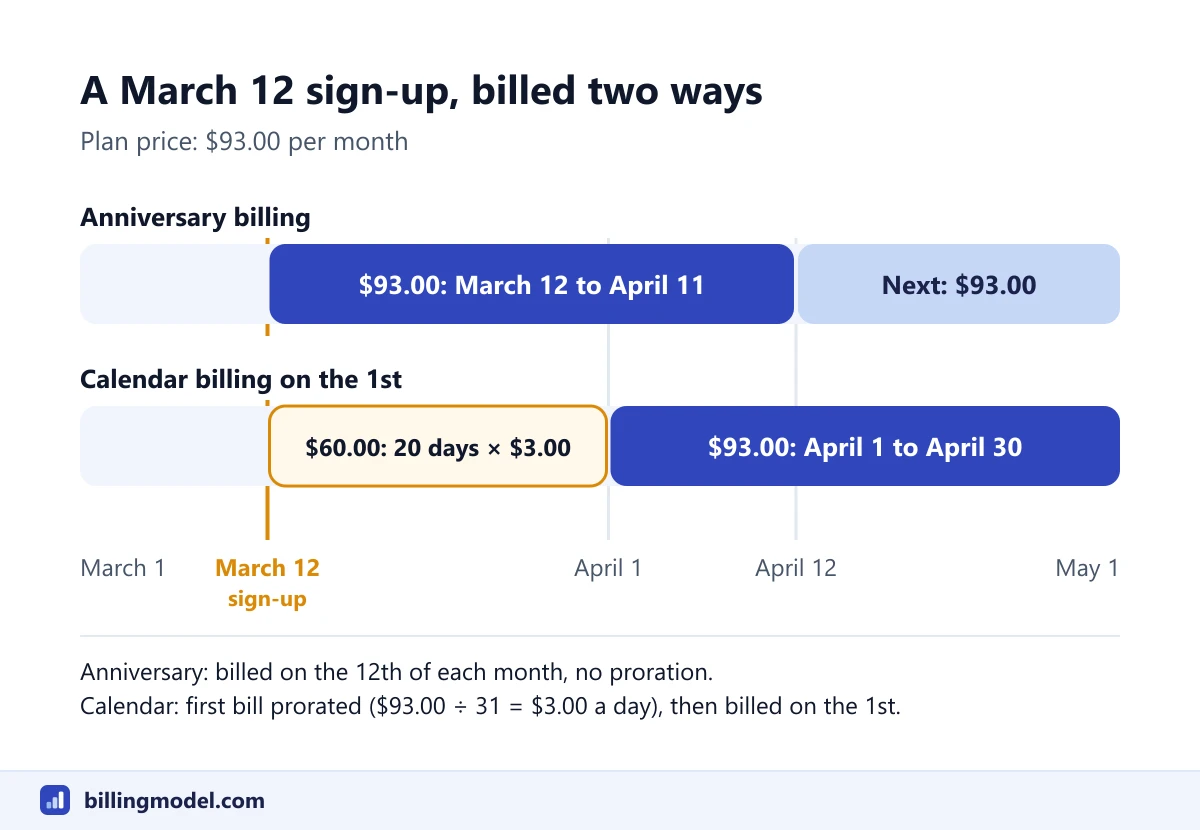 The same March 12 sign-up under anniversary billing and under calendar billing on the 1st.
By April 30 the calendar-billed customer has paid $60.00 + $93.00 = $153.00 for 50 days of service. The anniversary-billed customer has paid $93.00 so far and is charged the next $93.00 on April 12. The amounts differ only because the dates do.
Note: The daily rate depends on how you count. Dividing $93.00 by 31 gives $3.00, but by 30 it gives $3.10. Decide whether you use the actual days in the period or a fixed number, apply it the same way every time, and say so in your terms.
A plan change in the middle of a billing period
A change between billing dates is handled the same way: price the difference for the days that remain.
A team pays for 5 seats at $12 per seat, so $60.00 a month, billed in advance on the 1st. April has 30 days. On April 16 they add 3 seats, leaving 15 days in the period (April 16 to April 30).
- Extra monthly cost: 3 × $12.00 = $36.00.
- Share of the period remaining: 15 ÷ 30 = 0.5.
- Prorated charge: $36.00 × 0.5 = $18.00.
- May 1 bill: 8 × $12.00 = $96.00.
The $18.00 is either charged on April 16 or added to the May 1 bill, making it $114.00. Removing seats works in reverse and produces a credit. The guide to subscription billing works through an upgrade between two plans, where both a credit and a charge appear.
Where billing periods go wrong
- Short months. A customer who joins on January 31 has no 31st in February. Pick a rule and document it. Stripe's documentation, for instance, says a monthly subscription anchored on January 31 bills on the last day of the month closest to the anchor: February 28, or 29 in a leap year, then March 31 and April 30.
- Reading the due date as the period end. A bill dated April 1 on net 30 terms is due May 1, after the April service has been delivered, even though it was billed in advance.
- No service dates on the bill. A customer who can't tell whether a charge is for last month or next month will ask, and may dispute it.
- Moving the billing date. Shifting a customer from the 12th to the 1st creates one short or one long period. Charge or credit the difference, and tell the customer beforehand.
- Different counting in different places. If the checkout page prorates by day and finance divides by 30, the numbers won't agree.
Frequently asked questions
Is a billing period the same as a billing cycle?
In everyday use they overlap. Strictly, the cycle is the repeating schedule (monthly on the 1st) and the period is one instance of it (April 1 to April 30). Twelve monthly periods make up a year of one monthly cycle.
How long is a billing period?
As long as the plan or contract says. A month, a quarter and a year are the common lengths. For US credit card accounts, Regulation Z caps the cycle at a quarter of a year and its official commentary notes that monthly is typical. Other countries have their own rules.
Is the due date the last day of the billing period?
Usually not. The due date depends on the payment terms and on whether you bill in advance or in arrears. A card subscription is typically charged on the first day of the period. An invoice may fall due weeks after the period it covers has started or ended.
What does the billing period on my invoice mean?
It shows the service dates the amount pays for. If the dates are in the future, you're being billed in advance. If they have already passed, you're being billed in arrears for something already used.
Can a billing period be changed?
Yes. A business can move a customer to a different billing date or a different length, such as monthly to annual. The change creates a partial period that is normally prorated, and customers should be told before it takes effect.