Interchange plus plus pricing, written IC++, is a way of billing card payments in which your acquirer passes two costs through to you exactly as it pays them and then adds its own fee. The two costs are interchange and scheme fees. The acquirer's fee is the only part it controls.
The result is a price that changes with every card. A debit card sale and a premium credit card sale of the same amount can differ several times over, and your statement shows why.
Quick answer: Interchange plus plus pricing = interchange (to the card issuer) + scheme fees (to the card network) + the acquirer's markup. The first two are passed through at cost. The markup is fixed in your contract, usually as a percentage, an amount per transaction, or both.
What interchange plus plus pricing means
The clearest definition comes from the UK's Payment Systems Regulator. In the glossary to its card-acquiring market review (November 2021), IC++ pricing is where, for any given transaction, the acquirer automatically passes through at cost the interchange fee and the scheme fees that apply to it.
Each "plus" is one layer added to interchange:
- Interchange: the fee the acquirer pays to the bank that issued the customer's card.
- First plus, scheme fees: what the acquirer pays the card network, such as Visa or Mastercard, for scheme and processing services.
- Second plus, the acquirer's markup: the regulator calls this a processing fee or management fee. It covers the acquirer's other costs and its margin.
Together the three make up the merchant service charge, the total a merchant pays its acquirer for card-acquiring services.
The label is mostly European. In the United States the usual term is interchange-plus, and the US Government Accountability Office describes that model as one where the processor passes through both network and interchange fees and adds its own. That matches what Europe calls IC++. If a US quote says "interchange-plus", ask whether network fees are passed through at cost or folded into the markup.
The three components in detail
Interchange
Interchange is set by the card network and published. It is also the part that varies most. The regulator's final report lists what drives it: the card type, the card network, where the parties are located, whether the sale was online or face to face, and how the cardholder was authenticated.
Law shapes it too. In the European Union, the Interchange Fee Regulation caps interchange at 0.2% of the transaction for consumer debit cards and 0.3% for consumer credit cards, with commercial cards outside the caps. In the United States, Regulation II caps debit interchange for large issuers at 21 cents plus 5 basis points of the transaction, plus 1 cent for fraud prevention. A federal district court ruled in August 2025 that this US fee standard is contrary to law, but it stayed its order pending appeal, and the cap still appears in Visa's April 2026 table (checked October 2026). US credit card interchange is not capped.
Scheme fees
Scheme fees go to the network itself. Some are charged per transaction and vary with the same characteristics as interchange. Others are not tied to single transactions at all, and the regulator notes that an acquirer on IC++ may pass those through at cost as well.
Scheme fees are harder to look up than interchange. The Visa table used in the example below, for instance, lists interchange only. For scale, a 2026 working paper from researchers at Harvard, Northwestern, Stanford and Georgia State, "Who Pays for Payments?", puts US network fees at an average of 0.14% of the transaction value, against about 1.90% for credit card interchange.
The acquirer's markup
This is the price you negotiate. According to the regulator, it can be a percentage of the sale, a fixed amount per transaction, or both, and it is charged on each purchase and sometimes on refunds. On IC++ the same markup normally applies whatever card is used, because the costs that differ by card are passed through separately.
Expect a few event fees beside it. The report says merchants on IC++ typically also pay fees triggered by events such as authorization requests and chargebacks.
IC++ compared with interchange-plus and blended pricing
The three models differ in how much is passed through at cost and how much is bundled into one rate.
| Blended (flat or standard) | Interchange-plus (IC+) | Interchange plus plus (IC++) | |
|---|---|---|---|
| Interchange | Bundled into the rate | Passed through at cost | Passed through at cost |
| Scheme fees | Bundled into the rate | Recovered through the acquirer's fee | Passed through at cost |
| Acquirer's fee | Not shown separately | Covers scheme fees, other costs and margin | Covers other costs and margin only |
| Price per sale | Same for every card in the rate band | Varies with interchange | Varies with interchange and scheme fees |
| When network costs change | The acquirer decides whether to change your rate | Interchange changes reach you automatically | Both changes reach you automatically |
The names in the table follow the regulator's definitions. It uses "standard pricing" for a plan that does not pass interchange through automatically and is not a fixed periodic fee, which is what most people call blended pricing. A US flat rate such as 2.9% + $0.30 is the simplest version.
One detail separates IC+ from IC++. Because an IC+ acquirer recovers scheme fees inside its own fee, the regulator found that the IC+ fee can vary by card type. On IC++ it doesn't need to.
EU law leans toward unbundling. Article 9 of the Interchange Fee Regulation requires acquirers to offer and charge merchant service charges specified individually for different card categories and brands, unless the merchant asks in writing for blended charges.
A worked example on one transaction
A software company charges a customer $200 online. Its IC++ contract sets the acquirer's markup at 0.20% + $0.10. Scheme fees are taken as 0.14% of the sale, the research average above. Both numbers are assumptions for the example, and a real statement lists the actual scheme fees. Interchange comes from Visa's US interchange table (rates effective April 18, 2026; checked October 2026).
The markup is 0.20% × $200 + $0.10 = $0.50 and the scheme fee is 0.14% × $200 = $0.28, whichever card is used. Only interchange changes.
| Card used | Interchange rate | Interchange | Scheme fees | Markup | Total | Share of sale |
|---|---|---|---|---|---|---|
| US debit card, regulated issuer | 0.05% + $0.21, plus $0.01 | $0.32 | $0.28 | $0.50 | $1.10 | 0.55% |
| Basic US consumer credit card | 1.89% + $0.10 | $3.88 | $0.28 | $0.50 | $4.66 | 2.33% |
| Visa Infinite credit card, spend qualified | 2.60% + $0.10 | $5.30 | $0.28 | $0.50 | $6.08 | 3.04% |
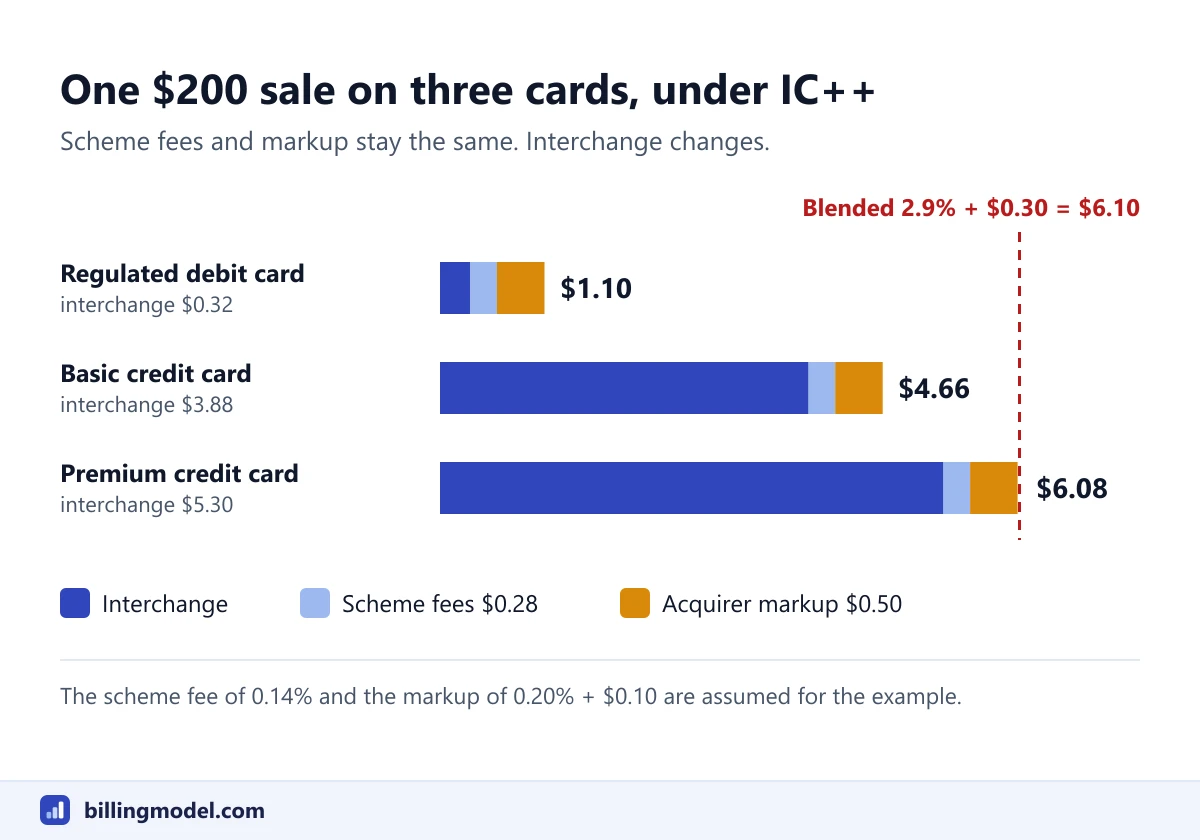 The same $200 sale on three cards. The markup and scheme fee stay put while interchange moves.
The debit row works like this: 0.05% × $200 = $0.10, plus $0.21, plus $0.01, gives $0.32. For the basic credit card, 1.89% × $200 = $3.78, plus $0.10, gives $3.88.
A blended rate of 2.9% + $0.30 would charge $6.10 on all three. On the debit sale IC++ saves $5.00. On the premium credit card it saves two cents. What IC++ is worth to you depends on which cards your customers carry.
For a European comparison, a consumer credit card at the EU's 0.3% cap would carry at most 0.60 of interchange on a sale of 200.
How to read an IC++ statement line
An IC++ statement groups transactions by card type and shows each cost in its own column. This illustrative line covers 120 sales of $200 on basic consumer credit cards, on the contract above.
| Card category | Transactions | Volume | Interchange | Scheme fees | Acquirer fee | Total |
|---|---|---|---|---|---|---|
| Visa consumer credit, online | 120 | $24,000.00 | $465.60 | $33.60 | $60.00 | $559.20 |
Check each column against something you can verify:
- Interchange. 1.89% × $24,000 = $453.60, plus 120 × $0.10 = $12.00, gives $465.60. It should match the network's published rate for that card category.
- Scheme fees. $33.60 ÷ $24,000 = 0.14%. Compare the percentage from month to month. A jump means the network changed a fee or your mix of transactions shifted.
- Acquirer fee. 0.20% × $24,000 = $48.00, plus 120 × $0.10 = $12.00, gives $60.00. This must match your contract to the cent.
- Total. $559.20 ÷ $24,000 = 2.33%, your effective rate for this card category.
In the EU you have a right to this breakdown. Article 12 of the Interchange Fee Regulation requires the acquirer to tell the merchant the charges for each card transaction, showing the merchant service charge and the interchange fee separately.
Who IC++ suits, and its drawbacks
IC++ suits businesses with enough card volume to negotiate a thin markup and enough staff time to check statements. The UK regulator's industry background annex reports that fewer than 5% of acquirers' merchants were on IC++ and that they were typically the largest, with annual card turnover above £50 million. Small in number, that group accounted for around 77% of transaction value, according to the final report.
The main benefit is that cost reductions reach you automatically. When the EU caps cut interchange, the regulator estimated that merchants on IC++ received the full saving, worth around £600 million in 2018. Merchants with annual card turnover up to £50 million received, on average, little or none of it.
The drawbacks are real:
- Harder to predict. One acquirer told the regulator that IC+ and IC++ are more complex and volatile than standard pricing, because the cost of each transaction depends on its characteristics. Budgeting needs a forecast of your card mix.
- Increases pass through as well. The regulator's analysis found that scheme fees rose significantly between 2014 and 2018. On IC++ a rise like that lands on your next statement.
- Needs volume. Most acquirers told the regulator that IC++ is available to, or suitable for, large merchants only, and several described the pricing as highly bespoke.
- More to check. A blended bill has one number to verify. An IC++ bill has a line for every card category.
A small business with modest volume may be better served by a blended rate it can predict. The guide to payment processing fees compares the models side by side, and the guide to the chargeback fee covers one of the event fees that sits outside the markup.
Frequently asked questions
What does IC++ stand for?
IC stands for interchange, and each plus is a layer added to it: scheme fees first, then the acquirer's markup. The UK Payment Systems Regulator spells it out as "interchange fee plus plus pricing".
Is interchange plus plus pricing cheaper than a flat rate?
It depends on your cards. In the worked example, a $200 sale cost $1.10 on a regulated debit card under IC++ and $6.10 at a flat 2.9% + $0.30, but a premium credit card came to $6.08. A business whose customers mostly use premium or commercial cards may save little.
What is the difference between IC+ and IC++?
On IC+ only interchange is passed through at cost, and the acquirer recovers scheme fees inside its own fee. On IC++ both interchange and scheme fees are passed through, so the acquirer's fee covers just its other costs and margin.
Can a small business get IC++ pricing?
Sometimes, but it was uncommon in the UK regulator's data: fewer than 5% of acquirers' merchants had it, and over 95% were on standard pricing. Availability depends on the acquirer and on your volume, so ask what minimum applies.
Does IC++ pricing include chargeback fees?
No. The markup covers ordinary processing. The regulator's report notes that merchants on IC++ typically pay additional fees triggered by events such as authorization requests and chargebacks, and these are set separately in the contract.