Flat rate payment processing is a pricing model in which your processor charges one percentage plus one fixed fee on every card sale, whatever card the customer uses. A published example is 2.9% + $0.30 for an online card payment, the standard US rate on Stripe's pricing page (checked October 2026).
The simplicity has a price. On a $200 online sale, a debit card from a large US bank carries about $0.32 of interchange and a premium credit card about $5.10, yet a flat rate of 2.9% + $0.30 charges $6.10 for both. Whether that is a good deal depends on your card mix, your ticket size and your monthly volume.
Quick answer: A flat rate bundles interchange, network fees and the processor's margin into one price for all cards. In the worked example below, 100 online sales of $20 cost $88.00 at 2.9% + $0.30 and $56.95 on interchange-plus pricing with an assumed card mix, an assumed network fee of 0.14% and an assumed markup of 0.25% + $0.10. A flat rate costs less mainly at low volume, on very small tickets with a low fixed fee, or when customers pay with premium and commercial cards.
What flat rate payment processing is
A flat rate is one price that covers three costs: interchange for the bank that issued the card, a fee for the card network and the processor's own margin. The guide to payment processing fees explains each part.
The US Government Accountability Office's 2025 report on payment card costs calls this the flat-rate or blended model: one fixed rate for all transactions that combines credit and debit rates. It says smaller merchants may choose it to simplify how they manage card payments.
The processor still pays a different cost on every sale. The UK Payment Systems Regulator's card-acquiring market review (November 2021) says that with pricing of this kind there will always be cases where the same headline rate applies to transactions with different interchange fees, so the acquirer's net revenue varies from sale to sale. The rate has to be set high enough to cover interchange across your whole mix of cards.
This article is about what a processor charges you. A flat rate as the price of your own product is a different subject, covered in the guide to flat-rate pricing.
Published flat rates: three examples
Three large providers publish flat rates for US businesses. The table is alphabetical and is not a ranking or a recommendation.
| Provider (US pricing) | Online card payment | In person | Manually keyed card | International payment |
|---|---|---|---|---|
| PayPal | 2.99% + $0.49 | 2.29% + $0.09 | 3.49% + $0.09 | 1.50% more |
| Square (Free plan) | 3.3% + $0.30 | 2.6% + $0.15 | 3.5% + $0.15 | 1.5% more |
| Stripe | 2.9% + $0.30 | 2.7% + $0.05 | 0.5% more than the online rate | 1.5% more |
Sources, all checked October 2026: PayPal's merchant fees page (last updated October 1, 2026; the online figure is its standard credit and debit card rate), Square's fees page and Stripe's pricing page. PayPal applies its international fee when the buyer is a resident of another market. Square and Stripe apply theirs when the card was issued in another country.
The pages show that a flat rate is the entry-level price, not the only one. PayPal's page also lists an interchange plus plus option. Stripe's mentions custom packages, including IC+ pricing, for businesses with large payment volume. Square's tells businesses with more than $250,000 in annual sales to contact its sales team.
A worked example: 100 sales at two ticket sizes
The numbers here are illustrative. A business takes 100 online card payments. The mix is an assumption: 40 regulated debit cards, 25 exempt debit cards, 25 basic consumer credit cards and 10 premium credit cards. It leans on two Federal Reserve figures. Debit cards made 120.6 billion payments in 2024 against 67.1 billion for credit cards, and 60.7% of debit transactions that year fell under the US interchange cap.
Interchange comes from Visa's US interchange table (rates effective April 18, 2026; checked October 2026). Start with a $20 ticket.
| Card | Sales | Volume | Visa's rate | Interchange |
|---|---|---|---|---|
| Debit, regulated issuer | 40 | $800 | 0.05% + $0.21, plus $0.01 | $9.20 |
| Debit, exempt issuer | 25 | $500 | 1.65% + $0.15 | $12.00 |
| Basic consumer credit | 25 | $500 | 1.89% + $0.10 | $11.95 |
| Visa Signature Preferred credit | 10 | $200 | 2.50% + $0.10 | $6.00 |
| Total | 100 | $2,000 | $39.15 |
The first row works like this: 0.05% × $800 = $0.40, plus 40 × $0.22 = $8.80, gives $9.20.
Now add the other two parts of interchange-plus pricing. Network fees are assumed to be 0.14% of volume, the average in a Harvard Business School working paper, "Who Pays for Payments?" (April 2026). The markup of 0.25% + $0.10 is an assumption, and it decides the result. The flat rate is 2.9% + $0.30.
| 100 sales of $20 | 100 sales of $200 | |
|---|---|---|
| Card volume | $2,000 | $20,000 |
| Interchange | $39.15 | $247.05 |
| Network fees at 0.14% (assumed) | $2.80 | $28.00 |
| Markup at 0.25% + $0.10 (assumed) | $15.00 | $60.00 |
| Interchange-plus total | $56.95 | $335.05 |
| Effective rate | 2.85% | 1.68% |
| Flat rate at 2.9% + $0.30 | $88.00 | $610.00 |
| Effective rate | 4.40% | 3.05% |
| Difference | $31.05 | $274.95 |
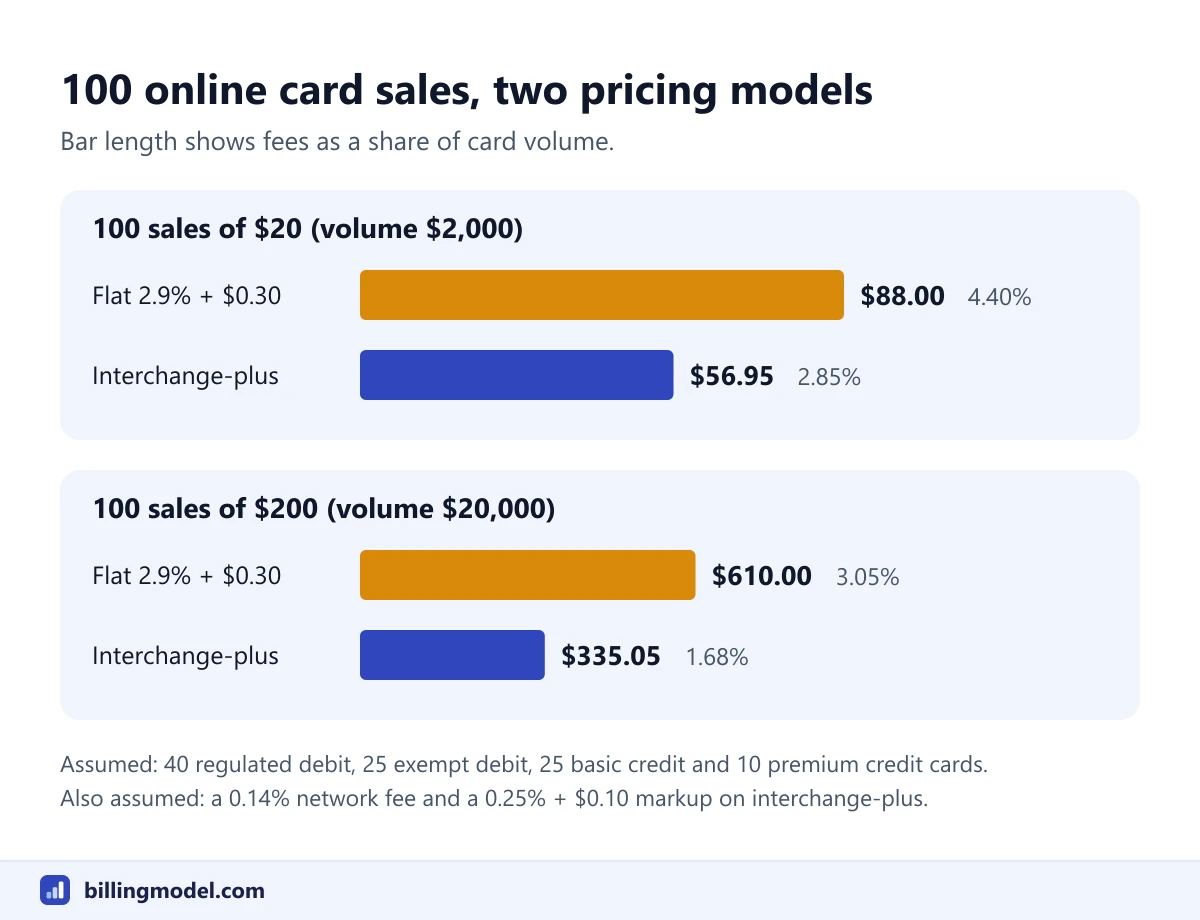 The same 100 sales under two pricing models. The card mix, the network fee and the markup are assumed.
The flat-rate lines are simple: 2.9% × $2,000 = $58.00, plus 100 × $0.30 = $30.00, gives $88.00. On $20,000 it is $580.00 + $30.00 = $610.00.
The fixed $0.30 explains the 4.40%. On a $20 sale it is 1.5% of the amount before the percentage is even applied.
The break-even: when a flat rate costs less
Under a flat rate, what the processor keeps is the flat fee minus the pass-through costs. In the $20 example those costs are ($39.15 + $2.80) ÷ 100 = $0.42 a sale, and the flat fee is $0.88. That leaves $0.46 a sale. At $200 it is $6.10 − $2.75 = $3.35.
So the test for any interchange-plus quote is plain. Add its markup per sale to its fixed monthly fees divided by your monthly sales. If the sum is below what the flat rate leaves the processor, interchange-plus is cheaper. Three situations push the answer toward the flat rate.
Low volume. Suppose the interchange-plus account carries $30 a month in fixed fees, an assumed figure. At $20 tickets it saves $31.05 ÷ 100 = $0.31 a sale, so the fees are covered only after $30 ÷ $0.31, about 97 sales a month. Below that, the flat rate wins. The UK regulator saw this in its market: the largest payment facilitators' headline rates were typically higher than acquirers', but they were often cheaper overall for merchants with low annual card turnover, because the merchant pays only when it takes a payment. It also found evidence that their prices become less competitive as the value of transactions rises.
Premium and commercial cards. The gap shrinks as interchange rises. Visa's rate for a corporate or purchasing card that isn't present is 2.70% + $0.10, which is $5.50 on a $200 sale. Add the assumed $0.28 of network fees and $0.60 of markup and interchange-plus costs $6.38, against $6.10 at the flat rate.
Very small tickets with a low fixed fee. Stripe's published in-person rate of 2.7% + $0.05 comes to $0.19 on a $5 sale. The interchange on a regulated debit card is $0.22 on that sale before any network fee or markup. The cents matter more than the percentage here: at 2.9% + $0.30, the same $5 sale costs $0.45.
The reverse cases follow. A flat rate costs more when volume is high enough to absorb fixed fees, tickets are large, and many customers pay with regulated debit cards. The guide to debit card processing fees shows how much of the saving a flat rate hides.
Watch out: The 0.25% + $0.10 markup is not a quote. Most acquirers told the UK regulator that pass-through pricing is only available to, or suitable for, large merchants. Run the test with the markup and fees you are offered.
Flat rate, tiered and interchange-plus compared
The GAO report names three models as common among processors and acquirers.
| Flat rate (blended) | Tiered | Interchange-plus | |
|---|---|---|---|
| How you're charged | One rate for every card | Several rates, set by the processor according to risk factors and other requirements | Interchange and network fees at cost, plus the processor's own fee |
| What the statement shows | The total | The rate band a sale fell into | Each cost on its own line |
| A customer pays with a cheaper card | Your cost stays the same | Depends on how the bands are defined | Your cost falls |
| Interchange changes | The processor decides whether your rate moves | The processor decides whether your rates move | The change reaches you automatically |
| Who may choose it, per the GAO | Smaller merchants | Not stated | Larger merchants |
The row on interchange changes has evidence behind it. When the EU capped interchange, the UK regulator found that merchants on IC++ pricing received the full saving. Small and medium-sized merchants, about 98% of them on standard pricing, got little or none on average.
EU law treats blending as the exception. Under Article 9 of the Interchange Fee Regulation, acquirers must offer and charge fees separately for different card categories and brands unless the merchant asks in writing for blended charges. In Europe the pass-through model comes in two versions, explained in the guide to interchange plus plus pricing.
What to check besides the headline rate
A flat rate is one line of a longer price list. Before comparing two offers, read the rest.
- Monthly and fixed fees. Stripe's page says its standard pricing has no setup or monthly fees. PayPal's lists $30.00 a month for its Payments Pro product. The UK regulator found that some acquirers set a minimum monthly service charge, and that acquirers typically charge monthly for terminal hire and for help with security compliance.
- Keyed-in and international surcharges. In the table above, a keyed-in card costs 0.7 to 1.2 percentage points more than one read in person (Stripe's works out to 3.4% + $0.30), and an international payment costs 1.5 points more. Currency conversion is separate: Stripe's page adds 1%.
- Chargeback fees. They range from $0 to $30 per dispute on the same three providers' public pages. The guide to the chargeback fee has the details.
- Funds availability. Stripe lists standard payouts as free and instant payouts at 1.5% of the amount, with a $0.50 minimum. Square's page says next-business-day transfers carry no fee.
- Contract terms. In the UK review, card terminal contracts could run for initial terms of three or five years, renew automatically and carry early termination fees. Ask for the term, the renewal rule and the cost of leaving, in writing.
Then measure. Your effective rate is every fee on one month's statement divided by that month's card sales, and it is the only number that compares a flat-rate offer with any other.
Frequently asked questions
Is flat rate payment processing cheaper than interchange-plus?
It depends on volume, ticket size and card mix. In the example above, interchange-plus cost $56.95 against $88.00 for 100 sales of $20, but that relied on an assumed card mix, network fee and markup, and on no monthly fees. A business with few sales, or one whose customers pay with premium and commercial cards, can come out ahead on the flat rate.
Does a flat rate include interchange?
Yes. The single rate covers interchange, network fees and the processor's margin. The processor pays the first two out of what you pay it, which is why its margin differs on every sale while your price doesn't.
Do debit cards cost less on a flat rate?
No. A flat rate charges the same for debit and credit. Square's fees page, for example, says its processing fee applies to every card brand at the same rate. The lower interchange on a regulated US debit card, about $0.22 plus 0.05% of the sale, stays with the processor.
Can a flat rate be negotiated?
Sometimes. Two of the three pricing pages cited above invite larger businesses to ask for custom pricing, and one names a threshold of $250,000 in annual sales. Whether a smaller account can negotiate is up to the provider.
Is blended pricing the same as a flat rate?
Close. The GAO uses the two words for the same model. The UK regulator's term, standard pricing, is wider: it covers any plan that doesn't pass interchange through automatically, including plans with separate rates for debit and credit.