Chargeback insurance is the everyday name for a service that reimburses a merchant when an order the provider approved comes back as a fraud chargeback. Fraud-screening companies and some payment processors sell it, under names such as chargeback guarantee or chargeback protection.
The name promises more than the product delivers. The four provider documents read for this article are all built around fraud: the cardholder says the purchase wasn't theirs. Only one also covers a claim that an order never arrived, and none says it covers a claim that the goods were faulty.
Quick answer: Chargeback insurance is the everyday name for a guarantee written into a contract with a fraud-screening or payment provider. The provider screens each order, and if an order it approved becomes an eligible fraud chargeback, it reimburses the sale amount and sometimes the chargeback fee. Non-fraud disputes are mostly excluded. One published price, on PayPal's US fee page, is 0.40% per transaction (checked October 2026), so it pays for itself only when your fraud chargebacks would cost more than that.
What chargeback insurance is
A chargeback is a card payment that the cardholder's bank reverses and sends back to the merchant. The guide to the chargeback fee covers what one costs. A guarantee moves part of that cost to a third party, for a price.
A public company's annual report shows the mechanism plainly. Riskified, a fraud-screening provider, says in its Form 20-F for 2025 that it guarantees the outcome of its decisions on merchants' orders by assuming the cost of fraud on each order it approves. The reimbursement applies to transactions later determined to be fraudulent, when the merchant sends a valid request.
Three steps follow from that design:
- Screening. The provider scores each order and approves or declines it.
- Guarantee. Approved orders that meet the provider's conditions are covered.
- Reimbursement. If a covered order becomes a fraud chargeback, the provider pays back the transaction amount. Riskified's filing says this is typically done as credits on the merchant's future invoices.
Payment processors sell the same idea inside their own platforms. PayPal's help page calls its version an opt-in risk tool. Shopify's and Stripe's documents are described below.
The loss being covered is real. In the Federal Reserve's report on 2023 debit card transactions, merchants absorbed 65.1% of the losses from card-not-present fraud on large issuers' debit cards.
What it covers and what it leaves out
Cover follows the reason for the dispute. Visa's dispute guide for merchants sorts disputes into four categories: fraud, authorization, processing errors and consumer disputes. The documents read for this article sit almost entirely in the first.
| The customer's claim | Covered? |
|---|---|
| "I didn't make this purchase" | Yes, in all four documents, for eligible orders the provider approved |
| "I don't recognize this charge" | Named as covered on Shopify's help page |
| "It never arrived" | Covered by PayPal's tool if the merchant supplies proof of shipment or delivery. Excluded by Shopify's and Stripe's documents |
| "It's faulty" or "not as described" | Excluded by PayPal's, Shopify's and Stripe's documents |
| "I'm owed a refund" or "I was charged twice" | Listed as not eligible on PayPal's help page. Outside Stripe's fraud-only definition |
That leaves a large share of disputes with the merchant. A Federal Reserve Bank of Kansas City working paper found that fraud accounted for about 50% of Visa and Mastercard chargebacks between October 2013 and September 2014. The data is old and covers one country, but it suggests the size of what is left: the non-fraud half is the kind of dispute these products mostly exclude.
Covered orders also have to meet conditions. The same documents show the usual kinds:
- You followed the provider's decision. Stripe's terms say that if you choose to go ahead with a charge it scored above its risk threshold, the charge is no longer protected.
- The order fits the eligibility rules. Shopify's help page limits Shopify Protect to US stores, Shop Pay orders and physical goods fulfilled with valid tracking within 7 days. Changing the shipping address after checkout voids the cover, and only the first order of a subscription is eligible.
- You stay under a cap. PayPal's page says it covers eligible chargebacks up to a monthly loss cap agreed in advance. Stripe's terms allow it to set a limit on the amount it will cover.
- You do the paperwork. PayPal's page says merchants must still respond to the dispute and submit proof when asked.
How chargeback insurance is priced
Pricing takes three forms in the documents: a percentage of every covered transaction, a rate negotiated for each merchant, or no separate fee on a narrow set of orders. The table is alphabetical and is not a ranking or a recommendation.
| Provider | What its document calls the product | Disputes covered | Price stated |
|---|---|---|---|
| PayPal | Chargeback Protection, an opt-in risk tool | "Unauthorized" and "item not received" | 0.40% per transaction on advanced card payments in the US, or 0.60% for the Effortless version |
| Riskified | Chargeback Guarantee | Approved transactions later determined to be fraudulent | A percentage of the value of orders it approves, set per merchant |
| Shopify | Shopify Protect | Fraudulent and unrecognized chargebacks on eligible Shop Pay orders from US stores | Free |
| Stripe | Chargeback Protection | Disputes where the cardholder says they didn't authorize the charge | Not published |
Sources, all checked October 2026: PayPal's help page and its US merchant fees page (last updated October 1, 2026), Riskified's Form 20-F, Shopify's Shopify Protect overview, which says the feature is available for free, and its page on addressing chargebacks with Shopify Protect, and Stripe's Chargeback Protection terms.
The Stripe terms are dated June 3, 2019 and cover charges made through Stripe Checkout. Stripe's Checkout page still lists Chargeback Protection as a feature a business can enable, but neither that page nor Stripe's pricing page gives a price, and the terms say the fee is communicated by email or in the dashboard. Confirm with Stripe whether it is offered to your account and at what fee.
Riskified's filing explains what moves a negotiated rate. The fee is set when the contract starts and varies by merchant with inputs such as historical fraud levels and the risk level of the market the merchant sells into. Its products that carry no guarantee are typically charged a fixed fee per transaction.
A percentage fee applies to every covered sale, not just the disputed ones. That is the number to test.
A worked example: is the fee worth it?
The numbers here are illustrative. An online store takes 2,000 card orders a month at an average of $80, so $160,000 in sales. A guarantee is offered at 0.40% of every transaction.
- Monthly fee: 0.40% × $160,000 = $640.
- Cost of one fraud chargeback without the guarantee: the $80 sale plus a $15 chargeback fee, or $95. The example assumes the guarantee reimburses both.
| Fraud chargebacks a month | Share of orders | Loss covered | Fee | Net result |
|---|---|---|---|---|
| 3 | 0.15% | $285 | $640 | −$355 |
| 7 | 0.35% | $665 | $640 | +$25 |
| 12 | 0.60% | $1,140 | $640 | +$500 |
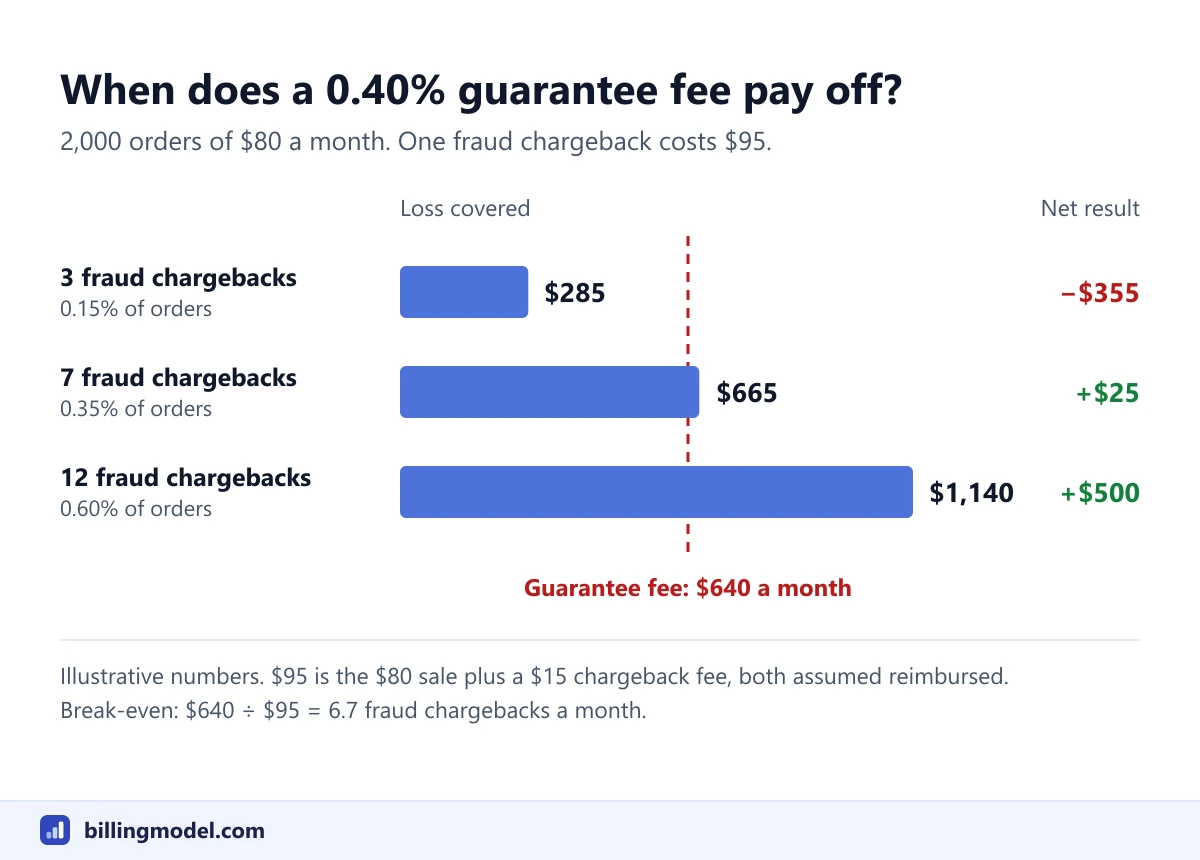 When a 0.40% fee pays for itself, using illustrative numbers.
The break-even is $640 ÷ $95 = 6.7 fraud chargebacks a month, or about one order in 300. If the guarantee returns the sale amount but not the fee, it is $640 ÷ $80 = 8.
A simpler way to say it: the fee is 0.40% of sales, so the guarantee pays only when fraud chargebacks would otherwise cost you about that much of your sales. For scale, the Kansas City Fed paper's abstract puts the merchant fraud loss rate at 2.6 basis points of sales value, which is 0.026%, in its October 2013 to September 2014 data on signature-based card transactions. It found fraud chargeback rates significantly higher for card-not-present sales, so an online store's own rate is the figure that counts.
Two things sit outside the table. Suppose the store also gets 5 non-fraud disputes a month. Those cost 5 × $95 = $475 with or without the guarantee. And every order the provider declines is a sale you don't make, so ask what share of orders it expects to approve.
Chargeback insurance vs. 3-D Secure and an insurance policy
Three different things protect a merchant from a fraud loss, and they work in different ways.
| Chargeback guarantee | 3-D Secure liability shift | Insurance policy | |
|---|---|---|---|
| What it is | A term in a contract with a fraud-screening or payment provider | A card network rule tied to cardholder authentication | A contract in which an insurer agrees to indemnify the insured in exchange for a premium |
| Who bears the fraud loss | The provider reimburses you | Not the merchant, under the rules Visa's guide describes | The insurer, within the policy's terms |
| What triggers it | An order the provider approved becomes an eligible fraud chargeback | The cardholder was authenticated and the dispute is fraud-related | A loss the policy defines |
| What it leaves out | Mostly non-fraud disputes, and orders outside the provider's rules | Non-fraud disputes | Whatever the policy excludes |
3-D Secure is authentication, not reimbursement. EMVCo, which maintains the standard, describes it as a fraud-prevention protocol for online purchases that passes data between the merchant and the card issuer, so the issuer can approve the payment or ask the customer for a further check such as a one-time passcode. Visa's guide says that when the cardholder is successfully authenticated through Visa Secure, the merchant is protected from fraud-related disputes. It adds that liability shift rules may vary by region and tells merchants to check with their acquirer.
The insurance column uses the definition from Cornell Law School's Legal Information Institute, which also notes that in the United States the states regulate the insurance business. PayPal's help page never uses the word insurance. It and the other documents describe a tool, a guarantee or a protection service inside a payments or software contract. Whether a given product counts as insurance under the law where you operate is a question for the provider and a lawyer. Whether a business insurance policy you already hold responds to card fraud is a question for your broker.
Watch out: Reimbursement doesn't erase the dispute. Stripe's terms say all chargebacks, including those on protected charges, are attributed to the merchant for the card networks' chargeback rates. Visa's monitoring ratio counts fraud reports and disputes on card-not-present sales, as the guide to chargeback prevention explains.
Questions to ask before paying for it
- Which dispute reasons are covered, by card network reason code, and which are excluded?
- Is the fee charged on every transaction, or only on approved and covered ones?
- Does reimbursement include the chargeback fee, or the sale amount alone?
- Is there a monthly or annual cap, and what happens above it?
- What must you submit, and by when? Riskified's filing says its agreements generally allow chargebacks to be submitted up to six months from order approval.
- What share of orders does the provider expect to decline, and can you override a decline without losing cover on other orders?
- Are subscriptions, digital goods, in-store pickup and orders with a changed address covered?
- Can either side end the arrangement at short notice?
Then compare the fee with your own records: fraud-coded chargebacks over the last 12 months, by value, as a share of card sales. The guide to chargeback fraud explains how to sort disputes by cause first.
Frequently asked questions
Is chargeback insurance real insurance?
This article can't answer that for any product. The documents read here use the words guarantee, risk tool and protection service, and they sit inside a payments or software contract. Whether the law in your country classifies a particular product as insurance is something to confirm with the provider and a lawyer.
Does chargeback insurance cover every chargeback?
No. All four documents center on fraud, meaning the cardholder says they didn't authorize the purchase. One also covers "item not received" with proof of shipment. Claims about quality, refunds and duplicate charges are excluded where the documents address them.
How much does chargeback insurance cost?
One published price is 0.40% of each transaction, with a 0.60% version called Effortless, on PayPal's US fee page (checked October 2026). One public company's filing describes a negotiated percentage of approved order value. One platform includes it free on a narrow set of orders.
Do I still need fraud checks and 3-D Secure with a guarantee?
A guarantee repays money. It doesn't stop the dispute from being filed or counted against you. Address checks, card security codes and 3-D Secure work earlier, at the point of sale, and under Visa's rules a successful 3-D Secure authentication protects the merchant from fraud-related disputes.