A simple invoice number example is INV-2027-0042: a short prefix, the year, and a counter that goes up by one with every invoice. A plain 0042 works as well. What matters is that each number is used once and that the numbers run in order.
The number is how you, your customer and a tax inspector point to one specific bill. Tax rules in several countries require it to be unique and sequential, and customers' payables offices use it to catch duplicates.
Quick answer: An invoice number is a unique reference given to each invoice in sequence, such as 0042, 2027-0042 or INV-2027-0042. Pick one format, let the counter rise by one each time, never reuse or delete a number, and correct mistakes with a credit note that has its own numbered series.
What an invoice number is for
An invoice number ties one bill to one entry in the books. OpenStax's accounting textbook describes the sales journal as having an invoice number column, and says the number should match the one on the invoice given to the customer. Its chapter on accounting information systems adds the other half: a remittance advice sent with a payment tells the seller which invoice the customer is paying.
Buyers depend on the number too. The University of Southern Indiana's vendor information page lists "a unique invoice number" among the things an invoice must show and asks vendors not to send duplicates. When a bill arrives with no number at all, the University of North Carolina's finance office builds one from the vendor's account number and the billing month and year, so that duplicate payments are not sent out.
Invoice number examples: six formats compared
No rule read for this article prescribes one layout, so the format is your choice. The table shows six workable layouts, each with the number that follows it.
| Format | Invoice number example | Next number | Good for | Drawback |
|---|---|---|---|---|
| Plain sequence | 0042 | 0043 | One business with one series | Says nothing about date or customer |
| Year prefix | 2027-0042 | 2027-0043 | Filing by year, restarting the counter each January | Someone has to reset the counter on the right day |
| Date plus daily counter | 20270315-02 | 20270315-03 | Finding an invoice by its date | Long, and a missing invoice is hard to spot |
| Customer code | NV-0007 | NV-0008 | Seeing one customer's invoices in order | One series per customer to keep straight |
| Project code | P114-03 | P114-04 | Billing a project in stages | A new series for every project |
| Document-type prefix | INV-2027-0042 | INV-2027-0043 | Keeping invoices and credit notes apart (CN-2027-0004) | Slightly longer to type |
The "good for" and "drawback" columns are this article's reasoning, not anyone's rule. The formats themselves fit what the UK tax authority accepts. HMRC's manual page on VAT invoice details says a number can be numeric or a mix of letters and numbers, that a series may start at a number such as 1135 instead of 1, that a consecutive number added to a customer reference is acceptable, and that a business may run several separate series at once, for example for different customers or divisions.
Two habits make any format easier to live with. Pad the counter with zeros (0042, not 42) so that numbers sort correctly in a file list. And keep it short: India's rule, covered below, caps the number at sixteen characters, and INV-2027-0042 uses thirteen.
Invoice numbering rules in four jurisdictions
Rules on invoice numbers differ by country, and the ones below come from tax and payment regulations. These are examples, not a full list, and an accountant should confirm what applies where you and your customer are registered.
United Kingdom. GOV.UK's list of what an invoice must include starts with a unique identification number. For VAT invoices, paragraph 16.3.1 of HMRC's VAT guide (Notice 700) is more exact: "a sequential number based on one or more series which uniquely identifies the document."
European Union. The European Commission's VAT invoicing rules list a unique sequential number identifying the invoice among the contents of a full VAT invoice. The same page says specific national rules apply in some member states.
India. Rule 46 of the Central Goods and Services Tax Rules, 2017 requires a consecutive serial number of no more than sixteen characters, in one or multiple series, that is unique for a financial year.
United States. The IRS's recordkeeping guidance says a business may choose any recordkeeping system that clearly shows its income and expenses, and that with a few exceptions the law does not require a special type of record. Its page on what records to keep lists invoices among the documents that support gross receipts. Neither page sets a numbering rule. A buyer's own rules may: for vendors billing federal agencies, 5 CFR 1315.9 lists a "vendor invoice number, account number, and/or any other identifying number agreed to by contract" among the contents of a proper invoice.
Worked example: numbering a month of invoices and one credit note
Here is March 2027 for a made-up consultancy that uses INV-2027-0000 for invoices and CN-2027-0000 for credit notes. February ended on INV-2027-0037.
| Number | Date | Customer | Amount | What happened |
|---|---|---|---|---|
| INV-2027-0038 | March 1 | Northside Vets | $840.00 | Monthly retainer, created by a recurring schedule |
| INV-2027-0039 | March 1 | Oak Street Bakery | $650.00 | Monthly retainer, created by a recurring schedule |
| INV-2027-0040 | March 9 | Pine Lane Studio | $2,400.00 | Project work: 16 hours × $150 |
| INV-2027-0041 | March 15 | Not sent | $0.00 | Voided before sending (wrong customer selected). Kept on file |
| INV-2027-0042 | March 15 | Sample Dental Group | $1,260.00 | The invoice that 0041 should have been |
| INV-2027-0043 | March 24 | Northside Vets | $375.00 | One-off hardware order |
| CN-2027-0004 | March 26 | Pine Lane Studio | −$300.00 | Credits 2 hours billed in error on INV-2027-0040 |
Check the month the way a bookkeeper or auditor would:
- Count the numbers. 0043 − 0038 + 1 = 6 numbers used. Five invoices were sent and one was voided: 5 + 1 = 6. Nothing is missing.
- Total the invoices. $840 + $650 + $2,400 + $1,260 + $375 = $5,525.
- Subtract the credit note. 2 hours × $150 = $300, so net billing is $5,525 − $300 = $5,225.
- Check the customer. Pine Lane Studio now owes $2,400 − $300 = $2,100 on INV-2027-0040.
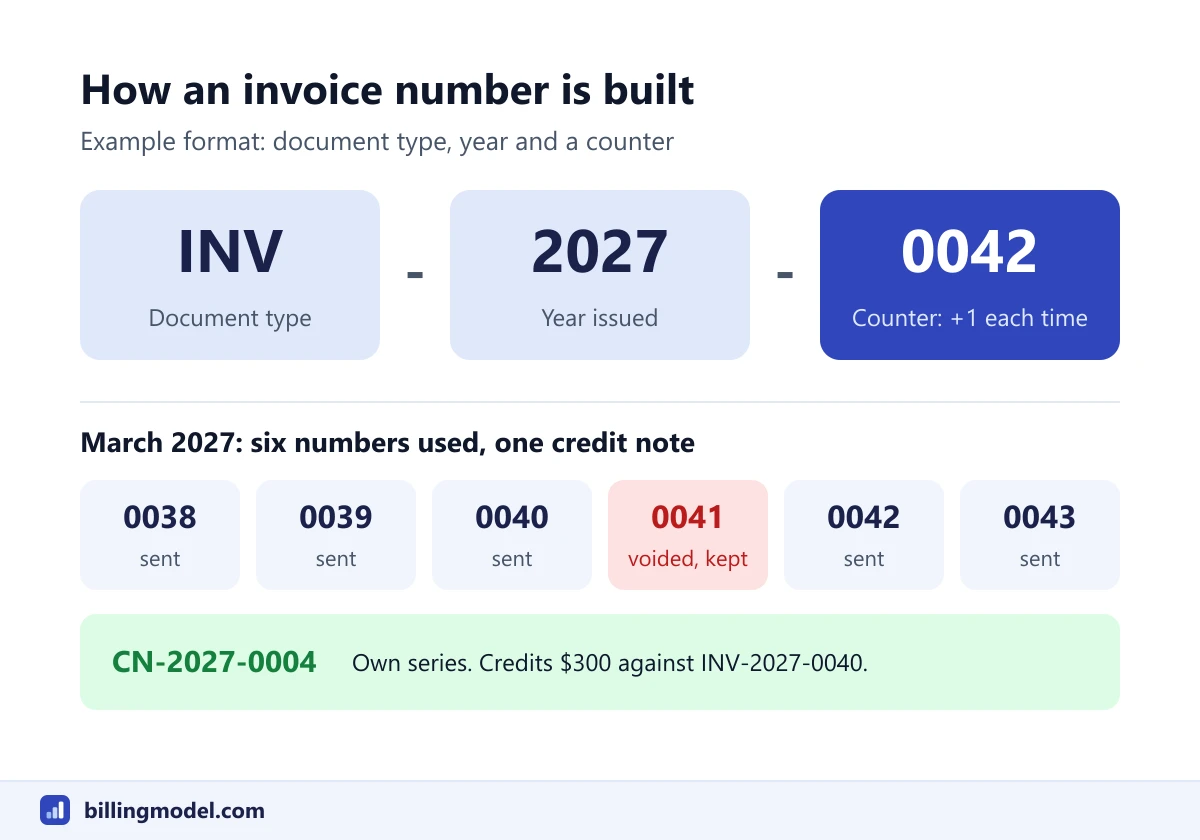 The parts of the example number, and the March 2027 sequence with one voided invoice and one credit note.
The credit note has its own number because it is its own document. Paragraph 18.2.3 of HMRC's VAT guide says a UK credit note must show an identifying number and date of issue, and paragraph 19.8 says a credit note that corrects an invoice should refer to that invoice's number and date. The credit memo example shows every field filled in.
Gaps, mistakes and voided invoices
Don't delete a number and don't reuse one. Either move breaks the link between the invoice the customer holds and the entry in your books.
A voided invoice that was never sent. Keep it, marked as void, as 0041 was above. HMRC's manual says a break in the sequence caused by a cancelled or spoiled invoice that was never issued to a customer is acceptable, as long as you keep that invoice in your accounting records or can explain the gap.
A wrong invoice that was sent. Leave it in the sequence and correct it with a credit note. Penn State's receivables procedure, for example, says invoices cannot be edited once posted and that adjustments go through credit memos. If the customer needs a corrected bill, it takes the next free number.
An unexplained gap. Find out why before the trail goes cold: a draft that was deleted, a second person invoicing from a spreadsheet, a system import that skipped. Write the reason down next to the missing number.
The same number issued twice. Buyers check for duplicates, as the two university pages above show, so one of the two invoices may be held or rejected. Ask your accountant how to correct it under your tax rules. A credit note against one copy, followed by a reissue under a new number, keeps both documents traceable.
Watch out: Keep the records as well as the numbers. In the UK, HMRC's record keeping notice says a VAT-registered business must keep a copy of every VAT invoice it issues, and must keep its VAT records for at least 6 years. Retention periods in other countries differ.
Restarting each year, and numbering in recurring billing
Restarting the counter every year is workable only if no two invoices end up with the same number. A year prefix does that job: 2027-0001 and 2028-0001 are different numbers, while a bare 0001 issued twice is not. Whether your tax rules allow a restart is a separate question.
How strict the rule is depends on the country. India's Rule 46 asks for a number that is unique for a financial year. The HMRC manual page cited above requires each number to uniquely identify its document and does not say whether a series may restart, so a UK business that wants an annual restart should keep the year in the number and confirm the approach with its accountant.
Recurring billing needs no separate scheme. Each bill that a recurring invoice schedule creates takes the next number in the normal series, exactly as INV-2027-0038 and 0039 did on March 1. Two things to check in your billing system:
- The template has no fixed number of its own that gets copied onto every invoice.
- Manual invoices and scheduled invoices draw from the same counter, so the two can't collide.
If you send a pro forma before the real invoice, give it a reference from a different series. The article on the meaning of a pro forma invoice explains why it is not part of the invoice sequence.
Frequently asked questions
Can an invoice number contain letters?
In the UK, yes: HMRC's manual accepts numbers that mix letters and digits, provided they form a unique sequential series. India's rule allows letters, numerals, hyphens and slashes within its sixteen-character limit. Check the rule in your own country.
Does invoice numbering have to start at 1?
Not under the UK guidance cited here. HMRC's manual gives the example of a business starting at 1135, provided the series then runs consecutively.
Can two customers have the same invoice number?
Not within one series. HMRC accepts separate series for different customers, so NV-0007 and OB-0007 are two different numbers, but a bare 0007 issued to two customers is a duplicate.
Is an invoice number the same as a PO number?
No. The invoice number is the seller's reference for the bill. A purchase order number is the buyer's reference for the order, and some large customers require both on the invoice. See PO numbers on invoices.