A PO number on an invoice is the customer's purchase order number, copied onto your bill so the customer's accounts payable office can tie the invoice to an order it has already approved. It is the buyer's reference, not yours.
For a small customer it is a courtesy. For a university, a public body or a large company it can decide whether you are paid at all, because some of them publish a "no PO, no pay" rule and return any invoice that arrives without the number.
Quick answer: The PO number identifies the buyer's purchase order. Put it on page 1 of the invoice, near the invoice number, exactly as it appears on the order. Buyers use it to match the invoice against the order and the delivery record. If the number is missing or wrong, the invoice can be rejected and the payment period may not start.
What a PO number on an invoice means
A purchase order (PO) is the buyer's written order. Carnegie Mellon University's finance office describes a PO as a commercial source document issued when ordering from a supplier, recording the PO number, the order date, the buyer and seller, the quantity, a description of the goods or services and the payment terms.
The seller sees the same document from the other side. OpenStax's accounting textbook, describing an order placed with a bookstore, says the form is "a purchase order to you, and it is a sales order" to the seller.
A PO can be more than paperwork. Carnegie Mellon states that once the buyer issues an approved PO and the supplier accepts it, the PO becomes a legally binding contract for both parties. Colorado State University's purchase order FAQ uses nearly the same words. That is how those two institutions describe their own orders. What binds you depends on the documents and the law involved, so ask a lawyer about a contract that matters.
The PO number is the buyer's identifier for that one order. Quoting it on your invoice tells the buyer which approved order you are billing against.
Why customers won't pay without a PO number: the three-way match
Buyers hold invoices without a PO number because they cannot check them. The check is called a three-way match, and it compares three documents.
A 1995 letter from the US General Accounting Office on federal payment procedures sets out what each one shows:
- The purchase order or contract shows the purchase was properly authorized.
- The receiving report shows the goods or services were delivered and accepted.
- The invoice shows the vendor has made a claim for payment.
The letter names the controls behind this: matching the types and quantities received and accepted with those ordered, and preventing duplicate payments. Rockefeller University's purchasing office puts it more bluntly, saying that agreement between the three sources is a prerequisite for its Finance Office to pay an invoice. For services, where there is no receiving report, it uses a two-way match of the order and the invoice.
The PO number is the link between the three. Without it the payables clerk has an invoice and nothing to compare it with.
Worked example: one order, four invoices
A made-up buyer issues purchase order PO-48213 for 20 barcode scanners at $85 and 5 label printers at $240. The order total is (20 × $85) + (5 × $240) = $1,700 + $1,200 = $2,900.
| Case | Received | Invoice | Result |
|---|---|---|---|
| A | 20 scanners, 5 printers | 20 scanners at $85, 5 printers at $240: $2,900, quoting PO-48213 | Match. Paid on the agreed terms |
| B | 18 scanners, 5 printers (2 scanners back-ordered) | Bills all 20 scanners: $2,900 | Quantity mismatch. $170 is billed for goods not received |
| C | 20 scanners, 5 printers | Scanners billed at $89: $2,980 | Price mismatch. $80 over the order |
| D | 20 scanners, 5 printers | $2,900, no PO number | Nothing to match against |
In case B the buyer has received goods worth (18 × $85) + $1,200 = $2,730, and $2,900 − $2,730 = $170. In case C the invoice comes to (20 × $89) + $1,200 = $2,980, which is $80 more than the order.
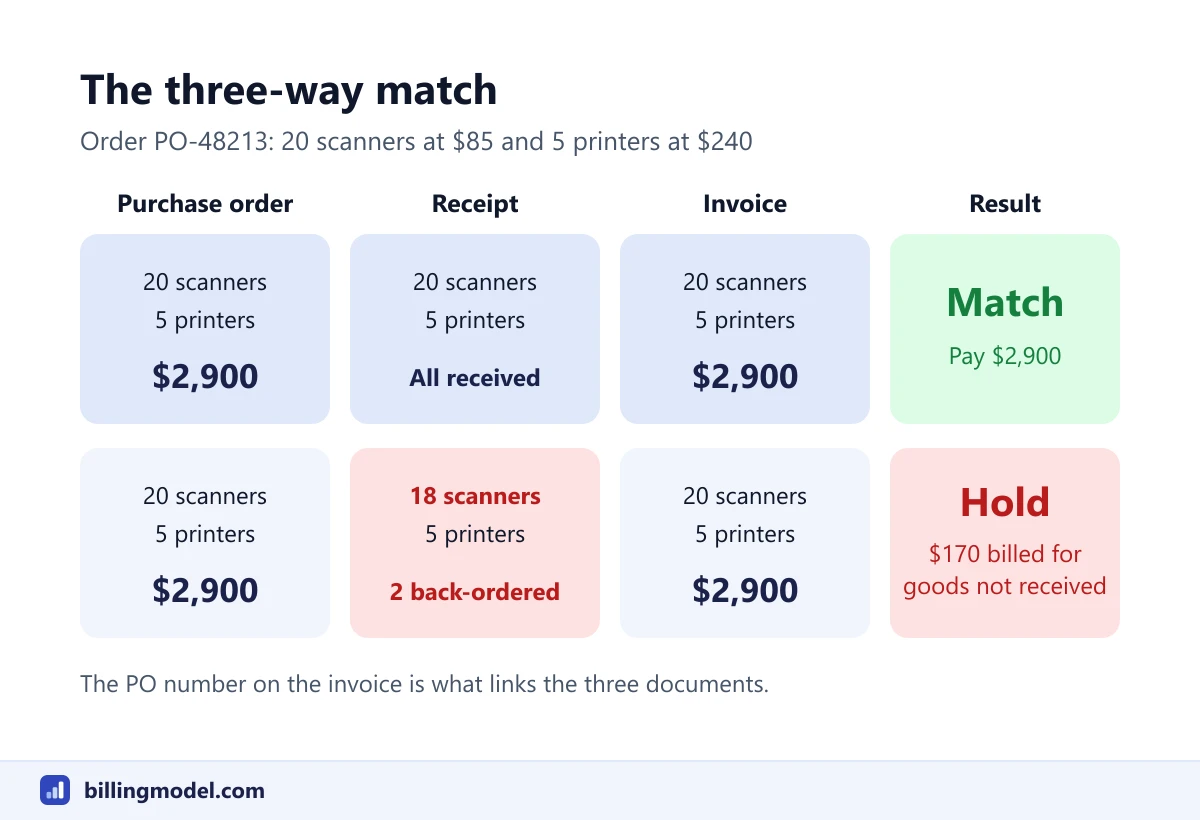 Cases A and B from the worked example: the same order and invoice, with two different receipts.
Whether case C is paid depends on the buyer's tolerance. Clemson University's procurement procedures set the tolerance for line item amounts at 0.00, so any mismatch goes to a review queue. Wayne State University's PO invoice page treats a unit price or quantity within the greater of 5% or $75 of the PO as a match (both checked October 2026). By this article's arithmetic, a $4 increase on an $85 unit price is 4.7%.
Purchase order vs invoice
One orders, the other bills.
| Purchase order | Invoice | |
|---|---|---|
| Who issues it | The buyer | The seller |
| When | Before goods are delivered or work begins | After the order, to request payment |
| What it says | What is ordered, the quantity, the price and the terms | What was supplied and the amount owed |
| What it shows in a payables check | The purchase was authorized | A claim for payment has been made |
| Whose number it carries | The buyer's PO number | The seller's invoice number, plus the PO number |
| Effect on the buyer's budget | Sets the funds aside | Leads to payment once matched |
The timing row follows the buyers' own policies. Carnegie Mellon's says POs should be issued before goods or services are received and before the invoice arrives. Kentucky State University's No PO, No Pay policy requires a PO issued to the supplier before delivery of the goods or commencement of the service. The budget row reflects Colorado State's description of a PO as a commitment voucher used to encumber funds.
Your own reference for the bill is covered in the invoice number example article.
Where to put the PO number on an invoice
Put it on the first page, in the header block, labeled. Published requirements point the same way:
- Indiana University's invoice requirements ask for the PO number on page 1, clearly stated and including the "PO" prefix.
- In the UK, the Royal Borough of Windsor and Maidenhead's no purchase order, no pay policy says the number must appear in the invoice header, and the "Bill To" name and address must match the entity named on the PO.
- The University of Louisville's vendor terms require the PO number on every invoice, along with a departmental contact for the order.
A header that covers those points looks like this. It is an illustration to adapt, not a standard layout.
Invoice number:  INV-2027-0058
Invoice date:    April 6, 2027
PO number:       PO-48213
Bill to:         [legal name and address exactly as shown on the PO]
Ordered by:      [name and department of the person who placed the order]
Payment terms:   Net 30
Due date:        May 6, 2027
Copy the number character for character, including any prefix and leading zeros. Wayne State lists an incorrect or expired PO number among the causes of delayed payment.
PO invoices, non-PO invoices and blanket POs
A PO invoice bills against an order and goes through the match. A non-PO invoice has no order behind it and is paid through a different route, where the buyer allows one.
The University of Missouri System's non-PO voucher is an example. It is for payments where its other methods are not appropriate, and no purchase order number is needed to complete the transaction. Its own illustration is a department paying $35,000 in rent each month. Kentucky State's exceptions include orders placed with a university purchasing card and purchases approved in writing by its Director of Purchasing.
Blanket and standing POs for recurring work
A blanket PO covers many invoices with one number. The University of Texas at Austin defines a blanket purchase order as one that allows recurring purchases when the quantity or the frequency of delivery cannot be fully determined at the start. Its blanket POs cannot extend beyond the current fiscal year and must state a maximum total value.
Indiana University's procedure on recurring orders describes two versions: a blanket PO for as-needed purchases over a fiscal year, and a recurring payment order that runs for the length of an agreement, with leases, utilities and multi-payment service contracts as examples. Once a line's funds are used up it becomes "Fully Invoiced," a new PO is needed for further invoices, and the procedure warns that this can delay supplier payments.
For the seller, that means watching the balance. Take a blanket PO for $15,120 that covers twelve monthly invoices of $1,260. After nine invoices, 9 × $1,260 = $11,340 has been billed and $3,780 remains, exactly three more invoices. If the price rises to $1,300 from month ten, the last three invoices need 3 × $1,300 = $3,900, which is $120 more than the PO has left. Ask the customer to increase the PO before sending them.
Put the same PO number on every bill in the series, and ask for the new number before the customer's fiscal year turns over. The recurring invoice guide covers the schedule side.
Missing or wrong PO number: what happens and what to do
A missing or wrong PO number delays payment, and several buyers say so in writing:
- Kentucky State University rejects invoices that do not clearly show a valid PO and returns them to the supplier.
- The University of Louisville says invoices without a PO number may be returned, and that payment may be delayed or forfeited.
- Windsor and Maidenhead returns such invoices unpaid, and its 30-day payment period starts only when a valid, compliant invoice is received. The policy has applied since April 1, 2026.
Watch out: A rejected invoice may never reach the customer's payment queue. Your own records will show it as overdue under your invoice payment terms while the buyer's system shows nothing owed. When you chase a past due invoice, first confirm that it was accepted.
If you were never given a PO
Louisville's terms tell vendors, "Do not take orders verbally without a PO number." Ask for the number when the order is placed and wait for it.
If the work is already done:
- Contact the person who ordered, not accounts payable.
- Ask whether the purchase can be paid without a PO, for example by purchasing card.
- If a PO is needed, expect an after-the-fact process. At Kentucky State the requester must submit a requisition with an Unauthorized Commitment form, and the supplier re-invoices once it receives the confirming PO.
- Send the invoice again with the number on it, by the one method the buyer specifies.
After-the-fact orders do happen. An internal audit review at Carnegie Mellon, covering three business units over twelve months and reported in April 2023, found that 15.8% of POs were generated after the invoice was received. Kentucky State says vendors who routinely supply without a PO are removed from its vendor list.
Frequently asked questions
Is a PO number the same as an invoice number?
No. The buyer assigns the PO number to its order, and the seller assigns the invoice number to its bill. An invoice to a customer that uses purchase orders carries both.
Is a PO number legally required on an invoice?
None of the sources cited here make it a general legal requirement. It is the buyer's condition for paying. For US federal agencies, 5 CFR 1315.9 lists the government contract number, or other authorization for delivery, among the contents of a proper invoice.
Can I add a PO number to an invoice I already sent?
Ask the customer's payables office what it will accept. Some want the invoice resubmitted with the number added. If your own tax rules treat that as a change to an issued invoice, the correction may need a credit note and a new invoice, as in the credit memo example.