Revenue recognition methods, under the current standards, come down to two questions. Is the promise to the customer satisfied at a point in time or over time? And if it is over time, do you measure progress by output or by input? US GAAP (ASC 606) and IFRS (IFRS 15) share that structure.
Names such as percentage-of-completion, completed-contract and installment method still turn up in textbooks and search results. They belong to earlier rules. A separate section near the end explains what each one meant and where it went.
Quick answer: Revenue is recognized at a point in time unless one of three over-time criteria is met. For an over-time obligation, progress is measured with an output method (units delivered, milestones reached, time elapsed) or an input method (costs incurred, labor hours), and one method is applied consistently.
Where today's revenue recognition methods come from
Both standards use one five-step model, and the choice of method sits in the fifth step: recognize revenue when, or as, each promise is satisfied. The US version is Topic 606, created by the FASB's Accounting Standards Update 2014-09. The international version is IFRS 15. The first four steps are walked through in the guide to SaaS revenue recognition.
The standards call each distinct promise a performance obligation. Two rules frame everything that follows. A company applies a single method of measuring progress to each obligation satisfied over time, and it applies that method consistently to similar obligations in similar circumstances. It also remeasures progress at the end of each reporting period.
Point in time or over time
An obligation is satisfied over time if any one of three criteria is met. In the standards' terms:
- The customer receives and consumes the benefits of the work as the company performs. IFRS 15 gives routine or recurring services, such as a cleaning service, as the plain case.
- The work creates or enhances an asset that the customer controls as it is created or enhanced.
- The work doesn't create an asset with an alternative use to the company, and the company has an enforceable right to payment for the work completed to date.
If none of the three applies, the obligation is satisfied at a point in time: the moment the customer obtains control. Both standards list indicators of that moment. The company has a present right to payment, the customer has legal title, physical possession has passed, the customer has the significant risks and rewards of ownership, and the customer has accepted the asset.
Point-in-time recognition needs no measurement method. The whole amount allocated to the obligation is recognized at once. Method questions only arise for obligations satisfied over time.
Output methods and input methods
The standards name two families of methods for measuring progress and give examples of each.
| Output methods | Input methods | |
|---|---|---|
| What is measured | Value transferred to the customer so far, against what is still promised | Effort spent so far, against total expected effort |
| Examples in the FASB text | Surveys of performance, appraisals of results, milestones reached, time elapsed, units produced or delivered | Resources consumed, labor hours expended, costs incurred, time elapsed, machine hours used |
| Weakness the standards name | Outputs may not be directly observable, and the information may not be available without undue cost | There may be no direct relationship between inputs and the transfer of control |
| Adjustment to watch | Count work the customer already controls, including work in process | Leave out costs that don't reflect performance, such as unexpected wasted materials or labor |
Three details from the text matter in practice.
Time elapsed appears in both lists, in the FASB text (paragraphs 606-10-55-17 and 55-20) and in IFRS 15 (paragraphs B15 and B18). The input-method guidance adds that when effort is spent evenly through the period, recognizing revenue on a straight-line basis may be appropriate.
There is a practical shortcut. If the amount a company has the right to invoice corresponds directly with the value delivered so far, as with a fixed fee for each hour of service, it may recognize revenue in the amount it has the right to invoice.
And there is a floor on reliability. Revenue is recognized over time only if progress can be reasonably measured. Where it can't be, but the company expects to recover its costs, revenue is recognized only to the extent of the costs incurred until the outcome can be measured.
Worked example: one contract measured five ways
The same work at the same date gives five different revenue figures, depending on the measure. Take a software firm that signs a fixed-price contract for $120,000 to build ten custom integration modules for one customer, with work planned from January to June 2026.
Assume the contract is a single performance obligation satisfied over time, for instance because the modules have no alternative use and the firm has an enforceable right to payment for work to date. At signing, the firm estimates total costs of $80,000 and 1,000 labor hours. The contract sets four milestones, each marking a quarter of the work.
On March 31, 2026 the position is: four modules delivered, one milestone signed off, three of six months gone, $36,000 of costs incurred and 420 hours worked.
| Measure of progress | Family | Progress at March 31 | Revenue to date |
|---|---|---|---|
| Units delivered | Output | 4 ÷ 10 = 40% | $48,000 |
| Milestones reached | Output | 1 ÷ 4 = 25% | $30,000 |
| Time elapsed | Listed under both | 3 ÷ 6 = 50% | $60,000 |
| Costs incurred | Input | $36,000 ÷ $80,000 = 45% | $54,000 |
| Labor hours | Input | 420 ÷ 1,000 = 42% | $50,400 |
Each revenue figure is the progress percentage multiplied by $120,000. For costs incurred, that is 0.45 × $120,000 = $54,000.
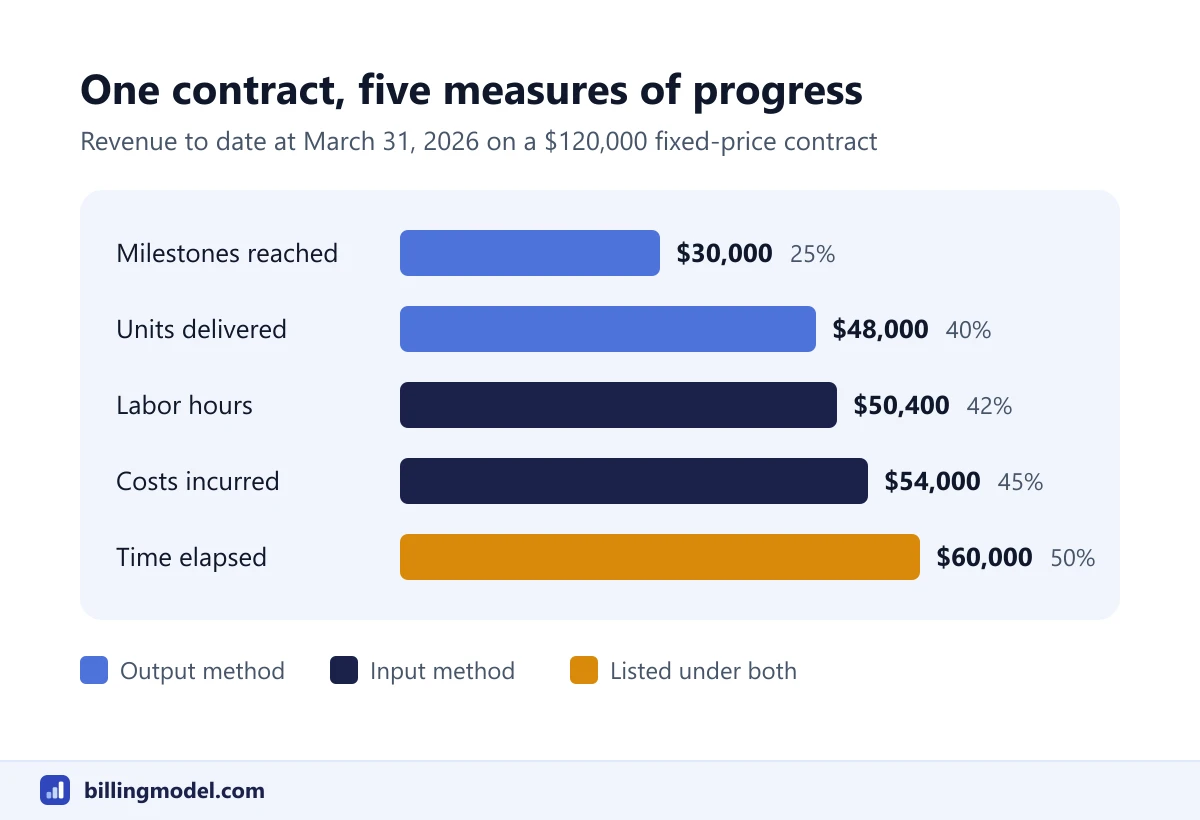 One $120,000 contract at March 31, 2026: revenue to date runs from $30,000 to $60,000 depending on the measure of progress.
The range is $30,000 to $60,000, and the standards don't treat it as a menu. The stated objective is to depict the company's performance in transferring control to the customer. Two of the measures look weak against that objective here.
- Milestones count nothing for the work done toward the second milestone. The FASB text warns that an output method fails if it leaves out goods or services whose control has already passed to the customer.
- Time elapsed assumes even delivery, and the module count and hours both say the first half of the contract held less than half the work.
Cost-based measures need one more check. Suppose $4,000 of the $36,000 was rework caused by the firm's own error. If that counts as a significant inefficiency not reflected in the price, the standards say to leave it out: ($36,000 − $4,000) ÷ $80,000 = 40%, and revenue to date falls to $48,000.
If the contract met none of the three over-time criteria, no revenue would be recognized on March 31 at all. The $120,000 would wait for the point at which control passes.
This contract is a simplified illustration, not a statement of which method any real contract should use.
Subscriptions: ratable recognition is a time-elapsed measure
A subscription that gives continuous access meets the first criterion, because the customer receives and consumes the service as it is provided. The FASB's own illustration is a year of monthly payroll processing, treated as one obligation satisfied over time.
With access delivered evenly, time elapsed depicts performance, and the result is equal monthly amounts. Accountants call this ratable recognition. A 12-month plan priced at $24,000 produces $2,000 of revenue a month, whatever the invoice schedule says.
Cash collected ahead of that schedule sits in a liability until it is earned, as the deferred revenue journal entry shows. For pay-as-you-go plans under usage-based pricing, the right-to-invoice shortcut can line revenue up with each month's usage charge.
Older names: percentage-of-completion, completed-contract, installment and cost-recovery
These four terms come from rules that the current standards replaced. The FASB's 2014 update says it supersedes the revenue requirements in Topic 605, covered in the article on ASC 605, and most industry-specific guidance. IFRS 15 states that it supersedes IAS 11 Construction Contracts and IAS 18 Revenue.
Textbooks still teach the names. OpenStax's accounting textbook, published by Rice University, describes three of them in its section on revenue recognition for long-term projects. An undated accounting primer hosted by New York University's Stern School of Business describes the fourth.
| Older name | How the source describes it | Nearest place in ASC 606 and IFRS 15 |
|---|---|---|
| Percentage-of-completion | OpenStax: revenue on a long project follows the share of work completed, measured for example by the share of expected final costs incurred | Over-time recognition with a measure of progress. Costs incurred is a listed input method |
| Completed-contract | OpenStax: revenue and expenses wait until the entire contract is complete | Not a named method. An obligation that meets none of the over-time criteria is recognized at a point in time |
| Installment | OpenStax: used for real estate sold on installments. Revenue is deferred and recognized through a gross profit percentage as payments arrive | Doubt about payment is tested at step 1, where collection must be probable before a contract is accounted for |
| Cost-recovery | NYU Stern primer: cash receipts and expenses are matched dollar for dollar, so no profit appears until all costs are covered | Not a named method. Revenue limited to costs incurred applies while progress can't be reasonably measured |
Two notes on the table. OpenStax says the completed-contract method was "typically used only where cost and earnings cannot be reasonably estimated throughout the contract term", and that IFRS does not allow it. On collection doubt, the FASB's first example in Topic 606 is a building sold to a buyer from whom collection is not probable: the seller records the payments it receives as a deposit liability, not as revenue.
The last column is a guide to where to look, not a conversion table. A contract that used one of the older methods has to be assessed afresh under the five steps.
One reason the names persist is tax. In the United States, the Internal Revenue Code has special rules for long-term contracts that require the percentage of completion method, with an exception for certain construction contracts, and the IRS's Publication 537, written for 2025 returns, explains the installment method for reporting installment sales. Tax accounting is a separate set of rules from financial reporting, and other countries have their own.
None of this is accounting advice. The right method for a specific contract depends on its terms and on the framework you report under, so confirm the treatment with a qualified accountant.
Frequently asked questions
How many revenue recognition methods are there under ASC 606?
There are two timing patterns, point in time and over time, and two families of methods for measuring progress over time. The standards give examples within each family, such as units delivered or costs incurred, and the lists are not closed.
Is straight-line recognition an output method or an input method?
The FASB text and IFRS 15 each list time elapsed among the examples of both. Each mentions a straight-line basis in the input guidance, for cases where effort is spent evenly through the period. The label matters less than whether even recognition depicts how the service is delivered.
Can a company use different methods for different contracts?
The standards require a single method for each performance obligation and the same method for similar obligations in similar circumstances. Different kinds of obligation can be measured differently. As circumstances change, the measure of progress is updated, and the standards treat that as a change in accounting estimate.
Is the percentage-of-completion method still allowed?
ASC 606 and IFRS 15 don't use the name. An obligation that meets the over-time criteria and is measured by costs incurred produces similar arithmetic, but the test is the current one. US tax law still uses the term for long-term contracts, which is a different question from financial reporting.
Do US GAAP and IFRS use the same methods?
Yes, in structure. Topic 606 and IFRS 15 were issued together, and the FASB's summary says the two boards reached the same conclusions on all requirements, with some minor differences. The three over-time criteria and the output and input families appear in both.