IFRS 15 revenue recognition rests on one idea: a company records revenue as it transfers promised goods or services to a customer, in the amount it expects to be entitled to in exchange. The standard, IFRS 15 Revenue from Contracts with Customers, turns that idea into five steps.
It applies to annual periods beginning on or after January 1, 2018. It was written jointly with the US standard, ASC 606, and the two are close but not identical.
Quick answer: Under IFRS 15 a company identifies the contract, identifies the performance obligations, determines the transaction price, allocates it, and recognizes revenue when or as each obligation is satisfied. A subscription is recognized over time when the customer receives and consumes the benefit as the company performs.
What IFRS 15 is and who uses it
The International Accounting Standards Board (IASB) issued IFRS 15 in May 2014. The IFRS Foundation's page for the standard says it replaced IAS 11, IAS 18 and four interpretations. A September 2015 amendment moved the mandatory date to January 1, 2018, and clarifications followed in April 2016.
The IFRS Foundation describes its accounting standards as used across developed, emerging and developing economies, and says 140+ jurisdictions require them for all or most publicly listed companies (checked October 2026). The United States is not among them. The Foundation's US profile, last updated April 4, 2025, says the SEC requires domestic issuers to apply US GAAP and permits, but does not require, foreign private issuers to apply IFRS.
The standard covers contracts with customers. Paragraph 5 leaves leases, insurance contracts and financial instruments to other standards.
It has also been reviewed. On September 30, 2024 the IASB announced that its post-implementation review found the standard "working as intended". It listed three application issues for its next agenda consultation: deciding whether a company is a principal or an agent, reporting payments to customers, and how IFRS 15 works alongside other standards.
The core principle and five steps of IFRS 15 revenue recognition
Paragraph 2 of the standard states the core principle given above. The five steps apply it.
| Step | What IFRS 15 asks | Paragraphs |
|---|---|---|
| 1. Identify the contract | Approved by the parties, rights and payment terms identifiable, commercial substance, collection probable | 9 |
| 2. Identify the performance obligations | Each promise of a distinct good or service, or of a series of distinct services with the same pattern of transfer | 22, 27 |
| 3. Determine the transaction price | The amount the company expects to be entitled to, leaving out amounts collected for third parties | 47 |
| 4. Allocate the price | In proportion to standalone selling prices | 74, 76 |
| 5. Recognize revenue | When, or as, the customer obtains control of the good or service | 31 |
Variable amounts such as rebates and bonuses are estimated in step 3. Paragraph 56 lets them into the price only to the extent it is "highly probable" that a significant reversal of cumulative revenue will not occur.
These are the steps US students learn too. OpenStax's accounting textbook, published by Rice University, lists them as the FASB's five-step process. The guide to SaaS revenue recognition walks through each one in more detail.
Over time or at a point in time
Under paragraph 35, an obligation is satisfied over time if any one of three criteria is met:
- the customer simultaneously receives and consumes the benefits as the company performs
- the work creates or enhances an asset the customer controls as it is created
- the work creates an asset with no alternative use to the company, and the company has an enforceable right to payment for performance completed to date
If none is met, revenue is recognized at the point in time when control passes. Paragraph 38 lists indicators: a present right to payment, legal title, physical possession, the significant risks and rewards of ownership, and customer acceptance.
For an over-time obligation the company measures progress with an output method or an input method, and applies one method consistently to similar obligations.
A worked example: a €36,000 subscription with a migration service
Simplified illustration. On March 1, 2026 a company reporting under IFRS signs a 24-month, non-cancelable contract for platform access plus a one-off data migration completed in March. The customer pays €1,500 at the end of each month, and each payment falls due only as that month of service is provided. Sold separately, 24 months of access cost €36,000 and the migration €4,000. Assume the migration is distinct and there is no significant financing component.
- Contract: assume the criteria in paragraph 9 are met.
- Performance obligations: two, the access (a series) and the migration.
- Transaction price: 24 × €1,500 = €36,000.
- Allocation: by standalone selling price.
| Obligation | Standalone price | Share | Allocated |
|---|---|---|---|
| Platform access, 24 months | €36,000 | 90% | €32,400 |
| Data migration | €4,000 | 10% | €3,600 |
| Total | €40,000 | 100% | €36,000 |
- Recognition: access over time at €32,400 ÷ 24 = €1,350 a month, and the migration in March 2026.
March revenue is €1,350 + €3,600 = €4,950, but only €1,500 can be invoiced. The other €3,450 is a contract asset.
| Month | Invoiced | Revenue | Contract asset, month-end |
|---|---|---|---|
| March 2026 | €1,500 | €4,950 | €3,450 |
| April 2026 | €1,500 | €1,350 | €3,300 |
| Each month to January 2028 | €1,500 | €1,350 | down €150 a month |
| February 2028 | €1,500 | €1,350 | €0 |
| Total, 24 months | €36,000 | €36,000 |
The totals agree: €4,950 + (23 × €1,350) = €36,000, and €3,450 − (23 × €150) = €0.
| Date | Account | Debit | Credit |
|---|---|---|---|
| March 31, 2026 | Receivable | €1,500 | |
| Contract asset | €3,450 | ||
| Revenue | €4,950 | ||
| April 30, 2026 | Receivable | €1,500 | |
| Revenue | €1,350 | ||
| Contract asset | €150 |
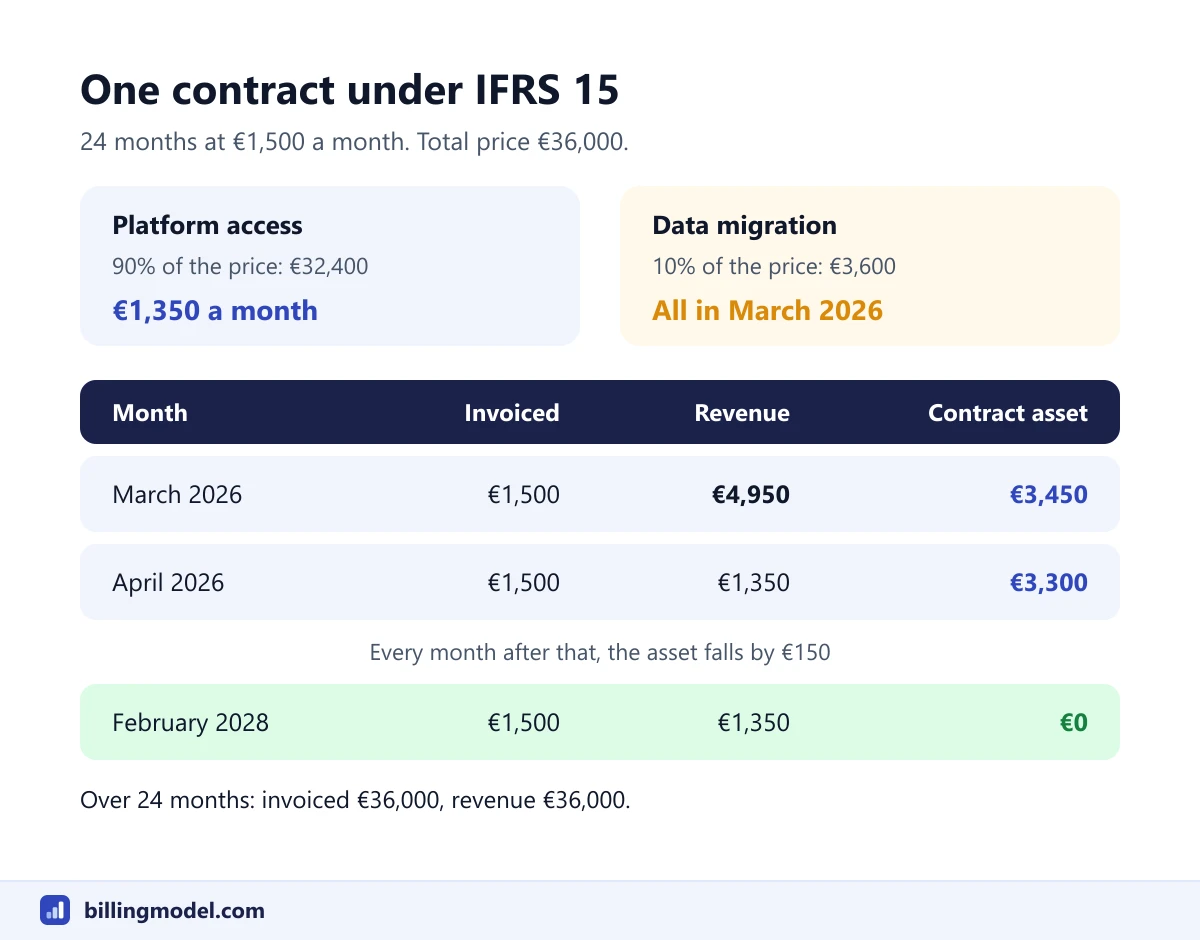 Revenue runs ahead of invoices in March, and the contract asset unwinds by €150 a month.
Now add a €1,800 sales commission paid for winning the contract. Paragraph 91 makes an incremental cost of obtaining a contract an asset if the company expects to recover it. The expedient in paragraph 94, which allows immediate expensing, applies only when the amortization period would be one year or less. Paragraph 99 asks for amortization on a systematic basis consistent with the transfer of the services. One such basis follows revenue: €1,800 × €4,950 ÷ €36,000 = €247.50 in March, then €67.50 a month for 23 months, which totals €1,800.
Contract assets, contract liabilities and contract costs
IFRS 15 gives three balance sheet positions their own names:
- Receivable: an unconditional right to payment. Only the passage of time is needed before it falls due (paragraph 108).
- Contract asset: a right to payment for goods or services already transferred that still depends on something else, such as the company's future performance. The €3,450 above is one.
- Contract liability: an obligation to deliver goods or services the customer has already paid for, or for which payment is due. Paragraph 109 allows other labels, and the common one is covered in the guide to the deferred revenue journal entry.
Contract costs come in two kinds. Costs of obtaining a contract follow paragraphs 91 to 94, as in the commission above. Costs of fulfilling one become an asset under paragraph 95 only if no other standard covers them and they relate directly to a contract, create or enhance resources the company will use to perform, and are expected to be recovered. General and administrative costs are expensed as incurred unless the contract makes them explicitly chargeable to the customer.
A cost asset is impaired when its carrying amount exceeds the consideration still expected less the direct costs still to come (paragraph 101).
What IFRS 15 requires in the notes
IFRS 15 revenue recognition comes with a disclosure objective in paragraph 110: give users enough to understand the nature, amount, timing and uncertainty of revenue and cash flows from contracts with customers. The requirements fall into three groups.
| Group | Main disclosures | Paragraphs |
|---|---|---|
| Contracts with customers | Revenue from customers shown apart from other revenue, revenue split into categories, opening and closing balances of receivables, contract assets and contract liabilities, a description of performance obligations and payment terms, the price allocated to obligations not yet satisfied | 113 to 122 |
| Significant judgments | The methods used to recognize revenue over time, how the timing of control was judged, how the price was determined and allocated | 123 to 126 |
| Contract cost assets | Closing balances by main category, the amortization method, amortization and impairment for the period | 127 and 128 |
Paragraph 121 offers relief on one item: the remaining-obligations disclosure can be skipped for a contract with an original expected duration of one year or less.
Where IFRS 15 and ASC 606 differ
The FASB's summary of its 2014 update says the two boards reached the same conclusions on all requirements, with some minor differences. Each board then clarified its own text in 2016, which added a few more. The table lists differences set out in those two FASB documents, mainly the comparison appendix to the May 2016 update, and in the two standards' own wording.
| Point | ASC 606 (US GAAP) | IFRS 15 |
|---|---|---|
| "Probable" in the collectibility test | Likely to occur | More likely than not |
| Constraint on variable consideration | "Probable" that no significant reversal will occur | "Highly probable" |
| Impairment of contract cost assets | Reversal not allowed | Reversal required when conditions improve (paragraph 104) |
| Interim reports | Public entities disclose disaggregated revenue, contract balances and remaining obligations | IAS 34 requires disaggregated revenue |
| Non-cash consideration | Measured at fair value at contract inception | Measurement date not prescribed |
| Sales and similar taxes | Policy election to exclude them all from the price | No such election |
| Licenses of intellectual property | Classified as functional or symbolic | Asks whether the company's ongoing activities significantly affect the intellectual property |
| Nonpublic entities | Some relief on disclosure, transition and effective date | None. IFRS for SMEs is a separate standard |
Whether any of these changes the answer for a given contract is a question for an accountant who knows both frameworks. For US cases worked through the same five steps, see the ASC 606 revenue recognition examples.
This article describes the standard in general terms and is not accounting advice. The treatment of a real contract depends on its terms and on local reporting rules, and a qualified accountant should confirm it.
Frequently asked questions
When did IFRS 15 become effective?
For annual reporting periods beginning on or after January 1, 2018, with earlier application permitted. The original date was January 1, 2017, and the IASB deferred it in September 2015.
Is IFRS 15 revenue recognition the same as ASC 606?
The five steps and the core principle are the same, and the FASB describes the remaining differences as minor. They include the meaning of "probable", reversal of impairment losses on contract costs, and policy elections on sales taxes and on shipping and handling that exist only in US GAAP.
What is the difference between a contract asset and a receivable?
A receivable is unconditional: only time has to pass before payment is due. A contract asset is a right to payment that still depends on something else, such as delivering the rest of the contract.
What did IFRS 15 replace?
According to the IFRS Foundation, it replaced IAS 11 on construction contracts, IAS 18 on revenue, and the interpretations IFRIC 13, IFRIC 15, IFRIC 18 and SIC-31.