A price increase letter to customers is a short written notice that says what is changing, from which price to which price, on what date, and what the customer can do about it. It goes out before the first charge at the new price, early enough for the customer to decide whether to stay.
Its job is to make sure nobody learns about the new price from a card statement. How much notice you owe depends on your contract with the customer and on consumer rules where they live, so the rules below are examples from named regulators, not a statement of what applies to you.
Quick answer: State six things: what is changing, the old and new price, the effective date, the reason in one honest sentence, the customer's options (stay, change plan or cancel) and who to contact. Send it early enough to meet the notice period in your contract and in local rules, and start the new price on a billing date or renewal date, not in the middle of a period.
What a price increase letter to customers should contain
Six pieces of information, in this order.
| Element | What to write | Example |
|---|---|---|
| What is changing | The plan, service or contract affected | "The price of your Team plan is going up." |
| Old and new price | Both figures, in the same unit and interval | "$120.00 per month becomes $132.00 per month." |
| Effective date | The date of the first charge at the new price | "Your April 1, 2026 bill is the first at the new price." |
| Reason | One sentence that is true | "Our hosting and support costs have risen since we set this price in 2023." |
| Options | What the customer can do, and by when | "You can change plan or cancel before April 1 at [link]." |
| Contact | A named person or a monitored address | "Reply to this email or call [number]." |
Put the two prices and the date in the first lines. The US Federal Trade Commission's advice to consumers on auto-renewals tells them to read a renewal notice closely to confirm the rate is what they expected, and to call the company right away if it isn't or if the notice doesn't say how much they'll pay. A letter that states both figures answers that call before it's made. Name it plainly, too: a subject line such as "Price increase from April 1" tells the reader what is inside.
What research says about explaining a higher price
Customers decide whether the increase is fair, and they work with less information than you have. In a Harvard Business School Working Knowledge interview from 2010, Frank Cespedes, one of three authors of a paper on pricing, put it in one line: "You do not determine what is fair, the customer does."
Research covered by Knowledge at Wharton in 2002 shows how wide the gap can be. Lisa Bolton, Joseph Alba and Luk Warlop ran 10 experiments with 1,100 college students and a phone survey of 3,500 Florida residents. Participants underestimated the effect of inflation even when they were given the rates, and telling them about costs such as labor and rent moved their idea of a fair price only modestly. The study is old and American, so read it as a tendency.
The practical reading: give one true reason and don't expect it to do much work. If costs rose, say which. If you underpriced the product, say that. Spend the rest of the effort on clear numbers and enough notice.
How much notice to give
Start with the contract. It may set a notice period for changes, and it may fix the price for a term. GTT Communications' annual report for 2016, for example, says its prices were fixed for the duration of the customer contract. Where a contract reads like that, a notice letter may not be enough to change the price before renewal. Read the contract's own terms on changes, and ask a lawyer if you are unsure what they allow.
Then look at the rules for your payment method and your customers' location. These are examples (checked October 2026), not a complete list.
| Source | Applies to | What it says |
|---|---|---|
| Regulation E (US) | Preauthorized debits from a consumer's bank account | Written notice of the amount and date at least 10 days before a transfer that differs from the previous one |
| Nacha rules, as set out in Nacha's developer guide (US) | Recurring ACH debits | 10 calendar days' notice for a change of amount on consumer accounts |
| Visa subscription policy, June 2019 (regions outside Europe) | Card subscriptions that began with a free trial or introductory offer | A reminder with a link to cancel online at least 7 days before a charge, when the price or billing period has changed |
| CMA guidance (UK) | Contracts between traders and consumers | A term allowing changes is more likely to be fair if the customer is warned with enough time and has a genuine right to exit without penalty |
| Your Europe (EU) | Consumer contracts | In the portal's example, a term raising the price of a service without letting the consumer cancel was "most likely unfair" |
The first three rows are about the payment, and the periods are short. The guide to setting up recurring payments covers them in more detail.
The last two rows are about whether the contract term that allows the increase is fair at all. The UK Competition and Markets Authority's guide to writing a fair contract, updated in July 2026, gives two sample terms. The one it calls unlikely to be fair lets the company raise the price at any time after the first year and makes the customer give three months' notice to leave. The one it calls more likely to be fair allows a change once a year to reflect supplier costs, caps any increase at the rise in the Consumer Prices Index, gives one month's written notice stating the level of the change, its basis and its date, and lets the customer cancel with one week's notice.
Note: None of this tells you what your own notice period is. Several rules can apply to one customer, and US states and other countries add their own. Have a lawyer confirm the period and the wording before you send anything.
Timing against the billing date and the renewal
Count the notice backward from the first charge at the new price, not forward from the day you decide.
Start on a billing date. If the new price begins at the start of a period, each bill carries one price. A change in the middle of a period has to be prorated, which puts two prices on one bill. The guide to subscription billing shows how proration works if you can't avoid it.
Mind anniversary billing. If customers are billed on the day of the month they signed up, "effective April 1" means a different first charge for each of them. Write "from your first bill on or after April 1". The billing period article explains the two schedules.
Annual and prepaid plans change at renewal. A customer who has paid for a year has bought that year at the old price. The letter should arrive well before the renewal date and say how to cancel before it.
Service contracts follow their own clause. Find what the contract says about when and how the fee can change, and quote that clause in the letter.
Worked example: the effect on one customer's bill
A software company raises its Team plan from $120.00 to $132.00 per month. The letter goes out on Monday, February 2, 2026, and the new price applies to each customer's first bill on or after April 1, 2026.
The increase is $132.00 − $120.00 = $12.00 per month, and $12.00 ÷ $120.00 = 10%.
Take a customer billed on the 1st of each month:
- February 2 to April 1 is 58 days of notice: 26 days left in February, 31 in March, plus April 1.
- The March 1 bill is still $120.00. The April 1 bill is the first at $132.00.
- In 2026 the customer pays 3 × $120.00 = $360.00 plus 9 × $132.00 = $1,188.00, a total of $1,548.00. That is $108.00 more than 12 × $120.00 = $1,440.00, or 9 bills × $12.00.
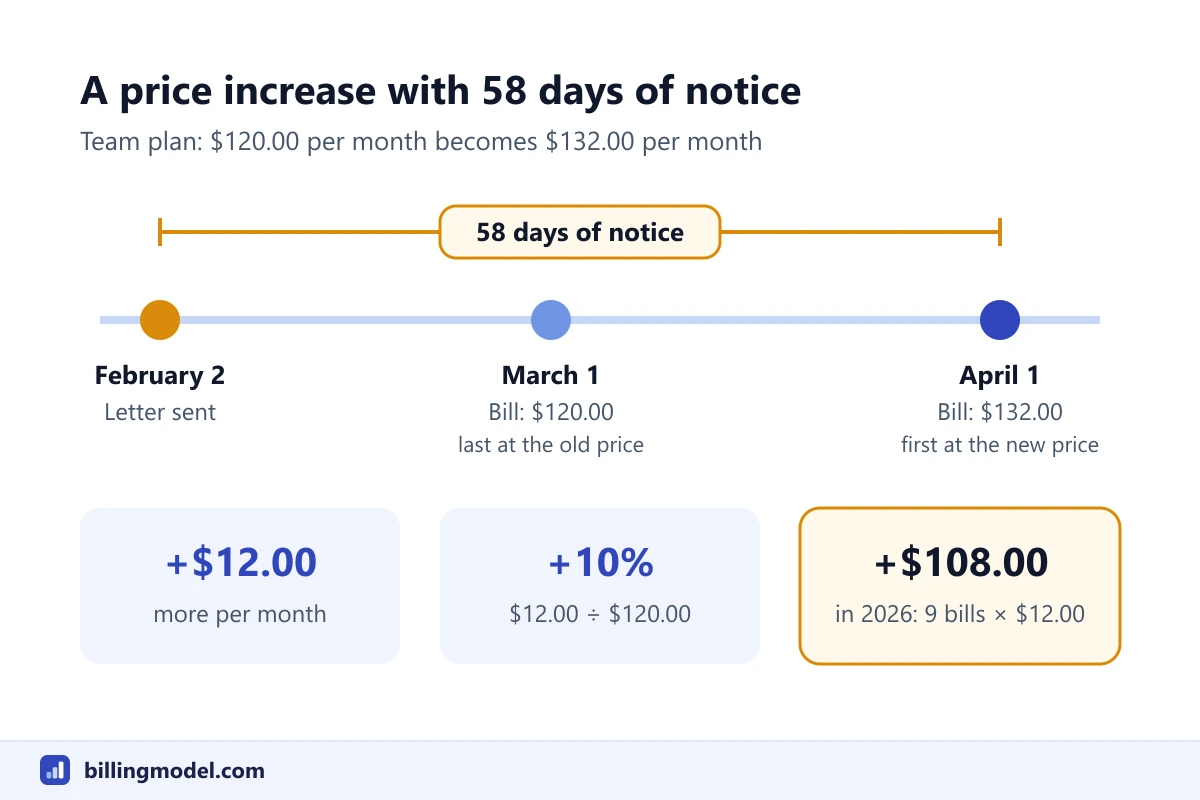 One customer's bills around the increase: 58 days of notice, then $12.00 more per month.
Two other customers get the same letter and different dates:
| Customer | Billing | First bill at new price | Notice before that bill |
|---|---|---|---|
| A | Monthly, on the 1st | April 1: $132.00 | 58 days |
| B | Monthly, on the 18th | April 18: $132.00 | 75 days |
| C | Annual, $1,200.00, renewed September 10, 2025 | September 10, 2026: $1,320.00 | 220 days |
Customer C's annual price rises by the same 10%, but nothing changes until the renewal, so customer C needs a second notice closer to that date.
Two sample letters
Here are two versions of a price increase letter to customers, one for a subscription and one for a service contract. They are illustrations written for this article, not standard forms. Adapt them to your contract and have the final wording reviewed by a lawyer, because notice periods and required content depend on the contract and the jurisdiction.
Subscription (email)
Subject: Price increase for your Team plan from April 1, 2026

Hi [First name],

The price of your Team plan is going up from $120.00 to $132.00 per
month. The new price applies from your first bill on or after
April 1, 2026. Your next bill at the new price will be on [date].

We set the current price in 2023, and our hosting and support costs
have risen since then.

Nothing else about your plan changes. If you'd prefer not to continue,
you can switch plans or cancel before [date] at [link], and you won't
be charged the new price.

Questions? Reply to this email or call [number].

[Name], [Business name]
Service contract (letter)
April 20, 2026

Re: Maintenance Agreement dated July 1, 2024 - fee change on renewal

Dear [Name],

Under clause [8.2] of the agreement, this is written notice that the
monthly fee will increase from $1,500.00 to $1,575.00, an increase
of 5%, when the agreement renews on July 1, 2026.

The increase reflects higher labor and parts costs over the past
year. The scope of service is unchanged.

If you do not wish to renew at the new fee, clause [11.1] allows you
to give notice of non-renewal by [date].

Questions: [name], [phone] or [email].

[Name, title]
The second letter is dated 72 days before the renewal. For that customer the increase is $75.00 a month, or 12 × $75.00 = $900.00 over the renewed year.
Mistakes that turn a letter into a complaint
A price increase letter to customers goes wrong in a small number of ways.
- Hiding the number. A percentage without the two prices, or the new price without the old one, makes the customer do the math.
- Counting notice from the wrong date. The period runs to the first higher charge, and anniversary billing gives every customer a different one.
- Giving a reason that isn't true. Customers compare the reason with what they can see.
- No way out. A letter that omits how to cancel leaves the bank as the customer's remaining option. The guide to chargeback prevention explains what that costs.
Keep a dated copy of each notice with the customer's account.
Frequently asked questions
How much notice should a price increase letter give?
At least what your contract and the rules for your customers require, which vary. Examples include 10 days under US Regulation E for a changed bank debit and one month in the UK regulator's sample of a fairer contract term. A lawyer should confirm the period that applies to you.
Do I have to give a reason for the increase?
That depends on the contract and the jurisdiction. The UK regulator's sample of a fairer term has the notice state the basis for the change. In practice, one honest sentence is enough.
Can I raise the price in the middle of a contract?
That depends on what the contract says, and consumer law may limit a term that allows it. Where the price is fixed for a term, expect the increase to wait for renewal unless the customer agrees otherwise. Ask a lawyer before relying on a variation clause.