A billing statement is a summary of everything that happened on a customer's account over a period: what was owed at the start, what was billed, what was paid or credited, and what is owed at the end. The billing statement example below is filled in line by line, and its numbers add up, so you can use it as a model.
The same document is also called a statement of account or a customer statement. Whatever the name, it isn't a new bill. Every charge on it has already been invoiced once.
Quick answer: A billing statement lists an opening balance, the period's invoices, payments and credits, and a closing balance, often with the open amounts sorted by age. In the example below, $1,650 opening + $1,544 of new charges − $1,100 paid − $150 credited = $1,944 closing. An invoice bills one transaction. A statement summarizes the account.
What a billing statement is
A statement reports on the account, not on a sale. An invoice says "you bought this, pay this amount by this date". A statement says "here is where your whole account stands on this date".
It comes in two layouts. Indiana University's documentation for its receivables reports describes both: a summary of all invoices outstanding on a customer's account, or a detailed statement showing a previous billed balance followed by all activity since that balance. The first is a list of open items. The second carries a balance forward and shows how it changed, which is the layout used below.
The period a statement covers follows the billing cycle, the repeating interval between one statement and the next. The billing period article defines billing cycle, billing date and due date, and the same terms apply here with one difference: a statement has a statement date, but each invoice on it keeps its own due date.
A complete billing statement example
The seller and customer are made up. This is a monthly statement for October 2026, every invoice is on net 30 terms, and the amounts include tax.
| Field | Entry |
|---|---|
| Document | Statement of account |
| Statement date | October 31, 2026 |
| Period covered | October 1 to October 31, 2026 |
| From | Example Software Ltd, 12 Quay Street, Example City |
| To | Sample Dental Group, 48 Mill Road, Sample Town |
| Customer account | C-1048 |
| Terms | Net 30 from each invoice date |
The activity section lists every transaction in date order with a running balance.
| Date | Reference | Description | Charges | Payments and credits | Balance |
|---|---|---|---|---|---|
| October 1, 2026 | Opening balance | $1,650.00 | |||
| October 1, 2026 | INV-2077 | Team plan, October 2026 | $880.00 | $2,530.00 | |
| October 8, 2026 | PMT-0412 | Bank transfer received, applied to INV-2052 | $1,100.00 | $1,430.00 | |
| October 12, 2026 | DN-0031 | Debit note: 6 seats not billed on INV-2077 | $264.00 | $1,694.00 | |
| October 20, 2026 | CM-0125 | Credit memo on INV-2031: onboarding session not delivered | $150.00 | $1,544.00 | |
| October 28, 2026 | INV-2090 | Data migration service | $400.00 | $1,944.00 | |
| October 31, 2026 | Totals and closing balance | $1,544.00 | $1,250.00 | $1,944.00 |
The opening balance is two unpaid invoices from earlier months: INV-2031 for $550.00 and INV-2052 for $1,100.00. The last section shows what the closing balance is made of.
| Open item | Dated | Due | Original | Paid or credited | Still open | Status on October 31 |
|---|---|---|---|---|---|---|
| INV-2031 | August 20, 2026 | September 19, 2026 | $550.00 | $150.00 | $400.00 | 42 days past due |
| INV-2077 | October 1, 2026 | October 31, 2026 | $880.00 | $0.00 | $880.00 | Due today |
| DN-0031 | October 12, 2026 | November 11, 2026 | $264.00 | $0.00 | $264.00 | Not yet due |
| INV-2090 | October 28, 2026 | November 27, 2026 | $400.00 | $0.00 | $400.00 | Not yet due |
| Total | $2,094.00 | $150.00 | $1,944.00 |
Aged by days past due, that is $1,544.00 current and $400.00 in the 31–60 day column.
The arithmetic, step by step:
- New charges: $880 + $264 + $400 = $1,544.
- Payments and credits: $1,100 + $150 = $1,250.
- Closing balance: $1,650 + $1,544 − $1,250 = $1,944.
- Cross-check against the open items: $400 + $880 + $264 + $400 = $1,944.
- Age of INV-2031: September 19 to October 31 is 11 days in September plus 31 in October, so 42 days past due.
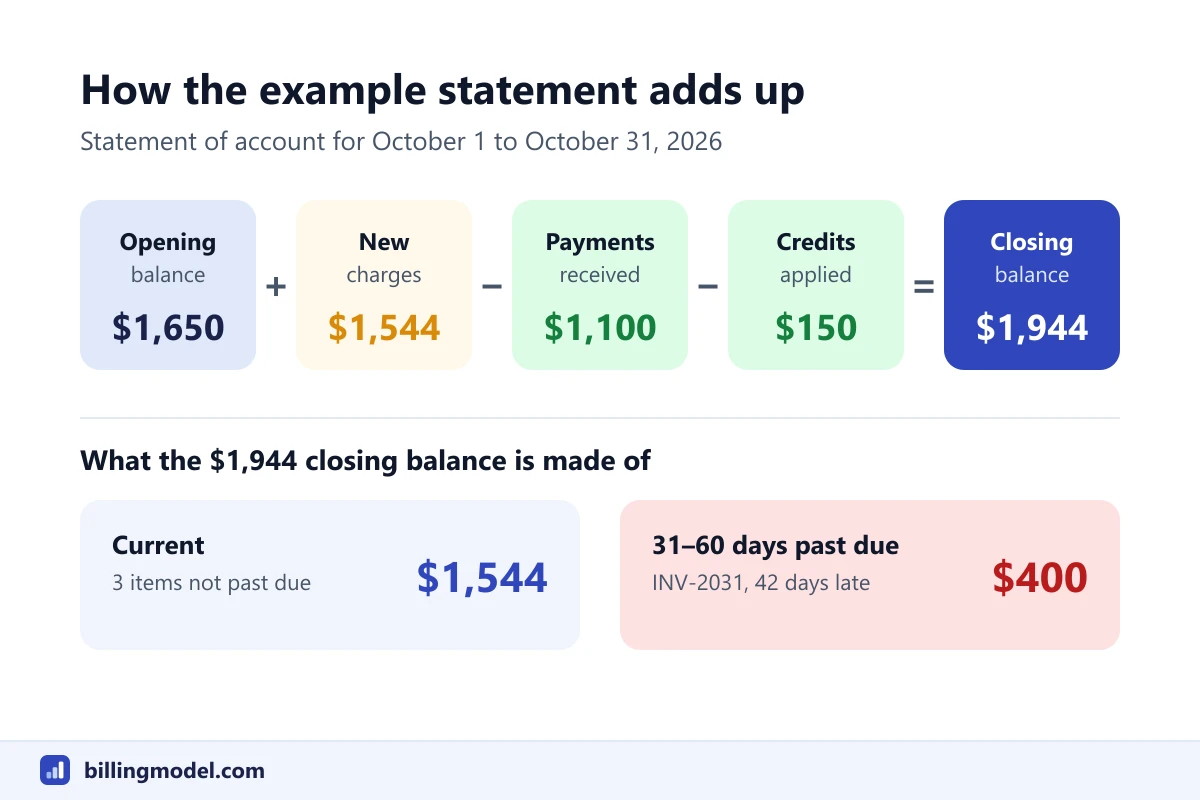 How the example statement gets from its opening balance to its closing balance.
This billing statement example is an illustration, not a standard. Adapt it to your business and local rules, and have your accountant review the template. The two adjusting documents on it are explained in the credit memo example and the debit note article.
How to read a billing statement
Read it in the order it was built, and check each part against your own records. The steps below use the billing statement example above.
- Look at the statement date first. A statement is a snapshot. Wayne State University's eBill FAQ says the statement balance "will not change, as the statement is static", and that payments or credits posted after the bill date appear on the next one. A payment sent on November 2 won't be on a statement dated October 31.
- Match the opening balance to the closing balance of the previous statement. Here that is $1,650.
- Match every charge to a document you hold. INV-2077, DN-0031 and INV-2090 should each exist in your files with the same amount.
- Tick off the payments and check which invoice each one was applied to. The $1,100 went to INV-2052, which is why that invoice has left the open items.
- Check the credits you were promised. CM-0125 took $150 off INV-2031.
- Read the open items by age. The $400 left on INV-2031 is the only late amount, and it is the line a collector will ask about. The steps a seller follows next are in the guide to a past due invoice.
Consumer bills follow the same path. The University of Nebraska–Lincoln's guide to reading a student bill starts with the previous balance and the payments made since the last statement, moves to new activity, which covers all debits and credits since the last statement, and ends with the amount due and its due date.
Billing statement vs invoice vs receipt
| Invoice | Billing statement | Receipt | |
|---|---|---|---|
| Covers | One sale, or one period's charges | The whole account over a period | One payment |
| Says | Pay this amount by this date | This is what was billed, paid and still open | This amount was received |
| Creates a new amount owed | Yes | No | No |
| Dates on it | Invoice date and due date | Statement date. Each invoice keeps its own due date | Payment date |
| Issued | At or after the sale | On a schedule, or on request | After payment |
| What the customer does | Approves and pays it | Reconciles the account | Keeps it as proof of payment |
GOV.UK's guidance on invoicing draws the last line in one sentence: an invoice is not the same as a receipt, which is an acknowledgement of payment.
The first line matters more in practice, because some buyers refuse to pay from a statement at all. Loyola University Chicago's accounts payable page says it does not pay from vendor statements, pro forma invoices, quotes or estimates, and that this helps prevent duplicate payments. Duke University's billing instructions for vendors say payments cannot be processed from vendor statements and that an invoice is required. Send the invoice first. The statement backs it up.
When to send statements and what customers do with them
Published university practice varies, and no rule sets the frequency for a business-to-business statement.
| Organization | When statements go out |
|---|---|
| Weber State University | Monthly, produced on about the 15th, showing balances due (policy dated October 4, 1984) |
| University of Connecticut | Quarterly, to customers with balances due |
| University of South Carolina | On request, and enclosed with each past due letter |
| Wayne State University (student eBills) | Monthly, usually by the first business day |
A monthly statement to every customer with an open balance or activity in the period is a reasonable default. It lines up with month-end, when payments have been applied and the accounts receivable aging report is reviewed, and the two should show the same total for each customer.
Customers use a statement to reconcile: they compare it line by line with their own payables records. The Washington State Auditor's accounts payable guide (first edition, November 2021) calls reconciling vendor statements to accounts payable records an industry best practice, done to identify duplicate payments or other discrepancies. It also notes that some vendors send statements only on request and that others leave out part of the activity. A complete statement is the one your customer's finance team can use against its accounts payable aging report.
What a regulated statement must show: a US consumer-credit example
In the United States, statements for consumer credit are regulated, and the rule shows what a regulator thinks a statement can't leave out. This is US consumer-credit law, shown here as an example. It is written for credit extended to consumers, not for an ordinary statement between two businesses.
Under Regulation Z, § 1026.7(b), the periodic statement for an open-end credit plan that is not home-secured must disclose, among other items (checked October 2026):
- the previous balance, meaning the balance outstanding at the beginning of the billing cycle
- each transaction, and each credit with its amount and date
- the periodic rates, labeled as annual percentage rates, and the balance each applied to
- interest charged and fees, with totals for the period and the calendar year to date
- the closing date of the billing cycle and the new balance
- for credit card accounts, the due date and the cost of paying late
- the address for notices of billing errors
Strip out the interest disclosures and the skeleton is the one in the example: previous balance, transactions, credits, new balance, due date. Other countries have their own consumer rules, and a lawyer should confirm which apply to you.
Note: If you charge interest or late fees on a statement, they need a basis in your contract or in local law. See late fees on invoices.
Common mistakes with billing statements
- Sending a statement in place of an invoice. The charge has no invoice number of its own, and a payables team like Loyola's or Duke's won't pay it.
- Leaving unapplied payments off the open items. The balance is right, but an invoice the customer has paid still shows as late.
- A closing balance that doesn't match the ledger. If the statement and your aging report disagree, fix the records before the customer finds the difference.
- No statement date or period. Without them the customer can't tell which payments should already appear.
- A balance with no detail. A single figure can't be reconciled. List the documents behind it.
Frequently asked questions
Is a billing statement the same as an invoice?
No. An invoice bills one transaction and creates the amount owed. A billing statement lists the invoices, payments and credits on the account over a period and shows the balance that results. It adds nothing new to what the customer owes.
Should a customer pay from a billing statement?
It depends on the customer's process. The two university payables offices cited above pay from invoices only. A consumer bill, such as a card or student account statement, is different: the statement is the payment request.
How often should a business send billing statements?
No rule sets it for business customers. The published examples here range from monthly to quarterly to on request. Monthly is easy to keep up because it follows the month-end routine.
Why doesn't my statement show a payment I just made?
A statement shows the account as of its statement date. A payment that arrived or was posted after that date appears on the next statement, which is how Wayne State University describes its own bills.