A debit note is a document that records a debit against a trading partner's account after an invoice has already been issued. Which way the balance moves depends on who sends it, and that is where the confusion starts: one name covers two documents that push the amount owed in opposite directions.
A buyer sends a debit note to a supplier to say it is reducing what it owes, for example for returned goods. A seller sends a debit note to a customer to add to an invoice that was too low. US usage prefers "debit memo" or "debit memorandum" for both.
Quick answer: A debit note is either a buyer's notice that it has reduced its payable and wants a credit note, or a seller's document that increases what a customer owes on an earlier invoice. In the example below, a seller's debit note for $264 lifts an $880 invoice to $1,144. Ask which meaning the other party intends before you book it.
The two meanings of a debit note
Both uses make sense from the issuer's side of the ledger. A buyer that sends goods back debits its accounts payable, the money it owes suppliers. A seller that bills more debits its accounts receivable, the money customers owe it. Each one calls the paper that explains its entry a debit note.
A buyer's debit note: "we owe you less"
The buyer issues this one. It tells the supplier that the buyer has reduced the amount it owes and expects a credit note to match. The triggers are the buyer-side view of the reasons for a credit memo. The University of Kentucky's credit memo policy, for example, names the return of purchased merchandise and a shortage in shipment among the reasons a vendor issues one.
Canada's tax guidance gives the buyer's version official standing. The Canada Revenue Agency's GST/HST Memorandum 12-2, dated April 2008, says a supplier that refunds, adjusts or credits tax must issue a credit note within a reasonable time, unless the other party issues a debit note to the supplier first.
OpenStax's accounting textbook ties the term to the same event. In its passage on purchase returns and allowances, a debit memo acknowledges the change and the reduction in the amount owed, but there it is the manufacturer who issues it. The label is loose enough that a textbook and a tax agency put it in different hands.
A seller's debit note: "you owe us more"
The seller issues this one, after an invoice turns out to be too low. UK tax guidance uses the term this way: HMRC's VAT manual says the supplier must issue a debit note to reflect an agreed increase in price. The University of Wisconsin–Madison's finance glossary defines a debit memo as an increase to the customer's accounts receivable balance, and gives a fee for a payment returned for insufficient funds as its example.
The triggers are an undercharge (wrong quantity, price or tax rate), extra work agreed after the invoice went out, or a fee the contract allows.
The bank's debit memo
Banks use the phrase for something else. In an open accounting textbook by Edwards and Hermanson, as adapted for a SUNY accounting course, debit memos on a bank statement reflect deductions for items such as service charges and NSF (bounced) checks. The rest of this article leaves that meaning aside.
When each kind of debit note is used
| Situation | Who issues it | Effect on the amount owed | What should follow |
|---|---|---|---|
| Goods returned to the supplier | Buyer | Down | The supplier's credit note |
| Short shipment: billed for 10, received 8 | Buyer | Down | The supplier's credit note |
| Supplier's invoice overcharged | Buyer | Down | The supplier's credit note |
| Invoice undercharged (quantity, price or tax) | Seller | Up | Customer pays the extra |
| Extra work agreed after invoicing | Seller | Up | Customer pays the extra |
| Fee the contract allows, such as a returned-payment fee | Seller | Up | Customer pays the fee |
A buyer's debit note is a claim, not a settlement. Georgia Tech's policy on credit memos tells departments to hold the original invoice until they receive the corresponding credit memo. That is the cautious way to treat it: the supplier's credit note closes the item, not the buyer's own paper. The credit memo example shows what that reply looks like.
A seller's debit note needs agreement too. HMRC's manual says an increase in price occurs when the change is agreed by both the supplier and the customer. A debit note for work the customer never approved is an invoice in dispute.
What a debit note contains
No single worldwide list exists, but tax rules often set a minimum. In the UK, paragraph 18.2.4 of HMRC's VAT guide (Notice 700) says a valid debit note must show:
- an identifying number and the date of issue
- the supplier's name, address and VAT registration number
- the customer's name and address
- the number and date of the original VAT invoice
- a description that identifies the goods or services
- the amount of the price increase, excluding VAT
- the rate and amount of VAT debited
Add the reason and the new balance even where no rule asks for them. Your own country's tax rules may differ, so check them or ask your accountant.
A filled-in debit note example
The seller and customer are made up. Invoice INV-2077 billed 20 software seats at $40 each, but the customer had added 6 seats under a contract amendment before the billing date, so 26 should have been billed. Tax is shown at an illustrative 10%.
| Field | Entry |
|---|---|
| Document type | Debit note |
| Debit note number | DN-0031 |
| Date of issue | October 12, 2026 |
| Seller | Example Software Ltd, 12 Quay Street, Example City. Tax registration no. 000 1234 56 |
| Customer | Sample Dental Group, 48 Mill Road, Sample Town |
| Original invoice | INV-2077, dated October 1, 2026 |
| Reason for debit | Invoice billed 20 seats. 26 seats were active under the amendment of September 22, 2026 |
| Increase agreed with customer | October 6, 2026 |
| Description | Team plan, October 2026: seats not billed |
| Quantity and unit price | 6 seats × $40.00 |
| Increase before tax | $240.00 |
| Tax debited (10%) | $24.00 |
| Total debit | $264.00 |
| Original invoice total | $880.00 |
| Amount owed after debit note | $1,144.00 |
| Payment due | November 11, 2026 (30 days from the debit note date) |
| Approved by | Finance manager (name and signature) |
The arithmetic, step by step:
- Original invoice: 20 × $40 = $800, plus 10% tax of $80, total $880.
- Debit note: 6 × $40 = $240, plus 10% tax of $24, total $264.
- Amount owed: $880 + $264 = $1,144.
- Check against a correct invoice: 26 × $40 = $1,040, plus 10% tax of $104, total $1,144.
The note is dated 6 days after the increase was agreed, inside the 14 days HMRC allows for UK VAT. Treat the layout as an illustration, not a standard, and have your accountant review your own template before you use it.
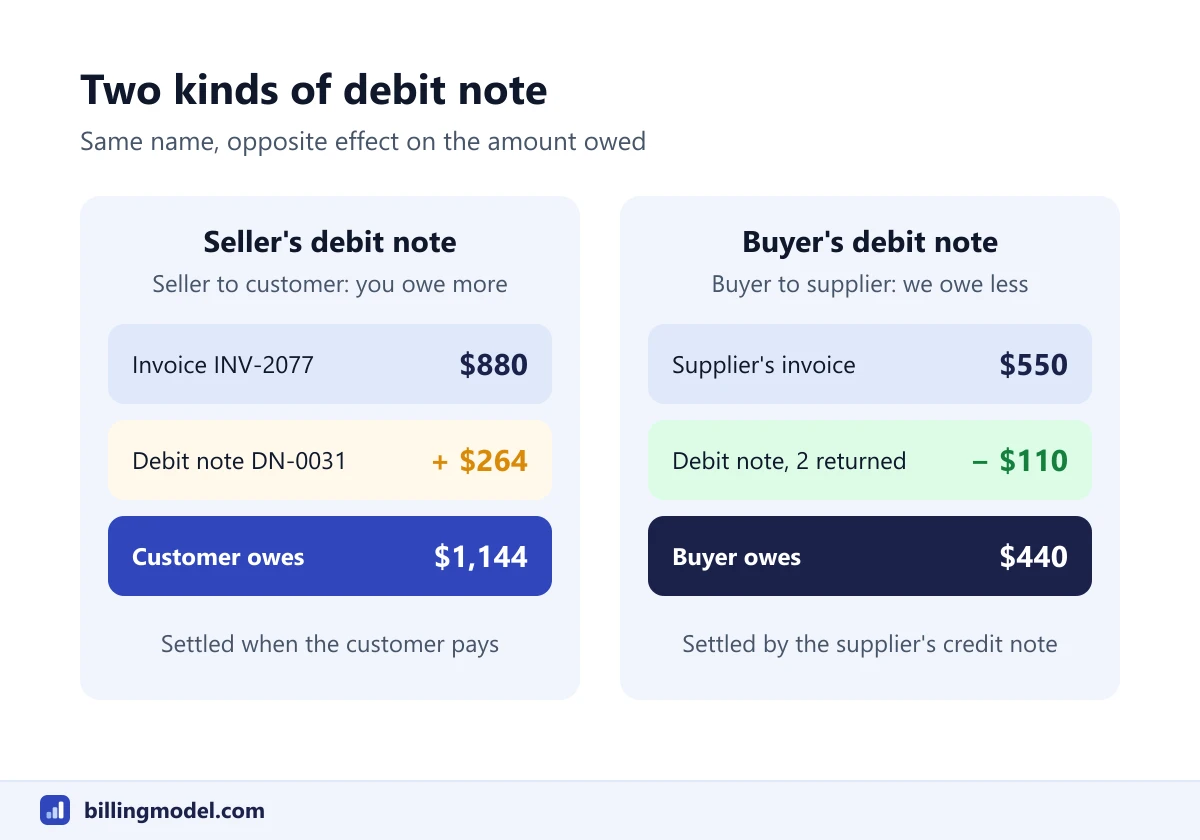 The seller's debit note from the example, next to a buyer's debit note for returned goods.
The buyer's version carries the same fields with the roles swapped. Say a retailer buys 10 headsets for resale at $50 each: $500 plus $50 tax, or $550. Two arrive damaged and go back. The retailer's debit note to the supplier covers 2 × $50 = $100 plus $10 tax, $110 in all, and its payable falls from $550 to $440 once the supplier confirms with a credit note.
Journal entries on each side
Each debit note produces a mirror-image pair of entries. For the seller's debit note DN-0031:
| Books | Account | Debit | Credit |
|---|---|---|---|
| Seller | Accounts Receivable | $264 | |
| Seller | Revenue | $240 | |
| Seller | Sales tax payable | $24 | |
| Customer | Software expense | $240 | |
| Customer | Recoverable tax | $24 | |
| Customer | Accounts Payable | $264 |
The seller's entry has the shape of the original sale. OpenStax's worked entries for a credit sale debit Accounts Receivable and credit Sales.
For the buyer's debit note on the returned headsets:
| Books | Account | Debit | Credit |
|---|---|---|---|
| Buyer | Accounts Payable | $110 | |
| Buyer | Merchandise Inventory | $100 | |
| Buyer | Recoverable tax | $10 | |
| Supplier | Sales Returns and Allowances | $100 | |
| Supplier | Sales tax payable | $10 | |
| Supplier | Accounts Receivable | $110 |
The buyer's lines follow OpenStax's entries for a purchase return made before payment under a perpetual inventory system: debit Accounts Payable, credit Merchandise Inventory. The supplier's lines are the credit memo entry.
The tax lines in both tables are this article's addition, since OpenStax's entries carry no tax. The right accounts depend on your accounting framework, your inventory system, whether you can reclaim the tax and how the original invoice was booked, so have a qualified accountant confirm the treatment.
Debit note vs credit note vs invoice
| Invoice | Credit note | Seller's debit note | Buyer's debit note | |
|---|---|---|---|---|
| Issued by | Seller | Seller | Seller | Buyer |
| Effect on the amount owed | Creates it | Reduces it | Increases it | Claims a reduction |
| Refers to an earlier invoice | No | Yes | Yes | Yes |
| Trigger | A sale | Return, overcharge, agreed reduction | Undercharge, agreed increase | Return, short shipment, overcharge |
| What settles it | Payment | Offset, refund or held credit | Payment | The seller's credit note |
A seller could send a second invoice instead. HMRC's manual on credit and debit notes describes the debit note as something issued for an increase in price "rather than a supplementary invoice being raised". Its advantage is the cross-reference: it points at the invoice it corrects, so nobody mistakes it for a new sale.
Either way it becomes one more open item with a due date under your invoice payment terms, and it appears as a charge line on the customer's next statement, as in the billing statement example.
Tax treatment: the UK and Canada as examples
Tax rules decide when a debit note is valid, and they differ by country. Two published examples, both checked in October 2026:
United Kingdom. HMRC's Notice 700 says a debit note is valid for VAT only if it reflects a genuine mistake, an undercharge or an agreed increase in the value of the supply, and is issued within 14 days of the increase being agreed. The VAT rate is the one in force at the tax point of the original supply. Where no error on a past return is involved, the supplier adjusts its output tax in the accounting period in which the two sides agreed the increase. HMRC's manual adds that since September 1, 2019, in most cases, a customer can no longer issue a tax debit note in place of the supplier's credit note.
Canada. The CRA memorandum works the other way round: its debit note comes from the recipient and stands in for the supplier's credit note. The supplier may deduct the tax when working out net tax for the reporting period in which it issues the credit note or receives the debit note. A registered recipient adds the amount back, to the extent it had claimed an input tax credit. The memorandum dates from 2008, so check the current rules.
Watch out: Two tax agencies, two different issuers. Before you send or accept a debit note, ask an accountant which document your country's rules expect and what deadline applies.
Common mistakes with debit notes
- Not saying which kind it is. Under the title, add a plain line such as "This note increases the amount you owe" or "We have reduced the amount we owe you".
- Leaving off the original invoice number. Without it the other side can't match the note to anything.
- Short-paying without a document. A deduction with no explanation leaves an unexplained balance on the supplier's accounts receivable aging report and a difference on the buyer's accounts payable aging report.
- Treating a buyer's debit note as final. Until the supplier's credit note arrives, the claim is still open.
- Adjusting the price and forgetting the tax on it.
Frequently asked questions
Is a debit note the same as a debit memo?
Yes. "Debit memo" and "debit memorandum" are the forms US textbooks and universities use, and "debit note" is the term in UK and Canadian tax guidance. All three carry the same two meanings.
Who issues a debit note, the buyer or the seller?
Either one. A buyer issues it to claim a reduction for returns, shortages or overcharges. A seller issues it to bill an increase after an undercharge or extra work. The document should say which it is.
Is a debit note an invoice?
A seller's debit note asks for payment the way an invoice does, but it refers back to an earlier invoice instead of standing alone. Whether the extra amount is owed depends on the contract and on whether the increase was agreed. A buyer's debit note asks for nothing to be paid. It asks the supplier for a credit note.