DSO and DPO are mirror-image measures. Days sales outstanding (DSO) is how many days, on average, your customers take to pay you. Days payable outstanding (DPO) is how many days you take to pay your suppliers.
Put together with inventory, they give the cash conversion cycle: the number of days your own cash is tied up in the business. A company that collects in 45 days and pays in 30 has to fund the 15 days in between.
Quick answer: DSO = average accounts receivable ÷ credit sales × 365. DPO = average accounts payable ÷ cost of goods sold × 365. Cash conversion cycle = days of inventory + DSO − DPO. A lower DSO and a higher DPO both shorten the cycle, but DPO can only stretch as far as your suppliers' terms allow.
What DSO and DPO each measure
DSO looks at money owed to you, and DPO at money you owe. OpenStax's finance textbook, in its section on working capital and the cash cycle, uses these names:
- The receivables collection period, which it says is also called days sales outstanding or the average collection period, is the number of days it typically takes to collect cash from a credit sale.
- The payables deferral period, also known as days in payables, is the average number of days it takes a company to pay its suppliers.
DSO comes from accounts receivable, the invoices you have sent and not yet collected. DPO comes from accounts payable, the supplier invoices you have received and not yet paid. The same textbook calls payables trade credit: suppliers letting creditworthy buyers pay later, generally interest-free while the account is current.
The DSO and DPO formulas side by side
Both are a turnover ratio converted into days. OpenStax's versions:
| DSO (receivables collection period) | DPO (payables deferral period) | |
|---|---|---|
| Turnover ratio | Credit sales ÷ average accounts receivable | Cost of goods sold ÷ average accounts payable |
| Days | 365 ÷ accounts receivable turnover | 365 ÷ accounts payable turnover |
| One-step form | Average receivables ÷ credit sales × 365 | Average payables ÷ cost of goods sold × 365 |
| Average balance | (Beginning + ending receivables) ÷ 2 | (Beginning + ending payables) ÷ 2 |
The two formulas don't share a denominator. DSO is measured against sales, DPO against cost of goods sold. That matters when you compare them, as the example shows.
Inventory adds a third measure. Days inventory outstanding, which OpenStax calls the inventory conversion period, is the time it takes to convert inventory to sales: average inventory ÷ cost of goods sold × 365.
The three combine into the cash cycle, also called the cash conversion cycle:
Cash conversion cycle = days inventory outstanding + DSO − DPO
The article on the days sales in receivables formula goes through the receivables inputs one at a time.
Worked example: one company, both numbers
This company is made up. It sells software subscriptions to businesses on invoice and holds no inventory. Figures are for the year ended December 31, 2026.
| Input | Amount |
|---|---|
| Credit sales | $1,825,000 |
| Cost of goods sold (hosting, support, third-party licenses) | $730,000 |
| Accounts receivable: beginning $200,000, ending $250,000 | Average $225,000 |
| Accounts payable: beginning $50,000, ending $70,000 | Average $60,000 |
| Inventory | $0 |
DSO. $225,000 ÷ $1,825,000 × 365 = 45 days.
DPO. $60,000 ÷ $730,000 × 365 = 30 days.
Days inventory outstanding. $0 ÷ $730,000 × 365 = 0 days.
Cash conversion cycle. 0 + 45 − 30 = 15 days.
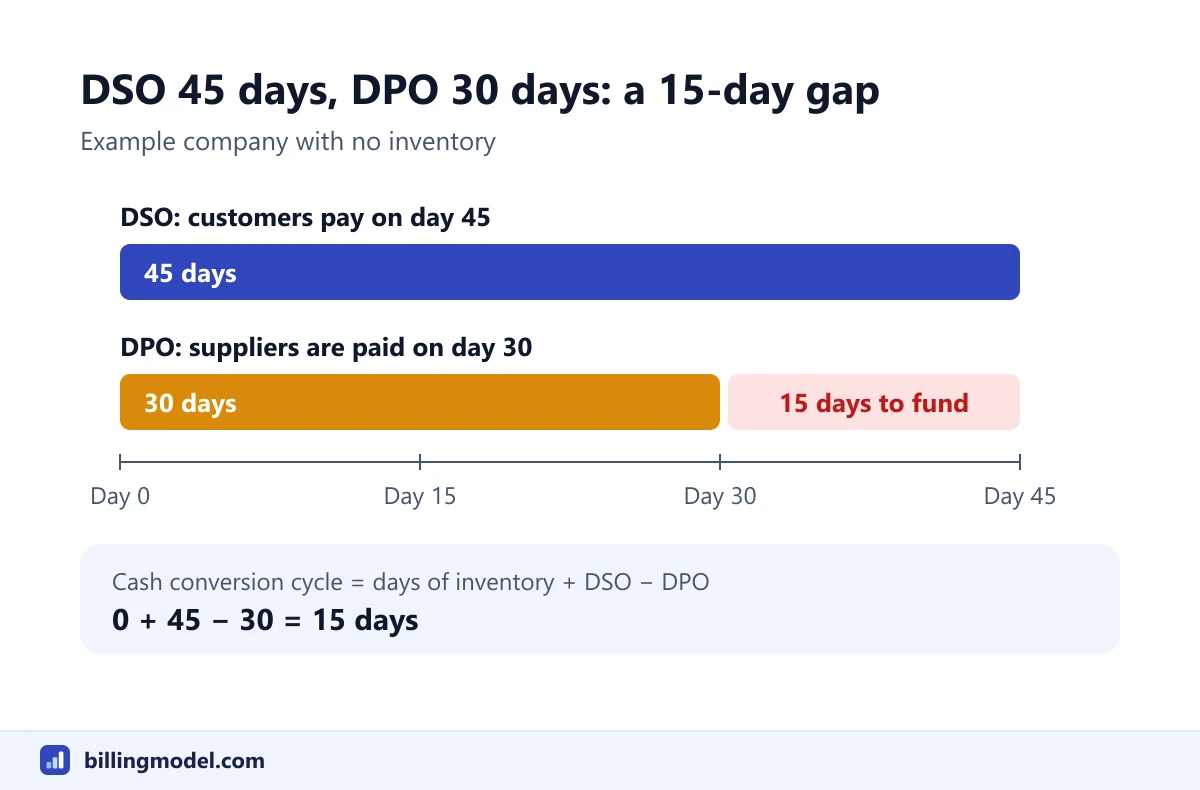 The example company pays suppliers on day 30 and collects from customers on day 45. It funds the 15 days between.
A day of DSO and a day of DPO aren't worth the same
The cycle treats every day alike, but the cash behind each day differs. Credit sales run at $5,000 a day ($1,825,000 ÷ 365). Cost of goods sold runs at $2,000 a day ($730,000 ÷ 365).
| Change | New cycle | Cash effect |
|---|---|---|
| Collect 5 days sooner (DSO 45 → 40) | 10 days | Receivables fall by 5 × $5,000 = $25,000 |
| Pay 5 days later (DPO 30 → 35) | 10 days | Payables rise by 5 × $2,000 = $10,000 |
Both changes cut the cycle to 10 days. The first frees $25,000 and the second $10,000. For a business whose cost of goods sold is small next to its sales, the receivables side carries more cash per day.
With inventory
Suppose the same company also sold hardware and held an average of $40,000 of stock. Days inventory outstanding would be $40,000 ÷ $730,000 × 365 = 20 days, and the cycle would be 20 + 45 − 30 = 35 days.
A published example
HP Inc.'s annual report for fiscal 2025 lists all three as of October 31, 2025: DSO of 35 days, days of supply in inventory of 66 and DPO of 139. Its cash conversion cycle was negative 38 days, since 35 + 66 − 139 = −38. A negative cycle means suppliers are paid after customers have paid.
HP's definitions also differ from the textbook's. It divides ending balances by a 90-day average of net revenue (for DSO) or cost of goods sold (for DPO and inventory), not annual averages. This is one company's disclosure, not a benchmark.
What a rising or falling number means on each side
The same direction of travel means opposite things for the two measures.
| DSO | DPO | |
|---|---|---|
| Rising | Cash arrives later. Possible causes: slower-paying customers, longer terms granted, weaker collection | Cash leaves later. Possible causes: longer terms negotiated, or bills being paid late |
| Falling | Cash arrives sooner. Possible causes: tighter terms, better collection, more upfront payment | Cash leaves sooner. Possible causes: shorter supplier terms, or early-payment discounts taken |
| What shortens the cash cycle | A lower DSO | A higher DPO |
| The risk of overdoing it | Terms so tight that good customers go elsewhere | Damaged supplier relationships and credit standing |
OpenStax's accounting textbook makes the DSO points in its chapter on receivables ratios: slow collection may point to lenient credit terms or cash tied up in receivables, while very fast collection may mean terms are too tight.
The DPO risks come from its finance textbook, which says cash can be conserved by delaying payments to vendors, but that trade credit needs to be paid on time or the relationship with the supplier can suffer. In a worst case, it adds, the company's credit rating could deteriorate.
A falling DPO isn't automatically bad. Paying early to take a discount can be the better deal. OpenStax works out that passing up a 2% discount on 2/10, net 30 terms, in order to pay 20 days later, costs the equivalent of 36.73% a year. A company that starts taking those discounts will show a lower DPO and lower costs.
Movements can also come from somewhere else entirely. HP attributes its two-day rise in DSO in fiscal 2025 mainly to lower factoring, and its rise in DPO mainly to higher purchasing volumes. Neither explanation is about customers or suppliers changing how fast they pay.
The tension: your DPO is your supplier's DSO
Every business invoice is a receivable on one set of books and a payable on another. When a buyer stretches payment from 30 days to 60, its DPO improves and its supplier's DSO gets worse by the same invoice. The cash doesn't appear from nowhere. It moves from the supplier's bank account to the buyer's for those extra 30 days.
That is why OpenStax describes the payables deferral period as the one element of the cash cycle that probably can't be optimized without violating credit terms. The supplier set those terms, and paying past them is paying late. The agreement may then allow late fees on invoices, and in some countries the law adds interest.
Some governments publish how long large buyers take. In the United Kingdom, large businesses must report their payment practices twice a year. The Department for Business and Trade's statistics for 2025, published in July 2026 and drawn from 11,178 reports, put the median average time to pay at 32 days and the share of invoices paid late, counted by number, at 15% (checked October 2026). The data is self-reported.
For a supplier, the practical response is on the receivables side: clear invoice payment terms, prompt invoicing and steady follow-up on anything past due.
Note: A long DPO built on late payment is not a financing strategy your suppliers agreed to. A long DPO built on negotiated terms is.
Common mistakes when comparing DSO and DPO
- Subtracting the days and stopping there. The denominators differ, so compare the cash per day too, as in the example.
- Using cost of goods sold when most payables are something else. This point is this article's own reasoning, not the textbook's. The textbook formula divides payables by cost of goods sold. If much of what you owe is for marketing, rent or equipment, those bills sit in payables but not in cost of goods sold, so average payables ÷ cost of goods sold overstates how long you take to pay. Say which payables and which costs you used.
- Mixing definitions. Ending balances against a 90-day average, as HP uses, and annual averages against annual totals give different numbers for the same business.
- Treating a higher DPO as free. It can cost discounts, goodwill and, where the contract or law provides, late fees.
- Reading one period alone. Both figures move with seasonality and with one large invoice at period-end. Track the trend.
DSO, DPO and the cash conversion cycle are analysis ratios, and the textbook and the company filing quoted here define them differently. How they should be calculated for your company depends on its facts, so have a qualified accountant confirm the definitions you report to lenders or investors.
Frequently asked questions
Is a higher DPO always better?
No. A higher DPO keeps cash in the business longer, but only terms your supplier has agreed to are safe to use. Past that point you are paying late, which OpenStax warns can harm supplier relationships and credit standing.
What is a good DSO to DPO relationship?
No universal target exists. A DSO close to the terms you offer and a DPO close to the terms you were given means both sides are running to agreement. Whether the gap between them is affordable depends on your margins and cash reserves.
Can the cash conversion cycle be negative?
Yes. It is negative when DPO is larger than DSO and days of inventory combined, as in HP's fiscal 2025 figures. OpenStax notes that some restaurant businesses can have negative cycles too, while construction companies can have very high ones.
Does a software company have a DPO?
It has accounts payable, so the ratio can be calculated. By this article's reasoning, it is less informative when cost of goods sold is small next to operating expenses, because supplier bills for things like marketing or rent never pass through cost of goods sold.
How do DSO and DPO relate to aging reports?
Each ratio compresses an aging report into one number. The accounts receivable aging report shows which customer invoices sit behind DSO, and an accounts payable aging report does the same for DPO.