
The aging of accounts receivable method estimates how much of the money customers owe you will never be collected. You sort unpaid invoices into age groups, multiply each group by the share you expect to lose, and add up the results. That total is the balance your allowance for doubtful accounts should show at the end of the period.
OpenStax's accounting textbook calls it the balance sheet aging of receivables method, because it starts from the receivables on the balance sheet and not from the period's sales.
Quick answer: Required allowance = the sum of each aging bucket's balance × that bucket's estimated uncollectible rate. The adjusting entry is the difference between that figure and what the allowance account already holds. In the example below, $200,000 of receivables needs an $11,800 allowance.
What the aging method estimates
It estimates bad debts before you know which customers will fail to pay. OpenStax's chapter on accounting for uncollectible accounts defines bad debts as uncollectible amounts from customer accounts, and describes two ways to record them.
Under the direct write-off method, nothing is recorded until a specific account is judged uncollectible. Under the allowance method, the company estimates the loss at the end of each period and records it against that period's sales. The aging method is one of three ways the textbook gives for making that estimate.
The estimate sits in an account called allowance for doubtful accounts. It is a contra asset: it carries the opposite balance to accounts receivable and is subtracted from it. What is left is net realizable value, which the textbook describes as the amount of accounts anticipated to be collected. The allowance reduces receivables as a whole, not any one customer's account, and the company still tries to collect everything.
How the aging of accounts receivable method works, step by step
The method has five steps, and the first one is a report you may already run.
- Age the receivables. Group every open invoice by how long it has been outstanding. This is the accounts receivable aging report, which has its own article.
- Assign a rate to each bucket. Each group gets its own estimated uncollectible percentage, and the percentages rise with age. OpenStax's reasoning is that the longer an amount has been owed, the greater the possibility it won't be collected.
- Multiply and add. Bucket balance × rate, for every bucket. The sum is the required ending balance of the allowance.
- Compare with the existing balance. The allowance account may already hold a balance. OpenStax says a carryover balance must be considered before bad debt expense is recorded.
- Record the difference. Debit bad debt expense and credit allowance for doubtful accounts.
Step 4 is where the method differs from an expense calculation. The aging schedule tells you what the allowance should be, not what this period's expense is.
Worked example: a $200,000 receivables balance
This example is made up. A software services company closes its books on December 31, 2026 with $200,000 of accounts receivable, aged by days past due. The rates are invented for the illustration and are not a recommendation.
| Age bucket | Balance | Estimated uncollectible rate | Estimated uncollectible amount |
|---|---|---|---|
| Current (not yet due) | $120,000 | 1% | $1,200 |
| 1–30 days past due | $40,000 | 4% | $1,600 |
| 31–60 days past due | $20,000 | 10% | $2,000 |
| 61–90 days past due | $12,000 | 25% | $3,000 |
| Over 90 days past due | $8,000 | 50% | $4,000 |
| Total | $200,000 | $11,800 |
The allowance needs a credit balance of $11,800. That is 5.9% of total receivables ($11,800 ÷ $200,000), and more than a third of it ($4,000) comes from the oldest $8,000.
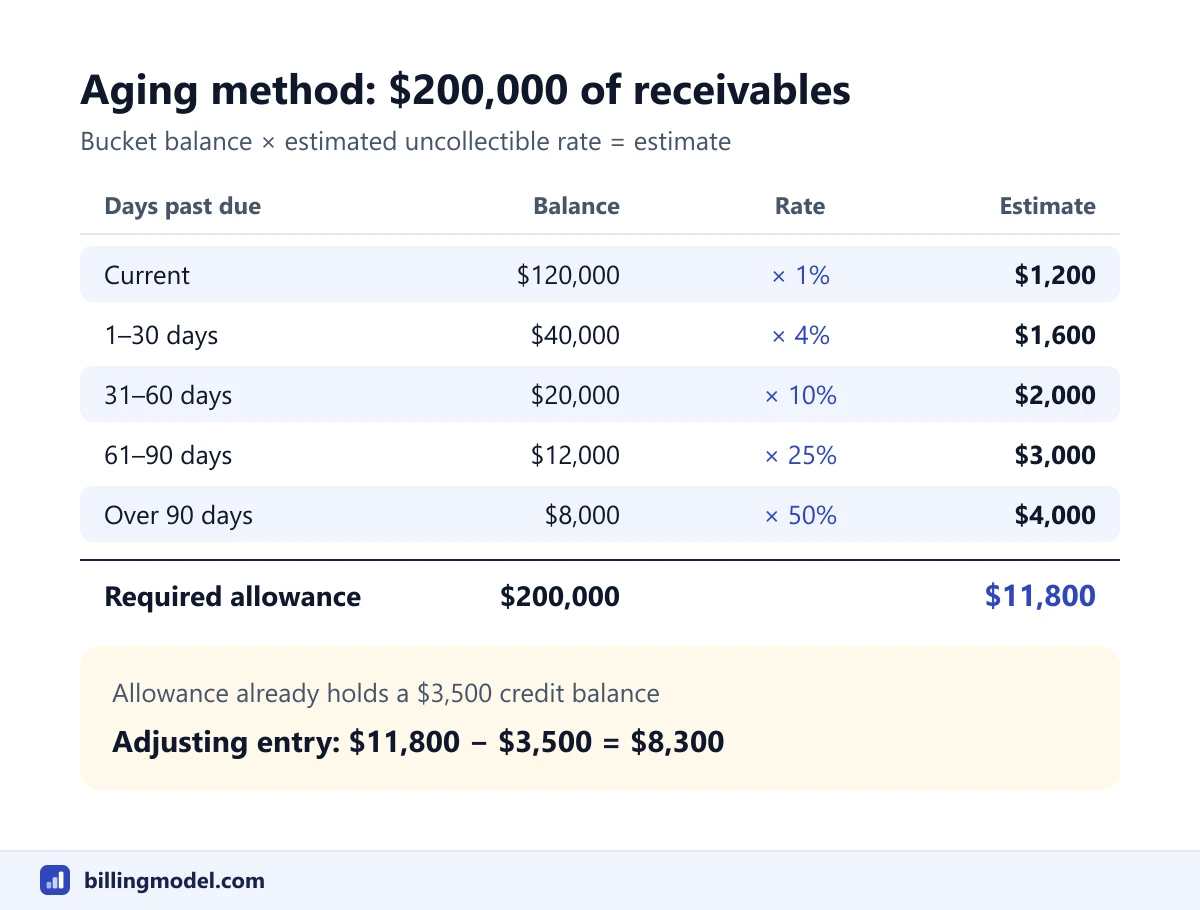 Each bucket's balance times its rate, added up, gives the required allowance. The existing balance decides the entry.
The adjusting entry depends on the existing balance
The amount you record is whatever moves the allowance to $11,800. Three cases:
| Allowance balance before adjusting | Calculation | Bad debt expense recorded |
|---|---|---|
| Zero | $11,800 − $0 | $11,800 |
| $3,500 credit | $11,800 − $3,500 | $8,300 |
| $1,200 debit | $11,800 + $1,200 | $13,000 |
A credit balance is what remains of last year's estimate, so you subtract it. A debit balance means more was written off during the year than the allowance held, so the account is below zero and you add the shortfall. OpenStax applies the same rule: subtract a prior credit balance from the new estimate, and add a prior debit balance to it.
For the middle case, the entry on December 31, 2026 is:
| Account | Debit | Credit |
|---|---|---|
| Bad debt expense | $8,300 | |
| Allowance for doubtful accounts | $8,300 |
The balance sheet then shows accounts receivable of $200,000, less an allowance of $11,800, for a net realizable value of $188,200.
Writing off an account later
When a specific invoice is finally judged uncollectible, the write-off uses up the allowance and creates no new expense. Suppose that on March 15, 2027, the company gives up on a $2,400 invoice from the over-90 bucket.
| Account | Debit | Credit |
|---|---|---|
| Allowance for doubtful accounts | $2,400 | |
| Accounts receivable: customer | $2,400 |
Receivables fall to $197,600 and the allowance falls to $9,400. Net realizable value is still $188,200, because the loss was already recognized in 2026.
If the customer later pays part of it, say $1,000, OpenStax's sequence is two entries. First reinstate the amount: debit accounts receivable and credit the allowance for $1,000. Then record the payment: debit cash and credit accounts receivable for $1,000. A reduction agreed with the customer for a billing error is a different thing, covered in the credit memo example.
Where the percentages come from
They come from the company's own collection history, and no published set of rates applies to everyone. OpenStax says only that the estimate is made from past experience and industry standards.
The examples in print show how far rates can differ:
- OpenStax's worked example applies 10% to receivables 0–30 days past due, 20% to 31–90 days and 30% to those over 90 days. Elsewhere in the same section it uses 6% and 15% as illustrations.
- An example in the FASB's 2016 update that created Topic 326 has a manufacturer whose tracked history shows losses of 0.3% on current receivables, 8% at 1–30 days past due, 26% at 31–60 days, 58% at 61–90 days and 82% beyond 90 days.
Those are teaching examples, not benchmarks. One company's over-90 rate is 30% and the other's is 82%.
Here is one way to build a rate from history, as an illustration only. Suppose that over the past three years, $400,000 of your invoices reached 61–90 days past due and $100,000 of that was never collected. $100,000 ÷ $400,000 = 25%. Repeat for each bucket.
History is the starting point, not the end. In the FASB example, the company expects economic conditions to improve and lowers each historical rate by roughly 10%, so 8% becomes 7.2% and 82% becomes 73.8%.
Watch out: The rates only mean something if the buckets are built the same way as the history behind them. A rate measured on invoices aged from the due date can't be applied to a report aged from the invoice date.
Aging method vs percentage of sales vs direct write-off
OpenStax describes three estimation approaches under the allowance method, plus direct write-off. The $200,000 example gives a different answer under each.
| Aging method | Percentage of receivables | Percentage of sales | Direct write-off | |
|---|---|---|---|---|
| Based on | Receivables in each age bucket | Total ending receivables | Credit sales for the period | Specific accounts judged uncollectible |
| Considers invoice age | Yes | No | No | No |
| What the calculation gives | Required ending allowance | Required ending allowance | The period's bad debt expense | The amount written off |
| Uses an allowance account | Yes | Yes | Yes | No |
| Example | $11,800 allowance | $200,000 × 6% = $12,000 allowance | $1,500,000 × 0.6% = $9,000 expense | $2,400 expense on March 15, 2027 |
The 6% and 0.6% rates and the $1,500,000 of credit sales are invented, like the rest of the example.
OpenStax's verdict on the aging of accounts receivable method is that it is more complicated than the other two but tends to produce more accurate results. A single percentage of receivables ignores the fact that $8,000 over 90 days late is riskier than $8,000 not yet due.
Direct write-off is the simplest and the least precise about timing. The textbook's example is a credit sale made in September 2018 and found uncollectible in February 2019: the expense lands in 2019, while the matching principle would put it with the 2018 sale. It says the method is not acceptable under GAAP for financial reporting, though companies with very little exposure to bad debts may use it. For US tax purposes, it adds, the IRS requires the direct write-off method, applied when the debt is determined to be uncollectible. Tax rules in other countries differ.
What US GAAP and IFRS say about the allowance
Accounting standards govern how the allowance is measured, and both major frameworks now look forward. Under US GAAP, the FASB's Topic 326, created by an update issued in June 2016, replaced the earlier incurred loss approach with a current estimate of expected credit losses. The measurement draws on historical experience, current conditions, and reasonable and supportable forecasts. The FASB does not prescribe one method, and it names an aging schedule among the methods a company may use.
Under IFRS, the standard is IFRS 9. The IASB's 2024 review of its impairment rules describes that model as forward-looking too, and notes that IFRS 9 includes a simplified approach for trade receivables.
One practical effect shows in the FASB example: even receivables that are not yet due carry a small loss rate. How either standard applies to your receivables depends on your company's facts, so have a qualified accountant confirm the method and the rates before you rely on them.
Common mistakes with the aging method
- Recording the whole estimate as expense. The $11,800 is the target balance. With $3,500 already in the account, the expense is $8,300.
- Missing a debit balance. A debit balance is added to the estimate, not subtracted from it.
- Expensing the write-off again. The write-off entry reduces the allowance. Bad debt expense was recorded when the estimate was made.
- Borrowing someone else's rates. A textbook's 10%, 20% and 30% describe a made-up watercraft dealer, not your customers.
- Leaving the rates alone for years. If collections have changed, the history behind the rates has changed too.
- Skipping the notes. OpenStax points out that the estimation method must be disclosed in the notes to the financial statements.
Frequently asked questions
Is the aging of accounts receivable method a balance sheet or an income statement approach?
A balance sheet approach. It starts from accounts receivable and works out what the allowance should be. The income statement approach starts from credit sales and works out the period's bad debt expense.
What is the journal entry under the aging method?
Debit bad debt expense and credit allowance for doubtful accounts for the amount needed to bring the allowance to the required balance. The entry is made at the end of the period, as an adjusting entry.
What if the allowance already has a debit balance?
Add it to the new estimate. With a required allowance of $11,800 and a $1,200 debit balance, the entry is $13,000, which leaves the account at an $11,800 credit.
What percentages should be used for each aging bucket?
No standard set exists. The rates should reflect how your own invoices of each age have performed, adjusted for what you expect now. An accountant can help you build and document them.
Does writing off an invoice mean you stop collecting it?
No. The write-off is a bookkeeping entry. You can keep following the steps for a past due invoice, and if money arrives, the receivable is reinstated and the payment recorded.