An early payment discount is a percentage a seller takes off an invoice when the customer pays within a short window, well before the normal due date. It is also called a prompt payment discount or a cash discount, and in the seller's books it is a sales discount.
The best-known version is 2/10 net 30: 2% off if the invoice is paid within 10 days, otherwise the full amount in 30. The offer looks small. Turned into an annual rate, 2% for 20 days is far larger than it looks, and that rate is what a seller should weigh before offering one.
Quick answer: Annual cost = [360 ÷ (net period − discount period)] × [discount % ÷ (100% − discount %)]. For 2/10 net 30 that is 18 × 2.0408% = 36.73% a year on OpenStax's 360-day formula. The buyer earns that rate by paying early, and the seller pays it.
How early payment discount terms work
The terms are read left to right: discount percentage, discount period, then the net period. OpenStax's Principles of Accounting explains 2/10, n/30 as a 2% discount rate, a 10-day discount period and "net of 30" days, with both periods counted from the invoice date. By the same reading, 1/10 net 30 is 1% off within 10 days.
Take a $6,000 invoice dated May 4, 2026 on 2/10 net 30 terms.
- Discount: $6,000 × 2% = $120
- Pay by May 14, 2026: $6,000 − $120 = $5,880
- Or pay by June 3, 2026: $6,000, the full amount
Terms can carry more than one step. Jean-Paul Olivier's open Business Math textbook reads 3/10, 2/20, n/30 as 3% off within 10 days and 2% off from day 11 to day 20.
A cash discount is not a trade discount. OpenStax describes a trade discount as a reduction to the advertised price that is negotiated before the purchase, which is why it never appears in the journal entries.
Watch out: Buyers may start the clock on a different day than you do. The University of Texas at Austin describes 2%10 Net 30 as a discount for paying within 10 days of receipt, and the University of Dayton's purchase order terms count the discount period from receipt of acceptable materials or services, or of an acceptable invoice, whichever is later. Print the discount deadline as a date.
What an early payment discount costs: the implied annual rate
A customer who skips the discount is paying extra to keep the money a little longer, and that extra can be written as an interest rate. OpenStax's Principles of Finance gives the formula for the annual cost of passing up a cash discount:
Annual cost = [360 ÷ (net period − discount period)] × [discount % ÷ (100% − discount %)]
On the $6,000 invoice, skipping the discount means paying $120 to hold $5,880 for 20 more days. That is $120 ÷ $5,880 = 2.0408% for 20 days. A 360-day year holds 18 such periods, and 18 × 2.0408% = 36.73%, the figure OpenStax reaches for 2/10 net 30. On a 365-day year the same arithmetic gives 37.24%, which is this site's calculation and not the textbook's. The article on a net 30 invoice walks through those steps one at a time.
The rate cuts both ways. For the buyer it is the return on paying early. For the seller it is the cost of being paid early.
| Terms | Days gained | Cost for that period | Annual, 360-day year | Annual, 365-day year |
|---|---|---|---|---|
| 1/10 net 30 | 20 | 1.0101% | 18.18% | 18.43% |
| 2/10 net 30 | 20 | 2.0408% | 36.73% | 37.24% |
| 3/10 net 30 | 20 | 3.0928% | 55.67% | 56.44% |
| 1/15 net 30 | 15 | 1.0101% | 24.24% | 24.58% |
| 2/10 net 45 | 35 | 2.0408% | 20.99% | 21.28% |
| 2/10 net 60 | 50 | 2.0408% | 14.69% | 14.90% |
| 1/10 net 60 | 50 | 1.0101% | 7.27% | 7.37% |
Only the 36.73% is OpenStax's printed figure. Every other number in the table is this article's calculation with the same formula.
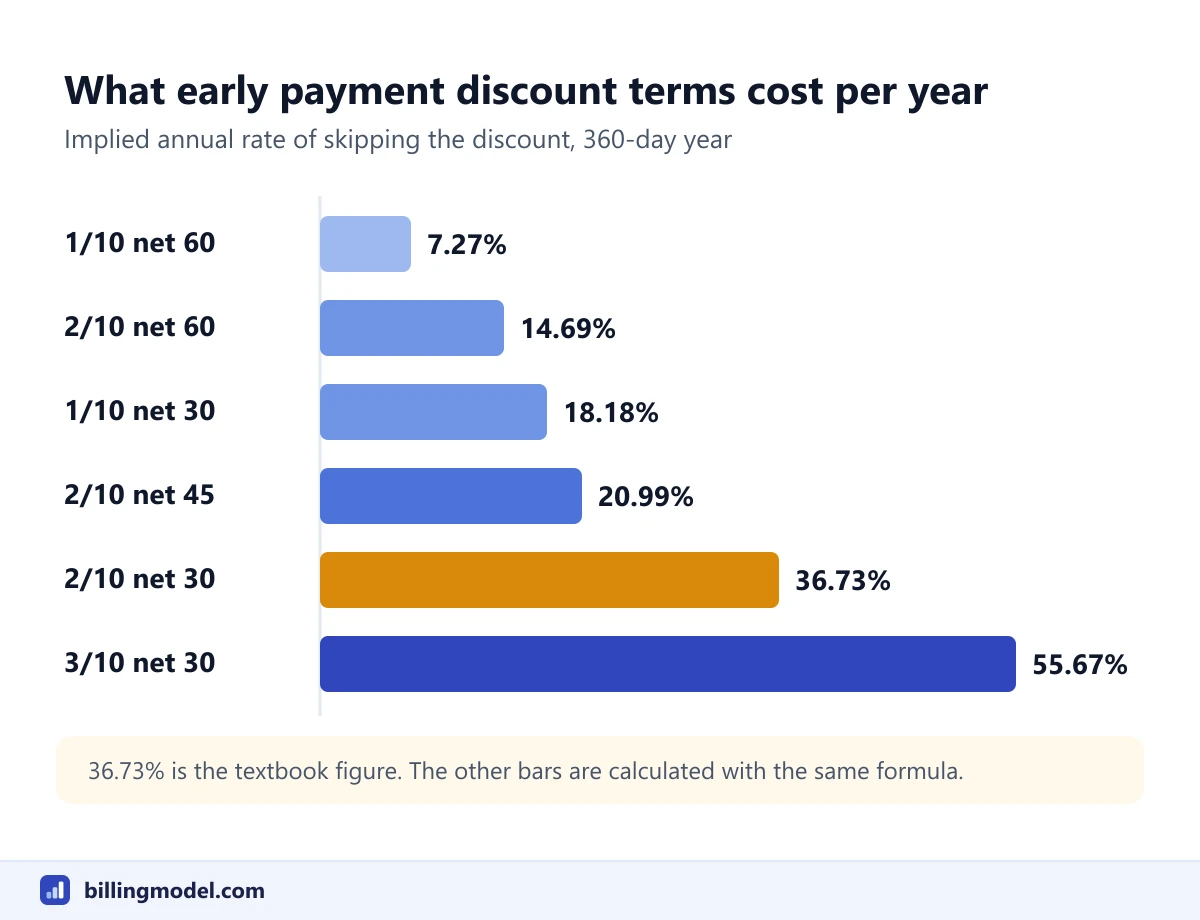 The same 2% costs less per year when the net period is longer, because the seller gets the cash more days ahead.
Two patterns show in the table. A bigger percentage raises the rate almost in proportion. A longer net period lowers it, because the same discount buys more days: 2/10 net 60 costs 14.69% a year against 36.73% for 2/10 net 30.
Textbooks annualize in slightly different ways. An open intermediate accounting text by Arnold and Kyle puts 1.5/10, n/30 at 27.38% by multiplying 365 ÷ 20 by 1.5%. Olivier says a 20-day 2% discount is the same as earning interest at 44.56% a year. The page doesn't show the working. Compounding the 20-day rate over a 365-day year gives about 44.6% by this article's arithmetic, so the higher figure is consistent with compounding. The methods differ and the conclusion doesn't.
When offering an early payment discount makes sense
Offer one when the cash is worth more to you than the implied rate, or when the discount is doing a second job. Compare it with your other sources of cash first.
Suppose you could borrow at an illustrative 9% a year. Borrowing $5,880 for 20 days costs $5,880 × 0.09 × 20 ÷ 365 = $29.00. The discount buys the same 20 days for $120, about four times as much.
The second job is risk. OpenStax says early payment frees up cash for other business opportunities and decreases the risk of nonpayment. Research on real contracts points the same way: an NBER working paper by Klapper, Laeven and Rajan, using almost 30,000 trade credit contracts, found that discounts for early payment tend to be offered to riskier buyers.
A discount is harder to justify when:
- Customers already pay on time. You give up 2% of the invoice and gain nothing you didn't have.
- Your margin is thin. The $120 comes straight off the top of a $6,000 sale.
- Cheaper credit is available, as in the 9% comparison above.
- The buyer takes the discount and still pays late. See the last section.
Some large buyers do this math as policy. The University of Dayton says it seeks to earn early payment discounts wherever possible, and lists 2% 10, net 30 first among the payment terms it is seeking to standardize across its suppliers. The US Treasury's discount calculator tells federal agencies to take a discount when its effective annual rate is larger than the government's current value of funds rate, and to pay as close to the due date as possible when it is smaller.
How to state the discount on an invoice
Print both amounts and both dates, so nobody has to calculate. Agree the discount in the contract or order first, with the rest of your invoice payment terms.
Invoice date:     May 4, 2026
Terms:            2/10 net 30
Invoice total:    $6,000.00

If paid by May 14, 2026:   $5,880.00  (2% discount of $120.00)
If paid by June 3, 2026:   $6,000.00  (full amount)

The discount applies only when payment of $5,880.00 is received
by May 14, 2026. After that date the full invoice total is due.
This wording is an example. Adapt it to your agreement and have a lawyer or accountant review your template.
Sales tax or VAT needs its own line of thought. In the UK, for example, HMRC's manual on prompt payment discounts says suppliers must account for VAT on the amount actually paid. They choose before invoicing between issuing a credit note when the discount is taken and putting the discount terms on the invoice with a statement that the customer can only recover the VAT actually paid. At the UK's 20% standard rate (checked October 2026), a £6,000 invoice carries £1,200 of VAT, and after a 2% discount the customer pays £5,880 plus £1,176. Those sums are this article's illustration. Other countries have other rules, and an accountant should confirm yours.
How an early payment discount is recorded
There are two bookkeeping methods, and they differ in when the discount is recognized. Arnold and Kyle's text describes both. Under the gross method the sale is recorded at the full amount and the discount is recorded only if the customer takes it. Under the net method the seller expects the discount to be taken and records the sale net of it from the start.
OpenStax's example is the gross method: a $1,000 sale on 2/10, n/30 that is paid within 10 days is recorded as a debit to Cash of $980, a debit to Sales Discounts of $20 and a credit to Accounts Receivable of $1,000. It describes Sales Discounts as a contra revenue account deducted from gross sales.
Applied to the $6,000 invoice:
| Event | Gross method | Net method |
|---|---|---|
| Sale on May 4 | Dr Accounts Receivable $6,000, Cr Sales $6,000 | Dr Accounts Receivable $5,880, Cr Sales $5,880 |
| Paid May 14, discount taken | Dr Cash $5,880, Dr Sales Discounts $120, Cr Accounts Receivable $6,000 | Dr Cash $5,880, Cr Accounts Receivable $5,880 |
| Paid June 3, no discount | Dr Cash $6,000, Cr Accounts Receivable $6,000 | Dr Cash $6,000, Cr Accounts Receivable $5,880, Cr Sales Discounts Forfeited $120 |
Arnold and Kyle add that IFRS 15 treats sales discounts as variable consideration, which has to be estimated at the time of sale. US GAAP's revenue standard is ASC 606. How either applies to a particular contract depends on its terms and should be confirmed with a qualified accountant.
Where early payment discounts go wrong
Partial payments. Your terms should say whether a part payment inside the window earns the discount. If it does, Olivier's textbook shows the method: the credit is the payment divided by (1 − discount rate). A $3,000 payment by May 14 clears $3,000 ÷ 0.98 = $3,061.22 of the invoice and leaves $2,938.78.
Discounts taken late. A customer pays $5,880 on day 20. You can accept it, bill the missing $120 or refuse the discount next time, but choose one policy and state it. The US federal rule holds agencies to the deadline: under 5 CFR 1315.7, an agency that takes a discount after the deadline owes interest on the amount left unpaid. An unpaid $120 stays open on your accounts receivable aging report until you bill it or write it off.
Returns and credits. The discount applies to what is still owed. OpenStax notes that when a refund comes before payment, the discount is taken on the cost less the refund. If you issue a credit memo for $1,000, the 2% applies to $5,000.
Discounting customers who would pay early anyway. The discount then buys no time at all.
Frequently asked questions
Is an early payment discount the same as a prompt payment discount?
Yes. HMRC's manual uses "prompt payment discount", OpenStax uses "cash discount", and the seller's ledger account is Sales Discounts. All describe a price reduction for paying before the normal due date.
What does 1/10 net 30 mean?
A 1% discount if the invoice is paid within 10 days, otherwise the full amount within 30. With OpenStax's formula the implied annual rate is 18 × 1.0101% = 18.18%, which is this article's calculation.
Should a buyer always take the discount?
Not automatically. The Treasury's rule for federal agencies is to compare the discount's effective annual rate with the government's current value of funds rate, and Rowan University's payment policy cautions that not all discounts offered by suppliers are beneficial to the university. The comparison depends on each buyer's cash position.
Does the discount period start on the invoice date?
In the textbook reading, yes: OpenStax counts both periods from the invoice date, and the Treasury's guidance for federal agencies starts the discount period on the invoice date when the invoice carries one. Some buyers count from receipt of the invoice or the goods, so confirm it in writing.