ASC 605 was Topic 605, Revenue Recognition, in the FASB Accounting Standards Codification: the US GAAP rules for when a sale counted as revenue before the current standard. It rested on four criteria and a long list of industry-specific rules. The FASB's 2014 update created Topic 606 and superseded it.
Nobody adopts ASC 605 today. People look it up to read older financial statements, older contracts and course material written before the change.
Quick answer: Under ASC 605 and the SEC staff's guidance, revenue was recognized when persuasive evidence of an arrangement existed, delivery had occurred, the price was fixed or determinable, and collectibility was reasonably assured. ASC 606 replaced that test with a five-step model based on the transfer of control. Public companies applied it for annual periods beginning after December 15, 2017.
What ASC 605 was
ASC 605 was a general concept with many specific rules attached. The summary of the FASB's Accounting Standards Update 2014-09 tells the history. Revenue guidance in US GAAP began with a concepts statement saying a company should recognize revenue only when it is realized or realizable and earned. That idea was codified in Subtopic 605-10.
Around it sat what the FASB calls numerous industry-specific and transaction-specific standards. Its examples are Subtopic 985-605 for software, Subtopic 605-35 for construction-type and production-type contracts, Subtopic 360-20 for real estate sales and Subtopic 605-25 for multiple-element arrangements. The FASB says these were developed by various standard setters, often to address narrow issues without a common framework.
ASC 605 was a US GAAP topic only. Companies reporting under IFRS used IAS 18 and IAS 11, which IFRS 15 superseded.
The four ASC 605 revenue recognition criteria
The four criteria come from the staff of the US Securities and Exchange Commission (SEC). The FASB's summary says the SEC issued Staff Accounting Bulletin No. 101 in 1999, amended it in 2003 with SAB No. 104, and codified it as SAB Topic 13. In SAB Topic 13, the staff says revenue generally is realized or realizable and earned when all four are met.
| Criterion, in the SEC staff's words | A point the staff makes about it |
|---|---|
| "Persuasive evidence of an arrangement exists" | Where the customer has to execute the agreement, that means a final agreement executed by the customer's properly authorized personnel |
| "Delivery has occurred or services have been rendered" | Delivery generally requires that the customer has taken title and assumed the risks and rewards of ownership |
| "The seller's price to the buyer is fixed or determinable" | A price is neither fixed nor determinable until a customer's cancellation privileges lapse |
| "Collectibility is reasonably assured" | Listed as the fourth condition |
The same bulletin covers up-front fees. The staff's view is that such fees, even if non-refundable, are earned as the products or services are delivered, and that they generally should be deferred and recognized over the periods in which they are earned.
SAB Topic 13 gave the staff's views for companies that file with the SEC. The FASB notes that nonpublic entities were not subject to it, though it understood some applied it by analogy. The SEC's page now carries a line saying Topic 13 is no longer applicable once a registrant adopts ASC Topic 606.
Software revenue under ASC 985-605 and VSOE
Software had its own subtopic, and its best-known feature was vendor-specific objective evidence, or VSOE. The clearest plain description is in a company's own accounting policy. Note 1 to Microsoft's financial statements for the year ended June 30, 2017, the last year it reported under the old rules, sets it out.
Microsoft says it allocated revenue between the elements of a bundle using a hierarchy: VSOE of fair value first, then third-party evidence, then its best estimate of selling price. For software elements it followed the industry-specific guidance, which, in its words, "only allows for the use of VSOE in establishing fair value." It defines the term this way: "Generally, VSOE is the price charged when the deliverable is sold separately".
The consequence showed up in Windows 10. Buyers of a license received unspecified updates and upgrades at no extra cost. Because those were not sold on a stand-alone basis, Microsoft says it was unable to establish VSOE, and so it recognized Windows 10 license revenue ratably over the estimated life of the device, between two and four years.
That is one company's summary of its own policy. The subtopic itself contained more conditions than this article covers.
Why ASC 605 was replaced
The FASB gives its reasons in the same summary. Previous US guidance combined broad concepts with numerous requirements for particular industries or transactions, which, it says, "sometimes resulted in different accounting for economically similar transactions." US rules also differed from IFRS, and disclosure requirements were limited and lacked cohesion.
The FASB and the International Accounting Standards Board ran a joint project with five stated aims: remove inconsistencies and weaknesses, provide a stronger framework, improve comparability across industries and countries, improve disclosures, and reduce the number of requirements a company must refer to. The result, in May 2014, was Topic 606 in the United States and IFRS 15 internationally. The FASB says the new guidance can be applied to all contracts with customers regardless of industry-specific or transaction-specific fact patterns.
ASC 605 vs ASC 606
The table compares the two using only the sources above. The five steps themselves are worked through in the guide to SaaS revenue recognition.
| ASC 605 (superseded) | ASC 606 (current) | |
|---|---|---|
| Basic test | Four criteria: revenue realized or realizable and earned | Five-step model: revenue as each performance obligation is satisfied |
| When a sale counts | Delivery, which the SEC staff tied to title and the risks and rewards of ownership | Transfer of control. Risks and rewards of ownership is one of five listed indicators |
| Structure | General concepts plus industry and transaction rules for software, construction, real estate and others | One framework for all contracts with customers |
| Splitting a bundle | A fair value hierarchy. For software elements, VSOE only, as Microsoft described it | Relative standalone selling prices, estimated when not directly observable |
| Collection | Reasonably assured | Probable, tested when the contract is identified |
| Disclosures | Described by the FASB as limited and lacking cohesion | Disaggregated revenue, contract balances, remaining performance obligations, significant judgments |
The collection row is narrower than it looks. The old wording varied: the SEC staff's criterion says "reasonably assured", while Microsoft's note says "collectability is probable". The FASB's May 2016 update says it understood that, in practice, the two terms were applied similarly.
The bundle row is where software companies felt the change. When a standalone selling price can't be observed, ASC 606 tells the company to estimate it and lists suitable approaches, including an adjusted market assessment and expected cost plus a margin. A missing observable price no longer blocks the allocation by itself.
Worked example: one software deal under each approach
This is a simplified illustration, not a full application of either set of rules. A vendor sells a perpetual on-premises license together with two years of unspecified updates for one price of $90,000, delivered and paid on the first day of year 1. The vendor never sells the updates separately.
Old approach. Follow the pattern Microsoft described. There is no VSOE for the undelivered updates, so the fee is recognized ratably over the 24 months: $90,000 ÷ 24 = $3,750 a month, or $45,000 a year.
ASC 606. Assume the license and the updates are two distinct performance obligations, and that the vendor estimates standalone selling prices of $80,000 for the license and $20,000 for the updates.
- Total of the estimates: $80,000 + $20,000 = $100,000.
- License share: 80% of $90,000 = $72,000, recognized when control of the license passes on delivery.
- Updates share: 20% of $90,000 = $18,000, recognized over 24 months at $750 a month.
| Period | Old approach | ASC 606 |
|---|---|---|
| First month | $3,750 | $72,750 |
| Year 1 | $45,000 | $81,000 |
| Year 2 | $45,000 | $9,000 |
| Total | $90,000 | $90,000 |
Year 1 under ASC 606 is $72,000 + (12 × $750) = $81,000. The cash and the total are identical. Only the timing moves.
Microsoft's note describes the same direction of change at scale. It said that under the new standard it would recognize Windows 10 revenue predominantly at the time of billing and delivery, and that adoption would result in additional revenue of $6.6 billion for fiscal 2017 and $5.8 billion for fiscal 2016. It expected revenue from cloud offerings such as Office 365 to remain substantially unchanged.
Transition dates, and why ASC 605 still comes up
The effective date moved twice. The dates below are taken from the FASB's own documents: the 2014 update, ASU 2015-14 and ASU 2020-05.
| Document | Public entities | All other entities |
|---|---|---|
| ASU 2014-09, May 2014 | Annual periods beginning after December 15, 2016 | Annual periods beginning after December 15, 2017 |
| ASU 2015-14, August 2015 | Deferred to annual periods beginning after December 15, 2017 | Deferred to annual periods beginning after December 15, 2018 |
| ASU 2020-05, June 2020 | Not affected | Entities that had not yet issued statements under Topic 606 could elect annual periods beginning after December 15, 2019 |
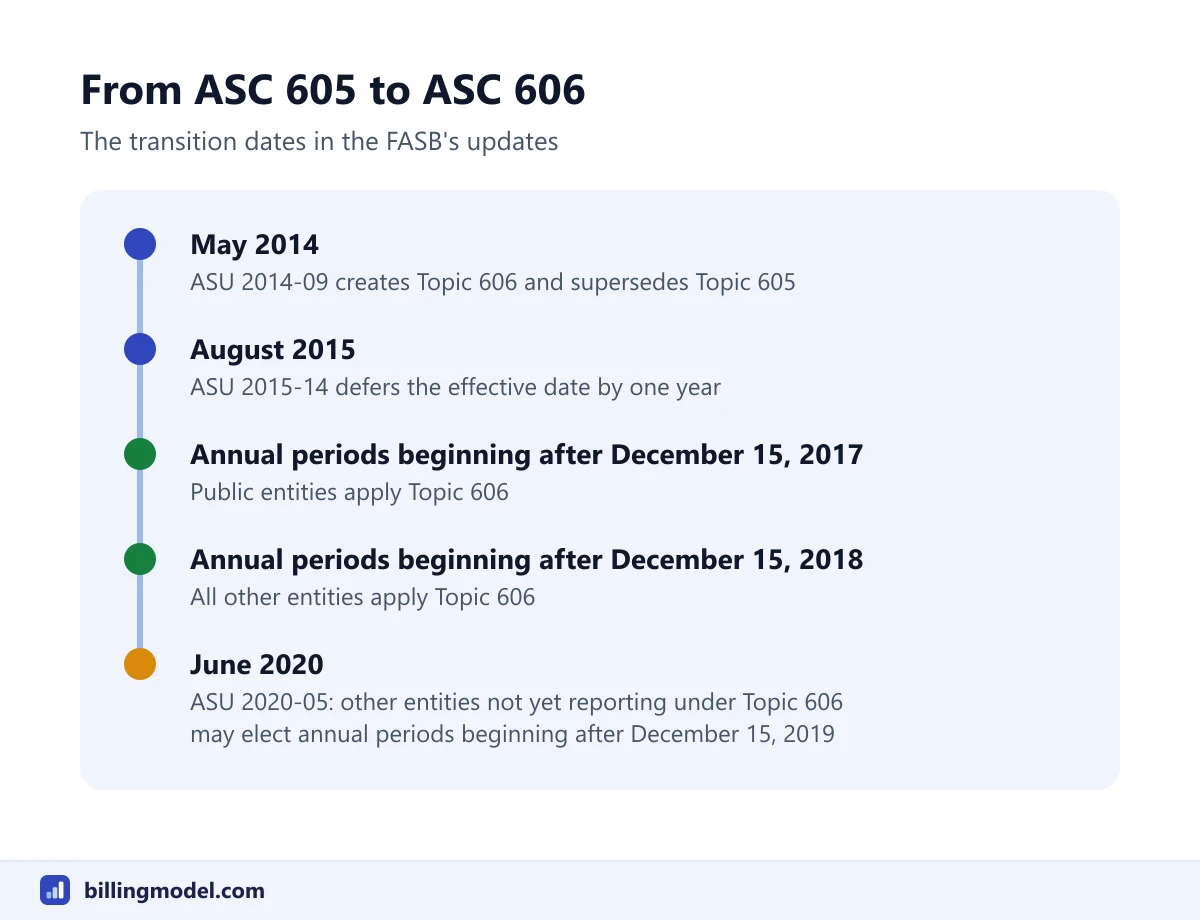 The dates that moved US companies from ASC 605 to ASC 606, as stated in the FASB's updates.
"Public entities" here means public business entities plus certain not-for-profit entities and employee benefit plans. Interim-period dates differ and are set out in the updates. For a company with a calendar year, those dates work out to 2018 for public entities and 2019 for others, or 2020 for an entity that used the last deferral. Early adoption was allowed within limits, and Microsoft's note says it elected to adopt effective July 1, 2017.
That history is why ASC 605 still comes up, in three places.
- Older financial statements. Periods before adoption were prepared under ASC 605 unless the company restated them. The 2014 update allowed two transition methods: restate each prior period presented, or record the cumulative effect at the date of initial application. Under the second, the company had to disclose how much each line item in the adoption year differed from the previous guidance, so both sets of numbers appear.
- Older contracts. The transition guidance defines a completed contract by reference to the revenue guidance in effect before the date of initial application. Anyone reconstructing how a pre-adoption contract was booked needs the old rules.
- Course and exam material. Older terminology stays in teaching material. The article on revenue recognition methods covers the percentage-of-completion, completed-contract and installment names.
This article describes the rules in general terms and isn't accounting advice. The treatment of a specific contract depends on its terms and on the period and framework involved, so confirm it with a qualified accountant.
Frequently asked questions
Is ASC 605 still in effect?
No. The FASB's 2014 update says Topic 606 supersedes the revenue recognition requirements in Topic 605 and most industry-specific guidance. The SEC's SAB Topic 13, which carried the four criteria, states that it no longer applies once a registrant adopts Topic 606.
What is the main difference between ASC 605 and ASC 606?
ASC 605 asked whether four criteria were met, with delivery tied to the risks and rewards of ownership and separate rules for individual industries. ASC 606 uses one five-step model for every contract and recognizes revenue when control of a good or service passes to the customer.
What does VSOE mean?
Vendor-specific objective evidence of fair value. Microsoft's fiscal 2017 accounting policy describes it as generally the price charged when a deliverable is sold separately. The same policy says the software guidance allowed only VSOE for establishing fair value, and that without it for Windows 10's future updates the license revenue was spread over the life of the device.
When did private companies have to adopt ASC 606?
Under ASU 2015-14, entities other than public ones applied it for annual periods beginning after December 15, 2018. ASU 2020-05 let those that had not yet issued statements under Topic 606 wait one more year. An accountant can confirm which date applied to a particular entity.
Did ASC 605 apply outside the United States?
No. It was part of US GAAP. IFRS reporters followed IAS 18 and IAS 11 until IFRS 15, which applies to annual periods beginning on or after January 1, 2018. The deferred revenue journal entry guide shows the current treatment of advance payments under both frameworks.